.png)


You're standing in the supplement aisle, or scrolling online, and one label keeps showing up: Vitamin D 400 IU. Maybe your oncologist mentioned vitamin D. Maybe a caregiver bought a bottle and asked if it's enough. Maybe you're already juggling scans, appointments, medications, and side effects, and now one more small number feels oddly hard to decode.
That confusion makes sense.
Vitamin D is familiar enough to sound simple, but dosing often isn't. 400 IU vitamin D is one of the most common amounts you'll see on bottles and in health guidance, yet it doesn't mean the same thing for a newborn, a healthy adult, and a person going through cancer treatment. In practice, that number can be a basic prevention dose, a maintenance dose, or far too little, depending on the situation.
If you're dealing with cancer, this matters. Treatment can affect appetite, digestion, mobility, bone health, and the body's ability to maintain steady nutrient levels. So when you see 400 IU on a label, the question isn't “Is this good?” It's “Is this enough for me?”
Why Is Everyone Talking About 400 IU Vitamin D
A patient recently asked me a very common question in a very ordinary moment. She had picked up a bottle that said “Vitamin D3 400 IU” and assumed it must be the standard adult dose because it was so easy to find. Then she noticed other bottles with much larger numbers and wondered if the smaller one was too weak, or if the larger ones were unsafe.
That's exactly where many people get stuck.

Vitamin D is often called the sunshine vitamin because the body can make it after sun exposure. But everyday life gets in the way. People spend more time indoors, use sun protection, live in places with less winter sunlight, or don't absorb or process nutrients as well as they once did. During cancer treatment, those issues can become even more noticeable.
Why this number shows up so often
The reason 400 IU vitamin D is everywhere is that it sits at an important baseline in medical guidance. It has a long history as a practical prevention dose, especially for infants. That's helpful, but it also creates confusion because many supplement labels make it look universal.
Many people read “400 IU” as if it means “right for everyone.” It doesn't. It means “start by asking who this dose was designed for.”
If you're comparing products, looking through an Australian Vitamin D range can be useful because it shows how widely supplement strengths vary in real life. That variation reflects a real clinical truth. Different people need different amounts.
For adults, and especially for cancer patients, 400 IU is best understood as a foundational number, not an automatic answer.
Decoding the Dose What 400 IU Actually Means
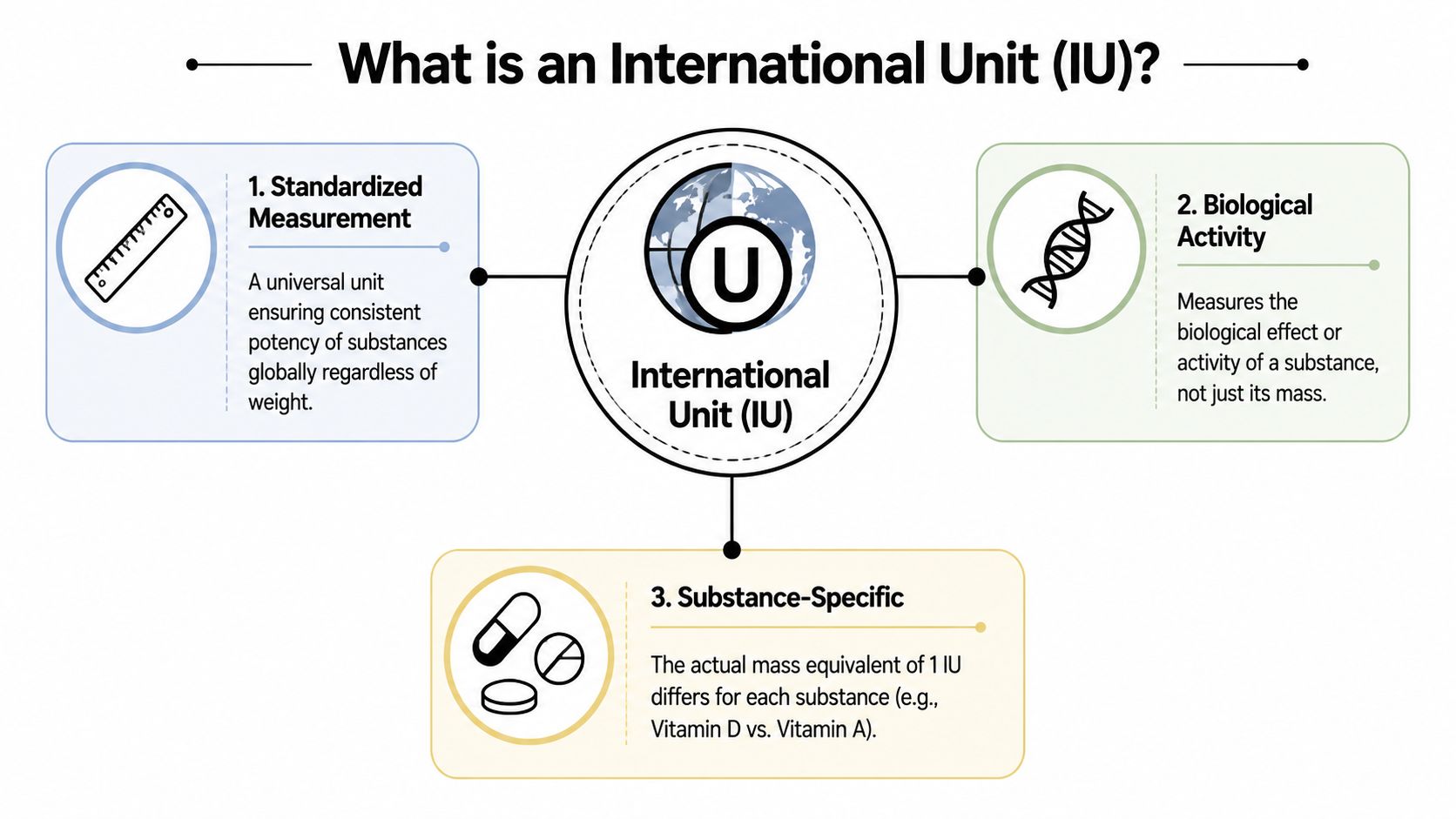
The letters IU stand for International Units. That sounds technical, but the idea is simple. An IU doesn't measure how heavy something is. It measures a standardized amount of biological activity.
To draw an analogy: A teaspoon measures volume. A gram measures weight. An IU is more like a standard effect measure used so one vitamin product can be compared with another in a consistent way.
Why 400 IU became such an important benchmark
For vitamin D, 400 IU equals 10 micrograms. In major regulatory markets including the United States, the United Kingdom, and the European Union, 400 IU (10 µg) of vitamin D3 is the established benchmark for the “Adequate Intake” or lower-bound daily recommendation for infants and other high-risk groups. The same guidance also notes a direct relationship between this dose and keeping serum 25-hydroxyvitamin D above 20 ng/mL (50 nmol/L), a commonly accepted cutoff for sufficiency.
That's why this number isn't random. It was chosen because it functions as a deficiency-prevention baseline.
What it does in the body
Vitamin D helps the body absorb calcium. Without enough of it, bones can weaken over time. In infants, that concern is especially serious because the skeleton is growing rapidly. In adults, low vitamin D can become part of a larger picture that includes low dietary intake, reduced mobility, less time outdoors, and treatment-related stress on the body.
A good plain-language way to think about 400 IU vitamin D is this:
- It's a floor, not a ceiling
- It's commonly used to prevent deficiency, not always to correct it
- It's meaningful, but it isn't automatically the right adult dose
Practical rule: If a bottle says 400 IU, read it as “a basic standardized amount,” not “the exact amount every adult should take.”
If you want a consumer-friendly explanation of how clinicians think about product quality and form, this guide with pharma veteran's D supplement advice can help you compare labels more thoughtfully.
Who Is the 400 IU Dose Intended For
The clearest place to start is infancy. That's where 400 IU vitamin D has the strongest and most consistent role.
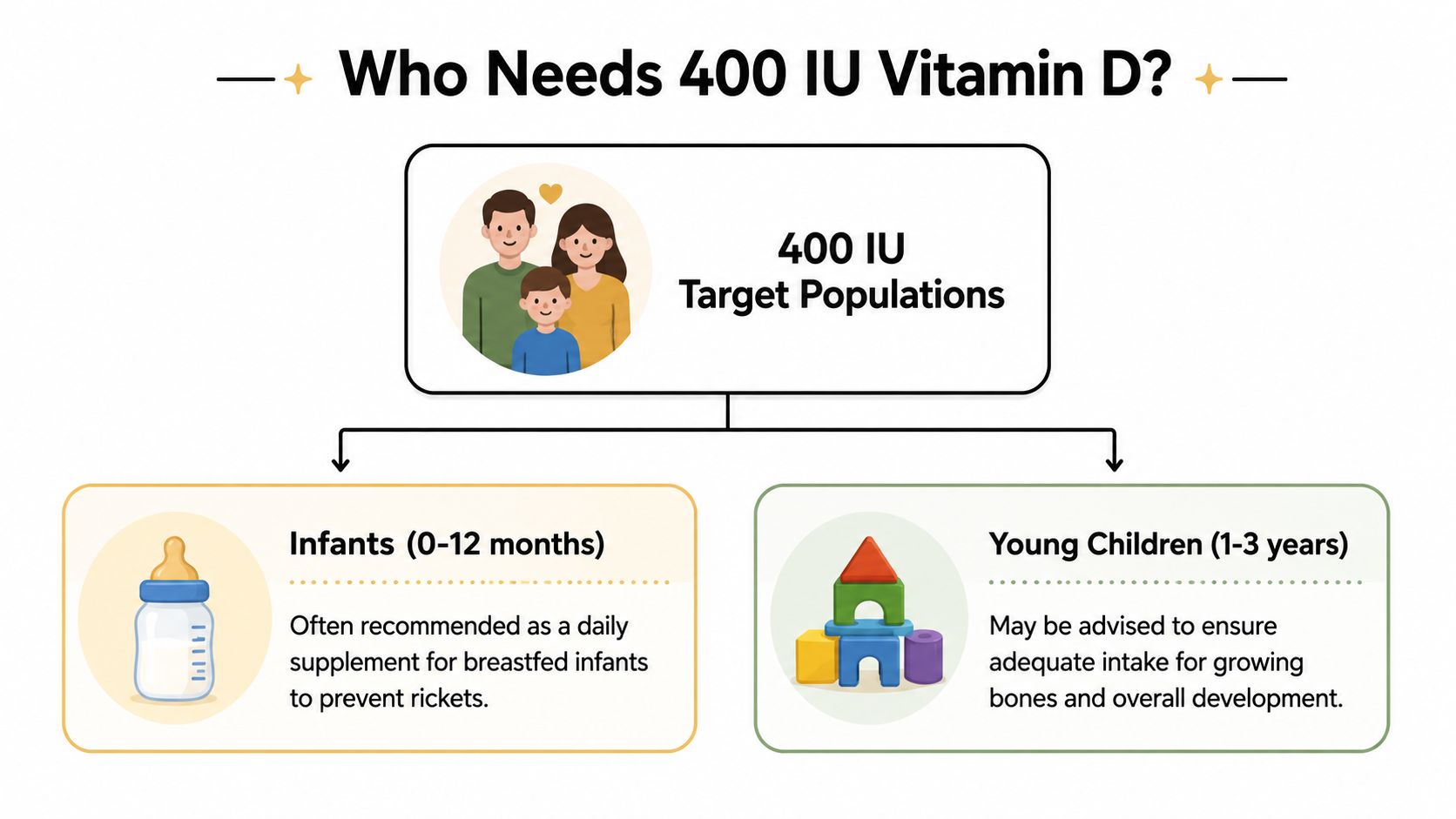
In 2021, the Indian Academy of Paediatrics updated its guidelines to recommend 400 IU daily for all infants from birth to 12 months, consistent with NIH guidance for the United States and Canada, which also defines 400 IU (10 mcg) as the critical daily intake for infants under one year Nature review of the guideline context.
That's the key point. For infants, 400 IU is not a vague wellness suggestion. It is a defined preventive dose.
A simple age-based comparison
Once people move beyond infancy, the picture changes. The same single number no longer fits everyone.
| Group | How 400 IU is typically viewed |
|---|---|
| Infants from birth to 12 months | Standard preventive daily dose |
| Older children and many adults | Often below usual guidance |
| Adults over 70 | Usually below recommended intake |
| People with diagnosed deficiency | Not a treatment dose by itself |
MedlinePlus presents this difference clearly. It lists 400 IU for birth to 12 months, but 600 IU for most children and adults and 800 IU for adults 71 and older. That's one reason adults get confused when they see 400 IU on a label. It's common on the shelf, but it may not match their age or risk category.
Here's a quick visual summary before we go further:
Where adults misread the label
Adults often assume a supplement amount is a recommendation. It isn't always. Sometimes it's just one available product strength.
For some adults, 400 IU vitamin D may still have a role as a low baseline maintenance dose, especially if intake is being combined with fortified foods, routine monitoring, or a clinician's broader plan. But that's very different from saying it's enough for every adult.
A more practical way to look at it is by purpose:
- Prevention in infants: 400 IU is standard.
- General adult maintenance: sometimes reasonable, depending on the person.
- Correction of deficiency: often not enough on its own.
- Higher-risk adults: frequently not enough.
If you're an adult reading an infant-guideline number on an adult supplement bottle, it's easy to draw the wrong conclusion.
For cancer patients, this distinction matters even more because nutrition status, body weight, digestion, and medications can all change what a “standard” dose does in the body.
The Role of 400 IU Vitamin D in Cancer Care
In oncology, I think about vitamin D less as a trendy supplement and more as part of supportive care. It belongs in the same conversation as bone health, nutrition, mobility, fall risk, medication review, and blood work.
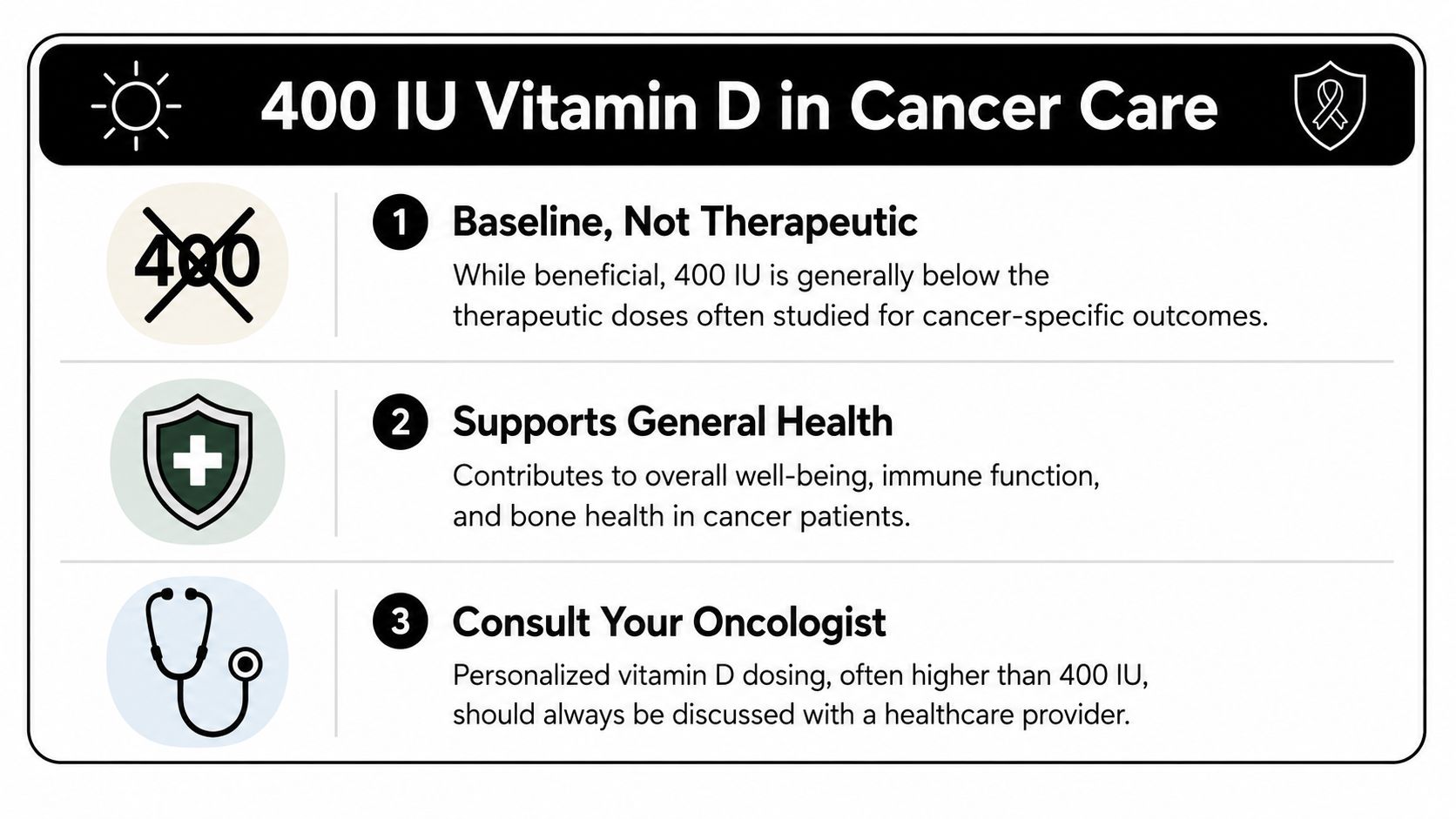
That's where 400 IU vitamin D can still be useful. It is often a safe baseline, especially when the goal is to maintain a basic level of support rather than aggressively correct a known deficiency.
Why a small dose still matters
Cancer treatment can strain the body in indirect ways. A patient may eat less, spend less time outdoors, lose muscle, become less active, or develop digestive issues that make absorption less reliable. Some therapies also raise concern about bone strength over time. In that setting, vitamin D sufficiency matters because it supports calcium handling and skeletal stability.
The clinically important nuance is this: 400 IU is often a maintenance or entry dose, not a correction dose.
The available clinical guidance notes that 400 IU is significant because it avoids the risk of hypercalcemia, while patients with serum 25(OH)D below 20 ng/mL are often started on 50,000 IU weekly, with later maintenance in stable oncology patients often dropping to 400 to 800 IU daily to maintain levels between 30 and 100 ng/mL. The same guidance describes 400 IU as a non-toxic entry point for maintaining homeostasis.
What I tell patients in practice
If a patient with cancer asks whether 400 IU is “good,” my answer is usually: it may be reasonable, but only if it matches the goal.
If the goal is simple maintenance and the patient's levels are already acceptable, 400 IU may be part of the plan. If the goal is correcting a deficiency, rebuilding stores after poor intake, or compensating for absorption problems, it often won't be enough by itself.
That's one reason I encourage patients to read more about the connection between cancer and vitamin D in a broader supportive-care context. At Hirschfeld Oncology, vitamin D status is considered alongside treatment tolerance, symptoms, lab trends, and the patient's overall care goals rather than in isolation.
In cancer care, the right question usually isn't “Is 400 IU safe?” It's “What problem are we trying to solve with it?”
What 400 IU does not mean
It does not mean vitamin D is being used as a stand-alone cancer treatment. It does not mean higher doses should be started without supervision. And it does not mean every person in treatment needs the same amount.
What it can mean is that a modest dose has a role in a careful, individualized plan.
Safety Monitoring and When 400 IU Is Not Enough
The biggest safety concern with 400 IU vitamin D usually isn't that it's too much. It's that people assume it must be enough because it feels familiar and low-risk.
For many adults, that assumption misses the core issue.
Who may need more than a baseline dose
MedlinePlus makes this variation clear. It lists 400 IU for infants, while adults are generally in the 600 to 800 IU range, and it specifically notes that people with obesity, limited sun exposure, darker skin, malabsorption, or medication interactions may need more vitamin D than the standard 400 IU dose MedlinePlus vitamin D deficiency guidance.
That list matters in oncology. Many cancer patients fit at least one of those categories, and some fit several.
- Limited sun exposure: Treatment fatigue, infection precautions, and time spent indoors can all reduce sunlight exposure.
- Malabsorption: GI cancers, bowel surgery, diarrhea, nausea, and certain therapies can interfere with absorption.
- Medication interactions: Some drugs can change how vitamin D is processed.
- Body composition and skin pigmentation: These can affect how much supplementation a person may need.
Why blood testing changes the conversation
This is why I'm cautious about one-size-fits-all advice. A label tells you what's in the bottle. It doesn't tell you what's happening in your bloodstream.
A blood test for serum 25-hydroxyvitamin D is what turns guessing into decision-making. If your level is low, the plan may involve a higher replacement approach under supervision. If your level is stable, a lower maintenance dose may be perfectly appropriate.
Some patients also read fitness or wellness discussions about higher-dose products and wonder whether those apply to them. Resources like optimising performance with D3 can be useful for understanding why stronger products exist, but people in active cancer care shouldn't translate general wellness dosing directly into their own plan without medical review.
This same caution applies to broader supplement use in oncology. The interaction question matters, which is why it helps to understand the wider conversation around antioxidants and cancer before adding multiple over-the-counter products at once.
A low dose can be safe and still be inadequate. Those are two different questions.
Practical Advice and Consulting Your Doctor
If you remember one thing, let it be this: 400 IU vitamin D is a meaningful dose, but it is not a universal adult answer.
For infants, it has a clear preventive role. For adults, it may function as a modest maintenance dose in the right setting. For people with cancer, it can be a reasonable starting point or part of a maintenance strategy, but it often needs to be interpreted in light of symptoms, treatment, diet, absorption, and lab results.
A practical checklist to use today
- Check the purpose: Are you trying to prevent deficiency, maintain a level, or treat a known deficiency?
- Review what you already take: Formula, fortified foods, multivitamins, calcium products, and standalone D3 supplements can overlap.
- Ask about testing: A serum 25-hydroxyvitamin D level can tell your doctor whether 400 IU is enough, too little, or unnecessary.
- Don't self-prescribe high doses: Cancer treatment changes the context. What's reasonable for one person may not be appropriate for another.
There's also a basic public health reason supplementation comes up so often. The NIH Office of Dietary Supplements notes that more than 97% of women and 94% of people aged 1 and older consume less than the Estimated Average Requirement of 400 IU from food alone, and a meta-analysis found that daily supplementation of 400 IU or 800 IU with calcium reduced the risk of any fracture by 6% and hip fractures by 16% NIH Office of Dietary Supplements vitamin D fact sheet.
That doesn't mean everyone needs the same regimen. It means food alone often doesn't close the gap.
If you're in treatment, or caring for someone who is, vitamin D belongs in the larger discussion about nutrition, symptom management, and safe supportive care. This broader view is part of why many clinicians also talk about nutraceuticals and their role in patient-centric cancer care rather than treating any single supplement as a simple fix.
If you're unsure whether 400 IU vitamin D is enough for your situation, a focused conversation with Hirschfeld Oncology can help you place that number in context. For cancer patients, the safest plan is individualized. It should match your labs, your treatment, your symptoms, and your goals.
.png)
.png)