.png)


Introduction
Gastrointestinal (GI) malignancies—encompassing cancers of the esophagus, stomach, liver, pancreas, colon, rectum, and biliary tract—represent a substantial proportion of cancer diagnoses worldwide, accounting for roughly 15% of all new cases and contributing markedly to cancer‑related mortality. Because these tumors arise in anatomically and biologically diverse sites, optimal management demands a coordinated, multidisciplinary approach that integrates surgical oncology, medical oncology, radiation oncology, pathology, radiology, and supportive‑care services. Personalized treatment planning, driven by molecular profiling, risk‑stratification models, and patient‑specific factors such as performance status and comorbidities, enables clinicians to select the most effective therapeutic combinations—ranging from neoadjuvant chemoradiation and targeted agents to immunotherapy and minimally invasive surgery. Evidence‑based guidelines, exemplified by the NCCN and ESMO recommendations, translate rigorous trial data into standardized pathways, ensuring that care remains current, consistent, and tailored to each patient’s disease biology and clinical context.
Multimodal and Precision Therapies Across GI Cancers

Neoadjuvant chemotherapy and chemoradiation – For locally advanced esophageal, gastric, rectal and pancreatic tumors, multimodal regimens (e.g., FLOT for esophagogastric adenocarcinoma, S‑1‑based chemoradiotherapy for pancreatic duct adenocarcinoma, 5‑FU/capecitabine chemoradiation for rectal cancer) improve R0 resection rates and survival while maintaining tolerable safety profiles.
Immunotherapy and checkpoint inhibition – MSI‑high or dMMR gastrointestinal malignancies respond to PD‑1 blockade (pembrolizumab, nivolumab). Combination chemo‑immunotherapy (e.g., FOLFOX + pembrolizumab) further extends progression‑free survival in selected patients.
Targeted agents – HER2‑positive gastric/gastroesophageal junction cancers benefit from trastuzumab‑based regimens; anti‑VEGF therapy (bevacizumab, ramucirumab) is standard in metastatic colorectal disease; PARP inhibition (olaparib) is approved for BRCA‑mutated pancreatic cancer after platinum exposure.
Emerging pancreatic therapies – Zenocutuzumab (Bizengri) targets rare NRG1‑fusion drivers in ~1 % of pancreatic cancers, offering durable responses where conventional chemotherapy fails. In February 2026 the FDA cleared Optune Pax, a wearable TTFields device combined with gemcitabine + nab‑paclitaxel, adding ~2 months OS without excess toxicity.
New drugs for pancreatic cancer – Zenocutuzumab and TTFields represent precision‑medicine and technology‑driven options that expand the therapeutic armamentarium beyond FOLFIRINOX and gemcitabine‑nab‑paclitaxel.
ASCO Oncology – ASCO provides evidence‑based guidelines, annual meetings, and the Conquer Cancer Foundation, ensuring clinicians (including those at Hirschfeld Oncology) practice with the latest standards.
Metastatic pancreatic cancer drugs – First‑line FOLFIRINOX or gemcitabine + nab‑paclitaxel remain standard; FDA‑approved NALIRIFOX (liposomal irinotecan + 5‑FU/leucovorin + oxaliplatin) offers modest survival gain. Maintenance olaparib is used for BRCA‑mutated disease.
Pancreatic cancer best medicine – The optimal regimen matches patient fitness with intensive chemotherapy (FOLFIRINOX), targeted maintenance (olaparib), and emerging agents (zenocutuzumab, TTFields) within a multidisciplinary framework.
Journal of Clinical Oncology Practice – JCO Oncology Practice (impact factor 4.7, 2023) publishes practical oncology research; it has no publication or submission fees and follows an EZSubmit format with clear author guidelines.
Clinical Practice Guidelines in Oncology – NCCN guidelines, covering 97 % of US cancers, provide evidence‑based, consensus‑driven algorithms for GI malignancies, regularly updated to incorporate new data.
Oncology in Clinical Practice Impact Factor – The journal currently has a CiteScore of 0.6 (2024) and is classified in Q4 for oncology.
Oncologist vs. clinical oncologist – An oncologist may specialize in medical, surgical, or radiation oncology; a clinical oncologist is trained in both medical and radiation oncology and can deliver systemic therapy and radiation within one practice (more common in the UK).
Highest‑paying oncologist type – Radiation oncologists earn the highest average salaries (≈ $361,000 / yr) in the United States.
Tablets for pancreatic cancer treatment – Oral agents include capecitabine, erlotinib, olaparib, and targeted pills for BRAF, MEK, NTRK, or RET alterations, enabling personalized, outpatient‑friendly regimens.
Surgical Innovations and Minimally Invasive Techniques
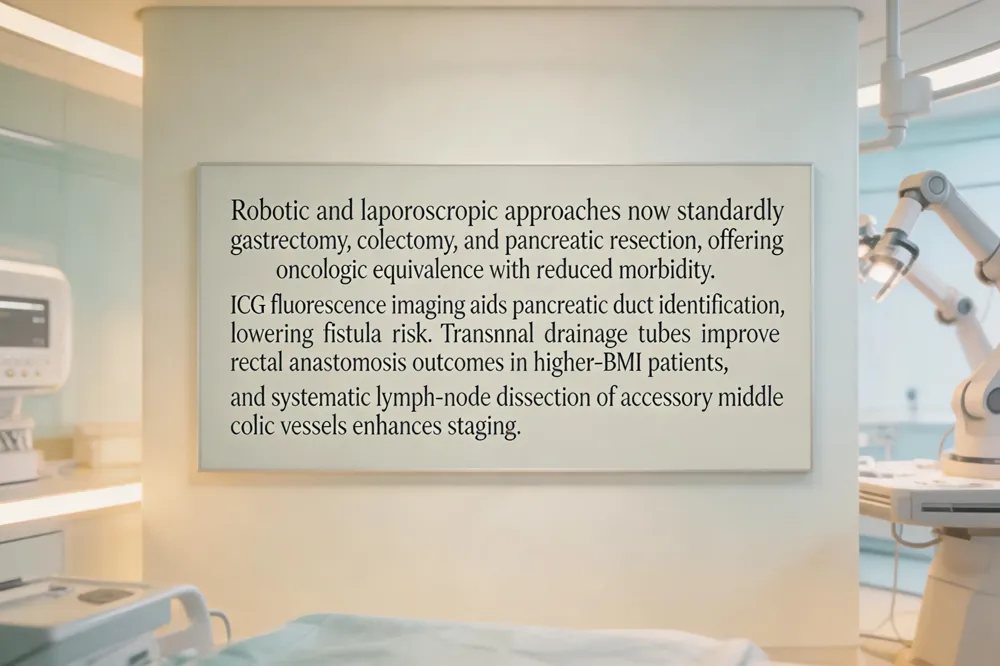
Robotic and laparoscopic approaches have transformed gastrectomy, colectomy, and pancreatic resection, offering oncologic equivalence with reduced postoperative morbidity, shorter hospital stays, and faster return to adjuvant therapy. Studies show that minimally invasive pancreatic resections, when combined with indocyanine‑green (ICG) fluorescence imaging, allow real‑time identification of the accessory pancreatic duct, markedly decreasing the risk of postoperative pancreatic fistulas. In rectal cancer surgery, placement of a transanal drainage tube (TDT) is especially beneficial for patients with a BMI ≥ 25 kg/m², helping to prevent anal leakage and facilitating safe anastomoses. Lymph‑node dissection strategies are also being refined: for splenic flexure colon cancers, systematic removal of nodes along the accessory middle colic artery is critical because metastasis to this basin is frequent; similarly, careful dissection of the middle colic and accessory vessels improves staging accuracy and may enhance survival. Together, these innovations underscore the importance of multidisciplinary planning and the integration of advanced imaging, ergonomics, and anatomy‑guided techniques to achieve safer, more effective GI cancer surgery.
Enhanced Recovery, Supportive Care, and Quality of Life

Enhanced Recovery After Surgery (ERAS) protocols have become a cornerstone of postoperative care for gastrointestinal (GI) cancer patients, integrating pre‑operative nutrition optimization, goal‑directed fluid management, and early mobilization to shorten hospital stays and reduce morbidity. Multimodal pain strategies that incorporating non‑opioid analgesics, regional anesthesia, and individualized dosing, complement ERAS goals and improve patient comfort. Because fluoropyrimidine agents (5‑FU, capecitabine) can cause severe toxicity in patients with dihydropyrimidine dehydrogenase (DPYD) deficiency, pre‑treatment DPYD genetic testing is now recommended to guide dose adjustments and prevent life‑threatening adverse events. Early palliative care integration, beginning at diagnosis, addresses pain, nutrition, psychosocial distress, and symptom control, and has been shown to improve quality of life and, in some studies, survival. Specific technical measures such as the insertion of a transanal drainage tube (TDT) after rectal cancer surgery—particularly in patients with a body‑mass index ≥25 kg/m²—reduce the risk of anal leakage and postoperative fistulas, illustrating how targeted supportive interventions can further enhance recovery outcomes.
Emerging Technologies, AI, and Precision Medicine

Artificial intelligence is reshaping gastrointestinal oncology by enabling real‑time endoscopic lesion detection and automating histopathologic classification, which accelerates diagnosis and guides targeted treatment. Parallel advances in patient‑derived organoids and digital‑twin platforms allow rapid, patient‑specific drug sensitivity testing, integrating genomic, transcriptomic, imaging, and clinical data to predict therapeutic response. In liver surgery, indocyanine green fluorescent imaging combined with an updated understanding of Laennec’s capsule anatomy enhances intra‑operative visualization of vascular and biliary structures, reducing bile‑duct injury and improving oncologic margins. Emerging strategies also target the gut microbiome to lower postoperative complications such as anastomotic leakage, while droplet‑microfluidics enables high‑throughput drug screening from minimal tissue samples. Imaging mass cytometry provides high‑dimensional profiling of the tumor immune microenvironment, uncovering novel immunologic targets and informing biomarker‑driven immunotherapy. Together, these innovations drive a precision‑medicine paradigm that tailors multimodal therapy to the molecular and functional landscape of each gastrointestinal cancer.
Guidelines, Multidisciplinary Boards, and Clinical Trial Access

The 2025 NCCN and 2024 ESMO updates emphasize multimodal, biomarker‑driven care for all GI cancers, mandating molecular profiling, MSI testing and DPYD screening before fluoropyrimidine use. Multidisciplinary tumor boards — exemplified by Atlantic Health’s Collaborative model — integrate surgical oncology, medical oncology, radiation, pathology and supportive services to personalize peri‑operative chemotherapy, targeted agents and immunotherapy. Incentives for clinical trial enrollment, such as streamlined consent and financial assistance, have boosted access to novel agents like zenucutuzumab, a bispecific antibody under investigation for refractory gastric tumors. Professional societies (ASCO, ASTRO, ONS) shape practice through guideline endorsement, AI‑driven diagnostic tools, ERAS protocols and advocacy for early palliative integration, accelerating the translation of evidence into routine GI oncology care.
Conclusion
Advances in gastrointestinal oncology now hinge on eight synergistic strategies: modern minimally invasive and organ‑preserving surgeries, robust neoadjuvant and adjuvant multimodal regimens, precision‑driven molecular profiling that directs targeted agents and immunotherapy, AI‑assisted diagnostics, and proactive supportive‑care pathways such as ERAS and palliative integration. Hirschfeld Oncology embraces this evidence‑based, multidisciplinary model, uniting surgeons, medical and radiation oncologists, pathologists, and nursing specialists to craft individualized, compassionate plans for every patient. Looking forward, the center will expand participation in clinical trials, integrate emerging bispecific antibodies, KRAS‑G12C inhibitors, and digital‑twin decision tools, and deepen collaborations with academic and industry partners to accelerate novel, life‑extending therapies.
.png)
.png)