.png)


Think of it like this: some cancers are actually fueled by the body's own natural hormones. Cancer hormone therapy is a smart, targeted treatment designed to cut off that very fuel supply. The goal is to either stop the body from producing these hormones in the first place or to block the cancer cells from being able to use them.
For many people, this approach is a cornerstone of their cancer treatment, and it often comes with fewer of the tough side effects associated with traditional chemotherapy.
How Cancer Hormone Therapy Works

The idea behind hormone therapy is surprisingly simple. Certain cancers have what are called hormone receptors on their surface. When a hormone—like estrogen in many breast cancers or testosterone in prostate cancer—connects with its receptor, it’s like a key turning in a lock. This "click" signals the cancer cell to grow and multiply.
Hormone therapy is a whole class of treatments, not just one drug, all designed to jam that lock-and-key system. It’s a precision strategy that disrupts this growth signal, essentially starving the cancer. This is very different from chemotherapy, which tends to affect all fast-growing cells in the body (cancerous or not). Hormone therapy hones in on the specific hormonal pathways the cancer relies on.
Let's break down the core concepts into a quick summary.
Hormone Therapy Fundamentals at a Glance
This table gives a high-level view of how hormone therapy fits into cancer care.
Understanding these basics makes it clear why this is such a powerful tool in an oncologist's arsenal.
Two Primary Strategies to Cut the Fuel Supply
So, how do we actually stop the fuel from getting to the engine? There are two main ways we do it, and the choice depends on your specific cancer, hormone status, and overall health.
Blocking Hormone Production: Some drugs work by shutting down the body’s hormone factory. A great example is a class of drugs called aromatase inhibitors (AIs) used for post-menopausal women. They block an enzyme that produces estrogen, causing levels to drop dramatically.
Blocking Hormone Receptors: Other medications act like a shield. They attach to the hormone receptors on the cancer cells, physically blocking the actual hormones from getting in. The fuel is still floating around in the bloodstream, but it can’t dock with the cell to deliver its growth message.
This targeted approach is highly effective for cancers confirmed to be hormone-receptor-positive. For instance, hormone therapy can reduce the risk of recurrence in hormone-receptor-positive breast cancer by at least 40% when used as prescribed.
This foundational knowledge helps explain why your oncologist might recommend this path. It's a versatile treatment that can be used to shrink a tumor before surgery, to help prevent a recurrence after you’ve finished initial treatment, or to manage cancer that has spread. Because it's so targeted, it’s a powerful and often much more tolerable part of a modern cancer treatment plan.
Which Cancers Respond Best to Hormone Therapy?
Hormone therapy isn't a one-size-fits-all treatment. Its power lies in its specificity—it only works against cancers that have a particular feature on their cell surfaces called hormone receptors.
Think of these receptors as tiny docking stations. When hormones circulating in your bloodstream—like estrogen or testosterone—latch onto these stations, they send a signal telling the cancer cell to grow and multiply. Hormone therapy cleverly intervenes by either blocking those docking stations or by lowering the amount of hormones available to use them.
Because of this mechanism, the treatment is only effective for cancers that are confirmed to be "hormone-receptor-positive" (HR+). We find this out by testing a small piece of the tumor after a biopsy.
Breast Cancer: The Prime Candidate
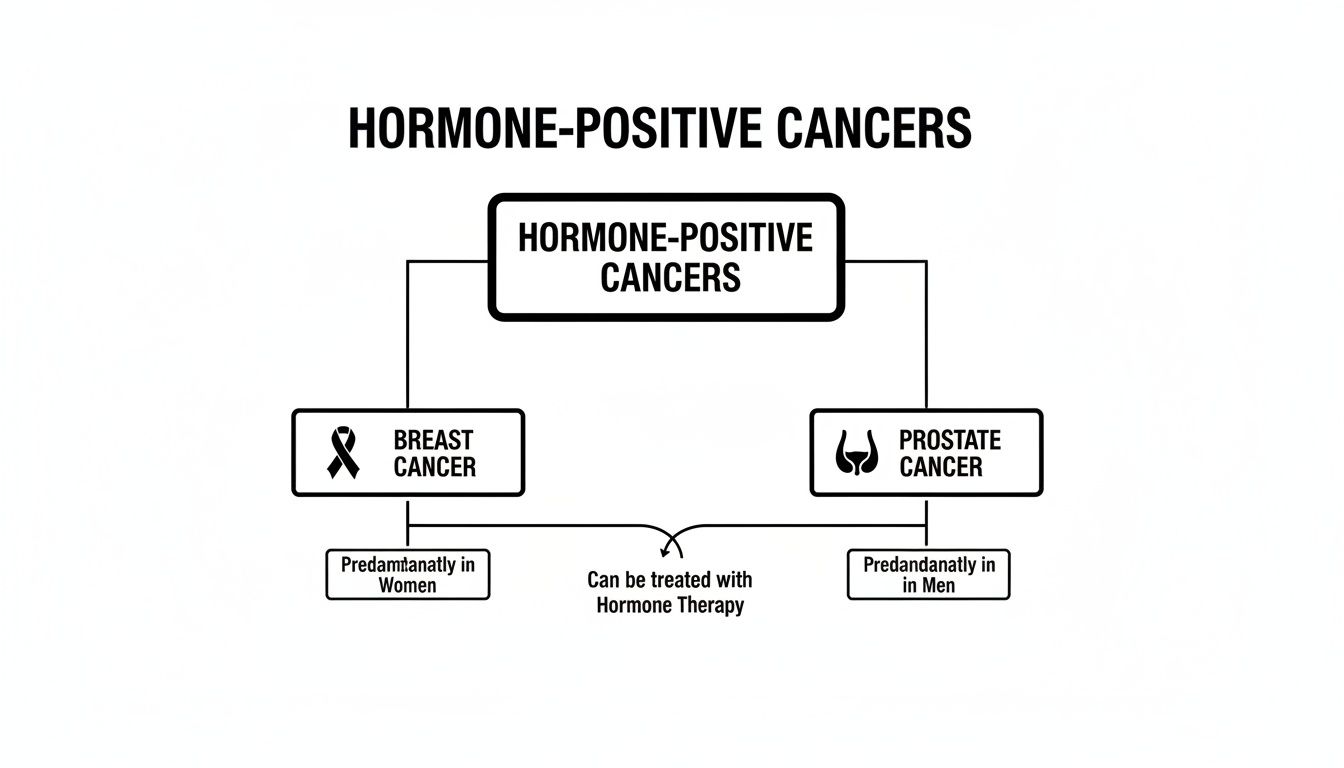
When people hear "hormone therapy," they often think of breast cancer, and for good reason. It’s the most common cancer treated this way. When pathologists analyze a breast tumor, they're specifically looking for two types of receptors:
- Estrogen Receptors (ER): If a tumor has these, it’s called ER-positive (ER+). Estrogen acts like a direct fuel source for these cancer cells.
- Progesterone Receptors (PR): Likewise, cancers with these are called PR-positive (PR+). Progesterone can also encourage their growth.
A tumor might be ER-positive, PR-positive, or both. As long as it has one of them, it’s a candidate for hormone therapy. The good news is that about 70% of all breast cancers fall into this category, making this treatment a cornerstone for the vast majority of patients.
The impact here has been enormous. In advanced or metastatic breast cancer, pairing hormone therapy with newer targeted drugs has truly changed the game, often turning a rapidly advancing disease into a much more manageable, chronic condition. You can explore the evolution of hormone therapy for breast cancer on OncoDaily.com to see how far we've come.
Prostate Cancer: An Androgen-Driven Disease
Prostate cancer is another classic example of a hormone-sensitive malignancy. In nearly all cases, its growth is fueled by male sex hormones known as androgens, with testosterone being the most well-known. Prostate cancer cells are covered in androgen receptors, and when testosterone binds to them, it signals the cells to divide.
This direct dependency makes Androgen Deprivation Therapy (ADT) a foundational treatment for prostate cancer. ADT is simply a form of hormone therapy designed to either dramatically reduce the body's testosterone levels or block androgens from reaching the cancer cells.
By cutting off the androgen supply, ADT effectively starves the prostate cancer. This can slow its growth, shrink tumors, and relieve symptoms, particularly when the cancer has spread.
Other Cancers That May Respond
While breast and prostate cancer get most of the attention, they aren't the only ones. A few other cancers can be hormone-sensitive, though it’s a less common treatment approach for them.
- Uterine (Endometrial) Cancer: Certain types of uterine cancer also express estrogen and progesterone receptors. For these tumors, especially if they are advanced or have come back after initial treatment, hormone-blocking therapies can be a valuable option.
- Ovarian Cancer: A small subset of ovarian cancers, particularly specific types called stromal tumors, can also be driven by hormones. In these cases, treatments that lower estrogen can be effective.
Ultimately, whether hormone therapy is right for you comes down to the unique biology of your tumor, which can only be confirmed through careful laboratory testing.
Getting to Know the Different Hormone Therapy Drugs
When you first hear all the different names and acronyms for hormone therapy drugs—SERMs, AIs, ADT—it can feel a little overwhelming. But the good news is that they all work toward the same simple goal: cutting off the hormonal fuel that your cancer is using to grow.
I like to think of it like defending a castle. Some drugs stop the body from producing the hormones in the first place, essentially cutting off the enemy's supply lines. Others act like guards at the castle gates (the cell receptors), blocking the hormones from ever getting inside to cause trouble. The specific drug your oncologist recommends will depend on your exact type of cancer, your body's unique biology, and for women, whether you are pre- or post-menopausal.
Let's look at the main players for the two cancers most commonly treated this way.
For Breast Cancer
When a breast cancer is hormone receptor-positive (HR+), the treatment is all about disrupting estrogen's ability to fuel the cancer cells. Oncologists have a few clever ways to do this.
Selective Estrogen Receptor Modulators (SERMs): These drugs are a bit like a key that fits into a lock but won't turn. Tamoxifen, a very common SERM, fits perfectly into the estrogen receptors on cancer cells, physically blocking real estrogen from getting in and delivering its "grow" signal.
Aromatase Inhibitors (AIs): This class of drugs is mainly used for post-menopausal women. After menopause, the ovaries don't make much estrogen, but other tissues (like body fat) still do, thanks to an enzyme called aromatase. AIs like Letrozole and Anastrozole work by shutting down that enzyme, which causes the body's overall estrogen levels to plummet.
Selective Estrogen Receptor Degraders (SERDs): Think of these as a more aggressive approach. Instead of just blocking the receptor, a SERD like Fulvestrant binds to it and signals the cell to destroy the receptor entirely. This drastically reduces the number of "docking stations" available for estrogen to land on.
For Prostate Cancer
With prostate cancer, the main fuel is a group of male hormones called androgens, especially testosterone. The goal of treatment, known as Androgen Deprivation Therapy (ADT), is to either slash testosterone levels or block its path to the cancer cells.
Here are the two primary ways we achieve this:
LHRH Agonists and Antagonists: These sophisticated drugs work on the brain's command center, telling it to stop sending signals to the testicles to make testosterone. Medications like leuprolide (an agonist) or degarelix (an antagonist) can lower testosterone just as effectively as surgically removing the testicles.
Androgen Receptor Blockers: Sometimes called anti-androgens, these work much like SERMs do in breast cancer. They attach directly to the androgen receptors on the prostate cancer cells, so even if testosterone is around, it can't bind and tell the cell to grow. Bicalutamide and enzalutamide are common examples.
To make this a bit clearer, here's a quick breakdown of these drug classes.
A Simple Guide to Hormone Therapy Drug Classes
Understanding the "how" behind your medication can empower you to have more productive conversations with your care team. Whether the plan is to block receptors or halt production, the endgame is always the same: to starve the cancer of what it needs to survive and grow.
In some situations, especially with more advanced cancer, these drugs are often used in combination with other treatments. If you're curious about how they fit into the bigger picture of precision medicine, you might find it helpful to read our overview of targeted therapy. It helps explain how we're getting smarter and more specific about fighting cancer.
Navigating and Managing Treatment Side Effects

While hormone therapy is often easier on the body than chemotherapy, it still works by fundamentally changing your natural hormone levels. That shift can definitely bring on side effects that affect your day-to-day life. The good news? These challenges are well-understood, and we have many ways to manage them.
The most important thing is to have an open, honest conversation with your oncology team. When we know what to expect, we can create a proactive plan to help you maintain your quality of life throughout treatment. Your experience will be unique, but many common side effects can be managed with simple lifestyle adjustments, supportive care, and sometimes medication.
Common Side Effects in Breast Cancer Treatment
For women undergoing hormone therapy for breast cancer, the side effects can feel a lot like menopause. That’s no coincidence—drugs like Tamoxifen and aromatase inhibitors are specifically designed to block or lower your body's estrogen.
Here are some of the common challenges you might face:
- Hot Flashes and Night Sweats: Those sudden, intense feelings of heat are one of the most frequent complaints. We often find that dressing in layers, avoiding triggers like spicy foods or caffeine, and practicing deep breathing can make a real difference.
- Joint Pain and Stiffness: Aches and pains, especially in the hands, wrists, and knees, are common with aromatase inhibitors. Gentle exercise like walking, stretching, or yoga can improve your flexibility and ease that discomfort.
- Vaginal Dryness: Lower estrogen levels can lead to dryness and discomfort, but there are great over-the-counter moisturizers and lubricants that provide significant relief.
- Bone Density Loss: Aromatase inhibitors can cause bone thinning over time, which increases the risk of osteoporosis. We will monitor your bone density closely and likely recommend calcium and vitamin D supplements along with weight-bearing exercises to keep your bones strong.
A critical part of managing your well-being is weighing the risks and benefits of other treatments. For instance, breast cancer survivors often wonder about hormone replacement therapy (HRT) for menopause symptoms. This requires a careful, personalized discussion with your oncologist. New research helps clarify these choices, highlighting that for many women, the absolute risk of relapse can be quite small, allowing for a more balanced conversation about quality of life. You can explore these findings on post-cancer HRT and their implications to learn more.
Common Side Effects in Prostate Cancer Treatment
For men on Androgen Deprivation Therapy (ADT) for prostate cancer, side effects are a direct result of the sharp drop in testosterone. These changes can be both physical and emotional, but taking a proactive approach makes a world of difference.
Here are some key side effects to be aware of:
- Fatigue: A persistent feeling of being wiped out is very common. The best strategy is often to pace yourself and build in short bursts of light exercise, like a daily walk, which can surprisingly boost your energy levels.
- Loss of Muscle Mass and Strength: Lower testosterone can lead to muscle weakening. Resistance training—even with light weights or resistance bands—is incredibly effective at preserving your strength.
- Hot Flashes: Just like in women, men on ADT can experience those sudden, uncomfortable waves of heat.
- Sexual Side Effects: Reduced libido and erectile dysfunction are frequent and understandable concerns. It's so important to discuss these openly with us, as many supportive treatments and strategies are available.
Finding the right way to handle these challenges is a core part of your cancer journey. We offer more detailed guidance in our article on managing treatment side effects to enhance patient quality of life.
Remember, your oncology team is your best resource. Never hesitate to tell us what you're experiencing, no matter how small it might seem. We can adjust medications, recommend supportive therapies like physical therapy or acupuncture, and connect you with resources to help you feel your best.
Using Hormone Therapy for Advanced Cancers
When cancer has spread to other parts of the body or has stopped responding to initial treatments, our entire approach has to shift. For patients with advanced, metastatic, or treatment-resistant disease, cancer hormone therapy becomes less about a cure and more about smart, long-term disease management. The focus is on slowing growth, extending life, and, just as importantly, preserving its quality.
Think of it as managing a chronic condition rather than fighting a short-term battle. This strategy is a cornerstone of modern care for diseases like metastatic HR+ breast cancer and advanced prostate cancer, giving us a powerful way to keep the cancer in check.
Combining Therapies for Greater Impact
In the world of advanced cancer, hormone therapy rarely fights alone. Its real strength is often revealed when we pair it with other targeted drugs that attack the cancer from different angles. This multi-pronged approach helps us outmaneuver the cancer's ability to develop resistance.
A fantastic example of this is how we now treat metastatic HR+ breast cancer by combining hormone therapy with drugs called CDK4/6 inhibitors.
- Hormone therapy does its job by cutting off the estrogen supply that the cancer cells are using as fuel.
- CDK4/6 inhibitors (like palbociclib or ribociclib) work on a completely different pathway, blocking specific proteins that give cancer cells the "green light" to divide.
When we use these two together, it’s a powerful one-two punch that is far more effective than either treatment on its own. This combination has been shown to significantly delay cancer progression—in many cases, doubling the time before the disease advances compared to hormone therapy by itself. It's a strategy that has truly changed the outlook for so many patients.
The Chess Match of Treatment Sequencing
Advanced cancers are remarkably resourceful; they can adapt and figure out new ways to grow, even when a treatment is working well. This is where the concept of treatment sequencing becomes absolutely critical. It’s like a strategic chess match your oncologist plays against the cancer.
Instead of throwing our most powerful treatment at the cancer all at once, we map out a dynamic, long-term plan. The first hormone therapy might work beautifully for months or even years. But when the cancer eventually starts to outsmart it, we don't see it as a failure. We see it as a signal to pivot.
This strategic pivot might mean switching to a different type of hormone therapy, adding a new targeted drug to the mix, or introducing another kind of treatment altogether. The goal is always to stay one step ahead, continually adapting our strategy to keep the cancer under control for as long as we can.
This methodical sequencing lets us manage the disease over the long haul, pulling different tools from our toolbox at just the right time. It helps preserve future treatment options while focusing on your quality of life today.
A Proactive Plan for Long-Term Control
For anyone facing an advanced diagnosis, this strategic use of hormone therapy offers a clear path forward. It isn't about giving up hope—it's about shifting the focus to proactive, intelligent management. An experienced oncologist doesn't just write a prescription; they develop a personalized, evolving roadmap for your care.
This plan typically involves:
- Starting with a hormone-based regimen that is both effective and well-tolerated.
- Monitoring you closely with regular scans and blood tests to see how the cancer is responding.
- Sequencing to the next line of therapy at the first sign that the cancer is developing resistance.
This approach helps turn a daunting diagnosis into a more manageable journey. It reflects our commitment to finding a sustainable path that controls the disease, minimizes side effects, and helps you live your life as fully as possible.
Personalized Care at Hirschfeld Oncology
Understanding the science of hormone therapy is the first step, but the real work begins when we translate that knowledge into a treatment plan that actually fits your life. That’s the heart of what we do at Hirschfeld Oncology. We look beyond the standard protocols to create a plan that’s truly yours, always keeping your well-being and personal goals front and center.
A one-size-fits-all approach just doesn't work for complex or advanced cancer. Our team specializes in designing sophisticated strategies that skillfully combine hormone therapy with other treatments. For some patients, that might mean pairing it with low-dose chemotherapy or a specific targeted drug to attack the cancer from multiple angles—maximizing effectiveness while keeping side effects in check.
A Collaborative and Forward-Thinking Approach
We firmly believe that the best treatment plans are built together. We’ll work right alongside you to monitor your progress, get ahead of side effects, and make adjustments whenever they’re needed. Our focus is on aggressively treating the cancer without sacrificing your quality of life, making sure you feel heard and supported every step of the way.
This kind of personalized medicine has never been more critical. The global market for hormone therapy is growing, which is a great sign of the progress being made. It's actually projected to reach USD 41.97 billion by 2035, a clear reflection of the demand for better, more effective cancer treatments. By that same year, the U.S. is expected to have over 22 million cancer survivors, and many of them will be living longer, healthier lives because of these advanced therapies. This growth underscores why specialized centers like ours are so essential for delivering state-of-the-art care. You can read more about these therapeutic market trends.
Your Partner in Navigating Complex Cancer
When you’re facing a tough diagnosis, especially if standard treatments haven't worked, figuring out the next step can feel completely overwhelming. At Hirschfeld Oncology, our mission is to find that path forward with you. Our entire philosophy is built on deep expertise, genuine compassion, and a tireless search for the best possible outcome for every single person who walks through our doors.
We don't just treat a disease; we care for the person. Our practice is built on the principle that every patient deserves a plan that aligns with their body, their goals, and their life. It’s a commitment to finding hope and creating a strategy, even in the most difficult circumstances.
This means we think about every part of your care:
- Customized Regimens: We don't just follow a manual. We combine treatments in innovative ways tailored to your cancer's unique biology.
- Proactive Symptom Management: We work to manage side effects from the start, helping you feel your best so you can stay on treatment.
- Responsive Monitoring: Through regular check-ins and diagnostics, we keep a close eye on how you're responding and adapt your plan in real-time.
Our team isn't just here to provide medical treatment. We're here to offer guidance, clarity, and unwavering support throughout your journey. Think of us as your partners, dedicated to helping you find hope and improve your health.
Your Questions About Hormone Therapy, Answered
When you're starting a new treatment, questions are completely normal. Let’s walk through some of the most common things patients ask about hormone therapy, so you can feel more confident and clear about your path forward.
How Long Will I Need Hormone Therapy?
There’s no single answer to this one, because the timeline is built entirely around you—your specific cancer, its stage, and your personal risk of it coming back. Think of it less like a standard prescription and more like a custom-fit plan.
For instance, someone with early-stage breast cancer might take a daily pill for 5 to 10 years after surgery to prevent a recurrence. On the other hand, a patient with advanced prostate cancer might stay on hormone therapy indefinitely, as long as it’s successfully keeping the cancer in check. Your oncologist will map out a timeline for you and adjust it as needed over time.
Is Hormone Therapy the Same as Chemo?
No, they are worlds apart, and this is a really important distinction to understand. Hormone therapy and chemotherapy are fundamentally different tools that fight cancer in completely different ways.
Chemotherapy is designed to attack any cell in the body that divides quickly. That’s great for targeting fast-growing cancer cells, but it also means it can affect healthy cells in places like your hair follicles, digestive tract, and bone marrow, which causes those well-known side effects.
Hormone therapy is much more specific—it's a targeted treatment. It works by finding and blocking the exact hormone signals your specific cancer is using for fuel. Because it’s so focused on that one pathway, its side effects are generally quite different and often less severe than what you see with chemo.
The key takeaway is that hormone therapy is a precision tool designed to starve the cancer, while chemotherapy is a more systemic treatment that targets cell division more broadly.
Can Hormone Therapy Be Used All by Itself?
Yes, it absolutely can be the main or only treatment in certain cases. This is especially true for managing advanced prostate cancer, where Androgen Deprivation Therapy (ADT) often serves as the cornerstone treatment, controlling the disease on its own for years.
More often than not, though, hormone therapy is a key player on a bigger team. It's frequently combined with other treatments as part of a multi-pronged strategy.
- After Surgery (Adjuvant): It helps wipe out any stray cancer cells left behind and significantly lowers the chance of the cancer returning.
- Before Surgery (Neoadjuvant): It can be used to shrink a tumor, which can make the operation simpler and more effective.
- In Combination Therapy: It’s often paired with other advanced treatments, like targeted therapies, to put up a stronger fight against metastatic disease.
Your oncologist will figure out the best role for hormone therapy in your unique situation, making sure it’s used in the smartest way to get you the best possible outcome.
At Hirschfeld Oncology, we believe that understanding your treatment is the first step toward feeling empowered in your care. If you have more questions or want to explore a personalized treatment strategy, we invite you to learn more on our blog.
.png)
.png)