.png)


A woman arrives for her first infusion carrying a notebook full of questions. Before the day ends, she has spoken with an oncologist about treatment, a nurse about side effects, a scheduler about follow-up visits, and a research team member about whether a trial might fit her situation.
The Heart of Healing An Introduction to Oncology Careers
A first oncology visit can feel like stepping into a city you have never seen before. There are many doors, many people, and a lot of new language all at once. For a student considering careers in oncology, that complexity is not a warning sign. It is the clearest introduction to how cancer care works.

At a modern outpatient center such as Hirschfeld Oncology, care runs through an interconnected team. A physician may explain the diagnosis and set the treatment plan. An infusion nurse monitors symptoms and reactions in real time. A pharmacist checks dosing, timing, and drug interactions. A patient coordinator keeps appointments, records, authorizations, and phone calls from breaking apart under pressure. If a trial is a possibility, research staff review eligibility and document every step carefully. Data specialists help keep the clinical picture accurate enough for safe, personalized treatment.
That is the first lesson many students need. Oncology includes medicine, nursing, pharmacy, patient support, research operations, and data work. The field works like an orchestra. One missed part can throw off the entire performance, even if the lead clinician is excellent.
Why this field feels different
Oncology asks for scientific precision and human steadiness at the same time. Treatment decisions can depend on biopsy findings, lab trends, genetics, timing, and side effect patterns. Patients and families also remember the quieter details: who explained things clearly, who noticed their fear, and who helped them keep going through a difficult week.
Practical rule: If you want work that combines complex science with relationships that unfold over time, oncology may be a strong fit.
This is significant because cancer care extends far beyond active treatment. People need symptom management, education, scheduling help, follow-up after therapy, and sometimes support through survivorship or recurrence. That broader reality creates room for students with different strengths. Some want direct bedside care. Others are drawn to analytics, trial coordination, documentation, or quality improvement that keeps treatment safe and organized.
If you are still sorting out whether your path is clinical or physician-focused, a plain-language guide on how to become a physician can help you compare that route with other options. If you are also trying to understand the standards and qualifications respected in a specialized cancer setting, reviewing oncology career credentials and clinical standards gives useful context.
Who thrives in oncology
No single personality type owns this field. Different roles reward different habits, and that is one reason oncology attracts thoughtful people from many backgrounds.
- The relationship builder: Often drawn to nursing, physician assistant roles, survivorship support, or patient coordination.
- The diagnostician: Often interested in physician roles that require treatment planning and complex judgment.
- The detail guardian: Often well suited for registry work, data abstraction, clinical research operations, or pharmacy review.
- The translator: Someone who can turn medical language into clear next steps for patients and families.
Many students say they want meaningful work. In oncology, the better question is whether you want meaningful work in a team setting where accuracy, compassion, and follow-through all matter every day.
The Physician Path Becoming an Oncologist
If you want to lead cancer treatment decisions as a doctor, the path is long but very clear. Think of it as learning the field in layers. First you build a broad science base, then general medical judgment, then cancer-specific expertise.
The training roadmap
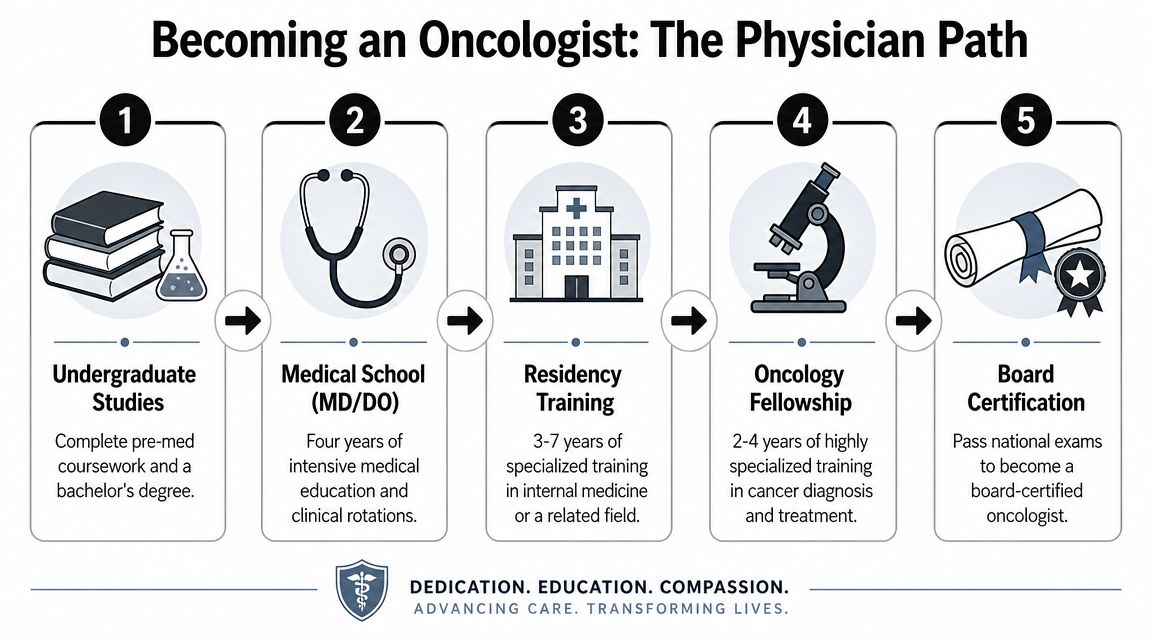
Most future oncologists start with undergraduate coursework that supports medical school admission. After that come the MCAT, medical school, residency, and a focused oncology fellowship. If you want a plain-language overview of the broader medical route first, this guide on how to become a physician is a useful starting point.
Here's the simplest way to picture it:
| Stage | What you're building | Why it matters |
|---|---|---|
| Undergraduate study | Science foundation and academic discipline | You need the basics before clinical training makes sense |
| Medical school | Broad medical knowledge and patient care exposure | Cancer care depends on understanding the whole patient |
| Residency | Independent clinical judgment | You learn to manage complex illness under supervision |
| Fellowship | Cancer-specific diagnosis and treatment expertise | This is where oncology becomes your professional language |
| Board certification | Formal professional validation | Employers and patients expect verified competence |
For physician readers comparing training expectations, a practice's oncology credentials and expertise can also help you see how subspecialized cancer care is in practice.
Choosing your oncology branch
Not all oncologists do the same work.
- Medical oncologists manage systemic treatments such as chemotherapy, targeted therapy, and immunotherapy. Their days often revolve around clinic visits, treatment planning, lab review, symptom management, and long-term follow-up.
- Radiation oncologists focus on radiation therapy. They work closely with imaging, treatment planning systems, and carefully defined dose strategies.
- Surgical oncologists treat cancer through operative care. Their training route differs because surgery comes first, then oncology-focused specialization.
The common mistake is thinking fellowship is just “more school.” It's closer to apprenticeship at a much higher level. You stop learning medicine in broad categories and start learning how to make cancer-specific decisions when every variable matters.
A short visual overview can help make that sequence feel more concrete.
The reality behind the demand
This path takes years, and students deserve honesty about that. The work can be intellectually demanding, emotionally heavy, and full of ambiguity. You won't always have a perfect answer. You will often need to guide patients through difficult tradeoffs.
At the same time, the need is real. A U.S. projection cited in 2025 indicated the hematology/oncology physician workforce would meet only 96% of demand by 2025 and 93% by 2037, which points to a structural gap rather than a brief shortage, as summarized by Barton Associates on hematology and oncology job trends.
The students who last in oncology usually aren't the ones chasing prestige. They're the ones who can stay curious, stay steady, and keep showing up for patients when the news is complicated.
The Allied Health Team The Backbone of Cancer Care
A patient in an outpatient infusion center rarely experiences cancer care as a single doctor visit. They experience it as a chain of careful handoffs. A nurse notices new numbness in the fingers. A pharmacist catches a dosing concern before the medication is mixed. A care coordinator realizes transportation problems could lead to a missed treatment. In centers built around personalized care, including advanced outpatient models such as Hirschfeld Oncology, that chain is what keeps treatment safe, timely, and humane.
What patients actually experience
For many patients, the allied health team becomes the steady point of contact. They are often the first people to hear, "I was fine yesterday, but today something feels off."
That matters because cancer treatment changes quickly. Symptoms that sound minor to a patient can signal dehydration, infection, neuropathy, or a medication reaction. Infusion nurses assess those changes in real time. Nurse practitioners and physician assistants review labs, adjust supportive medications, and decide when a patient needs urgent evaluation. Oncology pharmacists check regimens, dosing, timing, interactions, and premedications with the kind of precision that protects patients from avoidable harm.
Their work resembles an airport ground crew supporting a complex flight plan. The pilot matters, but the flight does not leave safely unless many skilled professionals do their part at exactly the right moment.
For readers who want a clinical example of how nuanced treatment planning can become, this discussion of low-dose multi-drug chemotherapy in oncology practice shows why close coordination among physicians, nurses, and pharmacists matters in outpatient oncology.
Core roles in an outpatient setting
One helpful way to understand these careers is to follow the patient journey from check-in to follow-up.
- Oncology nurses educate patients, give treatment, monitor for side effects, and notice small clinical changes early.
- Nurse practitioners and physician assistants often lead follow-up visits, symptom management, treatment monitoring, and survivorship conversations.
- Oncology pharmacists review protocols, calculate dosing, screen for interactions, and help refine supportive care plans.
- Care coordinators and patient navigators keep referrals, authorizations, scheduling, and communication from breaking down between visits.
- Medical assistants and infusion support staff help keep the clinic running on time while giving patients practical guidance and reassurance.
A modern outpatient center depends on this full team because treatment success is not only about choosing the right drug. It also depends on whether the patient understands the plan, can tolerate it, can get to appointments, and knows whom to call when something changes at home.
Why these careers matter so much
As noted earlier, cancer care now reaches far beyond diagnosis and active treatment. Survivorship, symptom control, education, follow-up, and coordination all require trained professionals who can stay close to the patient over time.
That has changed the meaning of "support staff" in oncology. These are patient-facing clinical and operational roles with real judgment, real responsibility, and a direct effect on whether care stays on track. In a setting like Hirschfeld Oncology, that ecosystem also connects closely with data, research, and personalized treatment planning, so the allied health team is not working on the margins of care. They are part of the structure that makes modern oncology function.
Some of the most trusted people in cancer care are the professionals who notice the small change before it becomes a crisis.
If you want meaningful patient contact but do not want the physician route, allied health roles offer a strong entry point into oncology. They let you build specialized skill, form lasting patient relationships, and contribute to the daily work that makes cancer care safer and more compassionate.
Beyond the Clinic Data Research and Innovation Roles
Some of the most important oncology careers happen away from the infusion chair and exam room. Patients may never meet these professionals, yet their work shapes trial quality, registry accuracy, outcomes review, and future treatment standards.

Oncology Data Specialist work
An Oncology Data Specialist, often called an ODS, does much more than enter information into a database. This role involves abstracting diagnostic, prognostic, treatment, and survival variables from the medical record, then maintaining high-quality cancer registry data in line with standards from the Commission on Cancer, SEER federal guidelines, and state registry rules, as described in this Oncology Data Specialist role posting from Lexington Medical Center.
That sentence is dense, so let's unpack it. An ODS reads pathology reports, physician documentation, treatment summaries, and follow-up records. Then they convert that information into standardized data that can support surveillance, quality review, and research.
This role fits people who like exactness. Histology, laterality, confirmation method, reportability, and managing physician documentation all matter. One missed detail can distort the dataset.
Clinical research and trial data roles
Clinical research data management is a different path, though it overlaps in spirit. In oncology trials, research data specialists and coordinators examine records, monitor patient status, and maintain the integrity of the study database. Their work affects eligibility decisions, endpoint tracking, response assessment, and safety reporting.
A concrete example helps. If a trial tests a new therapy, someone has to make sure the patient record matches the protocol, key events are documented correctly, and the database reflects what occurred. If the data are sloppy, the science becomes shaky.
For readers curious about where this kind of work intersects with active cancer innovation, oncology research and treatment updates can show how tightly modern care and data quality are connected.
Other non-physician pathways worth considering
Traditional career guides often narrow oncology to doctors and bedside clinicians. In reality, the field also needs people in roles like these:
- Clinical research coordinators: They organize study visits, documentation, and protocol compliance.
- Data managers: They monitor database quality and follow up on missing or inconsistent records.
- Medical writers: They help communicate science clearly in protocols, educational materials, and reports.
- Genetic counselors: They help patients understand hereditary risk and testing decisions.
- Biostatistics and analytics professionals: They help interpret patterns that individual clinicians can't see alone.
One formal signal that these are real technical careers, not generic admin positions, comes from Dana-Farber's posted salary range for an entry-level breast oncology research data specialist, which was $50,500 to $56,700 per year in that listing, as shown on Dana-Farber's research data specialist job post.
If you love medicine but not necessarily bedside care, oncology still has room for you. Research and data roles turn careful thinking into better treatment for future patients.
Navigating the NYC Oncology Job Market
New York City can be one of the best places to build an oncology career, but it rewards strategy more than optimism. The opportunity is real. So is the competition.
Why NYC attracts oncology professionals
A large metro area offers something smaller markets often can't. You get dense networks of hospitals, academic centers, outpatient infusion clinics, research programs, and specialists who handle rare or complex cancers. That concentration creates more role variety and more ways to move within the field over time.
For early-career professionals, that matters a lot. You might begin in infusion nursing, move into clinical trials, then step into navigation, education, leadership, or disease-specific specialization. In a city with many institutions, those transitions are easier to imagine because you can see people making them.
The local advantage and the local challenge
Recent workforce coverage notes that oncology jobs are geographically concentrated, with significant opportunities in states such as California, New York, Pennsylvania, Illinois, and Connecticut, according to Caliber Health on oncologist job outlook and location trends. For someone considering NYC, that means the market is active enough to reward specialization.
But city markets don't hand out opportunities evenly. Employers may want experience with outpatient oncology workflows, complex scheduling, prior authorizations, registry systems, infusion operations, or trial coordination. A candidate who says “I want to help people” won't stand out much. A candidate who understands how urban cancer care operates will.
A smarter way to evaluate jobs in NYC
Use this lens when comparing positions:
| Question | Why it matters in NYC |
|---|---|
| What setting is this? | Academic centers, hospital systems, and outpatient practices can feel very different day to day |
| How specialized is the patient population? | Complex cases can create strong learning but also heavier emotional and technical demands |
| Is research part of the role? | In NYC, research access can shape career growth even for non-physician roles |
| What does the workflow look like? | Commute, patient volume, and team structure affect sustainability |
| Is there mentorship? | In a fast market, strong mentorship can matter more than a prestigious name |
The strongest reason to pursue oncology in NYC isn't status. It's exposure. You can learn from varied patient populations, evolving treatment models, and teams that are often working at the edge of current practice.
If you come to the city with a flexible plan, clear skills, and a willingness to learn the operational side of cancer care, NYC can accelerate your development in ways few places can.
Actionable Steps to Start Your Oncology Career
A career in oncology is not a single leap. They build toward it. The smartest approach is to collect exposure, skills, and mentorship early so your interest becomes credible experience.

Start where you are
If you're in high school or college, don't worry about having the perfect plan. Focus on getting close enough to the field that the work becomes real.
- Volunteer in health settings. Hospitals, community clinics, hospice programs, and patient support organizations can all teach you how illness affects real lives.
- Shadow more than one role. Don't only shadow a physician. Ask to observe nurses, advanced practice clinicians, pharmacists, or research staff.
- Build your science base. Biology and chemistry matter, but so do writing and communication. Oncology professionals explain hard things every day.
- Keep a reflection notebook. Write down what energizes you and what drains you. Oncology is meaningful, but fit matters.
Build a profile that shows commitment
Once your interest is clearer, start making choices that point in a direction.
- For physician-track students: Look for oncology-related research, internal medicine exposure, and mentors who can talk candidly about training.
- For nursing or APP paths: Seek oncology floor experience, infusion exposure, or palliative care observation.
- For data and research paths: Learn medical terminology, records review habits, spreadsheet discipline, and research workflow basics.
- For career changers: Identify what transfers. Project management, documentation, patient communication, and analytical work can all matter in oncology settings.
This is also the stage to ask practical questions about work model and lifestyle. If you're exploring alternatives to a standard full-time track, oncology careers for balance can help you think through how different job structures may fit your life.
Skills that matter more than students expect
Students often focus only on credentials. Credentials matter, but oncology employers also look for habits.
- Emotional steadiness: Can you stay calm when the conversation is difficult?
- Attention to detail: Can you catch the medication change, missing scan, or inconsistent note?
- Reliable communication: Can you explain a plan clearly to patients, coworkers, and families?
- Follow-through: In oncology, loose ends can become clinical problems.
Career advice: Pick one skill from each category, clinical knowledge, communication, organization, and resilience, then improve it on purpose over the next few months.
Mentorship helps here more than motivation does. Find one person who will tell you the truth about the field, not just cheer you on. Honest guidance saves time and protects you from idealized ideas about what the work feels like.
Common Questions About Careers in Oncology
A student once asked me a question after a clinic visit that had run late. It was not about grades, board exams, or which certification to pursue. It was simpler and harder. “How do people do this work for years and still stay human?” That question sits underneath many career decisions in oncology.
People often start by asking about coursework. The questions that shape a lasting career usually come later. Can you carry difficult conversations without shutting down? Can you build a life outside work? Can you enter oncology without becoming a doctor? In a modern outpatient center such as Hirschfeld Oncology, those questions apply across the whole care ecosystem, from physicians and infusion nurses to research staff, patient coordinators, and data teams who help personalize treatment.
How do people cope with the emotional toll
Oncology asks you to be present during some of the hardest days in a person's life. Treatments help many patients, but not every scan brings good news, and not every plan works. Families may remember your tone, your clarity, and your steadiness long after they forget the exact wording.
The people who last in this field usually practice emotional hygiene the way surgeons practice hand hygiene. They do it routinely, not only after a crisis.
That may mean debriefing with colleagues after a hard visit, keeping boundaries around after-hours messages, using supervision or mentorship, and noticing when empathy is starting to turn into over-identification. Genuine caring helps you do the work well. Carrying each outcome by yourself wears people down.
Is work-life balance possible
Yes, though it looks different across roles.
A medical oncologist in a high-volume practice may face a very different schedule from an outpatient infusion nurse, a clinical research coordinator, a tumor registrar, a prior authorization specialist, or an analytics professional supporting precision medicine workflows. Broad career thinking matters for that reason. Public conversation about oncology still focuses heavily on physicians, even though many satisfying careers exist in research, operations, patient communication, policy, and industry, as reflected by CancerNetwork's oncology career center.
Outpatient settings can also change the rhythm of work. In centers modeled around coordinated cancer care, patient navigators help prevent loose ends, data staff support treatment planning, and research teams connect eligible patients to trials. That shared structure can make the work more sustainable than students expect, because responsibility is distributed across a team instead of sitting on one person alone.
Can you switch into oncology from another field
Often, yes.
Oncology is less like a single lane and more like a well-run orchestra. Different professionals enter with different training, then learn how their part supports the whole. Nurses may come from med-surg or critical care. Data professionals may move into cancer registry, quality improvement, or clinical trials. Social workers, pharmacists, administrators, and medical assistants can all build focused oncology careers.
A strong transition plan usually has three parts. First, learn the language of cancer care well enough to follow the conversation. Second, get close to the work through shadowing, volunteering, or an entry-level role. Third, find a mentor who can explain what hiring managers look for in that path.
What rewards do people underestimate
Students usually expect oncology to be meaningful. They often underestimate how intellectually demanding and relational it is at the same time. You may follow a patient for months or years, watch a treatment plan change as new information comes in, and see how careful coordination between clinic staff, lab teams, research personnel, and schedulers directly affects care.
The work gives many people a strong sense of purpose because the mission is concrete. Reduce suffering. Protect function. Explain the truth clearly. Keep looking for a better option, whether that comes from a standard treatment, a clinical trial, or better coordination around the patient.
The most rewarding part of oncology is often being the person who stays steady enough to help patients move through uncertainty one step at a time.
That steadiness matters in every role, not only the physician role. A receptionist who notices a frightened family member, a coordinator who catches a missing referral, or a data specialist who keeps records accurate can shape the patient's experience in ways that are quiet but lasting.
If you or a loved one is navigating cancer care in New York and want to learn from a team focused on thoughtful, patient-centered treatment, visit the Hirschfeld Oncology blog. It's a useful place to explore research updates, practical guidance, and a clearer view of how modern outpatient oncology care can support patients and families facing complex decisions.
.png)
.png)