.png)


Getting your genetic test results can feel like someone just handed you a technical manual for a spaceship—in another language. It's completely normal to feel a bit overwhelmed. That’s why we created this guide. Think of us as your translator, here to help you turn that confusing report into clear, confident knowledge you can use when talking with your doctor.
Your Guide to Genetic Test Results Starts Here

Let's start with a simple analogy. Your DNA is the master blueprint for your body. Genetic testing allows us to zoom in on specific parts of that blueprint to find unique details that can shape your health and medical care. It's an incredibly powerful tool, but the reports are often packed with scientific terms that don't mean much to anyone outside of a lab.
Our whole purpose here is to give you a patient-first roadmap to understanding your results, piece by piece. We'll start with the fundamentals and build from there, so you leave feeling prepared and in control of your health journey. No dense medical jargon, just clear, practical explanations.
To make this even easier, here's a quick cheat sheet for the key terms we'll be discussing.
Key Concepts in Your Genetic Test Report at a Glance
This table is just a starting point. Now, let's dive deeper into what all of this really means.
What This Guide Will Cover
We're going to walk through your report's most important sections, so you'll know exactly what to look for. By the end, you'll have a solid grasp of these concepts:
- Types of Genetic Tests: We’ll clarify the crucial difference between somatic tests (which analyze a tumor's DNA) and germline tests (which look at the DNA you inherited).
- Variant Classifications: You’ll finally understand what terms like "Pathogenic," "Benign," and the common but confusing "Variant of Uncertain Significance" (VUS) really mean for you.
- Treatment Implications: We’ll show you how these results can point toward personalized treatments like targeted therapies or immunotherapies. To learn more, check out our post on how genomic profiling is revolutionizing cancer treatment.
- Family Health: We'll also cover how some results, particularly from germline tests, can hold important health information for your relatives.
By the time you finish this guide, you won't just be holding a lab report. You'll hold a deeper understanding of your own unique biology—and that knowledge is the key to working with your doctor to make the best decisions for your health.
We firmly believe that this information belongs to you. Let's start decoding it together.
Somatic vs. Germline Testing: What Your Test Reveals
Not all genetic tests are the same. In fact, understanding which one you had is the first step to making sense of your results. The two main types, somatic and germline testing, look at different DNA and answer very different questions. This distinction is crucial because it shapes what the results mean for your treatment and for your family.
Think of your DNA as a master cookbook of recipes for your body, with a copy in every single cell. This is the blueprint you were born with.
Germline testing reads that original, master cookbook. By analyzing DNA from your normal cells (usually from a blood or saliva sample), it looks for genetic variants you inherited from your parents. These are changes that are present in virtually every cell in your body.
Germline Testing: Your Inherited Blueprint
A germline test reveals your body’s foundational genetic instructions. If it uncovers a significant variant, like a change in the BRCA1 gene, it means that alteration is part of your original blueprint.
This has two major implications:
- For you: It can help explain why you developed cancer and might point to an increased risk for other health issues down the road.
- For your family: Since this variant is in your master cookbook, there’s a 50% chance you could pass it on to each of your children. Your siblings and other relatives might carry the same inherited variant, too.
Germline results create a ripple effect. They offer vital health information not just for you, but for your entire family, potentially shaping screening and prevention strategies for generations.
Somatic Testing: A Snapshot of the Tumor
Now, let's look at somatic testing. Instead of reading the master cookbook, this test analyzes a copy found only inside the tumor cells. To do this, it needs a tissue sample from a biopsy or surgery.
Imagine the tumor is like a rogue chef who scribbled all over a single recipe, causing it to go haywire. Somatic testing—sometimes called tumor sequencing or biomarker testing—reads those specific, scribbled-on notes. These changes, known as somatic mutations, are acquired over a lifetime and are only found in the cancer cells. They are not inherited and cannot be passed on to your children.
The main purpose of somatic testing is to guide your cancer treatment right now. For instance, finding a specific somatic mutation in the EGFR gene of a lung tumor could make someone a candidate for a targeted therapy designed to shut down that exact change. These results are incredibly valuable for creating a personalized treatment plan.
Why the Difference Matters
So, why does this distinction matter so much when you get your report back? It all comes down to the different actions you’ll take based on the findings.
Knowing whether your report is from a germline or somatic test provides the essential context for everything else inside. It frames the conversation you'll have with your oncologist, clarifies the next steps for your own health, and helps you understand if your results carry important news for the people you love.
Decoding the Five Genetic Variant Classifications
The most important part of your genetic test results is the classification of any genetic changes, or variants, that were found. To make sense of it all, scientists use a standard five-tier system to categorize these variants based on all the available evidence linking them to a particular disease.
Think of your DNA as a massive, detailed cookbook for building and running your body, with each gene being a specific recipe. A variant is simply a change in the text of one of those recipes. The classification tells us how much—or how little—that change actually affects the final dish.
Let's walk through what each of the five classifications really means.
Pathogenic and Likely Pathogenic Variants
A Pathogenic variant is a change in your DNA that we know, with a high degree of certainty, causes a specific medical condition. Using our cookbook analogy, this is like finding a typo that says "add 1 cup of salt" when it should have said "1 teaspoon of salt." The evidence is strong and clear: this change messes up the recipe and will definitely cause a problem with the final dish.
A Likely Pathogenic variant is almost the same. Here, there's a very high degree of confidence (typically greater than 90% certainty) that this variant causes disease, but the scientific evidence isn't quite as rock-solid as for a pathogenic one. It's like a recipe calling for "baking soda" when it absolutely needed "baking powder." The result will almost certainly be ruined, even if scientists are still finalizing a few minor details about why.
When your results show a pathogenic or likely pathogenic variant, it gives us a clear answer that can directly guide your medical care.
- Confirm a Diagnosis: This can be the final piece of the puzzle that confirms a suspected genetic disorder.
- Guide Treatment: It might mean you are eligible for specific targeted therapies designed for that exact genetic change.
- Inform Family: It identifies a hereditary risk that could be passed down, helping relatives make proactive health decisions.
Benign and Likely Benign Variants
On the complete other end of the spectrum are Benign variants. These are very common genetic differences that we know do not cause disease. Think of them as harmless spelling variations in the cookbook, like writing "grey" instead of "gray." The instruction is perfectly clear, and the final dish turns out just fine.
In the same vein, a Likely Benign variant is a change that is strongly believed to be harmless. While there might be a tiny, lingering shred of doubt, the overwhelming evidence points to it having no negative impact on your health. These are considered normal human genetic variations and don't require any medical follow-up.
The Challenge of a Variant of Uncertain Significance (VUS)
Right in the middle of "harmful" and "harmless" lies the most common—and often most frustrating—result: the Variant of Uncertain Significance (VUS). A VUS is a genetic change where scientists simply don't have enough information yet to know if it's disease-causing or completely benign.
It's like finding a smudge or an unfamiliar word in the cookbook. Is it just a harmless typo, or does it fundamentally change a critical step? We just don't know yet. A VUS is not a "bad" result; it just means "inconclusive at this time."
It's essential to understand that medical decisions, such as preventive surgery or specific treatments, should not be made based on a VUS finding alone. It is a question mark, not a diagnosis.
The good news is that laboratories are constantly researching these variants. Over time, as more data from population studies and functional research comes in, a VUS can be reclassified. In fact, many VUS results (often over 90%) are eventually downgraded to benign. Your genetic counselor or doctor will be notified if the classification of your VUS ever changes.
To help you keep these classifications straight, here's a quick reference table.
Understanding Your Variant Classification
Ultimately, this table serves as a guide, but a conversation with your oncologist or a genetic counselor is the best way to understand what your specific results mean for you.
This infographic shows how genetic testing is broadly categorized, which is the first step in understanding the context of your variant classifications.
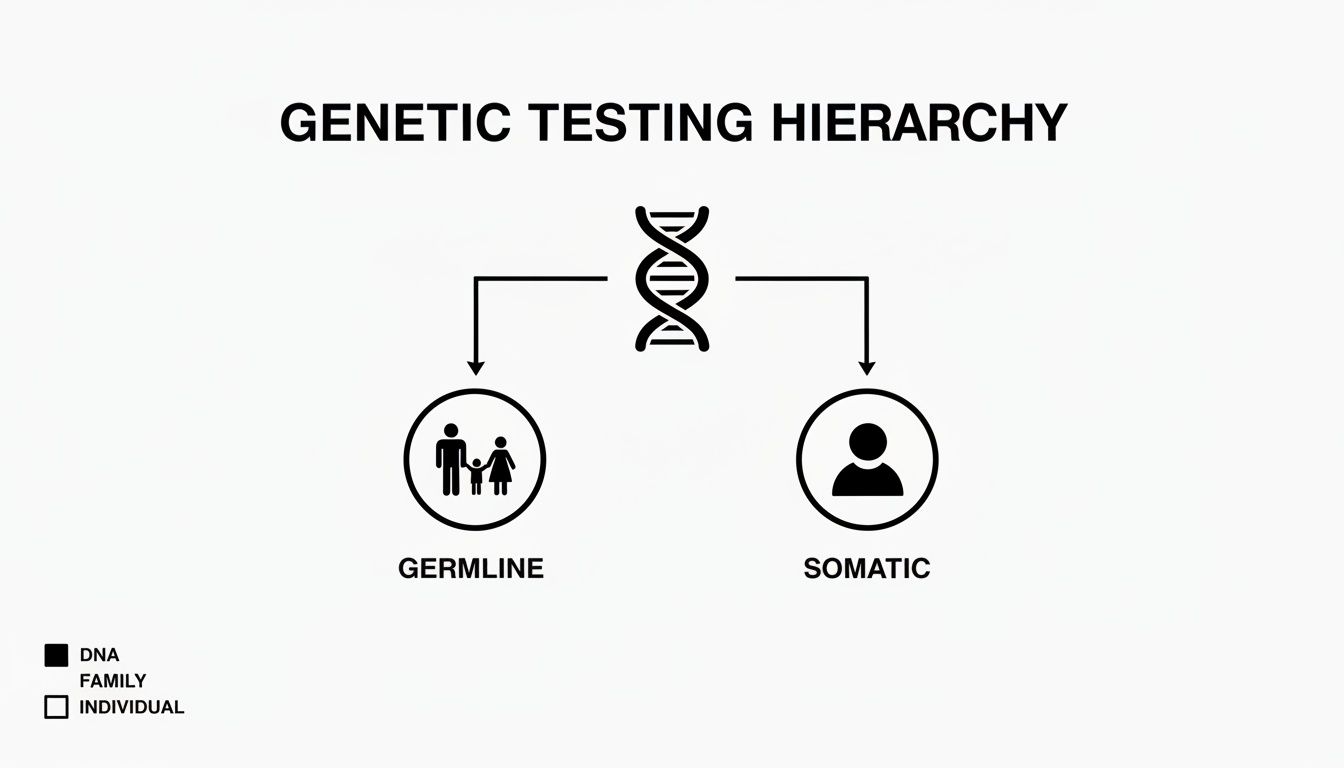
The diagram highlights that a variant's implications depend heavily on whether the test was germline (hereditary) or somatic (tumor-specific), framing how each classification is interpreted.
The rise of direct-to-consumer (DTC) genetic testing has made it easier for people to access their DNA data, often outside of a clinical setting. The DTC market, valued at USD 4.1 billion in 2024, is projected to grow to USD 13 billion by 2034, reflecting a major shift in how we interact with our genetic information. While these tests can be empowering, they also generate many VUS results that can cause anxiety without proper clinical interpretation. You can read more about the growth of the direct-to-consumer genetic testing market on gminsights.com.
How Your Genetic Results Shape Modern Cancer Treatment
Getting your genetic test results back is a pivotal moment. This report isn't just a piece of paper with complex data; it's a personalized roadmap for your cancer care. This is the heart of what we call precision medicine—moving beyond one-size-fits-all treatments to a plan built around the unique biology of your tumor.
The whole process starts by looking for specific genetic changes, which we call biomarkers. These biomarkers act like signposts, pointing us directly toward the therapies most likely to work for you.
Think of it this way: traditional chemotherapy can be like a blunt instrument, affecting both cancerous and healthy cells. Targeted therapy, guided by your genetic profile, is more like a smart bomb that only attacks cells with a specific genetic flag. This targeted approach often leads to better results with fewer difficult side effects.
Your report translates a complex genetic blueprint into real-world, actionable treatment options, giving your oncologist the vital intelligence needed to choose the right drug, for you, at the right time.
Unlocking Targeted Therapies with Your Results
One of the most powerful things genetic testing can do is pinpoint a specific mutation that makes a cancer vulnerable to a particular drug. We often call these "actionable mutations" because they allow us to take immediate, direct action. For many patients, this discovery completely reshapes their treatment journey.
A classic example is finding a mutation in the EGFR gene in someone with non-small cell lung cancer. This is a true game-changer. Patients with this biomarker can be treated with EGFR inhibitors—pills that specifically block the signals telling cancer cells to multiply. These drugs are often far more effective and much easier to tolerate than standard chemotherapy for this specific group.
Similarly, identifying a BRCA1 or BRCA2 mutation—whether it was inherited (germline) or just exists in the tumor (somatic)—opens the door to a powerful class of drugs called PARP inhibitors. These are incredibly effective against cancers with BRCA mutations, which can include certain breast, ovarian, pancreatic, and prostate cancers.
The goal is to match a vulnerability in the cancer's DNA with a drug designed to exploit it. Your genetic test results are the key that unlocks that match, providing opportunities for treatment that might not have been considered otherwise.
Genetic testing has rapidly become central to cancer care. In fact, cancer diagnostics now make up the largest part of the entire genetic testing market. Recent data shows that these tests find actionable mutations in 30-40% of patients with advanced cancer, qualifying them for targeted treatments. The impact can be profound. For instance, EGFR testing in non-small cell lung cancer has helped boost 5-year survival rates for responders from around 20% to over 80%.
Predicting Success with Immunotherapy
Your genetic report can also help predict whether a treatment called immunotherapy might work for you. Immunotherapy is a groundbreaking approach that unleashes your own immune system to fight cancer. Certain genetic biomarkers can tell us if a tumor is more likely to be recognized and attacked by your immune cells once they're activated by these drugs.
Two of the most important biomarkers for this are:
- Tumor Mutational Burden (TMB): This is essentially a count of how many mutations are inside a tumor's cells. A high TMB means the cancer has lots of mutations, which creates unusual proteins that your immune system can more easily spot as "foreign" and dangerous.
- Microsatellite Instability (MSI): This biomarker indicates that a tumor has a faulty DNA repair system. Tumors that are MSI-High (MSI-H) can't fix errors when their DNA copies itself, leading to more mutations that also make them a prime target for immunotherapy.
If your results show a high TMB or an MSI-H status, it’s a strong sign that immunotherapy could be a powerful option for you, often no matter what type of cancer you have.
Opening Doors to Clinical Trials
Finally, your genetic test results can serve as your ticket to the future of cancer medicine: clinical trials. Today, many trials are designed not just for a certain type of cancer, but for patients who have specific genetic biomarkers.
If your tumor has a rare mutation, a clinical trial might be the only way to get access to a new drug being developed to target that exact change. By participating in a trial, you not only gain access to next-generation therapies but also help advance the science that will benefit countless patients in the future. Our team can help you understand the role of genomic testing in developing personalized treatment plans and see if there are any trials that could be a good fit.
The Ripple Effect: What Your Results Mean for Family

When your genetic test results come from a germline test—the kind that looks at the DNA you were born with—they tell a story that goes far beyond just you. This information creates a ripple effect, holding important clues for the health of your parents, siblings, and children. It’s a deeply personal finding that suddenly becomes a shared family health map.
If your report identifies a pathogenic or likely pathogenic variant in a gene like BRCA1 or BRCA2, it means the change is hereditary. You inherited it from a parent, and you could pass it on to your children. In fact, each of your closest relatives—parents, siblings, and children—has a 50% chance of carrying that exact same genetic variant.
This knowledge can feel heavy, but it's also an incredibly powerful tool. It gives your family members the chance to understand their own cancer risks and take proactive steps to manage their health in a way they never could before.
How to Start the Conversation with Family
Broaching this topic with loved ones is a delicate matter. There’s no single "right" way to do it, but approaching the conversation with empathy and clear information can make all the difference. Remember, you aren't just sharing a test result; you're offering an opportunity for them to protect their future health.
Here are a few practical tips to guide you:
- Talk to a Genetic Counselor First. Before you even approach your family, a genetic counselor can be an invaluable resource. They'll help you find the right words, provide simple handouts or letters to share, and prepare you for the questions and emotions that might come up.
- Choose the Right Time and Place. Find a calm, private moment where you won’t be rushed or interrupted. It's probably best to avoid bringing it up during a big holiday celebration or another stressful event. A one-on-one chat is often much more effective than a group announcement.
- Share What You Know, Simply. Explain what a germline variant is and which one was found in your DNA. It’s crucial to emphasize that this is about a shared genetic risk, not blame. Let them know what it could mean for them and that testing is available if they decide to pursue it.
Your role is to share the information; their decision about what to do next is entirely their own. The goal is to empower them with knowledge, allowing them to make informed choices with their own doctors.
Sharing this news can stir up a lot of emotions for everyone. Be patient and give your relatives the time and space they need to process everything. To help with the basics, you might find it useful to read our guide explaining if cancer can be genetic. It can provide helpful context for both you and your family.
Ultimately, sharing your genetic information is a profound act of care. You’re opening a door for your loved ones to access preventive screenings and other measures that could genuinely change the course of their lives.
What to Do After You Get Your Results
Getting your genetic test report back isn't the end of the road—it’s actually where a new, more informed part of your health journey begins. Think of the report as a detailed map. Now, let's talk about how to read it and decide where to go next.
The single most important first step is to sit down with a professional who can walk you through it. A genetic counselor is an expert at translating the dense, scientific language of your report into plain English. They can help you understand what your results really mean for you and your family.
Working With Your Healthcare Team
Your genetic results don't exist in a vacuum. You'll want to share this report with your oncologist, your primary care doctor, and any other specialists on your team. This ensures everyone is on the same page and can make decisions about your care with the full picture in front of them.
Sometimes, especially if you used a direct-to-consumer test, your doctor might recommend confirmatory testing. This just means running a second, clinical-grade test to verify the initial findings before making any major medical decisions. It's an important quality-control step to make sure your treatment plan is built on rock-solid information.
Your genetic report is a critical part of your permanent medical record. Be sure to keep both a digital and a physical copy. We’ll add it to your official file here at Hirschfeld Oncology, but you should also provide it to your other doctors to ensure your care is always coordinated.
Understanding Privacy, Insurance, and Your Rights
It’s completely normal to have questions about who can see your genetic information. The good news is that there are strong federal laws in place to protect you. The most important one is the Genetic Information Nondiscrimination Act (GINA).
GINA makes it illegal for health insurers and most employers to use your genetic data against you. Specifically, health insurance companies cannot:
- Use your results to raise your premiums.
- Deny you coverage or change your eligibility.
- Treat a genetic finding as a pre-existing condition.
It's worth knowing that GINA’s protections don't currently apply to life insurance, disability insurance, or long-term care insurance. These types of insurers may still ask for your genetic information when you apply for a policy. Knowing the specifics helps you make informed choices.
Genetic testing is quickly becoming a standard part of medicine. The market itself was valued at USD 11.71 billion in 2024 and is expected to grow to USD 39.25 billion by 2030. This incredible growth highlights just how vital this information is becoming in healthcare, which is why learning to manage your own results is so important. You can discover more insights about the genetic testing market on straitsresearch.com.
Common Questions About Genetic Test Results
Even after getting a handle on the science, you're bound to have more questions about your genetic test results. That’s completely normal. Let's walk through some of the biggest concerns that come up, so you can feel more confident about what this all means for you.
These are the practical, real-world questions that usually surface once you've had a moment to process everything.
What Should I Do with a VUS Result?
Receiving a Variant of Uncertain Significance (VUS) result can feel confusing. It simply means the lab found a genetic change, but there isn't enough scientific evidence yet to say whether it's harmful or harmless. For now, think of it as an open question.
The most important thing to know is that you should not make major medical decisions—like preventive surgery—based only on a VUS. Your doctor will likely recommend we just keep an eye on things, with no immediate action required. As researchers learn more, labs often update these classifications. In fact, most VUS results are eventually reclassified as benign. Your genetic counselor is your best ally here; they'll be notified if the classification of your VUS ever changes.
Will My Genetic Test Results Affect My Insurance?
This is a huge and very valid worry for many people. Thankfully, in the United States, there's a federal law called the Genetic Information Nondiscrimination Act (GINA) that provides powerful protections.
In simple terms, GINA makes it illegal for most health insurance companies and employers to treat you unfairly because of your genetic information.
This means a health insurer cannot:
- Use a genetic test result to raise your premiums or cancel your policy.
- Consider your genetic makeup when deciding if you're eligible for coverage.
- Count a genetic finding as a pre-existing condition.
It's critical to understand what GINA doesn't cover. The law's protections do not apply to life insurance, disability insurance, or long-term care insurance. These types of insurers can ask about your genetic test results and may use that information to make their decisions.
How Is My Genetic Data Kept Private and Secure?
Your genetic information is protected health information, plain and simple. Clinical labs and healthcare providers like us at Hirschfeld Oncology are legally bound by the strict privacy rules of the Health Insurance Portability and Accountability Act (HIPAA). This ensures your data is handled with the utmost confidentiality.
When it comes to direct-to-consumer (DTC) tests, the picture can be a bit different. Their privacy policies can vary quite a bit, so it's really important to read the fine print. You'll want to understand how your data might be de-identified and used for research or even shared with other companies. You almost always have control over these settings and can opt out, but you have to be proactive. Always be an informed consumer with something as personal as your genetic data.
At Hirschfeld Oncology, we know that understanding your genetic test results is a crucial step in creating a treatment plan that’s truly right for you. If you have questions about your report or want to explore your care options, our team is here to help. You can request a consultation with us by visiting our blog and resource center.
.png)
.png)