.png)


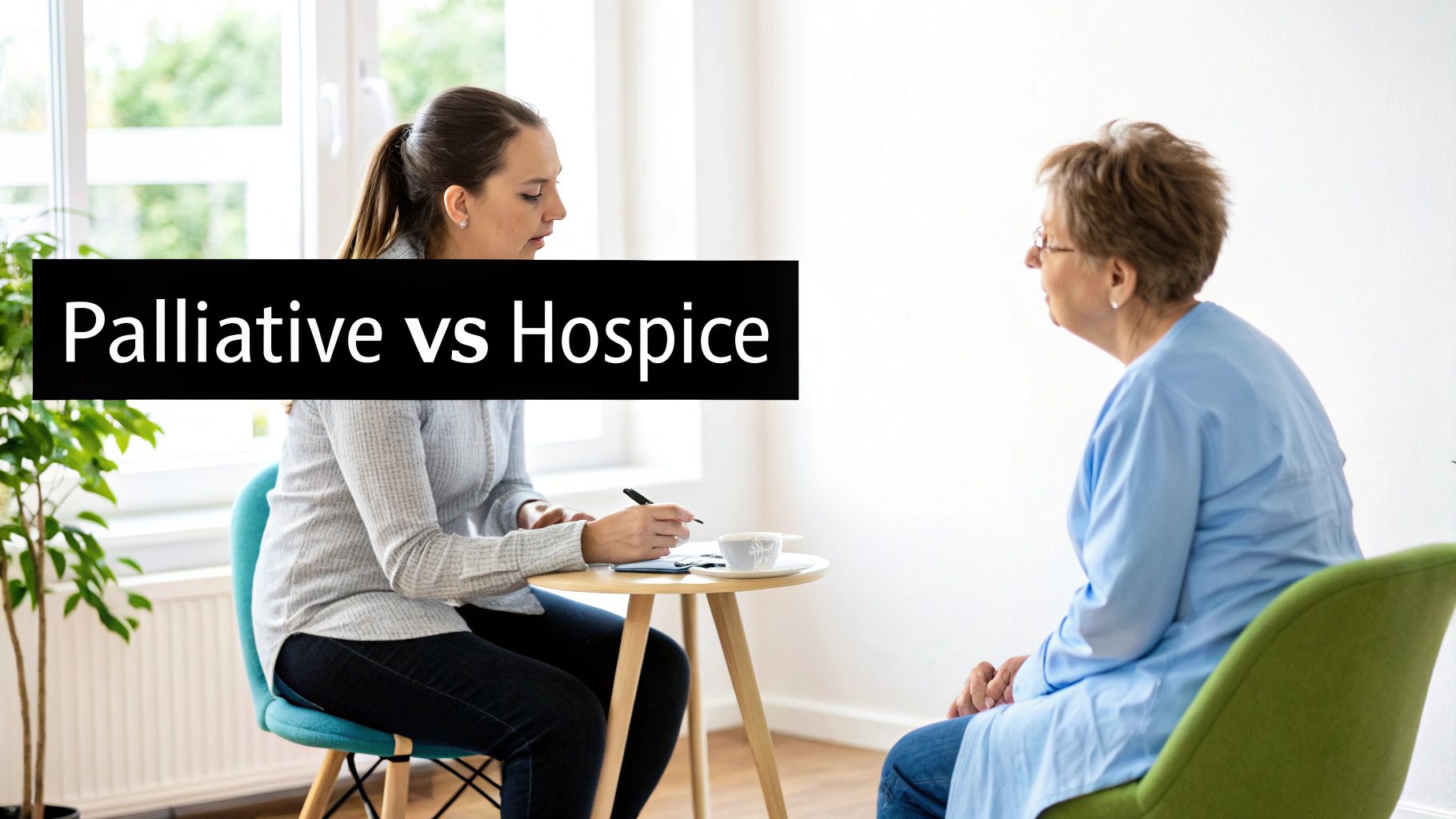
When people hear the terms palliative care and hospice care, they often think they’re the same thing. It’s a common and understandable mix-up, but the distinction between them is crucial for patients and their families. The real difference comes down to timing and the goals of your medical care.
Think of palliative care as an extra layer of support that can start the moment you’re diagnosed with a serious illness. The goal here isn't to replace your cancer treatment—it's to work right alongside it, helping you manage symptoms, pain, and the emotional stress that comes with a diagnosis.
Hospice care, on the other hand, is a specific type of care that begins when curative treatments are no longer an option or are no longer desired. It's for patients with a terminal diagnosis, focusing entirely on comfort, dignity, and quality of life.
Understanding the Fundamental Difference
Facing a serious illness means making tough, deeply personal decisions. Getting a clear handle on your care options is the first real step toward regaining a sense of control over your life and your treatment journey.
The biggest myth we need to bust is that palliative care is just for the end of life. That’s simply not true. It’s a specialized medical approach that helps anyone with a serious illness, regardless of their prognosis. You can receive palliative care while actively undergoing chemotherapy, radiation, or other treatments intended to cure your cancer.
Hospice care is actually a specific type of palliative care, reserved for a time when the focus shifts from curing the illness to maximizing comfort. It’s a compassionate choice for people with a life expectancy of six months or less, helping ensure their final chapter is lived with peace and dignity.
Palliative Care vs Hospice Care At a Glance
The need for this kind of supportive care is growing. In fact, the global palliative care market is expected to reach an incredible USD 363.36 billion by 2034. This surge is happening because of our aging population and a rise in chronic illnesses that require long-term management. You can learn more about these palliative care market trends to see how the landscape of patient support is changing.
To make things perfectly clear, here’s a straightforward table that breaks down the essential differences between the two.
Looking at them side-by-side, it's easier to see how they fit into different stages of a patient's journey. One is about supporting you through treatment, and the other is about ensuring comfort when treatment ends.
A Closer Look at Palliative Care: Focusing on Quality of Life During Treatment

While many people associate palliative care with the end of life, its role is actually much broader and begins much earlier. Think of it as a specialized layer of support focused squarely on providing relief from the symptoms and stress of a serious illness. The ultimate goal is simple but profound: to improve quality of life for both the patient and their family.
One of the biggest misconceptions is that you have to be at a certain stage of illness to receive it. The truth is, palliative care is appropriate at any age and at any stage of a serious illness. It's designed to work right alongside curative treatments, not replace them.
So, What Does Palliative Care Actually Involve?
Palliative care is delivered by an interdisciplinary team—a group of specialists who work together to address your physical, emotional, and even spiritual needs. This team partners with you, your family, and your oncologist to create a holistic care plan that makes sense for your life.
The support is customized to you, but it generally includes:
- Expert Symptom Management: Specialists tackle the tough side effects that can come from cancer or its treatments, like persistent pain, nausea, fatigue, or shortness of breath.
- Emotional and Psychological Support: A cancer diagnosis carries a heavy emotional burden. The team’s counselors and social workers are there to help you and your family navigate the anxiety, depression, and stress that often accompany the journey.
- Spiritual Guidance: A serious illness can bring up big questions. Chaplains and spiritual advisors offer support that aligns with your personal beliefs, whatever they may be.
- Care Coordination: These teams are experts at navigating the healthcare system. They help ensure all your doctors are on the same page and that you fully understand your treatment options.
Palliative care isn’t about giving up; it’s about adding strength. It’s an extra layer of support to make the journey through treatment as comfortable and manageable as possible, empowering you to live more fully.
Palliative Care and Active Cancer Treatment in Action
Let’s put this into a real-world context. Imagine a patient in Brooklyn who is undergoing chemotherapy for advanced-stage colorectal cancer. The treatment is effective, but the side effects—intense nausea and debilitating fatigue—are making it almost impossible to continue.
This is the perfect moment for a palliative care team to step in. They would work directly with the oncologist at Hirschfeld Oncology to find more effective anti-nausea medications and create a plan to manage the fatigue. At the same time, a counselor could help the patient cope with the emotional strain of it all. By getting these side effects under control, the patient is better able to tolerate chemo, complete their treatment, and maintain a better quality of life. As you can imagine, improving your quality of life during cancer therapy is a mission we share with our palliative care colleagues.
The demand for this kind of support is surging. By 2025, the number of specialized palliative care teams worldwide was projected to hit 33,700, a 32.7% jump from 2017. Yet even with that growth, these teams are estimated to serve only about 14% of the people who need them, highlighting a significant gap. For anyone interested in the data, you can read more about global palliative care service growth.
This integrated approach means you never have to choose between fighting your cancer and feeling well. It’s a partnership that prioritizes the whole person, not just the illness, right from the very beginning.
Defining Hospice Care: A Compassionate Approach to End of Life

While palliative care adds a layer of support at any point during a serious illness, hospice is a specific philosophy of care reserved for life's final chapter. It's a deeply compassionate, person-first approach that comes into play when curative treatments are no longer the goal and a doctor has certified a life expectancy of six months or less.
The central mission of hospice isn't to speed up or delay death. Instead, it’s about making sure a person's last months are lived with as much comfort, dignity, and peace as possible. This marks a fundamental shift in focus—away from treating the disease and toward caring for the whole person, addressing their physical, emotional, and spiritual needs.
Hospice care is most often provided right where the patient calls home, whether that's a private house, a nursing facility, or an assisted living community. The idea is to keep people in a familiar, comforting environment, surrounded by those they love.
The Holistic Nature of Hospice Services
Hospice care is delivered by an entire interdisciplinary team that wraps a comprehensive net of support around both the patient and their family. Unlike most medical services that target a specific problem, the hospice benefit is typically all-inclusive, covering everything related to the terminal diagnosis.
This support network usually includes:
- Nursing Care: Registered nurses make regular visits to manage pain and other symptoms, like shortness of breath or anxiety, to ensure the patient is always comfortable.
- Medical Equipment and Supplies: All the necessary items—from hospital beds and oxygen equipment to wound care supplies—are provided and delivered right to the home.
- Medications: Prescriptions for pain relief and symptom management tied to the hospice diagnosis are fully covered.
- Therapies: Physical, occupational, and speech therapists can help with mobility and safety, while music or art therapists can provide powerful emotional comfort.
- Social Work and Counseling: Social workers help families navigate the practical and financial hurdles, while counselors are there to offer emotional and spiritual support.
Hospice care is a profound affirmation of life. It acknowledges that even when a cure is not possible, care is always possible. The focus shifts to ensuring every day is lived with meaning and comfort, honoring the patient's final wishes.
Extending Support to the Entire Family
A unique and absolutely vital part of hospice is its unwavering commitment to the family unit. The hospice philosophy understands that a terminal illness sends ripples through the lives of everyone involved. Caregivers face immense physical and emotional strain, and hospice provides direct support to ease that burden.
This family-focused care involves several key elements. First, hospice aides can assist with personal care like bathing and dressing, giving family members a much-needed break from the daily caregiving grind. Second, respite care is available, allowing a patient to stay in a facility for up to five days to give their primary caregiver a real chance to rest and recharge.
Crucially, the support doesn't stop when the patient passes away. Bereavement counseling and support groups are offered to the family for up to a year, helping them navigate the complex journey of grief. This complete circle of care highlights the deep connection between a patient’s well-being and their family’s support system. In fact, providing guidance is a critical part of the process, and you can explore more about supporting families and caregivers of cancer patients in our related articles.
The growing acceptance of this model is clear. Hospice utilization has climbed steadily, with 51.7% of Medicare decedents receiving hospice services in 2023. This rise reflects a growing demand for dignified end-of-life care, with Medicare hospice payments reaching approximately $25.7 billion that year. You can find out more about the latest hospice care trends and what they mean for families.
Comparing Palliative and Hospice Care Side by Side
Let’s get practical and break down the real-world differences between palliative care and hospice care. While they both spring from the same well of compassion—a deep commitment to comfort and dignity—they are designed for very different stages of a serious illness.
Think of it this way: they aren't competing options, but two distinct types of support that apply at different times. We'll look at who qualifies for each, the philosophy driving the care, and how insurance and Medicare handle them.
Eligibility and Timing
The biggest differentiator is timing. When can you start?
Palliative care can begin the moment you’re diagnosed with a serious illness. There's no need to wait, and it doesn’t depend on your prognosis. It’s an extra layer of support that works right alongside your main cancer treatments.
For example, a patient just starting chemotherapy for pancreatic cancer can immediately bring a palliative care team on board. Their job is to tackle treatment side effects like pain or nausea from day one, helping the patient stay strong enough to continue with their life-extending therapies.
Hospice care, on the other hand, is for a very specific point in time. It’s for someone with a terminal illness when a doctor has determined their life expectancy is six months or less. The other crucial piece is that the patient has decided to stop treatments meant to cure their illness.
The core difference is timing and intent. Palliative care is about living as well as possible during treatment. Hospice care is about living as well as possible when treatment is no longer the goal.
Goals of Care
This difference in timing naturally leads to different goals. The whole philosophy shifts.
The primary mission of a palliative care team is to improve your quality of life while you’re actively pursuing a cure or trying to control your disease. They work hand-in-glove with your oncologist to manage symptoms that could otherwise derail your treatment plan.
Hospice care shifts its focus completely to comfort. Once you’re in hospice, the goal isn't to fight the illness anymore. It's about making sure your final months are as peaceful, meaningful, and comfortable as they can be. This is what many people call "comfort care," where every decision is guided by one question: will this improve the patient's quality of life?
So, while a palliative specialist helps you manage pain to get through another round of chemo, a hospice nurse manages that same pain to help you enjoy a quiet afternoon at home with your grandkids.
In-Depth Feature Comparison Palliative vs Hospice
To make these distinctions crystal clear, here’s a table that lays out the key features of palliative and hospice care, showing exactly where they differ in practice.
This side-by-side view helps highlight how each service is structured to meet very different patient needs at different points in their journey.
Payment and Insurance Coverage
Let's face it, how you pay for care is a huge part of the equation. Fortunately, the systems for palliative and hospice care are pretty straightforward.
Palliative care is generally treated like any other medical specialty. It’s billed as a specialist consultation, similar to seeing a heart or lung doctor. Most insurance plans, including Medicare Part B and Medicaid, cover these services. You’ll likely still have the usual co-pays or deductibles you’d have for any other doctor’s visit.
Hospice care is handled very differently, thanks to the Medicare Hospice Benefit. This is a unique, all-inclusive benefit designed to cover almost everything related to the terminal illness once a patient chooses to enroll.
The Medicare Hospice Benefit typically covers:
- Visits from the entire hospice team (nurses, social workers, spiritual counselors, aides).
- All medications needed for pain and symptom relief.
- Medical equipment and supplies, like a hospital bed for the home, oxygen, or walkers.
- Short-term respite care to give family caregivers a much-needed break.
- Bereavement counseling and support for the family after their loved one has passed.
This comprehensive approach is meant to lift the financial weight off families during an incredibly stressful time, ensuring that cost doesn't get in the way of comfort. The different payment models really underscore the different roles each type of care is meant to play.
When to Choose Each Type of Care
Navigating care options during a serious illness can be incredibly stressful. Deciding between palliative and hospice care often feels like a monumental choice, but understanding when each is most appropriate can bring a sense of clarity and control. This isn’t about giving up or fighting harder; it’s about aligning the right support with your personal goals at every stage of your journey.
To make this feel less abstract, let's walk through a few real-world scenarios. These examples are here to illustrate the key decision points and help you feel more prepared for conversations with your healthcare team.
A simple way to think about it is this: are you still pursuing treatment meant to cure or control your illness? If so, palliative care is your partner. If the focus has shifted to comfort and quality of life above all else, hospice is the compassionate choice.

This flowchart really boils it down to the most critical factor: whether curative treatment is still part of your care plan.
When Palliative Care Is the Right Choice
Palliative care is the answer when you’re undergoing treatment to cure or manage your illness but need help dealing with the physical and emotional challenges that come with it. Think of it as an extra layer of support designed to strengthen you throughout your treatment.
Scenario A: A Patient Starting Chemotherapy
Let’s imagine a 58-year-old from Williamsburg who was just diagnosed with Stage 3 breast cancer. She's about to start an aggressive chemotherapy regimen. While she feels hopeful about the treatment, she’s also deeply worried about potential side effects like nausea, fatigue, and nerve pain.
For her, palliative care is the ideal choice. It can begin right away, alongside her very first infusion.
- A palliative specialist would coordinate with her oncologist to get ahead of the nausea with advanced medications.
- They’d help her develop a personalized plan for managing her energy, so she can stay as active as possible without feeling completely wiped out.
- The team's counselor could also provide her with strategies for coping with the anxiety that so often accompanies a new diagnosis.
With this support system in place, she can tolerate her chemotherapy better, stay on schedule, and protect her quality of life. Palliative care helps her live as well as possible while she fights her cancer.
When to Consider a Transition to Hospice Care
The conversation naturally shifts toward hospice when the goals of care move from curing the disease to maximizing comfort. This is almost never a sudden event but a thoughtful decision made gradually with family and medical providers.
Scenario B: When Treatment Burdens Outweigh the Benefits
Now, consider a 72-year-old with metastatic pancreatic cancer who has been through several rounds of chemotherapy. His latest scans show the cancer is still progressing, and the treatment's side effects have become debilitating, leaving him too weak to enjoy his family.
After many heartfelt discussions with his oncologist at Hirschfeld Oncology, he decides the burden of more treatment is greater than any potential benefit. His priority now is to be comfortable and spend meaningful time with his loved ones at home.
This is the exact moment when a transition to hospice care makes sense.
Choosing hospice is not about giving up. It is an active choice to prioritize quality of life, focusing on dignity, comfort, and peace for the time that remains. It empowers the patient to define what a good day looks like.
Once he's enrolled in hospice, his care is completely reoriented. A nurse would visit his Brooklyn home regularly to manage his pain, his medications would be delivered right to his door, and a hospital bed would be set up to keep him comfortable. Most importantly, he would be in his own familiar space, surrounded by the people who matter most.
Questions to Ask Your Doctor
To help you navigate these conversations, here are a few specific questions you can bring to your next appointment. Getting clear answers will help you choose the path that feels right for you.
- What are the main goals of my current treatment? Is it intended to cure my cancer or control its growth?
- Realistically, how will this treatment affect my daily life and my ability to do things I enjoy?
- What kind of support is available right now to help me manage symptoms like pain, fatigue, or anxiety?
- If the burdens of my treatment start to feel like too much, what are my options then?
- At what point should we start talking about focusing entirely on my comfort?
Asking these questions opens the door to a partnership with your doctor, ensuring your care plan always reflects what’s most important to you.
How Hirschfeld Oncology Puts Patient-Centered Support into Practice
It's one thing to understand the difference between palliative care and hospice, but it's another to see how your oncology team actually brings those concepts to life. At Hirschfeld Oncology, patient support isn't an add-on service; it’s baked into our DNA. From your very first appointment, our entire approach to cancer treatment is grounded in the core principles of palliative medicine.
This means we’re always thinking about your quality of life. We proactively manage symptoms right alongside your cancer treatment, and we make a point of having honest conversations about your goals, your fears, and what living well truly means to you. We believe your physical comfort and emotional well-being should always be at the heart of your care.
A Partnership Through Every Step
We see our role as empowering you with the information and support you need, no matter what lies ahead. We build palliative principles directly into our care by:
- Aggressively Managing Symptoms: We work tirelessly to get ahead of treatment side effects like pain, nausea, and fatigue. Our goal is to help you feel strong enough to continue with your therapy and daily life.
- Encouraging Honest Conversations: We create a safe space for you to talk about your hopes and concerns without judgment. We want to make sure your voice is not just heard, but is the most important one in the room.
- Caring for the Whole Person: You are so much more than a medical chart. We're here to help you and your family navigate the emotional and psychological weight of a cancer diagnosis.
This patient-first mindset is the foundation for every treatment strategy we develop. You can see how we build supportive and personalized cancer care plans that truly reflect your individual needs. We've always believed that the most effective cancer care is a true partnership.
Guiding a Compassionate Transition to Hospice
When the focus of care shifts from curative treatment to comfort, our role changes, but our dedication to you never wavers. Deciding to begin hospice is an incredibly personal choice, and our team is here to offer guidance and ensure that transition is as smooth and dignified as possible.
At Hirschfeld Oncology, we see it as our responsibility to honor a patient’s wishes at every stage. Facilitating a smooth transition to hospice care is not an end to our support but a continuation of our promise to provide compassionate, patient-centered guidance.
We work hand-in-hand with trusted local hospice providers right here in Brooklyn and the surrounding communities. Our team personally handles the referrals, transfers all the necessary medical information, and makes sure the hospice team understands your unique history and what matters most to you. This coordination lifts the logistical burden from your family, letting you focus entirely on comfort and spending quality time with the people you love. Our support continues, ensuring you feel cared for and respected every step of the way.
Common Questions About Palliative and Hospice Care
Even when the definitions seem clear, you probably still have some real-world questions about how all this works. Let’s tackle some of the most common things patients and their families ask.
Can I Get Palliative Care at Home?
Yes, you absolutely can. While many people first encounter palliative care in a hospital or clinic setting like ours, home-based programs are becoming much more common.
Think of it as bringing the support team to you. Nurses, social workers, and other specialists can visit you right where you live, helping you manage symptoms without the stress and fatigue of constant trips to the doctor.
If I Start Palliative Care, Does That Mean I’m Giving Up?
Absolutely not. In fact, it’s the exact opposite. This is probably the biggest myth we have to bust.
Starting palliative care is a powerful way to take control and strengthen your ability to fight your cancer. The whole point is to manage the tough symptoms and side effects, which helps you tolerate treatments like chemotherapy better. It’s about improving your quality of life while you’re on your cancer journey.
A key takeaway is that palliative care is provided alongside curative treatment, not instead of it. It’s an extra layer of support designed to help you live as well as possible while fighting your illness.
What if I Get Better on Hospice? Can I Stop?
Yes. Hospice isn't a one-way street, and you're never locked in. Patients can stop hospice care at any time if their situation changes.
If you have an unexpected improvement, or if you decide you want to try a new treatment that becomes available, you can simply revoke the hospice benefit. You can always go back to pursuing curative care. The choice is always yours.
This flexibility is crucial because it ensures your care plan always matches your current medical reality and personal goals.
At Hirschfeld Oncology, our commitment is to walk with you through every part of your cancer journey, offering both clarity and compassion. We can help you navigate all your support options, whether that means weaving palliative principles into your treatment plan or connecting you with trusted local hospice providers. To talk about your specific needs, please request a consultation with our team.
.png)
.png)