.png)


Setting the Stage for Immunotherapy in Pancreatic Cancer
Pancreatic ductal adenocarcinoma (PDAC) accounts for >90% of pancreatic cancers and carries a dismal prognosis: 5‑year overall survival is only 5–13% in the United States, with a median overall survival of less than 12 months for metastatic disease. Standard first‑line therapy for advanced PDAC relies on combination chemotherapy, most commonly gemcitabine + nab‑paclitaxel or the FOLFIRINOX regimen, which extend survival but are not curative. Because the disease is usually diagnosed at an advanced stage, surgical resection is possible in only ~20% of patients. The tumor microenvironment is “cold,” and infiltrated by suppressive myeloid cells, limiting single‑agent checkpoint blockade. Consequently, there is an urgent need to develop immunotherapeutic strategies that can overcome these barriers, generate tumor‑specific immunity, and improve outcomes over chemotherapy alone.
A Comprehensive Review of Pancreatic Cancer Immunotherapy

Pancreatic cancer immunotherapy review
PDAC is highly resistant to immunotherapy due to an immunosuppressive microenvironment rich in myeloid cells, dense stroma, low mutational burden, and sparse CD8⁺ T‑cells.
Single‑agent checkpoint blockade (anti‑PD‑1/PD‑L1 or anti‑CTLA‑4) has not improved survival in phase II trials, even with chemotherapy.
Pancreatic cancer and immunotherapy: a clinical overview
Combination approaches aim to remodel the niche: chemotherapy‑induced immunogenic death, CD40 agonists, stromal‑depleting agents (FAK inhibitors, hyaluronidase), and microbiome modulation improve antigen presentation and T‑cell trafficking.
These regimens also aim to reduce regulatory T‑cell suppression.
Early‑phase adoptive cell therapies (CAR‑T, CAR‑NK, TCR‑engineered) and personalized vaccines show promise when paired with checkpoint inhibitors.
Barriers and opportunities in pancreatic cancer immunotherapy
Barriers include low MSI‑H/dMMR (<3 %), abundant MDSCs, M2 macrophages, and KRAS‑driven immune evasion.
Opportunities lie in targeting these pathways—CSF‑1R, CXCR2, CD73 inhibition—and in biomarker‑driven patient selection.
Biomarkers such as PD‑L1 expression and T‑cell infiltrates guide enrollment.
Role of immunotherapy in pancreatic cancer
Only MSI‑H/dMMR or high‑TMB patients receive FDA‑approved PD‑1 inhibitors (pembrolizumab, dostarlimab).
Ongoing trials test combos with chemotherapy, radiation, oncolytic viruses, and novel checkpoints to turn “cold” tumors into responsive ones, hoping to raise the <10 % 5‑year survival.
The Tumor Microenvironment: Challenges and Opportunities

The pancreatic tumour microenvironment (TME) is dominated by a dense desmoplastic stroma that physically blocks drug delivery and excludes CD8⁺ T cells. This fibrotic barrier, rich in hyaluronic acid and collagen, limits the efficacy of both chemotherapy and immune checkpoint blockade. Within the TME, immunosuppressive myeloid cells—MDSCs, M2‑like TAMs, and N2 neutrophils—are recruited by KRAS‑driven CXCL1/GM‑CSF signaling, while cancer‑associated fibroblasts (CAFs) display heterogeneous subpopulations that either promote tumor growth or restrain it. Recent single‑cell spatial multi‑omics and AI‑driven analyses have mapped these fibroblast niches and immune micro‑domains, revealing distinct cytokine and metabolic cross‑talk pathways. Remodeling strategies—such as CD40 agonists to re‑program dendritic cells, CXCR4 or FAP inhibition to deplete tumour‑promoting CAFs, and microbiome modulation—are entering early‑phase trials. By integrating TME‑focused remodeling with KRAS inhibition and standard chemotherapy, clinicians can convert current clinical challenges into actionable therapeutic opportunities.
Recent Clinical Advances and FDA Approvals (2024‑2026)
Pancreatic cancer new treatment 2026
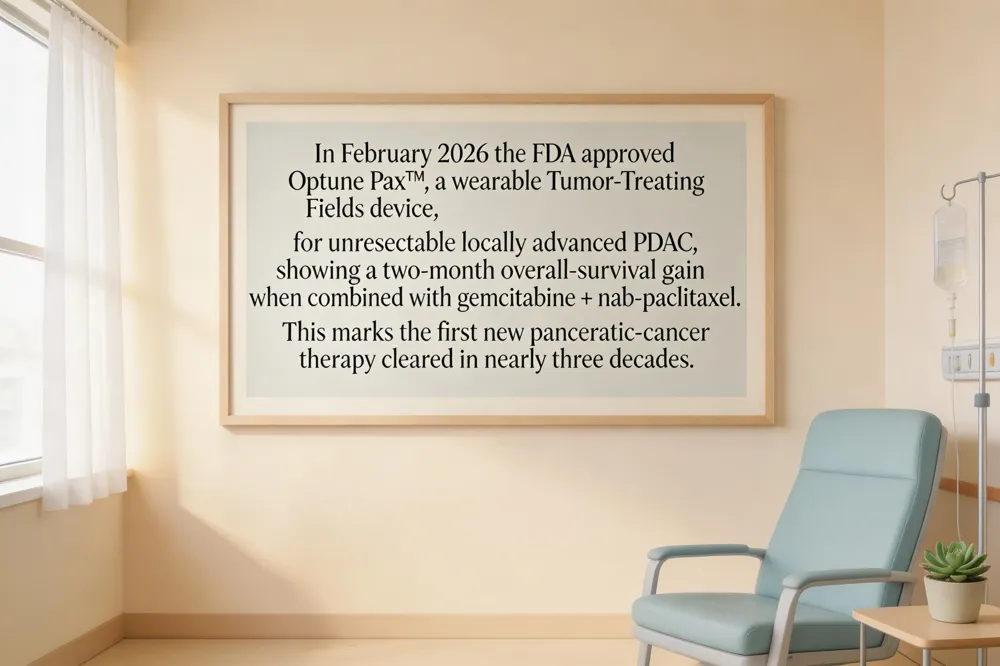
In February 2026 the FDA approved Optune Pax™, a wearable device delivering Tumor‑Treating Fields (TTFields) for unresectable, locally advanced pancreatic adenocarcinoma. Used with gemcitabine + nab‑paclitaxel, Phase III data showed a two‑month overall‑survival gain without added systemic toxicity, offering a patient‑friendly, non‑invasive option.
New drug for pancreatic cancer approved by FDA
Optune Pax™ is the first new pancreatic‑cancer therapy cleared in nearly three decades. The portable system can be worn during daily activities, providing continuous TTFields that delay pain progression and improve survival when combined with standard chemotherapy.
New treatments for pancreatic cancer stage 4
Advanced stage IV options now include Optune Pax™ plus chemotherapy, emerging KRAS‑targeted inhibitors entering late‑stage trials, and next‑generation vaccine platforms aimed at priming tumor‑specific T‑cell responses. These strategies seek to overcome the dense stromal barrier and immunosuppression.
What is the latest treatment for pancreatic cancer
The latest FDA‑approved therapy is Optune Pax™ TTFields device combined with gemcitabine + nab‑paclitaxel, marking a breakthrough in first‑line care. Ongoing research on KRAS inhibitors, multimodal combos, and personalized vaccines promises further expansion of the therapeutic arsenal.
FDA‑Approved Immunotherapy Landscape

Pancreatic ductal adenocarcinoma has no FDA‑approved immunotherapy that is tumor‑specific. The only FDA‑cleared device for this disease is Optune Pax, a tumor‑treating electrical‑field system used with chemotherapy; it works by disrupting mitosis rather than activating immunity. Consequently, standard care relies on surgery, chemotherapy (gemcitabine + nab‑paclitaxel or FOLFIRINOX), radiation, and emerging non‑immunologic agents. A very small subset of patients—approximately 1‑3 %—benefit from checkpoint‑inhibitor therapy because their tumors are microsatellite‑instability‑high, mismatch‑repair‑deficient, or have high tumor‑mutational burden. For those cases, pembrolizumab (Keytruda®) and dostarlimab (Jemperli®) are FDA‑approved. The majority of pancreatic cancer patients must enroll in clinical trials where immunotherapy is combined with chemotherapy, stromal‑modulating drugs, vaccines, or cell‑based approaches. Therefore, while immunotherapy exists for pancreatic cancer, it is limited to biomarker‑selected individuals, and no dedicated immunologic therapy has received FDA approval for the broader patient population.
Emerging Immunotherapeutic Modalities and Cell Therapies

Current and future immunotherapeutic approaches in pancreatic cancer treatment Pancreatic ductal adenocarcinoma (PDAC) is dominated by a dense, immunosuppressive stroma that blocks T‑cell entry. At present, FDA‑approved options are limited to PD‑1/PD‑L1 checkpoint inhibitors for the <3 % of MSI‑H/dMMR tumors, usually combined with gemcitabine‑based chemotherapy. Experimental strategies include oncolytic viruses (e.g., reovirus, VCN‑01) that lyse tumor cells and release neoantigens, and cancer vaccines (GVAX, KRAS‑peptide, personalized mRNA) designed to prime tumor‑specific T‑cell responses. Emerging bispecific antibodies (PD‑L1 + mesothelin) and STING agonists aim to convert the "cold" TME into an inflamed one, while myeloid‑targeted agents (CSF‑1R, CXCR2 inhibitors) are being paired with checkpoint blockade to dismantle suppressive myeloid populations.
New immunotherapy for pancreatic cancer UCLA has engineered an off‑the‑shelf CAR‑NKT cell that targets mesothelin, leveraging invariant NK‑T cells for rapid, mass‑produced therapy at ~ $5,000 per dose](https://newsroom.ucla.edu/releases/immunotherapy-car-nkt-pancreatic-cancer-ucla). Pre‑clinical models show robust infiltration of primary and metastatic lesions with minimal exhaustion. Parallel early‑phase trials of TCR‑engineered T cells against KRAS G12D or multiple tumor‑associated antigens report disease‑control rates up to 85 % when sequenced after chemotherapy, suggesting synergy between conventional cytotoxic agents and adaptive cell therapies.
CAR‑NKT pancreatic cancer CAR‑NKT cells combine a mesothelin‑directed CAR with innate NK‑receptor activity, allowing dual killing mechanisms that penetrate the desmoplastic stroma. Derived from donor blood stem cells, they are cryopreserved, ready‑to‑use, and avoid graft‑versus‑host disease. In mouse models they eradicate orthotopic tumors and liver/lung metastases, extending survival without severe cytokine‑release syndrome. With pre‑clinical validation complete, an IND submission is imminent, paving the way for first‑in‑human trials.
Clinical Trial Landscape and Biomarker‑Driven Strategies

Pancreatic cancer immunotherapy clinical trials Phase III PRISM‑1 evaluates the CD73 inhibitor quemliclustat with gemcitabine/nab‑paclitaxel, building on Phase II data that cut death risk by 37 % and added 5.9 months OS. The PRINCE trial combines chemotherapy, an agonistic CD40 agonist, and anti‑PD‑1, achieving an 83 % disease‑control rate in early‑phase studies. Other active studies include GVAX + ipilimumab, KRAS‑directed vaccines, and off‑the‑shelf mesothelin CAR‑NKT cells, all testing multimodal approaches to overcome PDAC’s immunosuppressive microenvironment.
Pancreatic cancer and immunotherapy: a clinical overview PDAC’s 5‑year survival is <10 % and most patients present with advanced disease. Single‑agent checkpoint blockade yields <5 % response rates because of dense desmoplastic stroma, low TMB, and abundant myeloid‑derived suppressor cells. Current investigational strategies pair checkpoint inhibitors with chemotherapy, radiation, CD40 agonists, stromal modulators, oncolytic viruses, adoptive cell therapies (CAR‑T, CAR‑NKT), and personalized neoantigen vaccines to prime and sustain anti‑tumor immunity.
Biomarker testing and patient enrollment importance Only ~1–3 % of PDAC tumors are MSI‑H/dMMR or TMB‑high, qualifying for FDA‑approved pembrolizumab or dostarlimab. Broader biomarker panels now assess KRAS mutation subtypes, stromal signatures (FAK, CXCR4), and immune infiltrates to stratify patients for combination trials. Enrolling in clinical studies is critical: it provides access to cutting‑edge therapies, generates data to refine biomarker‑driven selection, and offers the best chance for therapeutic benefit in this historically resistant disease.
Biomarkers, Success Rates, and Patient‑Centric Outcomes

Immunotherapy for pancreatic ductal adenocarcinoma (PDAC) remains modest. In unselected patients single‑agent checkpoint inhibitors achieve objective response rates < 5 %, while only ≈1 % of tumors are MSI‑H or dMMR and can experience durable responses to pembrolizumab or dostarlimab. A recent multi‑institutional case series of 14 exceptional responders—most not MSI‑high—showed 82 % partial tumor shrinkage and 1‑year/2‑year survival of 80 %/70 %, illustrating a biologically distinct subset that benefits. The top ten U.S. pancreatic cancer centers (Moffitt, Cleveland Clinic, Stanford, William P. Clements Jr., University Hospital Michigan, City of Hope, Baptist Hospital, Fred Hutchinson, IU Health Methodist, University of Cincinnati) provide high‑volume surgery, multidisciplinary care, and robust trial access, which correlates with improved outcomes. The most successful overall treatment remains curative surgery combined with neoadjuvant or adjuvant chemotherapy; for metastatic disease, systemic chemotherapy (FOLFIRINOX or gemcitabine + nab‑paclitaxel](https://www.mdanderson.org/cancer-types/pancreatic-cancer/pancreatic-cancer-treatment.html)) plus biomarker‑driven targeted or immunotherapy offers the best chance of life extension. Enrollment in clinical trials is essential to access emerging combination regimens and to identify predictive biomarkers that may broaden immunotherapy benefit.
Human Touch, Advocacy, and Future Outlook

Pancreatic cancer carries a heavy psychosocial burden; patients are at heightened risk of depression and anxiety, and in some cases depression may even precede diagnosis, suggesting a biological link. Advocacy has co‑opted the purple ribbon—chosen by Rose Schinder to symbolize courage, honor, and compassion—to create a visual cue that sparks conversation, early detection, and fundraising. Wearing purple unites personal stories into a collective beacon of hope.
At Hirschfeld Oncology, care is personalized and multidisciplinary. High‑volume surgeons perform optimal resections, while medical oncologists integrate neoadjuvant FOLFIRINOX, targeted agents, and emerging immunotherapies such as KRAS‑specific vaccines or CD40 agonists. Support services address mental health, offering counseling and support groups to mitigate the emotional toll.
Together, patient emotional support, community advocacy, and coordinated specialist care form a comprehensive strategy aimed at improving outcomes and quality of life for those facing this aggressive disease.
Looking Forward: Hope Through Innovation and Compassion
The future of pancreatic‑cancer care hinges on integrating emerging immunotherapies—personalized cancer vaccines, CD40‑agonist‑chemo combos, and off‑the‑shelf CAR‑NKT cells—into standard regimens that also remodel the dense stromal barrier. Because these strategies are still experimental, enrolling in clinical trials is essential; trial participation not only grants patients access to cutting‑edge treatments but also accelerates the collective understanding of which biomarker‑driven approaches work best. Hirschfeld Oncology embodies this mission by offering a multidisciplinary team that seamlessly weaves surgery, chemotherapy, and the latest immunotherapy trials into a compassionate, patient‑centered pathway, ensuring every eligible patient can benefit from the most promising advances while receiving expert supportive care.
.png)
.png)