.png)


Why Design Matters in Cancer Care
A growing body of evidence shows that the physical environment of oncology wards directly influences patient outcomes. Natural light, biophilic elements, and low‑noise acoustics lower cortisol and improve sleep, which in turn enhances immune function and reduces inflammation—key mediators of cancer recovery. When patients can control lighting, temperature, and sound, they experience greater autonomy, less anxiety, and better pain control. Evidence‑based, patient‑centered design therefore emphasizes private single‑occupancy rooms, adaptable spaces for social connection, soothing sensory cues, and invisible infection‑control measures. These principles create a therapeutic backdrop that mitigates stress, supports healing, and improves satisfaction.
Design Foundations: The 3 C’s of Cancer‑Care Architecture

What are the 3 C’s of architecture relevant to cancer care facilities? The three C’s of architecture applied to cancer‑care facilities are Connection, Cohesion, and Changeability. Connection refers to designing spaces that seamlessly link patients, families, clinicians, and support services, promoting easy navigation and collaborative care. Cohesion ensures that clinical, administrative, and therapeutic areas function as a unified whole with consistent aesthetic, workflow, and technology standards. Changeability means creating flexible, modular environments that can be reconfigured quickly to accommodate new treatment technologies, evolving protocols, or expanded services.
Connection is achieved through private family zones, sleeper sofas, and shared lounges that foster social support while maintaining personal privacy (Healing Environments for Cancer Care). Cohesion is reinforced by unified visual language—soft natural colors, biophilic elements, and integrated digital signage—that reduces way‑finding stress and aligns staff workflows (Evidence‑Based Design guidelines). Changeability is built into flexible room typologies, such as convertible twin rooms with acoustic partitions and modular infrastructure that can adapt to emerging therapies like CAR‑T or tele‑oncology (Designing Tomorrow’s Cancer Center). Together, these principles create a patient‑centered, resilient oncology environment that supports healing, reduces stress, and remains adaptable to future advances.
Stress and the Body: From Hormones to Symptoms

What is the relationship between stress and cancer symptoms? Elevated stress amplifies pain, fatigue, and nausea by activating the hypothalamic‑pituitary‑adrenal axis and releasing cortisol and norepinephrine. These hormones heighten inflammation, disrupt sleep, and impair mood, making disease‑related discomfort feel more severe. Chronic stress blurs the line between tumor‑driven and stress‑driven symptoms, risking mis‑management. Relaxation, counseling, and social support can lower perceived symptom intensity and improve quality of life.
Why is stress detrimental for cancer patients? Persistent stress hormones suppress immune surveillance, promote angiogenesis, and foster a pro‑inflammatory milieu that aids tumor growth and metastasis. They also increase treatment‑related side effects and erode adherence to therapy regimens. Consequently, unmanaged stress creates a biological environment that favors cancer progression and hampers recovery.
How do stress hormones affect breast cancer biology? Cortisol and catecholamines boost proliferation of hormone‑receptor‑positive breast‑cancer cells, inhibit apoptosis, and enhance angiogenic signaling. Elevated glucocorticoid‑receptor activity in metastatic cells drives colonisation and reduces chemotherapy efficacy, while reduced protective neuropeptides weaken anti‑tumor immunity. Managing stress and judicious glucocorticoid use may therefore improve therapeutic outcomes.
Design Strategies That Reduce Stress

Privacy and personal control are key. Rooms with ensuite baths let patients adjust lighting, temperature, and sound via bedside interfaces, fostering autonomy and reducing anxiety. Biophilic design brings nature inside: large windows, indoor plants, green walls, and nature‑based murals provide daylight and views that lower cortisol, shorten length of stay, and improve mood. Acoustic comfort is achieved through NRC‑≥0.80 ceiling tiles, smart alarm routing to staff wearables, and quiet‑hour protocols that keep ambient noise below the WHO limit of 35 dB, supporting sleep, pain control. Ethical considerations demand that design respects autonomy, beneficence, justice. Interventions must be transparent, consented to, and distributed so all patients receive healing environments. Designers must avoid layouts that unintentionally restrict freedom or create disparities, and assess impacts.
How does healthcare facility design influence patient outcomes in oncology? Design reduces stress, infection risk, and promotes healing, leading to faster recovery and better clinical results.
What bioethical considerations arise from built‑environment design in health‑care? Designers must uphold autonomy, beneficence, justice, privacy, ensuring interventions are disclosed, and do not unintentionally cause harm.
Participatory and Flexible Spaces
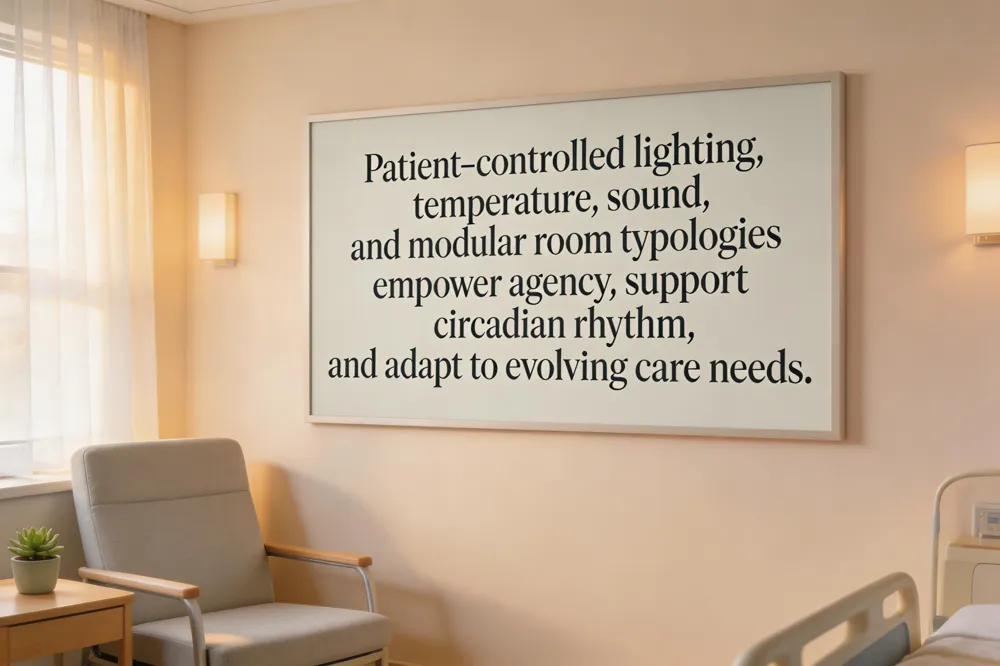
Patient‑controlled lighting, temperature and sound empower oncology inpatients to restore a sense of agency during long treatment courses. Adaptive circadian lighting (6500 K daytime to 2700 K evening) and bedside master interfaces let patients dim lights, adjust blinds and set personal music, which improves sleep hygiene and reduces cortisol spikes. Modular room typologies—twin rooms with full‑height acoustic partitions or convertible private suites—allow rapid shifts between solitary recovery and socially supportive settings, while high‑NRC ceiling tiles and smart alarm routing keep ambient noise below WHO’s 35 dB target.
Family‑friendly amenities such as sleeper sofas, dimmable guest lighting and in‑room storage enable overnight stays and ritualized caregiving, reinforcing emotional support and reducing isolation. Participatory design processes—patient‑provider charrettes, mock‑up testing and post‑occupancy QR kiosks—ensure that these spatial solutions match real‑world needs and evolve with treatment advances.
How does stress affect cancer treatment effectiveness? Stress triggers cortisol, epinephrine and norepinephrine release, dampening immune surveillance, promoting inflammatory signaling and impairing drug metabolism, which can lower chemotherapy potency and increase side‑effects. Stress‑reduction interventions (CBT, mindfulness, relaxation) lower these hormones, improve anti‑tumor immunity and enhance therapeutic outcomes.
Does stress influence cancer recurrence rates? Yes. Chronic stress weakens immune monitoring and creates a pro‑inflammatory environment that can reactivate dormant tumor cells, raising recurrence risk. Managing stress through psychosocial support and relaxation techniques may therefore help reduce the likelihood of disease return.
Technology, Safety, and Infection Control

A well‑engineered oncology unit transforms safety from a procedural checklist into an environmental guarantee. HEPA‑filtered ventilation delivering ≥12 air changes per hour, combined with copper‑silver ion antimicrobial surfaces, creates an invisible barrier against airborne and surface pathogens while preserving a home‑like ambience for immunocompromised patients. Smart alarm routing to staff wearables reduces ambient noise and alerts clinicians directly, and acoustic paneling (NRC ≥ 0.80) keeps sound levels under the WHO 35 dB threshold, protecting sleep and lowering cortisol spikes. Digital infrastructure—reliable Wi‑Fi, bedside master interfaces for lighting, temperature, blinds, and entertainment—empowers patients to control their micro‑environment, reinforcing autonomy and reducing stress‑related errors. These design elements collectively lower falls, medication mistakes, and infection rates by clarifying pathways, minimizing clutter, and supporting focused, error‑free work. In sum, technology‑enabled infection control and acoustic comfort are essential pillars of patient safety in modern cancer care.
Future Directions: Integrating Stress Management Into Care

Mindfulness‑based stress reduction (MBSR) and cognitive‑behavioral therapy (CBT) are becoming core components of oncology care. Both interventions teach patients to recognize and reframe stressors, improve sleep hygiene, and enhance emotional resilience, leading to measurable reductions in cortisol and sympathetic activation. Telehealth‑enabled counseling expands access, allowing patients to engage in guided meditation, CBT modules, or virtual support groups from home, which is especially valuable for rural or immunocompromised individuals. A growing body of evidence links stress reduction to improved immune function: lower circulating IL‑6, enhanced NK‑cell cytotoxicity, and normalized cortisol rhythms have been documented after MBSR or CBT programs, correlating with better treatment tolerance and, in some studies, reduced recurrence risk. Hirschfeld Oncology exemplifies a holistic model, integrating on‑site mindfulness studios, digital wellness apps, and coordinated psychosocial teams that deliver personalized stress‑management plans alongside standard therapy.
How does stress impact cancer progression? Chronic stress activates the neuro‑endocrine system, releasing catecholamines such as norepinephrine and epinephrine that bind β‑adrenergic receptors on tumor cells and surrounding stromal cells. This signaling promotes cellular proliferation, angiogenesis, and the expression of matrix‑degrading enzymes, thereby facilitating tumor growth and metastasis. Stress‑induced hormones also modulate immune cells—e.g., activating neutrophils that shield tumor cells and suppressing cytotoxic T‑cell activity—creating a microenvironment that favors cancer progression. Animal models consistently show that stressed mice develop larger, more metastatic tumors, and human laboratory studies have linked elevated β‑adrenergic activity with poorer outcomes in several cancer types. Consequently, managing chronic stress through behavioral, pharmacologic, or integrative interventions may help slow disease progression and improve patients’ overall response to therapy.
A New Standard for Cancer Care
Evidence shows that environmental stressors—noise, harsh lighting, lack of nature—raise cortisol and impair immune function in cancer patients. Biophilic elements, lighting, acoustic insulation, and private yet flexible spaces lower perceived stress, improve sleep, and support circadian rhythms, translating into shorter stays and better treatment tolerance. Hirschfeld Oncology has operationalized these principles: single‑occupancy rooms with dimmable lights, bedside temperature controls, indoor gardens visible through floor‑to‑ceiling windows, and meditation pods. Families can stay overnight in sleeper sofas, and smart‑alarm routing reduces disturbances. The oncology must replicate this model, integrating evidence‑based design into every cancer center to make stress reduction a therapeutic pillar.
.png)
.png)