


.png)


Why Genomic Guidance Matters in Radiation Oncology
For more than seven decades radiation therapy has been prescribed with a uniform, one‑size‑fits‑all dose based on historic fractionation schedules. This approach ignores the substantial heterogeneity in intrinsic radiosensitivity that genomics now reveal across and within tumor types such as NSCLC, breast, and pancreatic cancer. Gene‑expression signatures like the Radiosensitivity Index (RSI) and derived metrics such as the Genomic‑Adjusted Radiation Dose (GARD) or RxRSI demonstrate wide dose‑requirement ranges—e.g., 50 Gy for radiosensitive tumors versus >70 Gy for resistant ones—highlighting that up to 75 % of patients receive sub‑optimal dosing. Prospective and in‑silico studies (e.g., RTOG 0617 simulations) show that genomics‑guided dose escalation can improve 5‑year local control by ~8 % while sparing the majority from excess toxicity. Integrating tumor gene‑expression profiling into planning workflows promises a therapeutic ratio that matches physical dose to biological need, moving radiation oncology toward true precision medicine.
From One‑Size‑Fits‑All to Genomics‑Guided Dose

Traditional uniform fractionation schedules Radiation therapy has long relied on a one‑size‑fits‑all approach, using historic fractionation (e.g., 60 Gy in 2 Gy fractions) that ignores patient‑specific radiosensitivity. This results in overtreatment for radiosensitive tumors and undertreatment for radio‑resistant disease.
Radiosensitivity Index (RSI) and its validation Radiosensitivity Index (RSI) is a 10‑gene expression signature that predicts intrinsic tumor radiosensitivity. Validated across breast, lung, prostate and glioblastoma cohorts, low RSI values identify radiosensitive tumors while high values flag resistance. Numerous retrospective studies show RSI correlates with local control and overall survival when combined with dose information.
Genomic‑Adjusted Radiation Dose (GARD) model Genomic‑Adjusted Radiation Dose (GARD) integrates RSI into the linear‑quadratic model, converting a physical dose into a biologic effect score. Higher GARD scores predict better outcomes; the model has been retrospectively linked to improved metastasis‑free survival in breast, lung and pancreatic cancers.
RxRSI as the physical dose needed for a target GARD RxRSI is the calculated physical dose required to achieve a predefined therapeutic GARD (e.g., GARD_T = 33). In a 1,747‑patient NSCLC cohort, RxRSI ranged from <50 Gy to >70 Gy, allowing classification into radiosensitive, intermediate and radio‑resistant groups.
Clinical implications for NSCLC and other solid tumors Only ~25 % of NSCLC patients receive an empiric dose within 10 % of their RxRSI, leaving 75 % potentially under‑ or over‑dosed. In‑silico trials of RTOG 0617 showed that targeted escalation to RxRSI‑appropriate doses could improve 5‑year local control by ~8 % while sparing toxicity. Similar benefits are emerging in breast, prostate and pancreatic cancers, supporting broader adoption of genomics‑guided RT.
Cancer precision medicine
Answer: Precision medicine in cancer tailors treatment to the unique molecular makeup of each patient’s tumor by using DNA sequencing, gene‑expression profiling, and protein analysis to identify actionable genetic alterations. At Hirschfeld Oncology, this detailed tumor profiling drives the selection of targeted therapies, immune‑checkpoint inhibitors, and rational combination regimens specifically for pancreatic cancer. By matching drugs to the molecular drivers of a patient’s disease, clinicians can achieve higher response rates while sparing patients the unnecessary side effects of non‑specific chemotherapy. The approach also incorporates broader patient factors—such as disease stage, overall health, and lifestyle—to refine therapy choices and support tumor‑agnostic treatment options when appropriate. Ultimately, precision oncology enables a science‑based, compassionate care plan that maximizes efficacy and minimizes toxicity for every individual.
What is genomics in oncology?
Answer: Genomics in oncology is the study of the complete genetic material—DNA and RNA—of cancer cells to uncover mutations, copy‑number alterations, and gene‑expression patterns that drive tumor growth. By analyzing somatic (acquired) variants, clinicians can match patients with targeted therapies that specifically inhibit those molecular abnormalities, such as EGFR inhibitors for EGFR‑mutated lung cancer. The field also evaluates germline mutations that confer inherited cancer susceptibility, like BRCA1/2 or TP53, which can influence prevention strategies and familial risk counseling. Genomic information is increasingly integrated with traditional pathology to refine diagnoses, predict prognosis, and determine eligibility for clinical trials. Ultimately, cancer genomics enables a more precise, personalized approach to treatment and management, improving outcomes for patients across all tumor types.
What is the main purpose of personalized oncology?
Answer: The main purpose of personalized oncology is to match each cancer patient with the most effective therapy based on their unique molecular and clinical profile. By using validated biomarkers—genomic, proteomic, metabolic, and imaging—clinicians can predict which drugs will work, estimate prognosis, and monitor early response. This approach aims to improve survival and quality of life while sparing patients from unnecessary side effects and reducing overall health‑care costs. It also enables proactive prevention and surveillance for high‑risk individuals. Ultimately, personalized oncology strives to deliver the right treatment to the right patient at the right time.
Predictive Biomarkers and the 4 Ps of Personalized Medicine

What are the 4 Ps of personalised medicine? The 4 Ps are Predictive, Preventive, Personalized, and Participatory. Predictive medicine uses genomics and biomarkers to forecast disease risk before symptoms appear; Preventive medicine applies those insights to intervene early; Personalized medicine tailors diagnostics, therapeutics, and dosing to each patient’s unique genetic and clinical profile; Participatory medicine engages patients as active partners in decision‑making. Radiogenomics integrates quantitative imaging (radiomics) with genomic, transcriptomic, and epigenomic data, creating a non‑invasive, voxel‑by‑voxel portrait of tumor biology. By linking imaging signatures to genetic mutations, radiogenomics predicts radiosensitivity, guides dose escalation or de‑escalation, and helps select radiosensitizers, especially when tissue is scarce. SNPs and CNVs influencing radiosensitivity and toxicity: Common variants in DNA‑repair genes (e.g., ATM rs1801516, XRCC1 rs2682585) and copy‑number changes (e.g., XRCC1 CNV) have been associated with increased risk of pneumonitis, esophagitis, and rectal bleeding, allowing risk‑adapted dose planning. Why is genomics controversial? Genomic testing raises privacy and ethical concerns because DNA data reveal personal health risks and information about relatives. Regulatory frameworks are still evolving, and debates persist over data ownership, potential discrimination, and protecting patients’ genetic privacy. Integrating these biomarkers into clinical workflows promises more precise, patient‑centered radiation therapy while demanding robust ethical safeguards.
Clinical Impact: Trials, Modeling, and Outcome Gains

RxRSI Classification – In a cohort of 1,747 NSCLC patients, the Genomic‑Adjusted Radiation Dose (GARD)‑derived RxRSI stratified tumors into radiosensitive (optimal dose ≤ 50 Gy), intermediate (50‑70 Gy), and radio‑resistant (>70 Gy) groups, revealing that only 25 % of a 60‑patient post‑operative series received a dose within 10 % of their RxRSI.
RTOG 0617 In‑Silico Simulation – Using a competing‑hazards TCP/NTCP model, simulations of the RTOG 0617 trial (60 Gy vs 74 Gy) reproduced the observed lack of benefit from uniform escalation; only ~18 % of patients would have gained, while the majority incurred excess toxicity.
Targeted Dose Escalation – Modeling targeted escalation—delivering 74 Gy only to patients whose RxRSI fell between 62–74 Gy—projected a ~7.8 % absolute increase in 5‑year local control versus uniform 60 Gy treatment.
Health‑Economic Implications – Applying genomics‑guided RT to the ~850,000 U.S. patients treated with radiation each year could raise cure rates by 5 %—equating to >40,000 additional cures—while reducing toxicity‑related costs, offering a compelling cost‑effectiveness argument for national adoption.
Precision Medicine’s Growing Role – Precision oncology replaces one‑size‑fits‑all regimens with genomics‑informed strategies, enabling tailored radiosensitivity, dose escalation, and de‑escalation, as illustrated by Hirschfeld Oncology’s pancreatic‑cancer programs.
Is Radiation Oncology Declining? – No; the specialty is expanding, with a 16 % rise in practitioners (2015‑2023) and consolidation into larger centers that support advanced, genomics‑integrated workflows.
Side Effects of Precision Medicine – Targeted and immunotherapies can cause skin, GI, hematologic, organ‑specific, and immune‑related toxicities, underscoring the need for vigilant monitoring and supportive care.
Integrating Radiomics and AI into Genomics‑Based Planning
Radiomics workflow and feature extraction start with high‑quality CT, MRI, or PET images. After precise tumor segmentation, automated algorithms compute hundreds of quantitative descriptors—shape, texture, intensity—that capture underlying biology. In pancreatic cancer, where tissue is scarce, these imaging biomarkers complement gene‑expression data to predict treatment response.
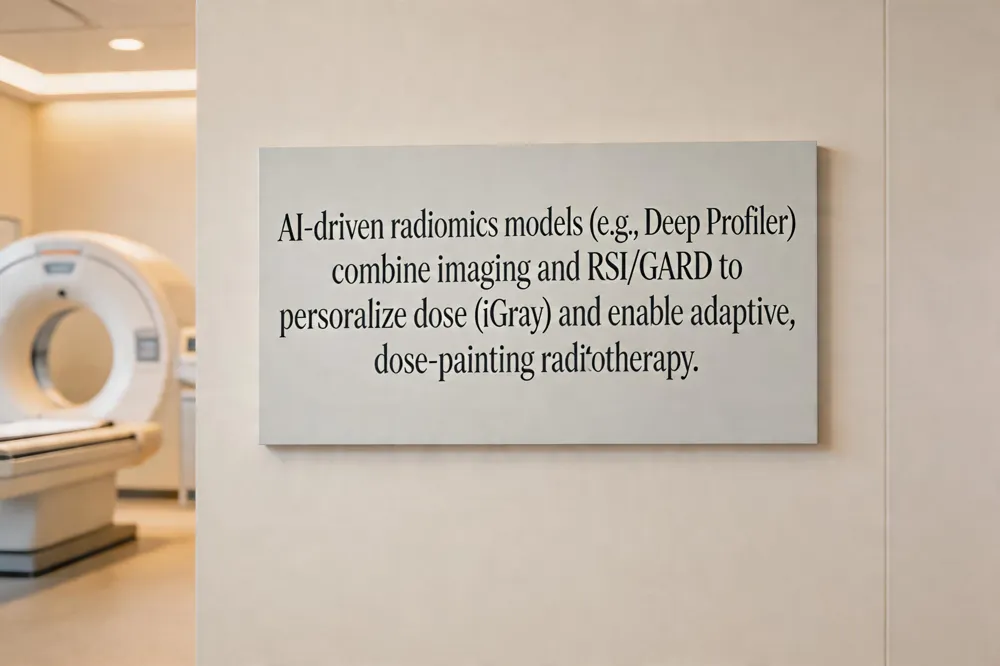
Deep Profiler AI model for CT‑based radiosensitivity leverages a deep‑learning network trained on 849 lung‑cancer cases. It produces a radiation‑sensitivity signature that, together with clinical BED and histology, yields a personalized dose called iGray, reducing projected local‑failure risk to <5% at 24 months. The model outperforms traditional radiomics and clinical variables and can safely de‑escalate dose in low‑risk patients while escalating for high‑risk subpopulations.
Adaptive online radiation therapy platforms such as Varian Ethos, Karmanos Adaptive RT, and Roswell Park’s AI‑enhanced linear accelerators enable daily plan replanning based on anatomical changes and genomic risk scores. By integrating GARD or RSI‑derived radiosensitivity indices, these systems support dose‑painting—delivering higher biologically effective doses to radioresistant tumor subvolumes while sparing normal tissue.
Radiogenomics bridges imaging and genomics for precision oncology by linking radiomic features to molecular signatures (e.g., KRAS, TP53, BRCA). This non‑invasive approach reduces biopsy reliance, mitigates sampling bias, and permits real‑time monitoring of therapeutic response, guiding dose escalation, de‑escalation, and combined‑modality strategies.
Examples of precision medicine in cancer include PARP inhibitors for BRCA‑mutated tumors, KRAS‑G12C inhibitors for KRAS‑mutant cancers, HER2‑directed therapies, MSI‑high‑specific pembrolizumab, NTRK‑fusion‑targeted larotrectinib, and CAR‑T cell approaches—each aligning treatment with specific molecular alterations rather than organ of origin.
Patient‑Centric Considerations and Practical Guidance

Radiation therapy today is increasingly personalized, but patients still have many practical questions.
What patients wish they knew before starting radiation – Most people are surprised to learn that the actual treatment is painless; the machine delivers a high‑energy beam while you lie still, and any discomfort usually appears afterward as fatigue, skin irritation, or mild nausea. Planning light‑activity days, staying well‑hydrated, and keeping soothing moisturizers on hand can make recovery smoother. Temporary tattoos or surface‑guided imaging guarantee precise targeting each session, and you can request appointment times that fit work or caregiving duties. Bringing a book, music, or a knitting project, and practicing breathing techniques for breath‑hold phases turn waiting periods into relaxing moments.
Managing fatigue, skin changes, and daily logistics – Fatigue often peaks mid‑course; short naps, gentle walks, and balanced nutrition help. Skin may become dry or reddened; fragrance‑free moisturizers and gentle washing are advisable. Use the clinic’s skin‑care recommendations and ask about topical agents to prevent rash.
Multidisciplinary coordination at Hirschfeld Oncology – The team includes radiation oncologists, medical physicists, nurses, and dietitians who meet in tumor boards to integrate genomic risk profiles (e.g., RSI, GARD, RxRSI) with imaging and patient preferences, ensuring that dose escalation or de‑escalation aligns with each tumor’s biology.
Supportive care resources and patient‑reported outcomes – Hirschfeld offers counseling, nutrition services, and a patient portal for tracking symptoms and quality‑of‑life metrics. Reporting fatigue, skin issues, or other side effects early allows timely interventions, preserving both efficacy and comfort.
A New Era of Genomic‑Guided Radiation Therapy
Genomic risk profiling reveals each tumor’s radiosensitivity, enabling dose escalation for resistant disease and safe de‑escalation for sensitive cases, thus improving cure rates while limiting toxicity. Future adaptive and AI‑enhanced radiotherapy will integrate imaging with genomic data for plan optimization. Hirschfeld Oncology commits to science‑driven, compassionate care, embedding genomics into treatment planning to personalize patient’s radiation journey.
.png)
.png)






