.png)


At their core, cancer clinical trials are research studies that bring together doctors, scientists, and patient volunteers to find better ways to prevent, find, diagnose, or treat cancer. They represent the final, critical step in a long and careful journey, moving a promising idea from the lab into a real-world setting where it can help people.
Understanding Your Role in Cancer Research
Think of it like this: if basic science and lab work are the blueprint for a new building, clinical trials are the actual construction. It's where theory meets reality. Each trial is a meticulously designed plan, created to answer very specific questions about a new treatment or strategy. The ultimate goal is always to move medicine forward.
This isn't about "experimenting" on people. It's a partnership. Every major advance we have in cancer care today—from the earliest chemotherapy drugs to modern immunotherapy—is a direct result of people choosing to participate in a clinical trial.
A clinical trial is the bridge between a scientific idea and a new standard of care. It's the essential path that allows promising discoveries to become the treatments that help patients everywhere.
The Purpose Behind Every Trial
So, what exactly are researchers trying to achieve? While the specifics vary, the focus is always on improving things for patients. Every trial is designed to figure out if a new approach is both safe and more effective than what we currently have.
They’re trying to answer questions like:
- Does this new treatment work better than the current standard? Does it shrink tumors more or help people live longer?
- Is it safer? Does it come with fewer or less severe side effects? Improving a patient's quality of life is a huge priority.
- Can a new test find cancer earlier, when it’s most treatable?
- Can we develop new ways to prevent cancer from developing in people who are at high risk?
By joining a trial, you can get access to new treatments that aren't available to the public yet. Just as importantly, you're contributing to a collective pool of knowledge that will help shape the future of cancer care for everyone. You can learn more about the importance of clinical trials in advancing cancer treatment in our related article.
To help break it down, here’s a quick overview of the essential parts of any clinical trial.
Cancer Clinical Trial Components at a Glance
Understanding these key pieces can make the whole process feel much more approachable. Each element is designed with patient safety and scientific accuracy in mind, making sure the research is both ethical and effective.
Navigating the Four Phases of a Clinical Trial
Before any new cancer treatment becomes a go-to option in a clinic, it has to go through a long and incredibly thorough vetting process. This journey is broken down into four distinct stages, which we call phases.
Think of it like building and launching a brand-new type of boat. You wouldn't just build it and immediately send a full crew out to sea. Instead, you'd test it in a controlled pool, then in a calm bay, and finally in the open ocean against other boats. Each phase of a clinical trial works the same way, building on the knowledge of the last while always putting patient safety first.
This step-by-step process is crucial. It allows researchers to answer specific questions at each stage, making sure a potential treatment is not only effective but also safe for a wider group of people.
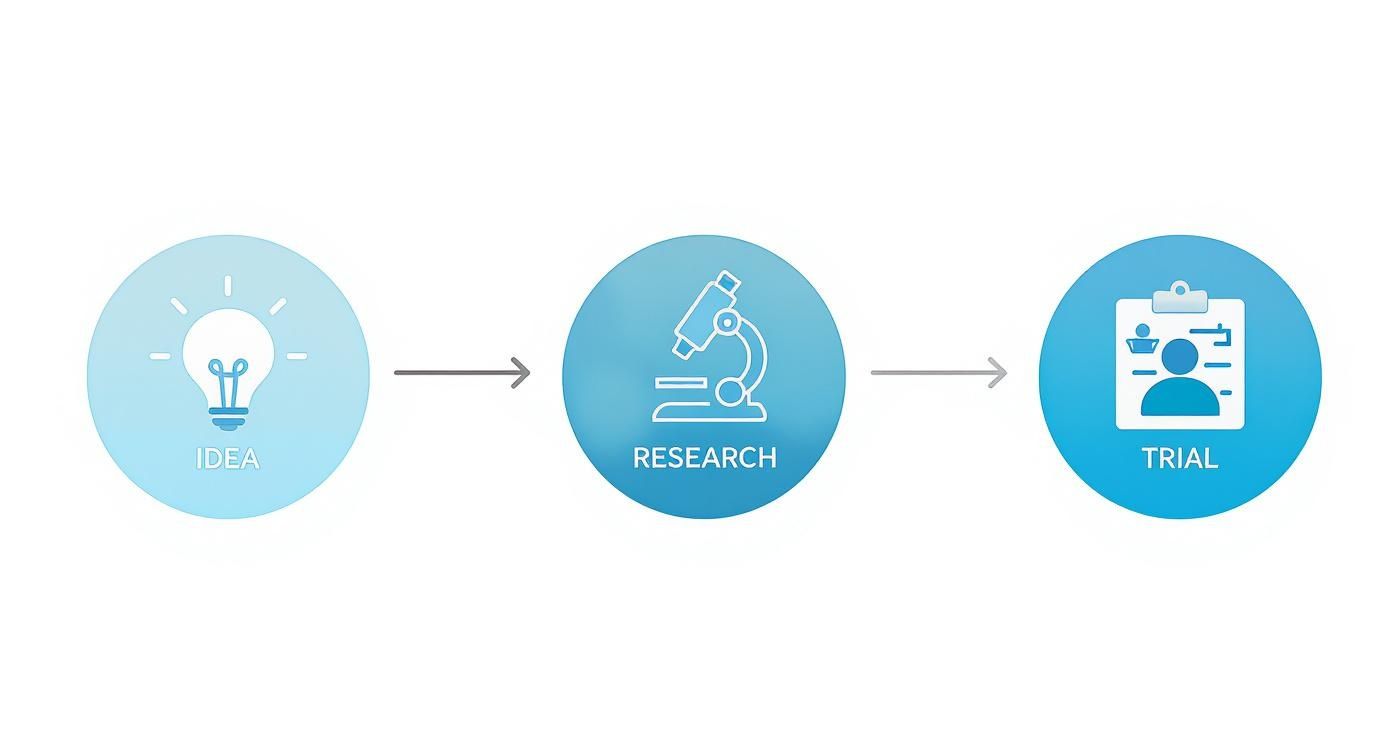
As you can see, a clinical trial doesn’t just come out of nowhere. It’s the final, most important step after years of brilliant ideas and painstaking lab work.
Phase I: Is It Safe?
The very first time a new drug or treatment is tested in people happens in a Phase I trial. This is a huge step. The main goal here isn't to see if the treatment can cure cancer, but to answer a more fundamental question: is it safe for humans?
Researchers are focused on a few key things:
- Finding a safe dose that doesn't cause harmful side effects.
- Figuring out how the body absorbs and processes the new drug.
- Watching closely for any unexpected reactions.
These trials involve a very small group of people, usually just 20 to 80 participants. Often, these are patients with advanced cancer who have already tried all available standard treatments. It's a critical first look that lays the groundwork for everything that follows.
Phase II: Does It Work?
Once a treatment has passed the safety checks of Phase I, it’s ready for Phase II. Now, the focus shifts. The big question becomes: does this treatment actually do anything to fight the cancer?
In this phase, researchers are looking for signs of efficacy—a clear signal that the treatment is having a positive effect on a specific type of cancer. They might measure things like whether tumors are shrinking or if the cancer's growth has slowed down. Think of it as a proof-of-concept stage.
This is a tough hurdle to clear. The U.S. Food and Drug Administration (FDA) notes that only about one-third of treatments that enter Phase II trials show enough promise to move on to the next, much larger stage.
Phase III: Is It Better?
If a treatment looks promising in Phase II, it graduates to a Phase III trial. This is the big league. These are large-scale studies, often involving hundreds or even thousands of patients across many different hospitals.
The goal here is a head-to-head comparison. The new treatment is tested directly against the current standard of care—the best treatment doctors are already using for that specific cancer. To keep the results unbiased, patients are randomly assigned (like a coin flip) to receive either the new treatment or the standard one.
This randomization is the key to proving, with confidence, whether the new approach is just as good, or hopefully even better, than what we have now. A successful Phase III trial is usually the last major piece of evidence needed before a drug can be approved for widespread use.
Phase IV: What Happens Long-Term?
You might think the story ends with FDA approval, but there’s one more step: Phase IV trials. These studies happen after a treatment is already on the market and available to the public.
The work isn’t done yet. Phase IV studies act as a long-term safety net, continuing to monitor the treatment in thousands of patients over many years. This helps researchers spot very rare side effects that might not have appeared in smaller trials and can even uncover new ways the treatment can be used. It’s all about building a complete, real-world picture of a treatment’s benefits and risks over time.
Comparing the Four Phases of Clinical Trials
To see how these stages fit together, it helps to compare them side-by-side. Each phase has a distinct purpose and answers a very different set of questions on the path from a lab discovery to a standard medical treatment.
This structured, four-phase approach ensures that by the time a treatment reaches you or a loved one, it has been rigorously tested for both safety and effectiveness, giving doctors and patients confidence in the care they receive.
Are You a Match? Understanding How Trial Eligibility Works
You might wonder if you can just sign up for any clinical trial that seems promising. The short answer is no, and for very good reason. Every trial has a specific set of rules, called eligibility criteria, that acts as a blueprint for who can participate.
Think of it less like a gatekeeper and more like a precise matching service. The goal is to find the exact right people for a study to ensure the results are clear and, most importantly, that every participant is kept as safe as possible.
Each study has two sets of criteria:
- Inclusion criteria: These are the "must-haves"—the specific characteristics you need to join.
- Exclusion criteria: These are the "must-not-haves"—the factors that would prevent you from taking part.
This careful screening process is vital. It allows researchers to gather a group of participants who are similar enough that any differences in outcome can be confidently linked to the new treatment being tested. It’s all about filtering out the “noise” so the “signal” from the treatment comes through loud and clear.

Common Factors That Determine Eligibility
While the specifics change from one study to the next, most research teams look at a similar set of factors to find the right fit. This creates a solid, consistent foundation for their research.
Here are some of the most common things they’ll consider:
- Your Specific Cancer and Its Stage: A trial for someone with early-stage breast cancer is going to be very different from one for a person with metastatic pancreatic cancer. Each study is designed to answer a very narrow, specific question.
- Your Treatment History: Have you already had chemotherapy or another treatment? Some trials are only for newly diagnosed patients who haven't started any therapy (first-line), while others are built for patients whose cancer has come back after standard treatments (second-line or third-line).
- Tumor Genetics: This is a big one in modern oncology. Many new therapies are targeted, meaning they only work on cancer cells with a specific genetic mutation or protein. For example, a trial might only be open to patients whose tumors have a HER2 mutation.
- Your Age and Overall Health: To handle a new treatment safely, you generally need to be within a certain age range and have good organ function (healthy kidneys, liver, and heart).
- Performance Status: This is a straightforward way for doctors to measure how well you can handle everyday activities. It helps them gauge if you’re strong enough for the demands of a trial, including potential side effects and extra appointments.
It's so important to remember that eligibility isn't a judgment on your health. It's simply a scientific tool to make sure the right people are in the right study, which protects everyone involved and leads to the clearest possible answers.
What Eligibility Looks Like in the Real World
Let's make this practical. Imagine a new drug is being tested for a type of lung cancer. The researchers believe it works best on tumors with a specific EGFR mutation, but only in patients who have not yet received immunotherapy.
Here’s how it might play out for three different people:
- Patient A: Has lung cancer with that exact EGFR mutation and has only had chemotherapy. They are likely an excellent candidate for the trial.
- Patient B: Has the same cancer and mutation but has already been treated with an immunotherapy drug. They would likely be excluded, as that prior treatment could muddy the waters and make it hard to tell if the new drug is working.
- Patient C: Has lung cancer, but their tumor doesn't have the EGFR mutation. They would be ineligible because the drug simply isn't designed for their type of cancer.
As you can see, it's a very objective matching process. This precision is what has fueled decades of progress. The worldwide effort to find better cancer treatments is massive; between 1999 and 2023, a staggering 112,899 clinical trials for cancer were conducted. Breast cancer was the most studied, accounting for 12% of these, and 9,539 trials were dedicated to childhood cancers, showing a deep commitment across the board. You can explore more about the global landscape of cancer research to see the scale of this work, which all starts with matching the right patient to the right trial.
Ultimately, the only way to know for sure if you qualify for a particular study is to have a conversation with your oncology team. They can carefully review your medical history against the specific criteria of available trials to see if there's a good match for you.
Weighing the Potential Benefits and Risks
Deciding to join a clinical trial is a big step, and it's one you should never feel rushed into. It’s a deeply personal choice that involves weighing the promise of a new treatment against the unknowns. Think of it as a partnership—one you enter with the research team, armed with as much information as possible.
The goal isn't just to find a trial, but to find the right trial for you. That means taking a clear-eyed look at what it could offer, what it might ask of you, and whether it aligns with your personal hopes and goals.
The Potential Advantages of Joining a Trial
So, why do people choose this path? For many, the most compelling reason is getting access to a treatment that could be years away from being widely available. This can feel like a lifeline, especially when standard options have run their course.
When you enroll in a trial, you often gain access to:
- Innovative Treatments: You could be one of the first people to benefit from a new therapy. Many of the most exciting breakthroughs in cancer care, like targeted drugs and immunotherapies, started in trials. To see just how much progress is being made, you can read more about how trials are shaping the future of cancer immunotherapy.
- Expert Medical Attention: Trial participants are monitored incredibly closely. You’ll have a whole team of leading oncologists and researchers focused on your care, often specialists at the very forefront of your specific type of cancer.
- A Contribution to the Future: There’s a powerful sense of purpose that comes from participating. By joining a trial, you're not just doing something for yourself—you're generating the knowledge that will help countless others down the road. You become a direct partner in the fight against cancer.
Every standard cancer treatment we rely on today was first proven in a clinical trial. It’s the courage and commitment of participants that turns promising science into life-saving medicine.
Understanding the Potential Downsides
Of course, it's not all about potential benefits. It’s just as important to be honest and realistic about the challenges and risks involved. This isn't about being negative; it's about being fully prepared.
Some of the key risks to think about include:
- Unexpected Side Effects: Since the treatments are new, there can be side effects that doctors don't fully expect. Your team will watch you like a hawk to manage them, but some can be unpleasant or, in rare cases, serious.
- The Treatment Might Not Work for You: This is a tough but crucial reality. There is simply no guarantee that a new treatment will be better than the standard one. It might not be effective for your cancer, or it could even be less effective than existing options.
- A Significant Time Commitment: Clinical trials almost always require more of your time. Expect more frequent trips to the hospital for treatments, blood work, and check-ins. This can mean more time away from work, family, and daily life, plus the logistics of travel.
The drive for better treatments is fueled by sobering statistics. Cancer is still a leading cause of death around the globe. In 2025 alone, the American Cancer Society estimates there will be 2,041,910 new cancer cases and 618,120 deaths in the United States. The global economic cost is projected to hit $25.2 trillion by 2050. These numbers underscore why this research is so urgent and why every trial matters.
The Informed Consent Process and Your Rights as a Patient
Before you can join any clinical trial, you'll go through a crucial step called informed consent. This isn’t just about signing a piece of paper. It’s a detailed, ongoing conversation between you and the research team, designed to protect you and make sure you understand every single part of the study.
Think of it as a mutual agreement built on total transparency. The research team has a responsibility to lay all the cards on the table, and you have the absolute right to ask questions until you feel completely clear and comfortable. This is a dialogue, not a lecture.
The whole point is to give you the power to make a choice that feels right for you, without any pressure. Your participation is 100% voluntary—a principle that holds true from the first conversation all the way through the end of the study.
What Does the Consent Document Actually Cover?
The conversation you have with the research team is captured in a formal document. These forms can look long and intimidating, but every section is there to protect you. It’s your roadmap for the entire trial.
The document will clearly explain things like:
- The Trial's Purpose: What are the researchers trying to figure out? What question are they hoping to answer?
- Procedures and Timeline: Exactly what will happen to you, step by step. This includes all tests, treatments, and appointments, plus a realistic idea of how long it will all take.
- Potential Risks: A completely honest discussion of all known side effects or discomforts you might experience.
- Potential Benefits: What are the possible upsides? The team will be very clear that there are absolutely no guarantees.
- Alternative Options: A rundown of the standard treatments available to you if you decide not to join the trial.
Most importantly, it will state in plain language that you can leave the study at any time, for any reason, without it ever affecting the quality of your future medical care.
Informed consent is the foundation of ethical medical research. It puts your autonomy front and center, honoring your right to make decisions about your own health and your own body.
Your Role in the Conversation
This is your dedicated time to get answers. Seriously, no question is too small or silly. The research team expects and encourages your questions—it shows you’re an active partner in your care.
To help you feel prepared, here’s a checklist of great questions to bring to your informed consent discussion:
- What is the main goal of this study?
- What are all of my treatment options, including the standard ones?
- How will the treatments in this trial be given, and how often?
- What are the most likely side effects I might face, both short-term and long-term?
- How will my health be monitored while I’m on the trial?
- Will this trial require more of my time or involve extra travel?
- Who pays for the treatment and any additional tests?
- Can I still see my regular doctor while participating?
- Who is my main contact if I have questions or problems, day or night?
- If this treatment works for me, can I keep receiving it after the trial is over?
This conversation is the bedrock of your participation. Take all the time you need, bring a family member or friend for support, and don't sign anything until you feel confident and completely informed.
How to Find the Right Clinical Trial for You
Taking the step to explore cancer clinical trials is a powerful and hopeful move. The sheer number of options can feel overwhelming, but you absolutely don't have to sort through it all by yourself. The best place to start is always with the expert who knows your case inside and out: your oncologist.
Your medical team has a deep understanding of your specific diagnosis, your treatment journey so far, and your overall health. They can cut through the noise and help you pinpoint studies that are not only scientifically promising but also genuinely a good fit for you. This conversation is, without a doubt, the most important first step you can take.
Starting the Search With Your Oncology Team
Think of your doctor as your primary guide in this process. They are uniquely positioned to:
- Pinpoint relevant trials using their expert knowledge of current research.
- Connect with colleagues at other major cancer centers to see what studies they might be running.
- Carefully review a trial's protocol to determine if you meet the often-complex eligibility criteria.
Working together ensures your search is grounded in your personal medical reality, saving you time and focusing your energy on the trials that hold the most promise.
Using Online Resources and Databases
Once you've talked with your doctor, several excellent online tools can help you cast a wider net. The U.S. National Library of Medicine runs ClinicalTrials.gov, which is the most comprehensive database of clinical studies happening all over the world.

You can use specific terms like your cancer type (e.g., "bile duct cancer") and location to see a list of relevant studies.
Another fantastic resource is the National Cancer Institute (NCI). Their website has a search tool designed specifically for cancer trials, letting you filter by cancer type, trial phase, and where it's located. This global hunt for better treatments is always growing. In fact, from 2001 to 2020, China alone initiated 5,285 cancer clinical trials, showing just how much research is expanding worldwide.
Key Tip: When you're looking through these databases, it's easy to get swamped. If you find a few trials that seem interesting, save or print the details. Bring that list to your next appointment. Your oncologist is the best person to help you make sense of the scientific language and what it means for you.
The Power of Patient Advocacy Groups
Finally, never forget the value of community. Patient advocacy groups that focus on specific cancers, like those for pancreatic or colorectal cancer, are incredible sources of both information and support.
These groups often keep updated lists of relevant trials and can put you in touch with other patients who have been through the process. For people navigating less common cancers, resources like our guide to bile duct cancer clinical trials can offer more targeted help.
By bringing together your oncologist's expertise, these powerful online tools, and the support of the patient community, you can confidently explore all your options and make the best possible decision for your health.
Answering Your Questions About Cancer Trials
Even after learning the basics, it’s completely normal to have more questions about what it’s really like to be in a cancer clinical trial. Working through these common concerns can give you the confidence you need to decide what's best for you. Let's tackle some of the most frequent questions we hear from patients.
Will I Get a Placebo in a Cancer Clinical Trial?
This is probably the most common worry we hear, and it’s a valid one. The reality is, it's extremely rare for someone in a cancer trial to get only a placebo (an inactive pill or "sugar pill"). It would be unethical to give a patient no treatment at all if a proven, effective one already exists.
Instead, most trials compare a new treatment against the current standard of care. So, you'd either get the new investigational drug or the best treatment that's already available. Sometimes, a placebo might be used in addition to the standard treatment, so researchers can clearly see the new drug's effects. In that scenario, you're still getting, at minimum, the accepted best care.
A good rule of thumb is to always ask the research team to walk you through the trial's design. They can explain exactly what treatments are being used and clarify if a placebo is involved in any way.
Who Pays for the Costs Associated With a Trial?
Figuring out the financial side of things is a crucial step. In most cases, the company sponsoring the trial pays for the new drug itself. They also usually cover the cost of any extra tests or scans that are being done purely for the sake of the research.
Your health insurance is typically billed for the "routine" parts of your care—the things you’d be getting anyway, like standard doctor's appointments and regular lab work. Before you agree to anything, make sure you talk to the trial’s financial coordinator and your insurance company. This will help you get a clear picture of all the potential costs so there are no surprises down the road.
Can I Leave a Clinical Trial After I Have Started?
Yes, absolutely. Participating in a clinical trial is always voluntary. You can decide to leave a study at any point, for any reason—no questions asked.
Choosing to stop will not affect the quality of your future care or your relationship with your doctors. Your health and autonomy are always the top priority. If you do decide to withdraw, your oncologist will simply work with you to plan the next steps and arrange the best alternative treatment available.
At Hirschfeld Oncology, we believe an empowered cancer journey means exploring every single option. If you have more questions or want to discuss if a clinical trial could be a good fit for you, we encourage you to request a consultation with our team. You can learn more by visiting us at https://honcology.com/blog.
.png)
.png)