.png)


A scan is coming up. Treatment decisions have already filled your calendar. Then someone asks, “Do you have a living will?” For many people in cancer care, that question lands at the exact moment they're already carrying too much.
If that's where you are, take a breath. A living will isn't about giving up. It's about making sure your voice stays part of your care, even during a crisis, a hospitalization, or a period when medication, illness, or exhaustion makes it hard to speak for yourself.
Families often want to help but don't know what you'd want in a very specific medical situation. Doctors want guidance they can use. You may want peace, clarity, and less guessing. That's where this document can help.
Planning for Your Voice to Be Heard
Maria is in active cancer treatment in New York. Her daughter comes with her to appointments, writes down questions, and keeps track of medications. One night after a long infusion day, the daughter asks, “If something sudden happened in the hospital, how would I know what you want?”
That question comes up in many families, often discreetly and later than anyone expected.
A living will can turn that anxious uncertainty into something more usable. It gives written guidance about your medical wishes if you can't communicate them yourself. For people with cancer, that matters because care can change quickly. A serious infection, a reaction to treatment, confusion from illness, or a stay in the ICU can force decisions fast.
Many people agree this kind of planning matters, but fewer people put it in writing. In the United States, 45% of adults reported having a living will in Gallup's 2020 survey, up from 40% in 2005, which shows only a modest increase over time, according to Gallup's survey on living wills.
Why this matters during cancer care
Cancer doesn't always move in a straight line. There can be long stretches of routine treatment, then sudden detours. A living will helps when the road changes and your family needs more than guesses.
It can also reduce a burden many caregivers carry in silence. Without clear instructions, loved ones may wonder:
- Would you want every life-sustaining treatment tried, even if recovery is unlikely?
- Would comfort matter more than prolonging life in a particular situation?
- Would a short trial of intensive treatment feel acceptable, but not a prolonged intervention with little chance of meaningful recovery?
Those are not easy questions. Writing down your wishes doesn't make them easy, but it does make them clearer.
Practical rule: A living will is not a sign of hopelessness. It's a way to stay in charge of your care when circumstances become confusing.
If you're still gathering support as you undergo treatment, these cancer patient resources can help you organize conversations, care tasks, and practical next steps.
Planning is an act of care
A lot of people delay this because they think it will feel cold or legalistic. In real life, it's often the opposite. It can be one of the most caring things you do for yourself and the people who love you.
You're not trying to predict every future event. You're giving your family and medical team a better map.
What a Living Will Truly Is and Is Not
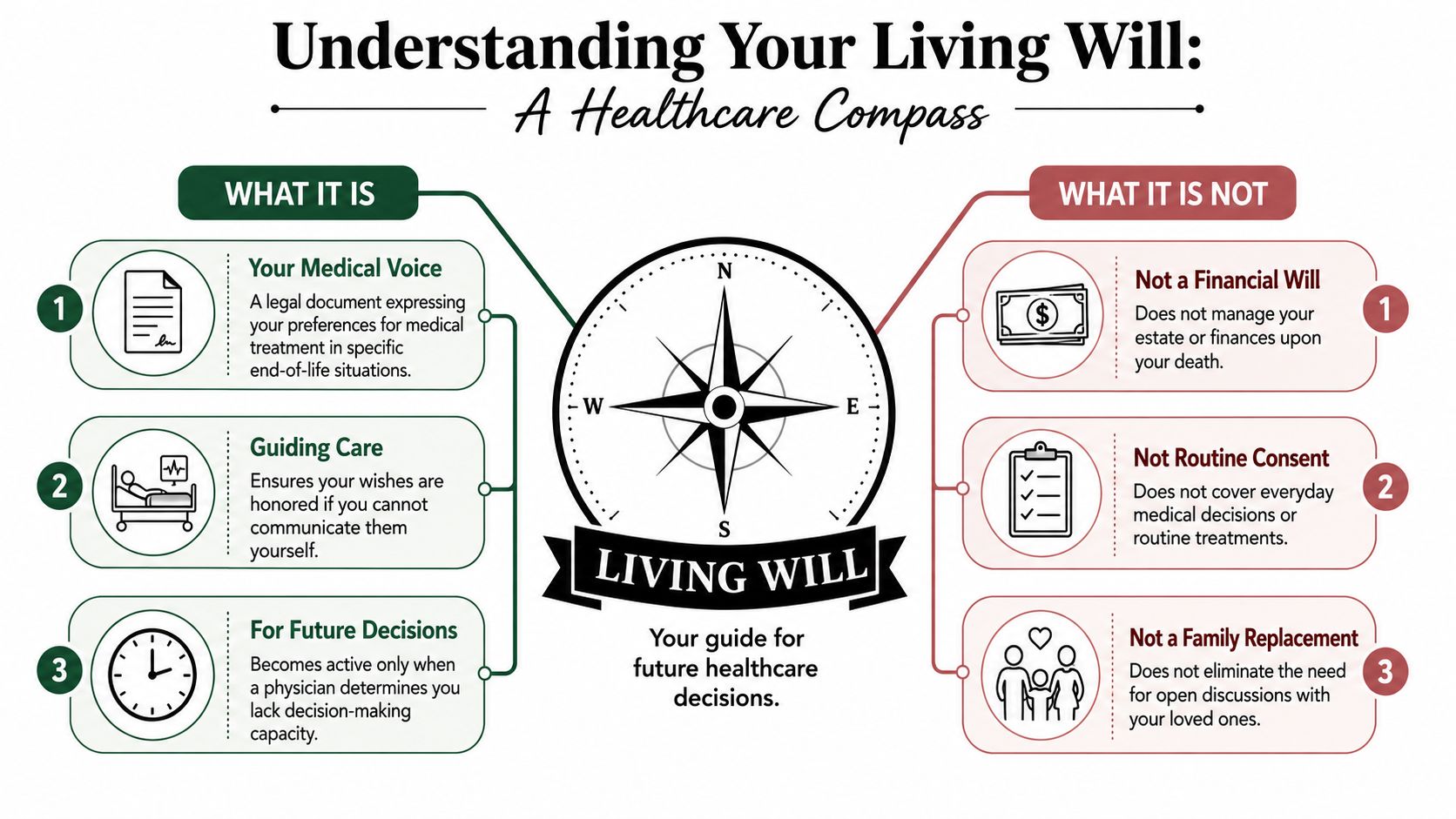
A living will is best understood as a written medical guide. Think of it as a care blueprint your team can turn to if you lose the ability to make decisions for yourself.
In clinical practice, a living will functions as a written advance directive that can specify which life-sustaining interventions to start, continue, withhold, or withdraw. Its effect is triggered only after the patient lacks decision-making capacity, as explained in this overview of how a living will works in clinical care.
What it does include
A living will usually addresses major treatment decisions rather than everyday care. In serious illness, that can include whether you'd want interventions such as:
- Resuscitation if your heart or breathing stops
- Mechanical ventilation if you can't breathe on your own
- Artificial feeding or hydration in certain circumstances
- Pain management preferences and comfort-focused care
- Organ donation wishes, if you want to include them
For oncology patients, these choices can become relevant in situations involving severe infection, complications from treatment, or a sharp decline related to advanced disease. The point isn't to make your document sound technical. The point is to give useful direction when a team is making hard decisions in real time.
When it takes effect
Many individuals find this confusing. A living will does not control your care while you're alert, informed, and able to speak for yourself.
If you can still understand your options and communicate a choice, you remain in charge. The living will steps in only if you can't make or express those decisions.
Your living will is your voice for a future moment when you may not be able to use your own.
That distinction is especially important during cancer treatment. A person may be very ill and still fully capable of deciding. Capacity is the key issue, not diagnosis alone.
What it does not do
A living will is often confused with other documents. It is not your last will and testament. It doesn't distribute money, property, or belongings after death.
It also isn't routine hospital paperwork that replaces discussion. Nurses, doctors, and family members still need context. If your written preferences are broad, they may need interpretation in light of your values.
Here's a simple explanation:
- A living will says what you want medically
- A financial will says who gets your property after death
- A conversation explains why those medical choices matter to you
If you're sorting through treatment goals more broadly, this guide to palliative care and hospice care can help clarify another area that people often mix up.
Living Will vs Health Care Proxy vs Power of Attorney
People often hear these terms in the same week and assume they mean the same thing. They don't. Each document has a different job.
In New York, that distinction matters because your paperwork should match the decision you want someone to make.
Advance Directive Documents at a Glance
| Document | Primary Purpose | Who It Empowers | When It's Used |
|---|---|---|---|
| Living will | Records your medical wishes and treatment preferences | Your clinicians and the person making medical decisions for you | When you can't make or communicate your own healthcare decisions |
| Health care proxy | Names the person who can make healthcare decisions for you | The healthcare agent you choose | When you lose decision-making capacity |
| Durable power of attorney | Handles financial or legal matters | The agent you name for finances and related affairs | According to the terms of the document, often during incapacity |
The simplest way to remember the difference
A living will is your what.
A health care proxy is your who.
A durable power of attorney is usually your money and legal affairs, not your cancer treatment choices.
That means if you only complete a financial power of attorney, your family may still be missing the person legally positioned to speak with doctors about care decisions. That mix-up causes real confusion.
Why oncology patients often need both medical documents
Cancer care rarely stays inside neat lines. A treatment course can bring side effects, setbacks, improvements, pauses, and urgent decisions that weren't obvious at the beginning.
A living will can state your preferences about life-sustaining treatment. A health care proxy adds flexibility by naming someone who can speak when new facts emerge, specialists disagree, or the situation falls into a gray area.
That can matter when your written document doesn't answer every question, such as:
- Short-term ICU care with a chance to recover enough for more treatment
- A treatment complication that may be reversible
- A choice between aggressive intervention and comfort-focused care when prognosis changes
Paper gives direction. A person gives interpretation.
This is why many patients feel more secure when the documents work together instead of standing alone.
A New York point worth knowing
In New York, people often focus first on the health care proxy because it names the decision-maker. That's practical. The person you choose may be the one fielding urgent calls from a hospital, hearing from oncologists, and trying to apply your wishes under stress.
Choose someone who can stay calm, ask questions, and speak up clearly. It doesn't have to be the relative others expect. It has to be the person who can carry your voice well.
For a broader look at how written preferences shape treatment choices, this article on integrating patient preferences into oncology care plans is a useful companion.
How to Create Your Living Will in New York
A living will only helps if it's valid, clear, and easy to use. The rules for these documents are state-specific, and hospitals work within those requirements. Federal law also requires most hospitals and healthcare facilities to inform patients of their right to execute advance directives, which is part of why this paperwork often comes up during admissions or major care transitions, as noted by the Iowa State Bar discussion of living will requirements and healthcare facility obligations.
Start with the right New York mindset
New York patients often complete a Health Care Proxy and may also prepare a living will to give more detailed written instructions. The proxy names your agent. The living will adds your treatment preferences.
That combination is often more useful than either document by itself.
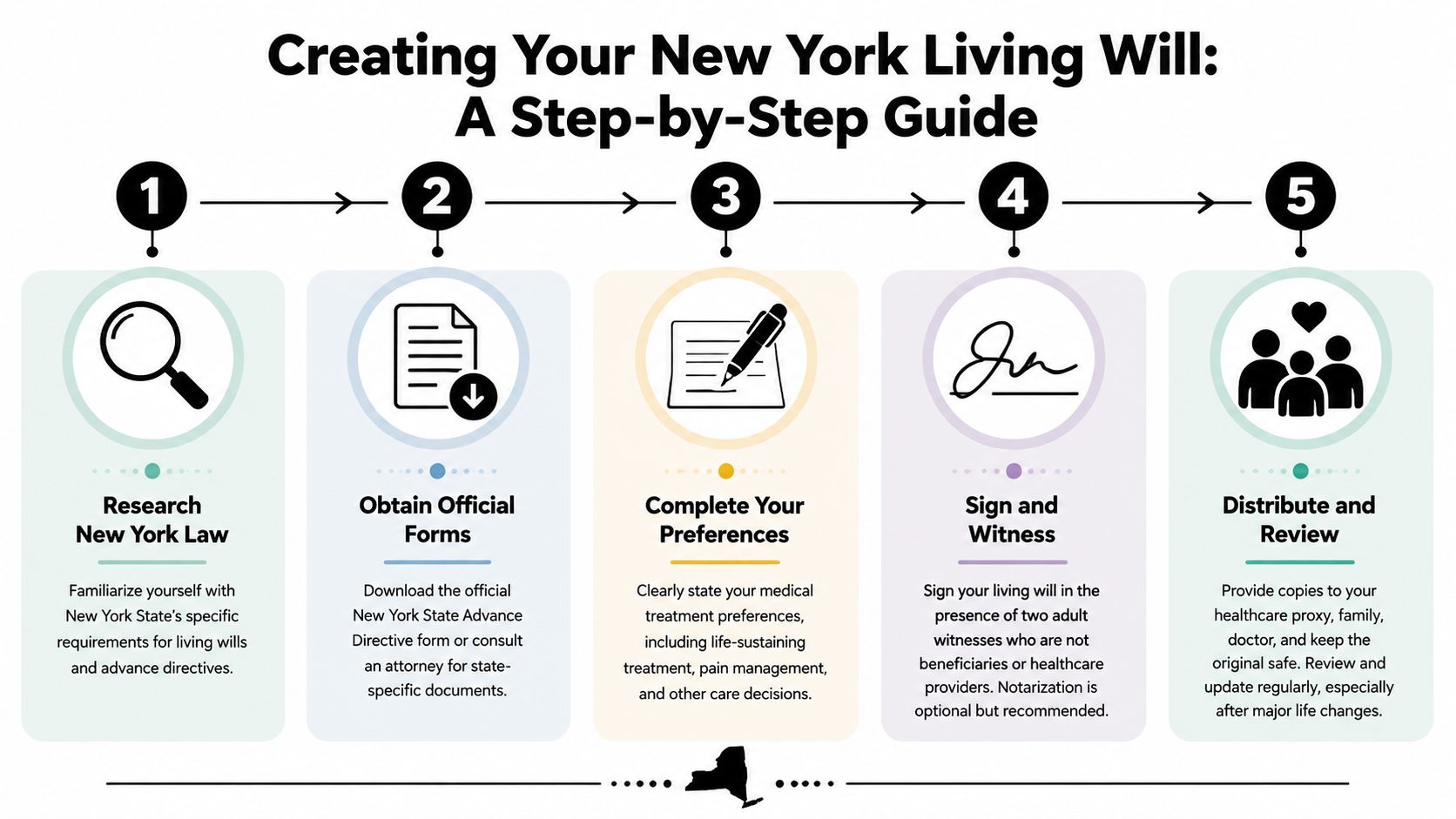
A practical step-by-step path
Choose your health care agent carefully
Pick someone who understands your values and can handle pressure. This person should be willing to speak with doctors, ask follow-up questions, and advocate without freezing or folding to family conflict.Write your treatment wishes in plain language
You don't need to sound like a lawyer. You can describe what matters to you, such as whether you'd want life support in a situation with little chance of recovery, how you view comfort-focused care, and what quality of life means to you.Follow New York signing requirements closely
For any advance care document, execution details matter. If witnessing is required for the form you use, treat that requirement as essential. A document that reflects your wishes but isn't properly completed can create trouble when it's needed most.Make the document readable in a medical setting
Avoid vague phrases like “no heroic measures” unless you also explain what that means to you. A hospital team needs instructions that can be translated into actual treatment decisions.Keep copies ready for real life
A living will is most useful when the right people can find it fast. That usually includes your proxy, close family, and medical team.
Why state details matter
A lot of online advice is too general. The form, witness rules, and local practice issues can differ by state, so it helps to compare guidance carefully. If you want to see how another state handles this process, these Texas living will form details offer a useful contrast and show why you shouldn't rely on a one-size-fits-all template when you live in New York.
Key point: The right document in the wrong format can fail at the worst time.
Questions to answer before you sign
Write down your thoughts on these before completing anything:
- What outcomes matter most to you
- What level of independence feels acceptable
- Whether you'd want short-term life support if recovery seems possible
- How you balance more time with treatment burden
- Who should speak if your document doesn't address a specific situation
If your cancer care is complex, it's reasonable to ask your doctor, social worker, or an attorney familiar with New York planning law to review your wording for clarity.
Starting the Conversation with Your Family and Doctors
A signed document helps. A real conversation helps more.
When cancer care becomes unpredictable, your family and doctors need more than checkboxes. They need to understand how you think. A broader advance directive can appoint a healthcare agent who interprets your wishes in real time and handles unforeseen medical developments, which is especially important in cancer care, as explained in this discussion of the difference between a living will and an advance directive.

What your family actually needs to hear
Many loved ones don't need a perfect legal explanation. They need to know what matters to you when things get hard.
That might include statements like:
- “If there's a good chance I could recover enough to return to treatment, I'd want a trial of intensive care.”
- “If I'm unlikely to regain awareness or interaction, comfort matters more to me than machines.”
- “I want treatment that helps me live, but not treatment that only extends suffering.”
Those sentences give your family something they can carry into difficult moments.
Good conversation starters
You don't have to do this all in one sitting. Often the best version is one calm talk, followed by another, then a few updates over time.
Try questions like these:
- What does acceptable quality of life mean to me now?
- What am I hoping treatment can still help me do?
- What medical situations would feel temporary and worth fighting through?
- What situations would feel like too much burden for too little benefit?
- If my condition worsens suddenly, who should speak first for me?
The goal isn't to predict every scenario. It's to help the people around you understand the values behind your decisions.
Talk with your doctors in concrete terms
Patients sometimes tell family one thing and doctors another, without realizing the messages don't fully match. That's why it helps to bring the conversation into the clinic.
Ask direct questions such as:
- “If this complication happened, what would treatment usually involve?”
- “Would this intervention likely help me recover, or mainly prolong the dying process?”
- “How would you describe my realistic best case and worst case?”
- “What would comfort-focused care look like for me?”
A short educational video can also help you think through how to discuss future care wishes:
If your family disagrees
This is common. One relative may want “everything done.” Another may think comfort should come first. Conflict often comes from fear, love, guilt, or different understandings of your illness.
That's another reason your own voice matters so much. A living will, paired with clear conversations, relieves relatives of the impossible job of guessing which version of hope should guide your care.
If you choose a health care agent, tell the rest of the family plainly: “This is the person I trust to speak for me.” That clarity can prevent painful arguments later.
Keeping Your Living Will Safe and Current
Completing a living will is only the first half of the job. The second half is making sure people can find it and trust that it still reflects your wishes.
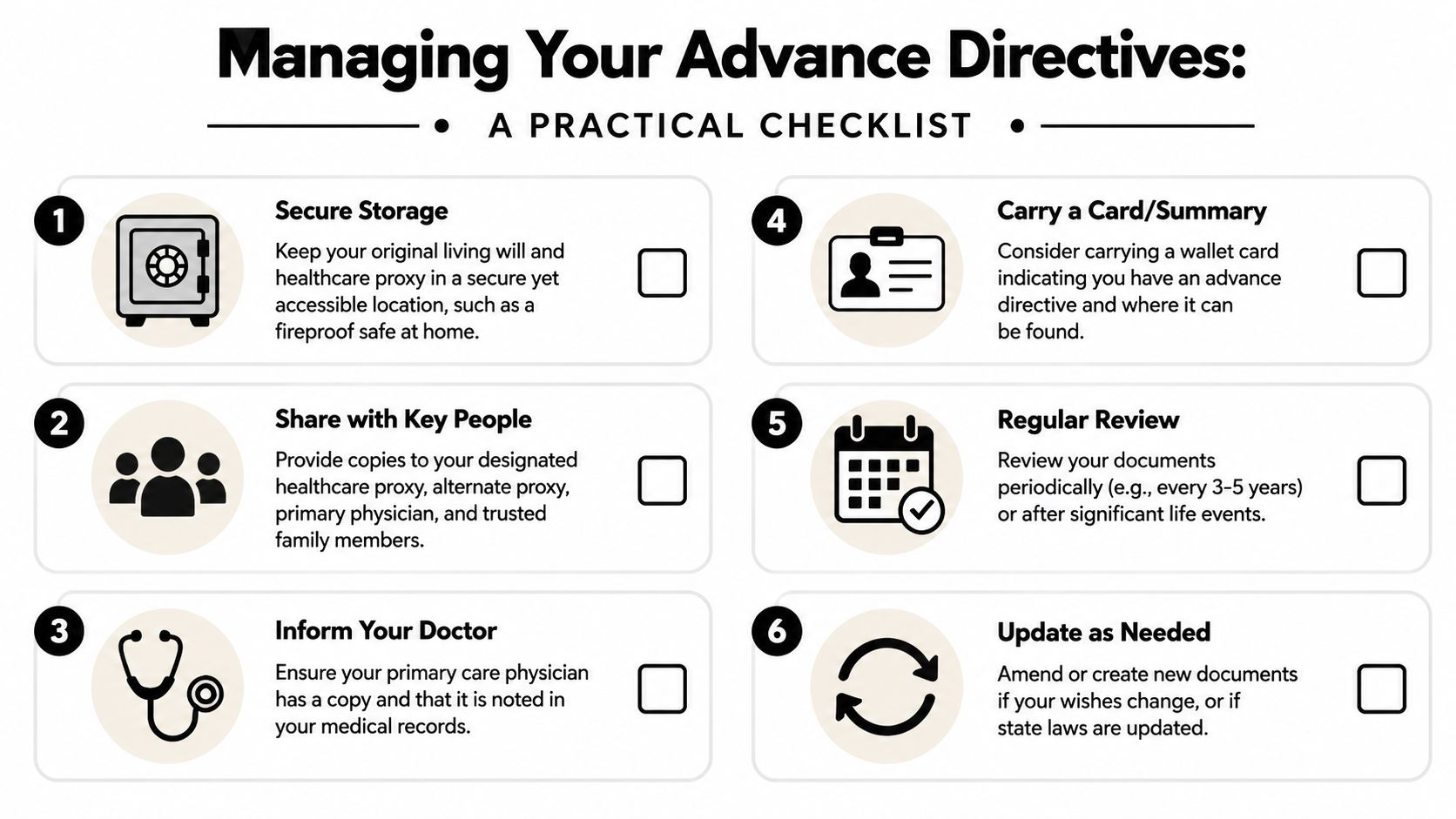
Guidance from NIH and Mayo Clinic, summarized in this review of how to keep a living will accurate and accessible, emphasizes distributing copies to your healthcare proxy and clinicians, storing the document where it can be reached quickly, and updating it regularly, at least annually or after major life events.
Where to keep it
The safest place is one that is both secure and accessible. If a document is locked away where nobody can reach it during a hospital admission, it may not help when needed.
A practical system often looks like this:
- Keep the original at home in a secure but reachable location
- Give copies to your health care proxy and alternate
- Provide copies to your primary doctor and oncology team
- Bring a copy for hospital admissions or major procedures
- Carry a wallet note that says you have advance directive documents and who to call
When to review it
A living will shouldn't sit untouched for years if your health or priorities have changed.
Review it when:
- A new diagnosis changes your outlook
- Your treatment goals shift
- You move to a new state
- Your relationships change
- The person you chose as proxy can no longer serve
Review your document when life changes, not just when paperwork reminds you.
Keep the wording aligned with your current values
People often think their wishes won't change. Sometimes they don't. Sometimes they do.
A patient may begin treatment wanting every possible intervention, then later decide that comfort, time at home, and avoiding repeated hospitalizations matter more. Another patient may move in the opposite direction after responding well to treatment. Updating your document lets your care plan keep pace with your real life.
Your living will works best when it is clear, current, shared, and easy to retrieve.
If you or a loved one is facing advanced or treatment-resistant cancer and wants care that aligns with personal goals, the team at Hirschfeld Oncology offers thoughtful guidance, individualized treatment planning, and support for the difficult decisions that come with complex cancer care.
.png)
.png)