.png)


You're probably in one of two places right now. Either you've found a project with real potential and need protected time to turn it into independent work, or you're staring at a patchwork of mentor funding, side experiments, and soft promises that won't carry you far enough.
That's exactly why the ACS Postdoctoral Fellowship matters. It's not just a line on a CV. It's one of the few awards that can signal, early and clearly, that you're not just a capable pair of hands in someone else's lab. You're a developing cancer researcher with your own trajectory.
Securing Your Future in Cancer Research
A strong postdoc usually doesn't fail for lack of effort. The problem is timing. You've finished the PhD or clinical research training, joined a productive lab, and now the expectations change fast. Your mentor wants papers. Your department wants momentum. You need funding that buys credibility, not just reagents.
That's where the ACS Postdoctoral Fellowship stands apart. It has a long history as a career-building award, and that history matters because reviewers know the fellowship is meant to identify people who can grow into leaders in oncology.

A follow-up study of ACS Special Postdoctoral Research Fellowship recipients from 1962 to 1973 found that a “very high percentage” of the 44 recipients remained in active research decades later, with many obtaining dual M.D./Ph.D. training, underscoring the fellowship's role in developing long-term cancer research leaders (PubMed follow-up study of ACS fellowship recipients).
That historical record should change how you think about the application. This isn't a form you complete after your science is done. It's an argument about who you are becoming. If you're still sorting out whether academic oncology is the right long-term path, it may help to review the broader range of careers in oncology before you write a single page.
The applicants who do best usually understand one thing early. Reviewers aren't just judging a project. They're judging whether this project is the right vehicle for this applicant's development.
That's why a technically solid proposal can still lose. If the science looks detached from a cancer-focused career path, or if the applicant reads like a skilled assistant to a senior PI, the whole package weakens.
Decoding the ACS Mission What Reviewers Want
Most applicants read the announcement for rules. Smart applicants read it for values.
The ACS mission should shape your framing from the first sentence of the research plan to the last line of the career statement. Reviewers are not looking for a generic “good postdoc project.” They want cancer research that matters, training that is intentional, and an applicant who can grow beyond the current lab.
What high impact looks like in practice
High impact doesn't always mean the flashiest mechanism or the largest dataset. In fellowship review, it usually means your work answers a cancer-relevant question with a believable path to significance. That path can be basic, translational, clinical, behavioral, or population-focused, but it can't be vague.
A weak framing sounds like this: “We will study a pathway involved in cell stress.”
A stronger framing sounds like this: “We will define how this pathway shapes tumor behavior or treatment response, and why that matters for cancer biology or patient care.”
That distinction matters because reviewers need to see cancer at the center, not pasted on at the end.
What reviewers look for beyond the science
Your file needs to answer three unspoken questions:
- Why this problem: Why is this cancer question worth funding at the fellowship level?
- Why you: Why are you the right person to lead this work as a mentored investigator?
- Why now: Why is this the right training stage for this project and this transition?
Applicants often overinvest in technical detail and underinvest in those three answers. That's a mistake. A flawless methods section won't rescue a proposal that lacks purpose.
Practical rule: If a reviewer can summarize your proposal as “good science, but it could be done by anyone in the lab,” you haven't built a fellowship narrative.
Alignment is a narrative problem
The best ACS applications feel integrated. The research question, mentor choice, training plan, and career goal all point in the same direction. If your story is tumor immunology, don't submit a proposal that reads like a side project in a broad signaling lab unless you explain exactly how it trains you for that future.
I also tell junior applicants to study how cancer organizations talk about scientific contribution, public benefit, and investigator development. Looking across major funders can sharpen your instinct for language and priorities, which is why it's worth browsing leading cancer research foundations before drafting.
What doesn't work is trying to sound “important.” Reviewers can spot inflated language instantly. What works is specificity, discipline, and a clear connection between the science and the researcher you're trying to become.
Key Eligibility Criteria and Funding Explained
Before you write, make sure you're eligible. I've seen strong candidates lose weeks building an application they couldn't submit.
The ACS Postdoctoral Fellowship provides annual stipends of $66,000, $68,000, and $70,000 across years one through three, plus a mandatory $4,000 annual allowance, and eligibility is limited to applicants within 4 years of their terminal degree who hold a postdoctoral position at a U.S. academic institution or eligible nonprofit organization (ACS Postdoctoral Fellowship eligibility and funding details).
The rules that actually screen people out
The first screen is usually administrative, not scientific. If you miss a core eligibility requirement, the rest of the application won't matter.
Focus on these points:
- Degree timing matters: You must be within the allowed post-degree window when the fellowship is activated. If you're close to the limit, verify your timing before you commit to a writing schedule.
- Position title matters: This award is for postdoctoral investigators. If your title has drifted into faculty-level, staff scientist, or research scientist territory, that can create a problem.
- Institution matters: Your work must be based at a U.S. academic institution or eligible nonprofit research setting.
- Training stage matters: The fellowship is designed for mentored development. If your application reads like you're already fully independent, you can accidentally undercut the logic of the award.
The fellowship term also depends on how long it has been since your degree. Applicants earlier in the window can receive a longer term, while those later in the window are limited to a shorter one. Treat that as a planning issue, not a footnote. It affects how ambitious your aims can be.
Funding structure at a glance
The funding is straightforward, and that's useful because it lets you budget your training with fewer surprises.
| Year of Fellowship | Annual Stipend | Annual Fellowship Allowance | Additional Travel Allowance |
|---|---|---|---|
| Year 1 | $66,000 | $4,000 | None |
| Year 2 | $68,000 | $4,000 | None |
| Year 3 | $70,000 | $4,000 | $1,500 |
That $1,500 final-year travel allowance is designated for attending the ACS Postdoctoral Fellows Symposium or a domestic scientific meeting, and the annual allowance is meant to help cover items such as health insurance, workshop costs, and scientific meeting expenses, as noted in the ACS program details cited above.
Practical implications for planning
Don't treat the allowance as background noise. It can support the professional development pieces that strengthen the fellowship logic, especially if your training plan includes specialized workshops, conference participation, or skill-building outside the home lab.
There are also family-support considerations that matter for real life, not just policy language. Verified eligibility information notes paid parental leave of 4 to 12 weeks per year with a corresponding extension of the grant term, designed to reduce disruption to early-career progression (OncoDaily ACS fellowship eligibility summary).
If your eligibility is borderline, get clarity before drafting. The cleanest application strategy in the world won't save a file that fails an administrative check.
Building a Winning Application Package
Most fellowship applications don't fail because the applicant is unqualified. They fail because the package feels assembled instead of designed.
A winning ACS application has one job. It makes every document reinforce the same conclusion: this applicant has a cancer-focused research future, this project is the right platform for growth, and this mentor environment will accelerate that development.
Here's a useful checklist view before you start drafting.
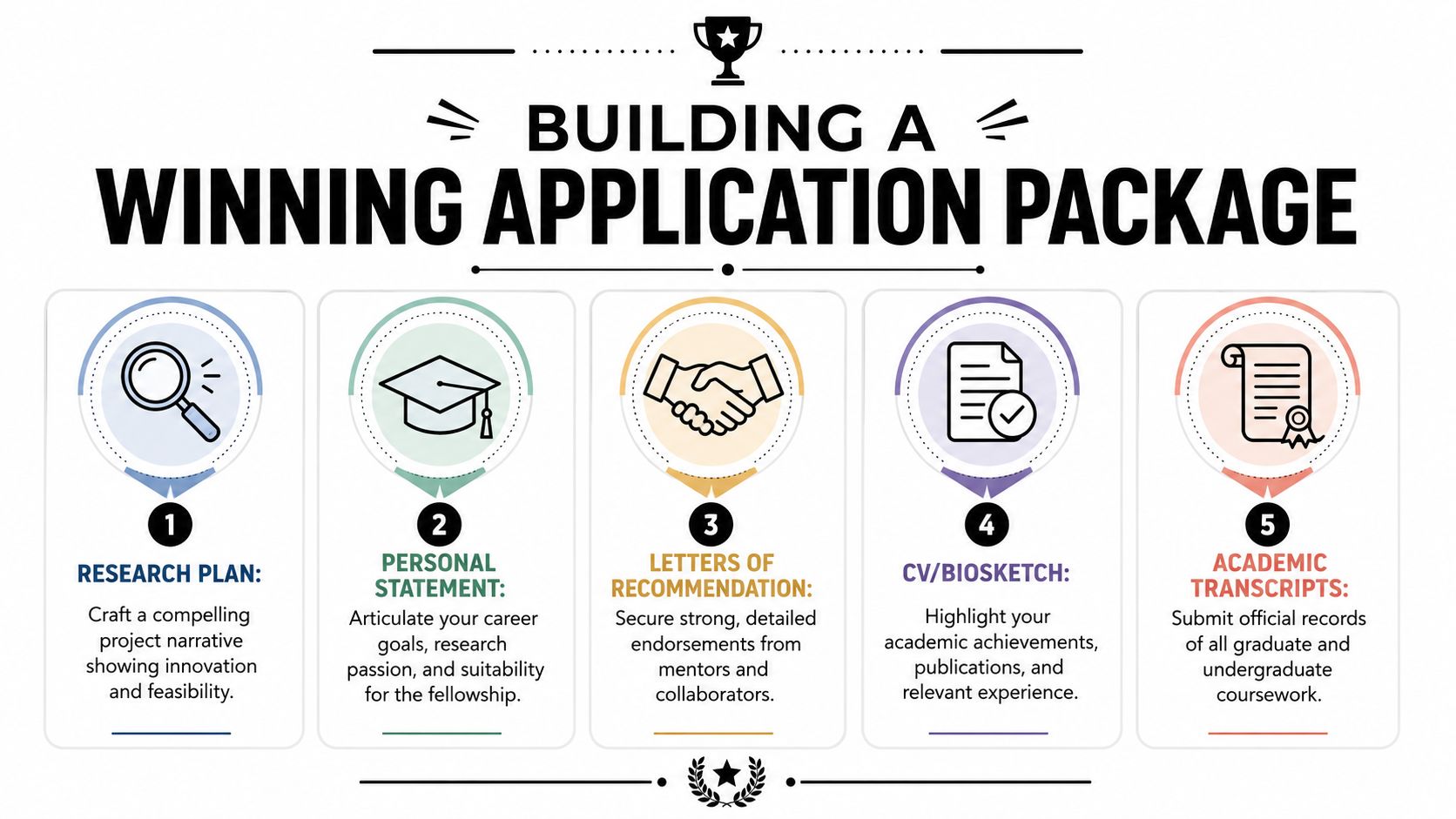
The research plan has to be both bold and survivable
Reviewers want ambition, but they also want judgment. If your proposal depends on every experiment working exactly as predicted, it reads as immature. If it's too incremental, it won't stand out.
Build aims that show range without becoming fragile:
- Lead with the biological or clinical problem. Don't open with a technique. Open with the cancer question.
- Define a limited number of core aims. Each aim should answer something meaningful on its own.
- Include feasible decision points. Show what you'll do if a central experiment underperforms.
- Make the cancer relevance explicit. Don't assume reviewers will connect the dots for you.
A common mistake is proposing the mentor's next R01 aim with your name on it. That almost never lands well. Your project can sit within a larger lab ecosystem, but it needs its own identity.
The strongest plans don't just say “this is innovative.” They show that the applicant knows where the risk is and how to manage it.
Your personal statement must sound like a scientist in formation
This document is often mishandled. Applicants either turn it into an autobiography or write a sterile summary of accomplishments. Neither works.
A good personal statement does three things well:
- Explains your trajectory: How did you arrive at this cancer research question?
- Shows intention: Why is this training environment necessary for your next leap?
- Projects forward: What kind of independent investigator are you trying to become?
Keep it concrete. Mention the skills you need, the conceptual gaps you're closing, and the reason this fellowship is the right mechanism for that transition.
If you're unsure how to present early academic work cleanly, reviewing examples of effective graduate student CVs can help you tighten structure and emphasis before you adapt that logic to your biosketch materials.
The mentor statement can carry or sink the whole file
Your mentor's letter shouldn't merely praise you. It should define a training strategy.
What reviewers want to see in that statement:
- Protected development: Evidence that you'll have room to own the project.
- Specific training commitments: Named techniques, systems, meetings, or collaborations.
- A path to independence: Not instant independence, but visible progression toward it.
- Fit between mentor and applicant: Why this lab is the right place for your next stage, not just a famous place to train.
If your mentor writes a generic endorsement, the application loses shape. Push for specificity. A letter that says you're “excellent and hardworking” is pleasant but weak. A letter that explains how you'll gain a distinct intellectual toolkit is much stronger.
The video below is worth watching if you need a reminder that application materials work best when they tell one coherent story rather than acting as separate documents.
Recommendation letters need orchestration
Don't collect letters passively. Curate them.
One recommender should speak to scientific horsepower. Another should speak to independence and initiative. If possible, a third can validate collaboration, rigor, or translational perspective. What you want is complementarity, not repetition.
Send each letter writer a short packet:
- your draft aims
- your updated CV
- a paragraph on what you hope their letter will emphasize
- the submission deadline, clearly stated
That last point sounds basic. It isn't. Plenty of strong applications get damaged by preventable logistics.
Navigating the Submission and Review Process
Once you submit, your application moves from being your writing problem to being a reviewer's reading problem. That shift matters. Reviewers won't see the effort behind the package. They'll see the clarity, fit, and credibility on the page.
The ACS fellowship has two annual application deadlines, June 1, 2025, and December 1, 2025, and the potential fellowship term depends on time since degree, with those earlier in the eligibility window able to receive a longer term than those later in it, as described in the program details above. If you want to track broader oncology funding activity while you wait, the Hirschfeld Oncology research page is a useful place to stay oriented to the field.
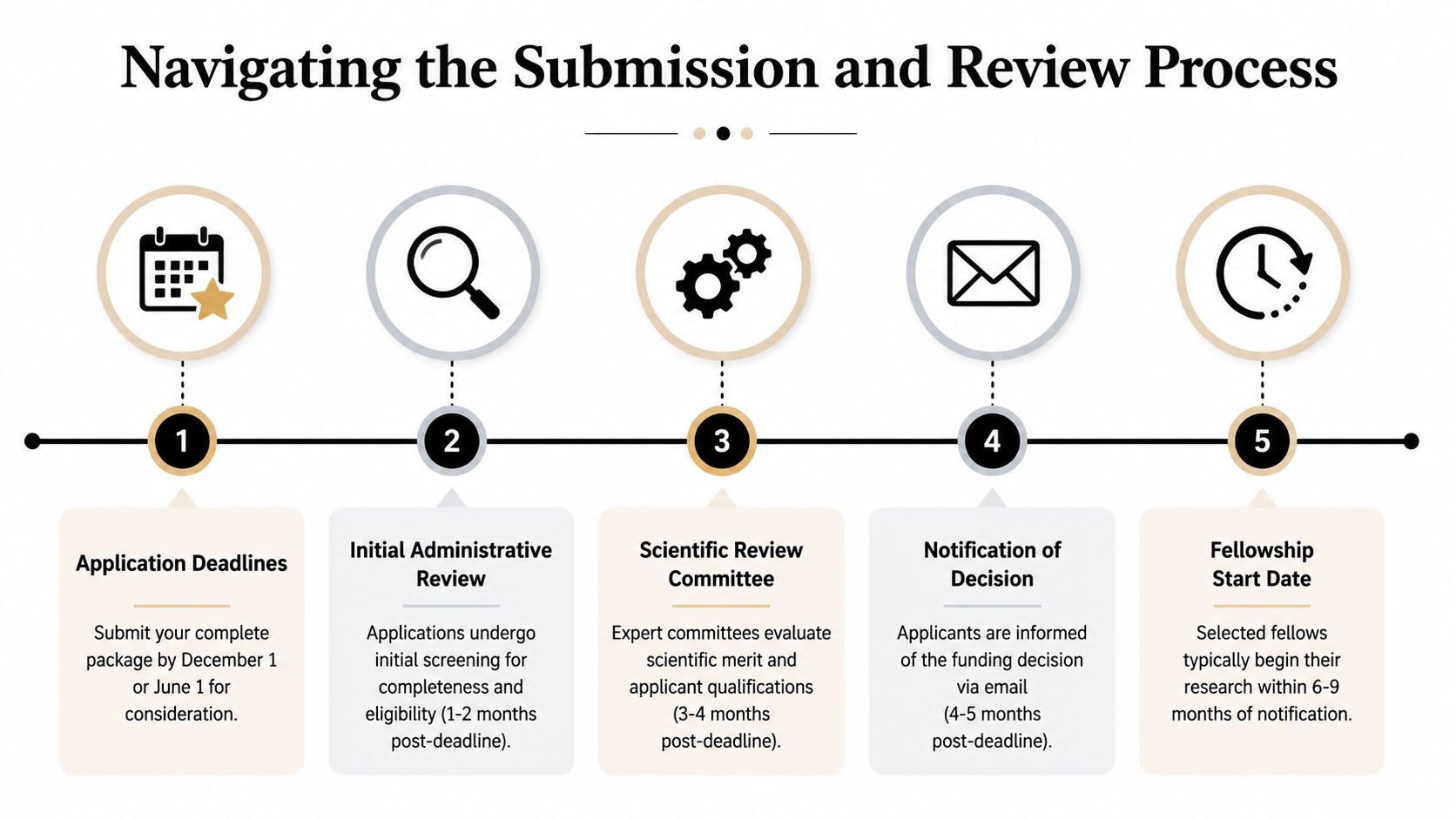
What happens after submission
The process usually unfolds in stages, even if you only experience it as silence followed by an email.
- Administrative screening: Staff check completeness and eligibility. Missing documents or mismatched eligibility can stop the application before scientific discussion.
- Scientific review: Experts assess the project, the applicant, and the training environment together. They are not scoring a standalone manuscript.
- Funding decision: Final decisions reflect both scientific judgment and programmatic fit.
That's why polished writing matters so much. A reviewer may be reading many applications in a compressed window. Dense prose, overloaded figures, and murky aims create avoidable friction.
Read your own file like a reviewer
Before you submit, do one pass with a narrow lens. Ask:
- Can a reviewer identify the central cancer question quickly?
- Does the training plan feel real, or decorative?
- Is your role clearly distinct from the mentor's broader program?
- Do all documents point to the same future research identity?
Reviewers forgive modest scope more easily than confused scope.
A disciplined proposal often beats a sprawling one. Applicants sometimes assume that adding more experiments, more sub-aims, and more methods will make the application look stronger. Usually it makes the application look less controlled.
Avoiding Common Application Mistakes
A lot of rejected applications come from capable people making predictable errors. The good news is that these mistakes are fixable if you catch them early.
Mistake one is submitting a project that looks borrowed
If your proposal reads like a direct extension of the mentor's existing machinery, reviewers may conclude that the science will move forward whether or not you're funded. That weakens the argument for supporting you as a fellow.
Do this instead. Carve out a question, approach, or bridge area that is clearly yours. It can sit inside the lab's strengths, but it needs an identifiable center of gravity.
Mistake two is writing a training plan as an afterthought
Some applicants spend weeks on the aims page and then toss in a generic paragraph about seminars, conferences, and mentorship. That signals poor judgment. This is a fellowship. Training is not secondary.
A strong training plan names what you'll learn, why you don't already have it, and how that training connects to your future lab or research niche.
Mistake three is letting letters stay vague
Many supportive letters are still ineffective. They describe the applicant as bright, motivated, and collaborative, but they don't explain distinctive strengths or future potential in concrete terms.
Push your writers for examples. Ask them to speak to independence, resilience, intellectual contribution, and trajectory. The more specific the evidence, the more believable the praise.
A generic strong letter is often weaker than applicants realize.
Mistake four is forcing relevance instead of building it
Reviewers can tell when “cancer relevance” was added in the final revision. If the project could just as easily be submitted unchanged to a non-cancer mechanism, that's a warning sign.
Fix this at the design stage, not the editing stage. The disease context should shape the question, not just the introduction.
Mistake five is hiding the applicant inside polished prose
Some applications are so carefully edited that the person disappears. You can't sound anonymous and expect reviewers to invest in your future.
Let the application show judgment. Explain why you chose this question, this system, this mentor, and this training sequence. Fellowship review is partly a test of scientific maturity. Mature applicants make deliberate choices and explain them plainly.
Beyond Submission Preparing for Your Next Steps
The ACS Postdoctoral Fellowship is competitive, but the application process has value even before a decision arrives. If you do it well, you'll come out with a tighter research story, a more realistic training plan, and a clearer sense of what independence should look like for you.
If you're funded, start using that momentum immediately. Tighten the project scope, schedule regular mentor meetings, and protect the parts of the plan that are supposed to build your distinct expertise. Don't let the fellowship turn into ordinary lab labor with a different budget code.
If you're not funded, don't waste the review. Read critiques for patterns, not bruises. Were reviewers unconvinced by the science, the training logic, or the ownership question? Those are different problems, and each one has a different fix.
The applicants who keep advancing are rarely the ones who wrote a flawless first fellowship. They're the ones who learned how to align project, mentorship, and career vision into one persuasive package.
If you're looking for more clear, research-informed guidance on oncology, treatment strategy, and cancer care decisions, explore the latest articles from Hirschfeld Oncology. Their blog offers practical insights for patients, families, and clinicians trying to make sense of complex cancer care.
.png)
.png)