.png)


When a standard cancer treatment plan stops working, it's easy to feel like you've hit a dead end. But what if it's not the end of the road? What if it's actually a turn toward a new, more precise path?
This is where an advanced cancer treatment center comes in. These specialized centers are designed for situations where the one-size-fits-all approach just isn’t enough, offering new possibilities for complex cancer diagnoses.
Finding Hope When Standard Treatments Fall Short

Getting a diagnosis of advanced cancer—like a metastatic disease or a cancer that has become resistant to initial therapies—is an enormous weight to carry. The conventional treatment journey often relies on standardized protocols. While these are the right choice for many, they don't always work for every person or every cancer.
An advanced cancer treatment center operates on a completely different level. Think of it like this: a standard oncology practice is your trusted primary care doctor, an expert in managing common conditions. An advanced center is the top-tier specialist you see for a rare and complex case that requires a deeper, more specific set of tools and knowledge.
Their entire focus is on creating highly individualized strategies, not just following a pre-written playbook.
To better understand the differences, let's compare the two approaches side-by-side.
Standard vs Advanced Cancer Care at a Glance
This table breaks down the fundamental differences between a standard oncology practice and an advanced cancer treatment center, from the overall philosophy to the patient experience.
| Feature | Standard Oncology Care | Advanced Cancer Treatment Center |
|---|---|---|
| Treatment Approach | Relies on established, national guidelines and protocols. | Focuses on personalized medicine, genomic testing, and customized regimens. |
| Treatment Focus | Primarily uses chemotherapy, radiation, and surgery. | Integrates immunotherapy, targeted therapies, and low-dose strategies to manage toxicity. |
| Patient Experience | Follows a more uniform care pathway. | Prioritizes quality of life, supportive care, and collaborative decision-making with the patient. |
| Specialization | Manages a broad range of common cancers. | Specializes in difficult-to-treat, rare, or advanced-stage cancers (e.g., metastatic, refractory). |
| Clinical Trials | May offer access to larger, more generalized trials. | Often provides access to innovative, targeted clinical trials not widely available. |
As you can see, the shift is from a broad approach to a deeply personal one, tailored to your unique cancer and your life.
A New Philosophy of Care
At a center like Hirschfeld Oncology, we've built our practice in Brooklyn around this patient-first philosophy. It’s a model grounded in a few core beliefs that set it apart from conventional care.
This philosophy means we prioritize:
- Deep Specialization: We have a concentrated focus on some of the most difficult-to-treat cancers, including pancreatic, bile duct (cholangiocarcinoma), and metastatic breast and colorectal cancers.
- Personalized Tools: We use advanced diagnostics to guide treatments like immunotherapy, targeted therapy, and uniquely customized low-dose chemotherapy regimens.
- Quality of Life as a Priority: Every treatment plan is designed to minimize side effects and preserve your strength. The goal is to help you live your life as fully as possible, even while undergoing treatment.
It’s all about changing the narrative of the cancer journey. Instead of just trying to endure treatment, you become an active partner in a plan designed to give you the best possible outcome with the highest quality of life. Exploring other viewpoints can also be helpful, and you can learn more by reading about alternative cancer treatment centers.
The proof is in the progress we've seen across the field.
The five-year relative survival rate for all cancers in the United States has climbed to 70% during 2015–2021. That’s a massive jump from just 49% in the mid-1970s. This incredible progress is fueled by the exact kind of sophisticated treatments available at specialized centers.
This improvement is especially dramatic for some metastatic cancers, where survival rates have more than doubled. It shows just how powerful it is to move beyond a one-size-fits-all mindset. For patients in Brooklyn and our neighboring communities, this means world-class care that was once only available at major research hubs is now right here at home. It’s a real shift toward hope and truly personal medicine.
When you come across the term “advanced cancer treatment center,” it’s natural to imagine a place full of shiny, futuristic equipment. While modern technology is certainly part of the equation, what truly defines an advanced center is a complete shift in philosophy. It’s about moving away from a rigid, one-size-fits-all model toward an approach that’s flexible, personal, and built entirely around you.
An advanced center doesn’t just treat a disease; it treats a person living with that disease. This means your specific genetic makeup, your personal health goals, and how you tolerate side effects become the building blocks of your treatment plan. Instead of following a set protocol, your care becomes a dynamic strategy that can change and adapt as your needs evolve.
This deep commitment to personalized medicine is reshaping the healthcare field. In fact, the global market for specialty hospitals—which includes facilities like an advanced cancer treatment center—was valued at around $74.9 billion in 2023. This number is expected to climb to $176.5 billion by 2032, a clear sign of the growing demand for this kind of expert, patient-focused care. You can learn more about these industry trends and what they mean for patients by looking at the latest data on top-performing oncology hospitals.
A Focus on Innovative Therapies
The first thing that sets an advanced center apart is its dedication to using smarter, more precise therapies. This goes far beyond defaulting to traditional chemotherapy and radiation. The focus shifts to therapies that are proven to work by attacking cancer cells while doing their best to leave your healthy tissue alone.
These aren't just experimental concepts; they are powerful, evidence-backed strategies that are changing what's possible for patients. They include:
- Immunotherapy: This approach essentially "trains" your own immune system to recognize and fight cancer cells, turning your body into a key part of the treatment.
- Targeted Therapy: These are drugs designed to zero in on the specific molecules that help cancer grow and spread, disrupting its essential functions.
- Metronomic Chemotherapy: This involves using low, continuous doses of chemotherapy to cut off a tumor's blood supply and support network, starving it over time.
Using these tools, specialists can build a multi-pronged plan of attack that is tailored to your cancer’s unique biology.
Expertise in Complex and Rare Cancers
Another key characteristic is a deep well of experience in treating complex, advanced, or rare cancers. A general oncologist has to be a jack-of-all-trades, seeing a little bit of everything. Specialists at an advanced center, however, often dedicate their practice to a few particularly challenging types of cancer. At Hirschfeld Oncology, for example, we concentrate on cancers like pancreatic, bile duct, and metastatic colorectal cancer.
That concentrated experience is incredibly valuable. It means the clinical team has managed a high number of similar cases, giving them a profound understanding of the disease's subtle behaviors and how it responds to different treatments.
Think of it this way: if you have a simple leaky faucet, any good plumber will do. But if your home has a complex, specialized geothermal heating system that’s on the fritz, you want the person who has built their entire career working on that exact system. An advanced cancer treatment center is that specialist for your health.
Low-Toxicity Regimens to Preserve Your Strength
A fundamental part of the philosophy at an advanced cancer treatment center is an absolute focus on your quality of life. The objective isn't just to add years to your life, but to ensure the life you're living is as full and comfortable as possible. This directly leads to a strong emphasis on low-toxicity regimens.
Instead of automatically reaching for aggressive, high-dose treatments that can leave you exhausted and weak, the goal is to find the most effective treatment with the fewest side effects. This might mean using gentler chemotherapy schedules or cleverly combining different therapies to get a powerful result without overwhelming your body. Keeping you strong is vital for helping you tolerate treatment and hold on to your independence.
Integrated Supportive Care
Finally, truly advanced care understands that cancer affects your whole life—not just your body, but your mind and spirit, too. That's why integrated supportive care is built into your treatment plan right from the very beginning.
This isn't an afterthought or a "nice-to-have." It's a proactive strategy. It involves everything from nutritional guidance to keep your body fueled and strong, to aggressive symptom management that gets ahead of side effects before they become a major problem. It also means fostering open, honest communication to make sure your mental and emotional health are always a priority. It’s about creating a complete support system to help you walk through every part of this journey with dignity and strength.
Understanding Your Advanced Treatment Options
When you hear the term “advanced cancer treatment center,” it’s easy to feel a little overwhelmed. It signals a shift away from the one-size-fits-all approaches of the past and toward a new era of care. What it really means is having access to smarter, more precise therapies designed to fight cancer while protecting your quality of life.
Let’s walk through what these treatments actually are, using some simple analogies. My goal is to give you a clear picture so you can feel more confident when discussing the right path forward with your oncology team.
Immunotherapy: Activating Your Body's Own Defenses
Think of your immune system as a dedicated security team that’s constantly on patrol, protecting you from threats. The problem is, cancer cells are incredibly clever and can wear disguises, tricking your immune system into ignoring them as if they were perfectly normal cells.
Immunotherapy is a treatment that essentially blows their cover. It acts like a new set of instructions, training your immune system to recognize cancer cells for what they are and empowering it to attack them. Instead of using an outside force to fight the battle, we’re mobilizing your body’s own built-in army.
We’ve seen incredible results with this approach, especially in cancers that were historically very tough to treat, like certain pancreatic, colorectal, and breast cancers. By working with your biology, immunotherapy can lead to long-lasting responses, often with a different and more manageable set of side effects than traditional chemo.
At its heart, immunotherapy is about re-engaging the most powerful defense system you have—your own immune system—and directing it to do what it does best.
Targeted Therapy: A Smart Key for a Specific Lock
If immunotherapy is the security team, then targeted therapy is like having a specialist with a smart key that fits only one specific lock. Every cancer is driven by unique genetic quirks—mutations or proteins that act like an engine, fueling its growth.
Targeted drugs are engineered to find that exact engine and shut it down, leaving most of your healthy cells untouched. It’s a world away from traditional chemotherapy, which is more like a sledgehammer that can cause a lot of collateral damage to healthy tissue.
This precision gives us two major advantages:
- Better Results: When you attack the very thing making the cancer grow, the treatment can be exceptionally effective.
- Fewer Side Effects: Since healthy cells are largely spared, patients often avoid many of the difficult side effects that come with standard chemo.
To use these therapies, we first need to understand your tumor’s unique genetic makeup through detailed testing. This is a fundamental part of the care you receive at an advanced center. You can learn more about how we put this into practice in our guide to innovative cancer treatments.
Metronomic Chemotherapy: A Gentler, More Consistent Approach
Traditional chemotherapy usually involves high-dose treatments followed by rest periods, a cycle that can be incredibly taxing on the body. Metronomic chemotherapy completely changes that dynamic. Instead of an all-out assault, this approach uses a continuous, low-dose stream of medication.
Think of it as cutting off an enemy’s supply lines rather than launching a frontal attack. Metronomic therapy works by constantly disrupting the tumor’s ability to grow new blood vessels—a process called angiogenesis. This slowly starves the tumor of the nutrients it needs to grow and spread.
This gentle, steady pressure helps manage the cancer effectively while dramatically reducing the toxicity and side effects of high-dose chemo. It has become a crucial strategy for improving a patient's daily life, particularly for those managing more advanced disease.
These therapies aren't just theoretical; they are the standard of care at the nation's best cancer hospitals. The 2025–2026 U.S. News & World Report Cancer Center Rankings, which reviewed nearly 5,000 hospitals, recognized top institutions for their expertise in delivering these advanced treatments. Ongoing work, like Duke Cancer Institute's new pancreatic cancer center and various immunotherapy trials, shows just how quickly the field is evolving. You can learn more about the latest cancer care rankings and advancements to see where the future of oncology is headed.
Your Patient Journey: A Step-by-Step Guide
Starting treatment at an advanced cancer center can feel like stepping into the unknown. We get it. That’s why we’ve created a clear, predictable path for our patients—one that replaces uncertainty with a sense of control and partnership. Think of it as a roadmap where you are always in the driver's seat, with our team navigating alongside you.
From your very first meeting to your ongoing care, every step is designed to be transparent, collaborative, and focused entirely on you.
The flowchart below shows how we can sequence or combine different therapies to create the most effective strategy for your specific cancer.
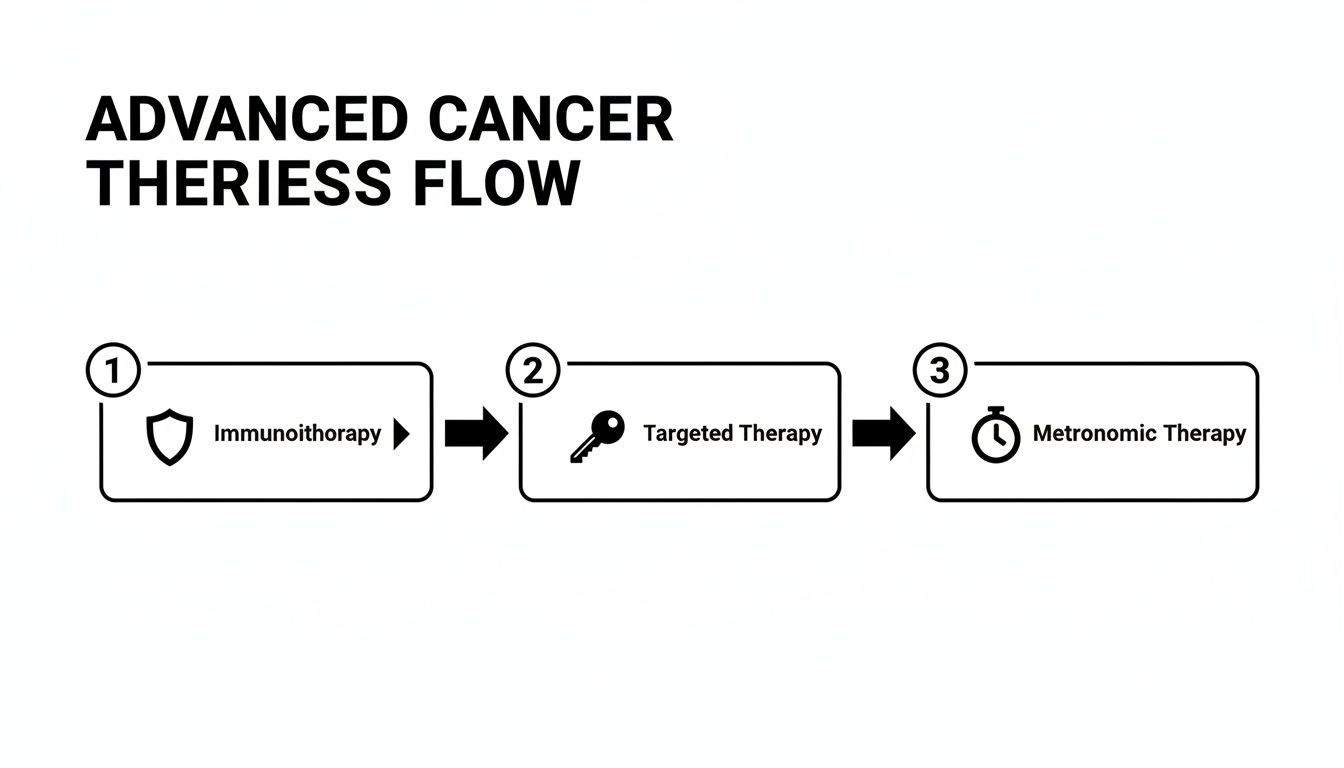
As you can see, treatments like immunotherapy, targeted therapy, and metronomic therapy aren't just standalone options. They are powerful tools we can weave together into a cohesive, long-term plan.
Your First Consultation
Your journey with us kicks off with a detailed first consultation. This is far more than just a quick introduction; it's a deep dive into your medical history, your personal goals, and any questions or concerns you have. We strongly encourage you to bring a family member or a trusted friend—an extra set of ears is always helpful.
During this appointment, your oncologist will carefully review all your records, pathology slides, and imaging. We want to understand your story and get to know you as a person, not just as a case file. This first meeting is all about building a foundation of trust and open communication.
Designing Your Personalized Plan
After your consultation, our team gets to work creating a treatment plan that is yours and yours alone. This isn't a one-size-fits-all protocol. It’s a strategy built from the ground up, revolving around a few core elements:
- Genomic Profiling: We run detailed tests on your tumor’s genetic code to find specific markers that new therapies can target.
- Your Personal Goals: What’s most important to you? Is it having enough energy to play with your grandkids? Or minimizing side effects so you can keep working? Your goals help shape our approach.
- Medical History: We take a close look at your overall health and how you’ve responded to past treatments to find the best path forward for you.
This is where the expertise of an advanced cancer treatment center really comes into play. We connect all the dots—from complex genetic data to your personal priorities—to build a flexible and powerful regimen.
A personalized plan is a living document. It’s designed to be adaptable, with the built-in flexibility to change based on how your cancer responds and how you feel throughout treatment.
The Infusion Visit and Ongoing Care
With your plan in place, you’ll start your treatment visits, which often take place in our comfortable infusion suite. Here at our Brooklyn center, we’ve worked hard to create a calm and reassuring atmosphere. Our expert oncology nurses will manage your infusion and stay one step ahead of any potential discomfort.
We don't just "wait and see." We constantly track your progress through regular follow-up visits, blood tests, and scans. This allows your oncologist to see exactly how the therapy is working. If a treatment isn't giving us the results we want, or if side effects become a problem, we can pivot quickly. This cycle of treating, monitoring, and adapting keeps you on the most effective and tolerable path at all times.
If surgery becomes part of your plan, nutrition plays a huge role in your recovery. You might find it helpful to explore resources on foods that promote healing after surgery to support your body's healing process. This is just one example of the holistic, proactive care that supports you every step of the way.
How to Choose the Right Center for Your Needs
Choosing where you'll receive cancer treatment is, without a doubt, one of the most important decisions you and your family will ever make. This isn't just about finding a clinic with the right equipment; it's about finding a true partner for your health journey. You need a team whose entire philosophy of care lines up with your personal goals.
It's a big decision, but it doesn't have to be an overwhelming one. By knowing what to look for and what questions to ask, you can confidently find a team that feels right for you. Think of it as gathering the information you need to feel empowered and in control of your path forward.
Digging into Medical Expertise and Treatment Philosophy
First things first: you need to understand the team's hands-on experience and their fundamental approach to care. Is their expertise a perfect match for your specific diagnosis? Does their philosophy on what makes a successful outcome resonate with you? A great center will be completely open about this.
Here are a few conversation starters to get a feel for their approach:
- Experience with Your Cancer: A crucial question is, how many patients with your exact type and stage of cancer have they treated? Deep experience, especially with less common or complex cases like pancreatic or bile duct cancer, is a huge sign of specialized knowledge.
- Treatment Philosophy: What does success look like to them? Is the focus entirely on the numbers and extending life, or is preserving quality of life just as important? You need to know that your priorities are their priorities.
- Managing Side Effects: How do they get ahead of treatment toxicity? Ask what their proactive strategies are for managing common side effects. The goal is to keep you feeling as strong and comfortable as possible throughout the process.
These initial conversations will tell you so much about how a center sees its patients—as true partners in their own care, or just as medical cases to manage.
Beyond the Medicine: Support and Practical Matters
Truly exceptional care goes far beyond the infusions and medications. It's about a complete support system that addresses your needs as a whole person. At the same time, the practical details—like location and insurance—are what make or break your ability to actually get that care without added stress.
An ideal advanced cancer treatment center integrates a full spectrum of support directly into your plan. This proactive approach ensures you're not just fighting the cancer but are also being supported emotionally, physically, and practically every step of the way.
To help you get a clear picture of what a center offers beyond the medical treatment, we've put together a simple checklist. Use these questions to make sure the center you're considering is the right fit for your life, not just your diagnosis.
Key Questions for Your Potential Oncologist
This table is designed to be a practical tool during your consultations. These questions will help you understand the full scope of care and support you can expect.
| Category | Question to Ask |
|---|---|
| Integrated Support | Do you offer in-house nutritional counseling, mental health support, or pain management? |
| Team Collaboration | How does the medical team collaborate? Do specialists meet regularly to discuss patient cases? |
| Insurance Navigation | Can your office help verify my insurance benefits and provide cost estimates for treatment? |
| Center Accessibility | How convenient is the center to access for regular appointments? |
These questions aren't just a formality; the answers reveal a center's commitment to patient-centered care. A team that has already thought through these details is a team that is prepared to support you fully.
For residents of Brooklyn, Williamsburg, and Bushwick, the accessibility of a local center like Hirschfeld Oncology is a game-changer. Having world-class care just a short trip away removes the heavy burden of travel, making it much easier to keep up with appointments without the exhaustion of long commutes.
Choosing a local, expert advanced cancer treatment center simplifies your life, so you can focus all your energy on what truly matters: your health and recovery.
Real Stories of Hope and Progress

The clinical data is one thing, but what truly defines an advanced cancer treatment center are the personal stories that unfold here every day. It's about seeing a patient regain the strength to play with their grandkids or feel well enough to simply enjoy a meal with family.
These aren't just abstract successes; they are real moments made possible by moving beyond one-size-fits-all protocols. The anonymized stories below, inspired by the experiences of our patients, show how this personalized approach can change everything.
Regaining Life with Treatment-Resistant Pancreatic Cancer
Take the case of a 64-year-old grandfather from Brooklyn we’ll call David. He was diagnosed with pancreatic cancer, and after the initial chemotherapy stopped working, he felt like he was running out of road. His energy was gone, and his goal was simple: to feel well enough to spend meaningful time with his family.
When he came to us, we designed a new strategy. It combined a specific immunotherapy agent with a very gentle, low-dose chemotherapy schedule. The focus wasn't just on attacking the cancer, but on doing so without the harsh side effects that had been wearing him down.
The change was noticeable within weeks. David's pain lessened, his energy started to come back, and he was soon back in the stands at his grandson’s baseball games—something he thought he’d never do again. While the cancer was still there, this approach gave him back his quality of life.
These stories are not always about finding a "cure" for advanced disease. They are about using precise tools to manage cancer as a chronic condition, giving patients the chance to live fuller, more comfortable lives.
Finding a Breakthrough with Genomic Testing
Now, think of a 52-year-old teacher we’ll call Maria, who was fighting metastatic colorectal cancer. Standard treatments weren’t holding it back, and the cancer was progressing. Her oncologist referred her for a different approach, starting with comprehensive genomic testing of her tumor.
The results were a complete game-changer. The test found a rare genetic mutation that was acting as the fuel for her cancer. This discovery meant she was a perfect candidate for a targeted therapy drug—a "smart key" made to fit that exact lock and shut it down.
The effect was profound. A few months after starting the new therapy, her scans showed the tumors were shrinking significantly. By looking at her cancer’s unique biological signature, we found a new path forward where it seemed none existed.
Maria’s story is a perfect illustration of how an advanced cancer treatment center uses deep diagnostics to create new opportunities. For our patients in Brooklyn and beyond, this isn't science fiction. It’s a practical strategy that restores a sense of control and real hope in the fight against cancer.
Taking the Next Step in Your Cancer Care
Making decisions after a cancer diagnosis can feel overwhelming. We've talked a lot about what makes an advanced cancer treatment center different—it’s about moving past a one-size-fits-all approach and creating a plan built around you. This is about more than just fighting a disease; it’s about finding a smarter path that helps you maintain your quality of life through it all.
For anyone living in Brooklyn, Williamsburg, Bushwick, or the nearby NYC communities, you don’t have to travel far for this level of care. It’s right here in your neighborhood, accessible and ready to help.
Let's Start the Conversation
You shouldn't have to figure this all out on your own. The first step is often the simplest: starting a conversation. A consultation is your chance to sit down with an expert, talk through your specific diagnosis, and see what a wider range of treatment options could look like. It’s where your voice is heard and your goals become the foundation of your care plan. If you want to dig a little deeper into the science behind this, our article explaining what precision oncology is is a great place to start.
At its heart, advanced cancer care is a partnership. We bring the clinical expertise, and you bring your life. Together, we find a way forward that offers both hope and practical results.
This collaborative spirit is what truly makes a difference. It ensures your treatment isn't just a medical protocol but a plan that fits you as a person. Exploring these options is a choice to put your well-being first.
At Hirschfeld Oncology, we’re here to provide the clarity and compassion you deserve. Your journey toward personalized, effective cancer care begins right here.
Request a consultation with our experienced oncology team today.
.png)
.png)