.png)


Precision oncology is a whole new way of thinking about cancer treatment. It’s about creating a treatment plan that’s built around the unique genetic story of your specific tumor. Instead of using a one-size-fits-all strategy, we focus on the molecular fingerprints that make your cancer different from anyone else's, opening the door to more effective and targeted care.
What Is Precision Oncology Really?
Think of it like this: trying to fix a complex, modern engine with a single, generic wrench. You might get lucky, but chances are you won't get very far. For a long time, that was our challenge with traditional cancer care. Precision oncology is about trading that one basic wrench for a custom-designed toolkit, with each tool built to address your engine's specific issues.
This represents a huge shift in how we approach cancer. Instead of just looking at where the cancer started—like the lung, breast, or colon—we now ask a much more powerful question: what is making this specific tumor grow? The answer is hidden in the tumor’s DNA.
From Carpet Bombing to Smart Missiles
A simple analogy can help make this clear. Traditional chemotherapy is often compared to "carpet bombing." It’s a powerful method that wipes out all rapidly dividing cells, but it can’t tell the difference between cancer cells and healthy cells. This leads to the collateral damage we know as side effects.
Precision oncology, on the other hand, is like a "smart missile." It’s programmed to seek out and destroy only the specific targets—the cancer cells—based on their unique biological markers. This focused attack leaves most healthy cells alone, which often translates to fewer severe side effects and a better quality of life during treatment.
This approach moves us away from treating the cancer type and toward treating the individual patient’s disease. It’s a change from battling "lung cancer" to battling your lung cancer, with a strategy tailored to its exact molecular drivers.
To better illustrate this difference, let's compare the two approaches side-by-side.
Traditional vs Precision Oncology At a Glance
The table below breaks down the fundamental differences between conventional cancer treatments and the personalized strategy of precision oncology.
This shift toward a more targeted, intelligent strategy is changing what's possible in cancer care, moving us closer to treating the person, not just the disease.
The Science Behind the Strategy
This individualized treatment is powered by incredible advances in genomic profiling, artificial intelligence, and sophisticated data analysis. By mapping out a tumor's genetic mutations, your oncologist can spot its vulnerabilities and select a therapy specifically designed to exploit them.
This isn't just a futuristic concept; it's a rapidly growing part of modern medicine that's already helping patients today. The global precision medicine market, with precision oncology as its largest component, was valued at USD 119.03 billion in 2023. It’s expected to climb to USD 470.53 billion by 2032, which shows just how significant its impact on patient care is becoming. You can dig into the full precision medicine market report to see the data behind this expansion.
This move toward data-driven, personalized care is leading us into a new era in cancer treatment—one that offers more hope and better outcomes than ever before.
How Genomic Testing Unlocks Your Tumor's Secrets
To find the right key to stop your cancer, we first need to understand the unique lock on your tumor cells. This is where genomic testing comes in. It’s a process of decoding your tumor’s specific genetic instruction manual to find its exact weaknesses.
It all starts with a small tissue sample, typically from a biopsy or surgery. This sample contains the cancer cells, which hold all the information we need to understand what’s making the tumor grow and spread. Think of it like getting a look at the enemy's confidential blueprints.
From a Tissue Sample to a Treatment Roadmap
Once your sample gets to a specialized lab, scientists get to work extracting DNA from the cancer cells. This DNA is the complete set of instructions telling the tumor what to do. Our goal is to read this entire genetic code and pinpoint any errors—or "typos"—that are driving the cancer's behavior.
To accomplish this, labs use a powerful technology called Next-Generation Sequencing (NGS). Imagine trying to find a single misspelled word in a library filled with thousands of books. NGS acts like a super-fast, incredibly accurate spell-checker that can scan all of those books at once, flagging every single error it finds.
This journey from patient to a personalized treatment plan is simplified here:
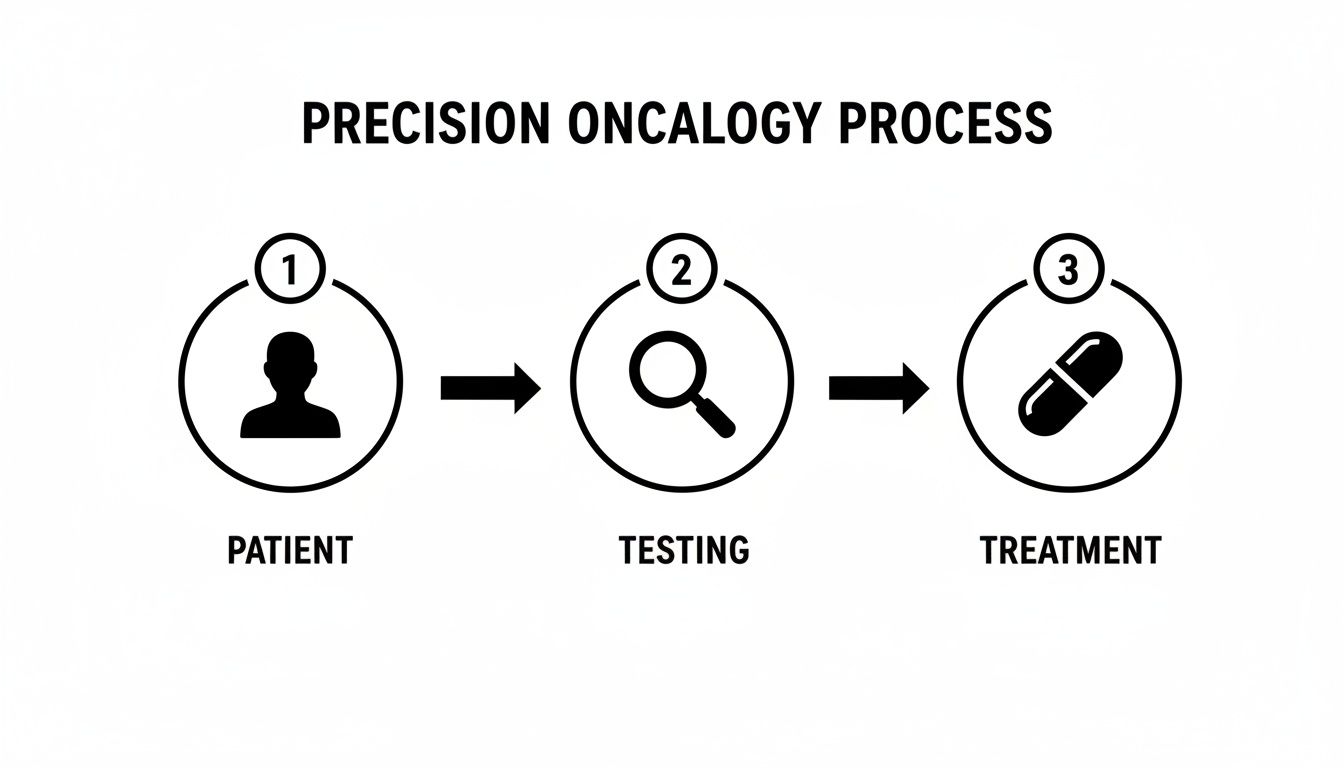
As you can see, your biological sample undergoes sophisticated testing, and the results directly guide us in choosing a targeted treatment plan designed just for you.
Making Sense of Your Genomic Profile Report
After the NGS analysis is complete, the lab creates a detailed report called a genomic or molecular profile. At first glance, this report can look overwhelming with its technical terms, but it’s actually a crucial roadmap for your oncologist. It clearly highlights the specific genetic alterations found inside your tumor.
Here are a few of the key "typos" the report might identify:
- Mutations: These are like single-word spelling mistakes in the DNA. A mutation can alter a gene's instructions, causing a protein to malfunction and tell the cell to grow out of control.
- Amplifications: This is when the tumor creates way too many copies of a particular gene. It’s like a copy machine getting stuck, printing thousands of copies of one page, which can dramatically boost the cancer’s growth signals.
- Fusions: This happens when two different genes break and then stick together, creating an abnormal hybrid gene. This brand-new gene can send powerful, non-stop "grow" signals to the cancer cell.
A genomic profile doesn't just list problems; it points to opportunities. Each identified alteration is a potential target—a specific lock that a specially designed drug, or targeted therapy, can fit into and shut down.
Understanding these results is the first step toward making truly informed decisions about your care. For a closer look, you can explore the different applications of genomic profiling in cancer treatment decisions in our guide. This report turns a complex lab analysis into a clear story, showing how your own biology can lead the way to the most effective treatment. It’s the very foundation of precision oncology, empowering your care team to move past guesswork and toward a genuinely personalized strategy.
Matching Targeted Therapies to Cancer Biomarkers
Once your genomic report identifies the specific genetic "typos" driving your cancer, the next step is to find the right tool for the job. This is where the true power of precision oncology comes to life—we move from simply knowing what's wrong to actively fixing it with specialized drugs.
The key to this entire process is the biomarker. You can think of a biomarker as a unique flag or signal that a cancer cell displays, either on its surface or inside. These flags are the direct result of the genetic mutations we found during testing.
A targeted therapy, then, is a drug engineered specifically to recognize and interact with one of those biomarkers. It’s like having a key that only fits one particular lock. By going after these unique flags, the therapy can attack cancer cells directly while leaving most of your healthy cells alone.
From Lab Report to Lifesaving Treatment
This connection between a biomarker and a drug isn't just a theory; it's a practical reality that is changing lives. We see this principle in action across many different cancer types, where identifying a specific biomarker has completely transformed the standard of care.
The logic is straightforward: if your tumor has a certain biomarker, then a specific targeted therapy can be used to block the cancer's growth pathway. This direct link is what turns a complex lab result into a clear, effective treatment plan. The goal is to get away from one-size-fits-all treatments and instead use a strategy designed for your tumor's exact biology.
The core idea is simple: your genomic report provides the coordinates, and the targeted therapy is the smart missile sent to that exact location. It’s a highly focused strategy designed for maximum impact on the cancer with minimal collateral damage.
This is precisely why understanding all of your treatment options has become so important. You can find more details in our guide on how targeted therapy works and its role in modern cancer care.
Now, let's look at a few real-world examples to see how this works in practice.
Examples of Biomarkers and Corresponding Targeted Therapies
The following table shows some of the most well-known biomarkers and the drugs designed to target them. This isn't an exhaustive list, but it clearly illustrates how a specific genetic finding can lead directly to a specific treatment.
As you can see, each drug is designed to exploit a very specific vulnerability in the cancer cell. This elegant approach is what makes precision oncology so powerful.
A Closer Look at How It Works
Here are a couple of prominent examples that show how matching the right drug to the right biomarker makes a profound difference for patients.
Breast Cancer and the HER2 Biomarker
- The Biomarker: Some breast cancer cells have far too many copies of a protein called HER2 (Human Epidermal growth factor Receptor 2). This over-expression acts like a stuck gas pedal, causing the cells to grow and divide uncontrollably.
- The Targeted Therapy: Drugs like Trastuzumab (Herceptin) are antibodies designed to attach to the HER2 protein on the outside of the cancer cell.
- The Action: By latching onto HER2, Herceptin physically blocks the growth signal from ever getting inside. It also acts like a beacon, flagging the cancer cell for destruction by the patient's own immune system.
Lung Cancer and the EGFR Mutation
- The Biomarker: In some non-small cell lung cancers, a mutation in the EGFR (Epidermal Growth Factor Receptor) gene causes the receptor to be constantly "on," sending non-stop growth signals without needing the proper trigger.
- The Targeted Therapy: Medications like Osimertinib (Tagrisso) are known as "small molecule inhibitors" because they are tiny enough to get inside the cancer cell.
- The Action: Tagrisso works by fitting perfectly into the faulty part of the EGFR protein, jamming its internal signaling machinery and effectively shutting down the cancer’s growth engine from within.
These examples really get to the heart of a complex science. By identifying a specific vulnerability, we can deploy a drug designed to exploit it. This is the essence of precision oncology—turning a deep understanding of a tumor's biology into a direct and powerful therapeutic action.
The Realities of a Personalized Cancer Approach
Precision oncology is a huge step forward, offering incredible hope to patients and their families. But like any medical treatment, it's important to look at the full picture. This personalized approach to cancer has some truly game-changing benefits, but it also comes with real-world challenges that doctors and researchers are working hard to solve every day.
Understanding both sides helps you make the best, most informed decisions for your care. It’s all about knowing what’s possible while being realistic about the path ahead.
The Clear Advantages of a Targeted Strategy
One of the biggest wins for precision oncology is the potential for more effective treatments. When we can match a specific drug to the exact genetic mutation driving a cancer, the results can be far better than what we see with traditional, one-size-fits-all therapies. It’s like having the right key for a very specific lock—you're directly targeting the engine that makes the cancer grow.
This targeted action often brings another welcome benefit: fewer harsh side effects. Because these therapies are designed to hunt down cancer cells, they tend to leave healthy cells alone. This is a world away from traditional chemotherapy, and it often means patients can maintain a much better quality of life during their treatment.
Finally, there’s a real sense of empowerment that comes from having a plan built just for you. It shifts the experience from following a standard procedure to executing a strategy based on your unique biology. That clarity gives you a feeling of control, knowing your treatment is guided by the best information we have about your specific tumor.
This isn't just a futuristic idea; it's a powerful force in cancer care right now. The development of these targeted drugs—the therapeutics segment—makes up the vast majority of the precision oncology market, accounting for 71.7% of its share. North America is at the forefront of this work, responsible for 42.5% of the total revenue in 2022, thanks to a strong healthcare system and a deep commitment to research. You can explore the complete market analysis on GrandviewResearch.com for a deeper dive.
Navigating the Current Limitations
While the potential is enormous, it’s important to be honest about the hurdles. A personalized approach isn't always straightforward, and there are a few key challenges we need to be aware of.
First, not every tumor has a known "targetable" mutation. We can run the most comprehensive genomic tests, but sometimes they don't turn up an actionable biomarker that has an approved drug ready to go. When that happens, your oncologist will turn to other proven treatments like chemotherapy or immunotherapy. The search just doesn't always yield a perfect match right away.
Another big challenge is something called acquired resistance. Cancer is clever and can adapt over time. A tumor might develop new mutations that let it sidestep a targeted therapy that was once working beautifully. Oncologists are very familiar with this possibility and are always thinking ahead, ready to pivot to a different treatment or a clinical trial if resistance develops.
Finally, there are some practical, real-world obstacles.
- Access to Testing: Getting comprehensive genomic testing isn't always simple, and figuring out insurance coverage can be a frustrating process.
- Cost of Therapies: Many targeted drugs come with a high price tag. Managing this requires a proactive approach, often with the help of financial navigators and patient assistance programs.
- Time: The whole process—from the biopsy to the genomic analysis and getting the final report—takes time. That waiting period can be incredibly difficult for patients and their families.
Even with these challenges, precision oncology is defined by its relentless push forward. Every day, researchers are working to find new targets, design smarter drugs to outwit resistance, and make these powerful treatments easier to access for everyone who needs them.
How to Become an Advocate for Your Own Care
Knowing what precision oncology is is a great first step. But the next, and arguably most important, step is figuring out how to get access to it. Taking an active role in your own cancer care is one of the most powerful things you can do. Let’s walk through a clear roadmap for how you and your loved ones can champion the most personalized care possible.
Always remember: you are the most important person on your care team. Your questions, your concerns, your voice—they aren't just your right; they are essential for creating a treatment plan that truly fits your life and goals. Advocating for yourself means showing up prepared, asking tough questions, and being a real partner in every decision.
Starting the Conversation with Your Oncologist
Think of your relationship with your oncologist as a partnership. And like any good partnership, it thrives on open communication, especially when you're exploring sophisticated options like precision oncology. The best way to get this conversation started is to come to your appointment with a few specific questions about how genomic testing and targeted therapies could play a role in your treatment.
Here are a few ideas to get you started:
- Is genomic or molecular testing something we should consider for my type and stage of cancer?
- What could we learn from this testing that might change our current treatment plan?
- Can you walk me through the process? From the biopsy all the way to getting the results back?
- Given what you know about my diagnosis, are there specific targeted therapies or clinical trials I should have on my radar?
Being prepared for your appointments transforms them from passive updates into active strategy sessions. Your questions ensure that every possible avenue is explored, giving you confidence that you are on the best possible path forward.
There's no such thing as a small or silly question here. Your oncologist is your guide, but they can’t read your mind. This back-and-forth dialogue is what personalized care is built on.
The Importance of a Second Opinion
Getting a second opinion isn't just common in cancer care—it's a smart and respected part of the process. It's not about distrusting your doctor. It's about empowering yourself with more information and gaining the peace of mind that comes from hearing another expert's perspective.
This is particularly true for complex or advanced cancers where precision oncology might open up new doors. An oncologist who focuses specifically on your type of cancer may know about the very latest research, new targeted drugs, or clinical trials that are a perfect match for your tumor's unique molecular fingerprint.
Navigating the Practical Steps
Being an advocate also means getting a handle on the practical side of things. Understanding the logistics of accessing these advanced treatments can make the entire process feel much less overwhelming.
Here are a few key areas to focus on:
- Understanding the Biopsy: Ask what kind of biopsy is needed for the genomic test. Can they use tissue from a past surgery, or will a new sample be required?
- Deciphering Insurance Coverage: Most oncology offices have a financial navigator or specialist. This person is your best resource for figuring out what your insurance will cover for testing and treatment. Don’t be shy about asking for their help.
- Exploring Clinical Trials: Clinical trials are research studies that give patients access to new, promising treatments, sometimes years before they're widely available. They can be an incredible pathway to the very latest therapies.
- Making Sense of Results: Your genomic report will be full of complex information. Our guide on what to do with your genetic test results can give you some background to help you prepare for the follow-up conversation with your doctor.
By taking these proactive steps, you shift from being a passive patient to a true partner in your own care. You become an informed advocate, equipped with the confidence and knowledge to pursue the very best treatment options for you.
The Future of Precision Oncology Is Here
The world of precision oncology is moving incredibly fast. What felt like a far-off concept just a decade ago is now a central part of how we approach a patient's care. Let’s look at some of the breakthroughs that are shaping cancer treatment right now, opening up more options and bringing new hope to patients and their families.
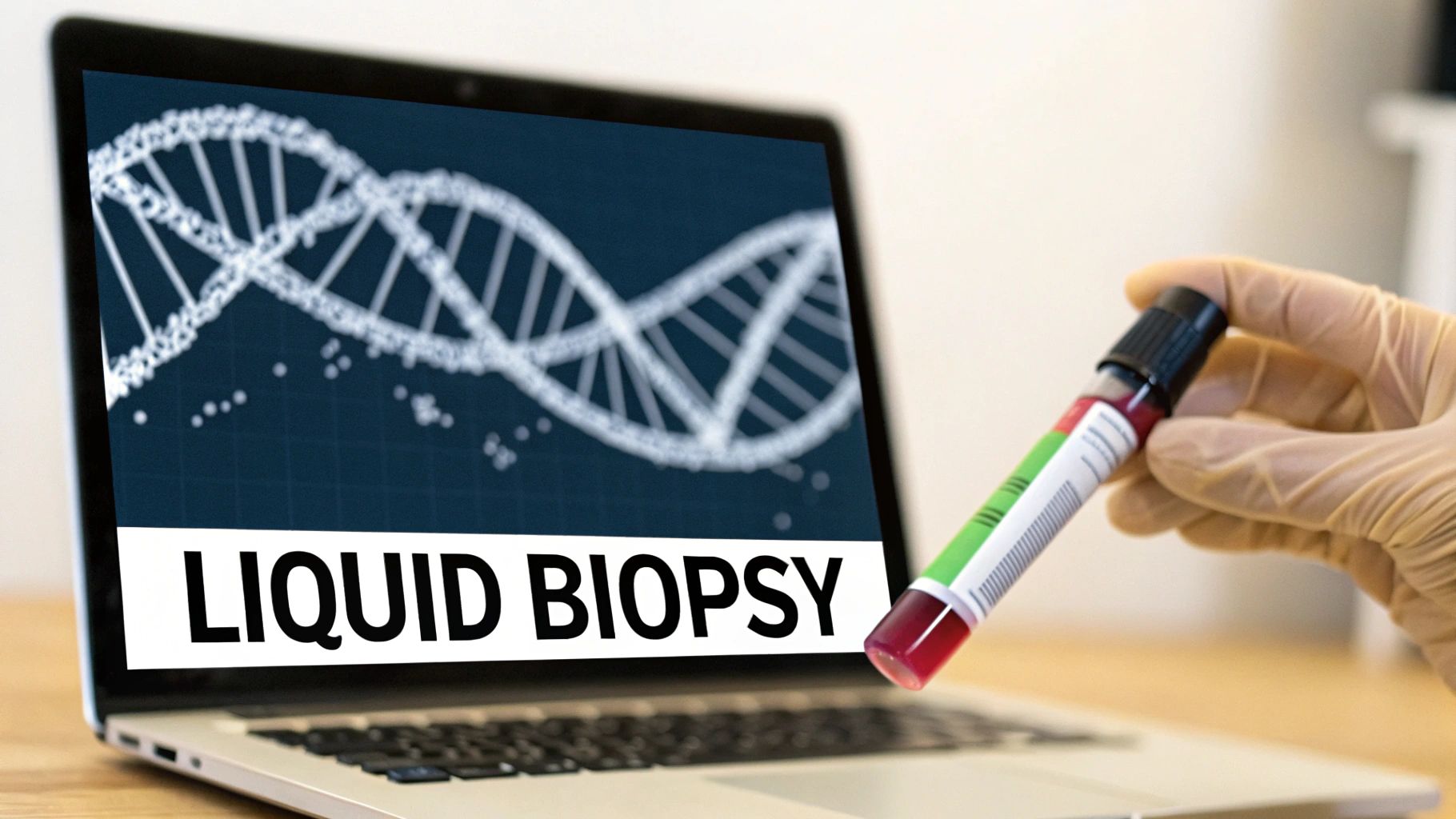
One of the biggest game-changers is the liquid biopsy. For years, the only way to analyze a tumor was through an invasive surgical biopsy. Now, we can often track a cancer and see how it’s responding to treatment with a simple blood test.
This test works by finding and analyzing tiny bits of cancer DNA, called circulating tumor DNA (ctDNA), that tumors release into the bloodstream. This gives your oncologist a real-time picture of the cancer's genetic profile, helping them monitor how well a treatment is working and detect signs of drug resistance as early as possible.
Smarter Tools and Strategies
It’s not just about less invasive testing. We’re also getting much smarter about how we analyze complex data and put together treatment plans. Two areas, in particular, are really pushing the boundaries of what precision oncology can do.
- Artificial Intelligence (AI): AI systems can sift through enormous databases of genetic information, clinical trial results, and patient outcomes—a task that would be impossible for a person. This helps oncologists better predict which treatments will work for a specific patient and can even help researchers identify entirely new biomarkers.
- Combination Therapies: We're learning that hitting cancer from multiple sides at once can be incredibly effective. By combining different targeted therapies or using a targeted drug alongside immunotherapy, we can create powerful treatment "cocktails" that make it much harder for a tumor to find a way to resist and grow.
The momentum behind these advancements is undeniable. Major investments are pouring into technologies like CRISPR gene editing and AI-driven drug discovery, all aimed at creating the next generation of cancer therapies. This progress is especially visible in regions with strong research and healthcare systems. You can learn more about the expanding precision oncology market to understand the global scale of this work.
The future of cancer care isn't on the horizon—it's already here. It’s a future where treatments are more specific, less invasive, and built around the individual. For patients and their loved ones, this constant progress shows that science is working relentlessly to turn the tide against this disease.
Your Questions About Precision Oncology, Answered
As you dig deeper into precision oncology, it's completely normal for questions to pop up. This way of treating cancer can feel a little complicated at first, but getting a handle on the details can empower you to make more confident decisions about your care. Here are a few of the most common questions we hear from patients and their families.
Can Precision Oncology Be Used for Any Type of Cancer?
That's a great question. We've seen incredible progress with precision oncology in many cancers—especially lung cancer, breast cancer, melanoma, and certain types of leukemia where we know a lot about the common genetic drivers. But, it isn't yet a standard, go-to option for every single cancer out there.
Whether a targeted therapy is available comes down to one thing: does your tumor have a specific genetic biomarker that an approved drug can lock onto? The good news is that research is moving at a breakneck pace, with new targets being identified all the time. It's always a worthwhile conversation to have with your oncologist about whether genomic testing makes sense for you.
Will My Insurance Pay for This Kind of Testing and Treatment?
Navigating insurance can feel like a maze, but coverage for genomic testing and targeted therapies is getting better. Many insurance plans, including Medicare, now cover broad genomic sequencing tests for patients with advanced cancers.
That said, your exact coverage can depend on the specific test, your cancer type, and the fine print in your policy. The targeted drugs themselves can be expensive, but most pharmaceutical companies have patient assistance programs to help with the cost.
The Bottom Line: The best first step is to work closely with your oncologist’s office and their financial navigator. They can help you verify your coverage and find financial assistance programs before you start treatment, which can save a lot of stress down the road.
What if the Test Doesn't Find Any "Actionable" Mutations?
It’s possible for a genomic test to come back without finding a mutation that has a matching, approved drug. It can be discouraging, but it absolutely does not mean you're out of options.
If no specific target is found, your oncologist will focus on the best standard-of-care treatments, which could be chemotherapy, immunotherapy, radiation, or a mix of approaches. The genomic report is still incredibly valuable in this scenario. It can often tell you which treatments are unlikely to work, saving you from therapies that won't help and come with needless side effects. Plus, it might point you toward a clinical trial that's studying a new drug for your tumor's unique genetic profile.
How Is This Different From Immunotherapy?
This is a really common point of confusion, as both are powerful, modern ways to treat cancer. They just work in very different ways.
- Precision Oncology is all about targeted therapies that hit specific genetic weak spots inside the cancer cells. Think of it like a smart bomb that only goes after a very specific target, shutting down the machinery that makes the cancer grow.
- Immunotherapy, on the other hand, is about revving up your body's own immune system. It essentially takes the brakes off your immune cells so they can better recognize and attack the cancer themselves.
Interestingly, the two fields are closely linked. Sometimes, genomic testing can reveal biomarkers (like PD-L1) that help predict if immunotherapy will be effective. In some cases, these two approaches can even be used together for a powerful, one-two punch against cancer.
At Hirschfeld Oncology, our goal is to help you find clarity in these complex decisions and explore every path forward. If you or someone you care about is dealing with a complex cancer diagnosis and wants to learn if a personalized treatment plan is the right fit, we encourage you to request a consultation. You can learn more by visiting us at https://honcology.com/blog.
.png)
.png)