.png)


If you're reading this from an apartment in Brooklyn, a treatment chair in Manhattan, or your phone on the subway after an oncology visit, you may be dealing with two things at once. The first is hair loss itself. The second is the scramble to figure out where to get help without spending hours on outdated websites and conflicting advice.
That confusion is understandable. A lot of people still search for american cancer society wigs expecting one national store or one simple application. In practice, the process has changed, and the most useful next step usually isn't more searching. It's knowing who to call, what to ask, and how to work from national guidance into local New York City support.
Navigating Hair Loss and Finding Support
Hair loss during cancer treatment can feel public even when you're trying to keep life private. Patients often tell me they can handle scans, lab work, and appointments better than they can handle the first handful of hair in the shower. That reaction is common, and it isn't vanity. Hair loss changes how you recognize yourself.
If you want a fuller explanation of treatment-related shedding and other causes, this guide on understanding why hair falls out can help put the experience in context. If you're trying to time practical decisions such as when to cut your hair, when to shop, or when scalp tenderness may start, this overview of the chemotherapy hair loss timeline is also useful.
Why the ACS information feels confusing
Part of the confusion is real, not imagined. The American Cancer Society's wig support moved from the long-running TLC program to the EverYou brand, which was relaunched in August 2024 and then discontinued as an ACS service on April 1, 2026, as summarized by Mayo Clinic's overview of hair loss during cancer treatment.
That matters because many pages, blog posts, and referrals still use older names. Some people will hear "TLC." Others will hear "EverYou." Others will be told to call a local American Cancer Society office. All of those references come from the same historical support pathway, but they don't describe the same current process.
The name changed. The national structure changed. The need for local help did not.
What patients in NYC should know first
For someone in New York City, the practical takeaway is simple. Don't wait for one national website to solve everything. Start local and use national lines to reach local resources faster.
In Brooklyn especially, access often depends on which chapter, hospital social worker, volunteer closet, or partner organization is active where you receive care. That's frustrating, but it's also why patients who ask direct questions early usually do better than patients who keep browsing and hoping the right page appears.
Understanding ACS Wig Programs in 2026
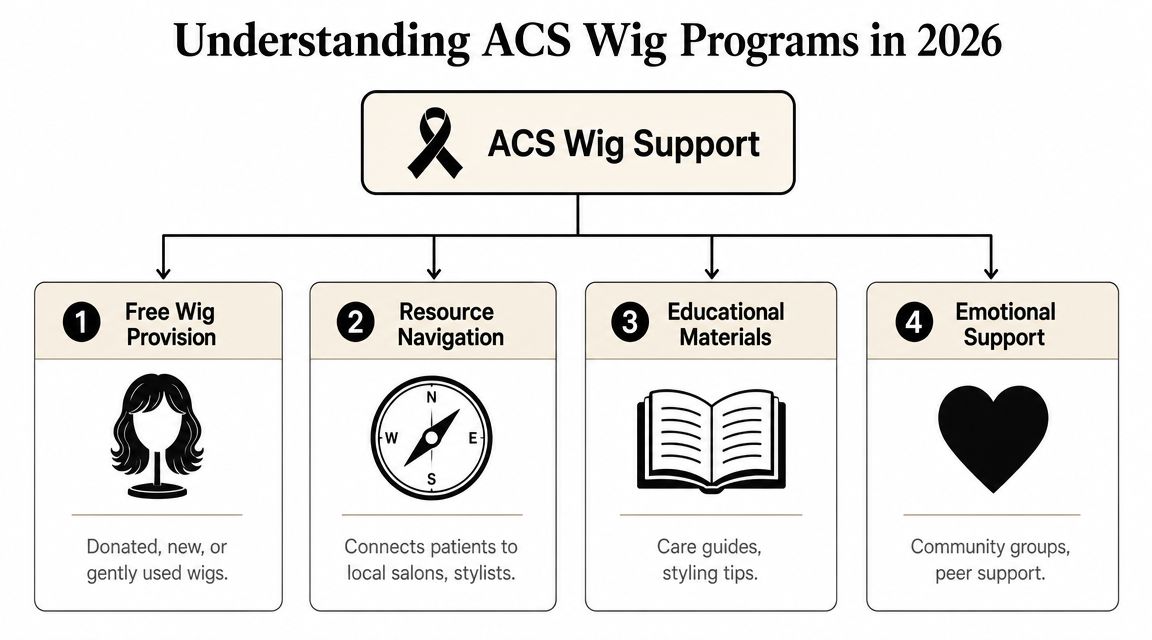
In 2026, american cancer society wigs are best understood as a local support pathway, not a single national catalog. Patients often picture a centralized program with the same inventory, same rules, and same turnaround everywhere. That isn't how access typically works now.
What the local-first model means
Access to ACS wig services is typically based at the local chapter level, often requiring an appointment for a fitting, as described in this Headcovers article on American Cancer Society wigs. That local-first setup matters because comfort and wearability depend heavily on fit, and fit is usually better handled in person than by guessing online.
Practical rule: "Getting an ACS wig" usually means connecting with a local office, local referral network, or local fitting arrangement. It rarely means clicking one button and having the same experience every patient gets nationwide.
In real life, this can include several different forms of support:
- A wig bank or gift closet with donated, new, or gently used wigs.
- Referral help to salons, fitters, or volunteers who work with cancer patients.
- Head covering options such as scarves, caps, or soft sleep hats for days when a wig feels like too much.
- Education and emotional support that helps patients learn basic care, storage, and what to wear when the scalp is tender.
Why availability varies so much
Local programs depend on staff, volunteers, space, and inventory. One office may have several styles available and fitting appointments within days. Another may mainly offer referrals. A hospital-based support program in NYC may also partner with nonprofit resources that don't show up clearly in a simple web search.
That variation is why I don't recommend assuming the first "no" is the final answer. If one office doesn't stock wigs directly, ask whether they maintain a referral list, a social work connection, or a patient boutique partnership.
The NYC lens
In New York, geography matters almost as much as eligibility. A resource in Midtown may not feel practical if you're exhausted after infusion and live in Bushwick. A Brooklyn patient often needs something close, quick, and realistic. That's why local chapter guidance, social work help, and hospital resource desks can be more useful than broad national messaging.
How to Access Local ACS Wig Services
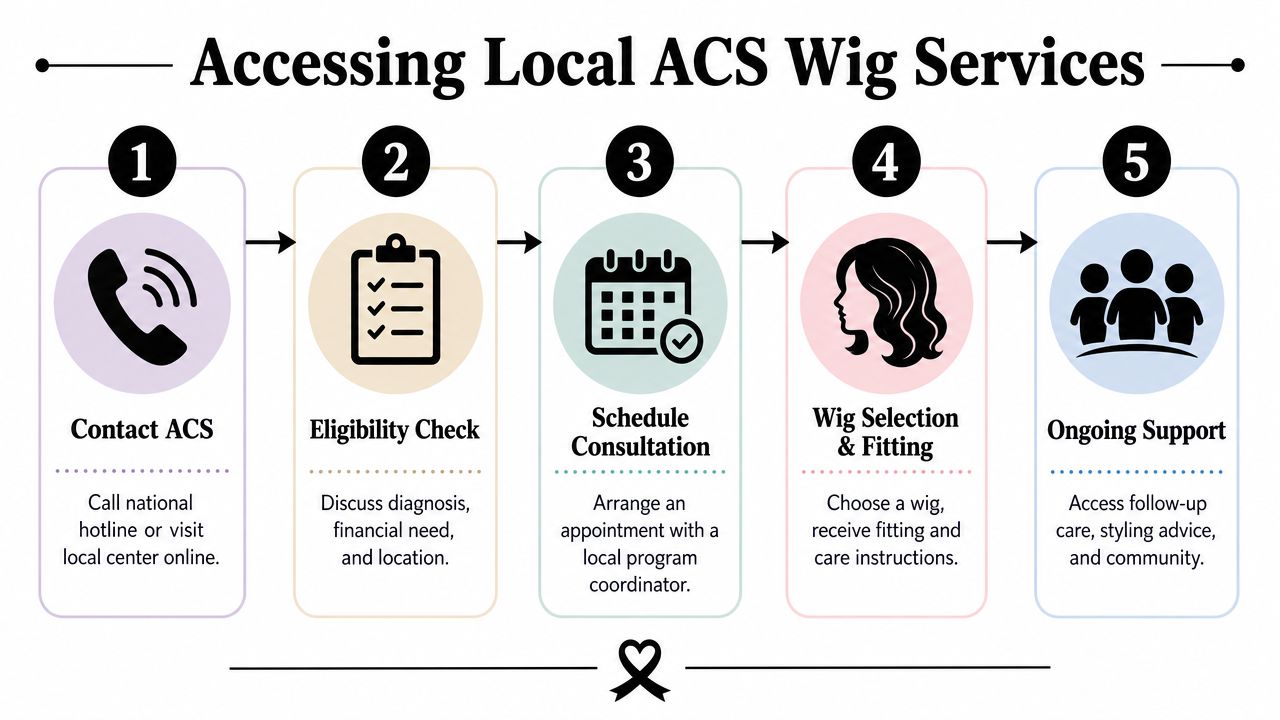
Most patients do best when they treat this like a short task list, not an open-ended research project. Start with the central phone route, then narrow to local options.
A useful video can make the process feel less abstract before you start making calls:
Start with the ACS helpline
Historically, the ACS cancer helpline at 800-227-2345 has been the primary access point for patients seeking direction to a local wig bank or financial help for a free wig, and a peer-reviewed 2025 study found that 31.4%, or 271 of 863 respondents, purchased wigs to cope with cancer-related alopecia, as reported in this PMC study on cancer-related alopecia and wig use.
That number matters because it shows wigs aren't a minor side issue. They're a common coping tool. If you're thinking about one, you're not overreacting.
Use this call script
When you call, keep your goal narrow. You are not asking for every cancer support service. You are asking for the fastest route to usable head coverage.
Ask these questions:
- Do you have a local wig bank or fitting partner in Brooklyn, Manhattan, Queens, or near my treatment center?
- Do I need an appointment before coming in?
- What documents should I bring if any are required?
- Is the wig free, reduced-cost, or donation-based, and how is eligibility determined?
- Do you also offer scarves, caps, or head coverings if I can't tolerate a wig every day?
- If you don't provide wigs directly, who do you refer patients to locally?
What to do after the call
Write down the name of the person you spoke with, the date, and any callback number. Patients in active treatment are often juggling multiple appointments, and details disappear fast.
Then do these three things in order:
- Book the first available fitting or consult if one is offered.
- Tell your oncology team or social worker what you've scheduled so they can suggest nearby alternatives if needed.
- Ask about backup options in case the first site has limited stock.
If you're in NYC, speed matters more than finding the perfect first wig. A reasonably comfortable wig this week is often better than the ideal wig after several more weeks of searching.
If you're in Brooklyn
Patients in Brooklyn should ask specifically about resources that are practical from Williamsburg, Bushwick, Downtown Brooklyn, and nearby hospital corridors. Travel burden is real during treatment. If an office gives you a referral in another borough, ask whether they know of a closer option or whether a social worker can help bridge the gap.
What to Expect at Your Wig Fitting
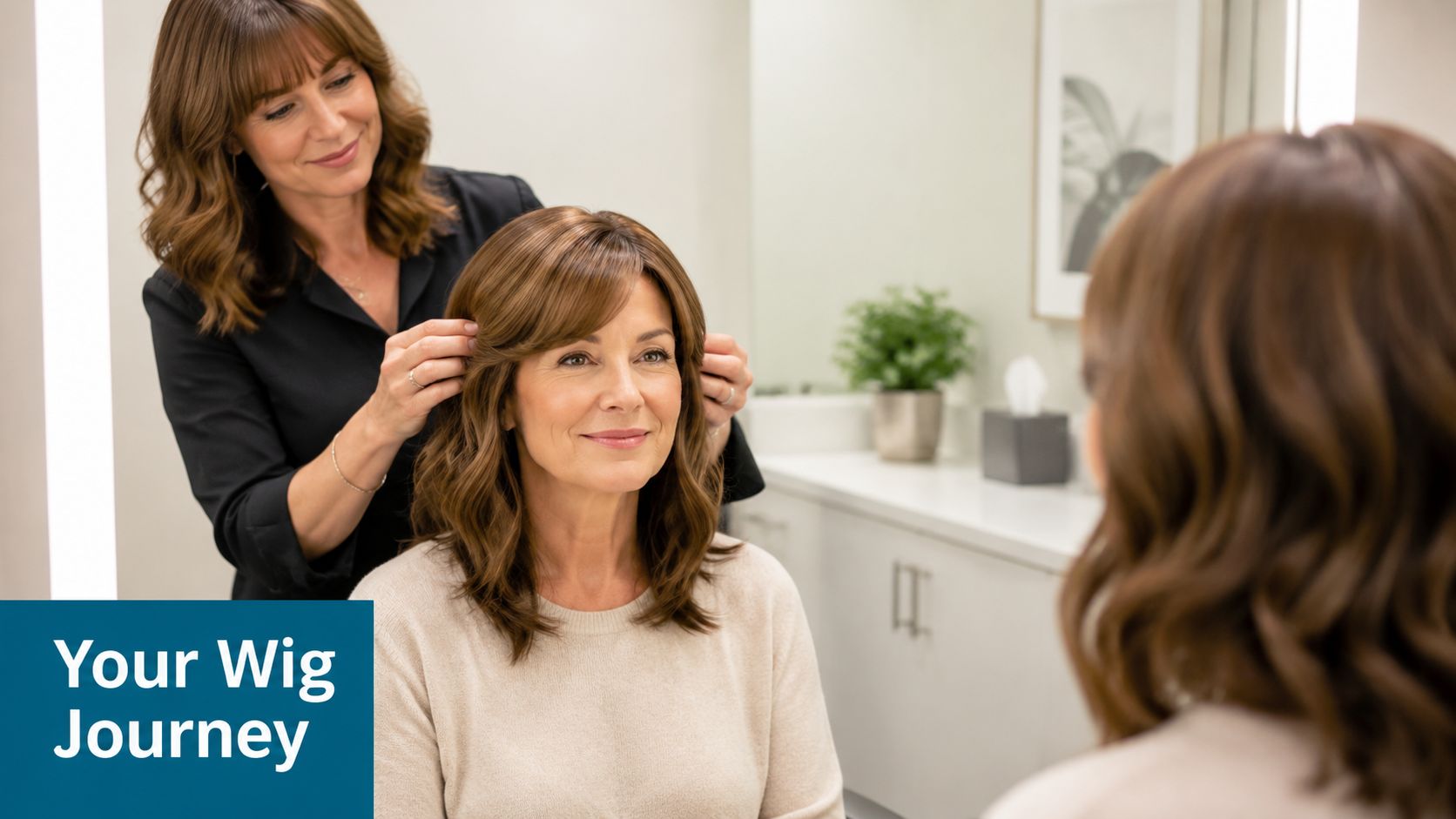
A fitting is usually much less intimidating than patients expect. It isn't a beauty pageant, and it isn't a test. It's a practical appointment built around comfort, privacy, and helping you leave with something you can wear.
The first few minutes
Most fittings begin with a short conversation. The person helping you may be a trained volunteer, boutique staff member, or program coordinator. They'll usually ask whether your hair has started shedding, whether your scalp is tender, and what you want the wig to do for you.
Some patients want to look like themselves. Others want something easy and low maintenance. Both are valid.
Measuring and trying styles
A good fitting focuses on fit before style. If the wig slips, pinches, rubs, or sits too low, you probably won't keep wearing it.
Common fitting steps include:
- Head measurement using circumference and basic dimensions, ideally after hair loss has begun or when hair is flattened closely to the scalp.
- Trying on more than one size or cap style because comfort varies even when labeled the same.
- Checking pressure points around the forehead, ears, and nape.
- Adjusting expectations if the exact former haircut or color isn't available in donation-based inventory.
A wig that feels secure and soft will usually get worn. A wig that looks good for five minutes but hurts after an hour often ends up in a drawer.
What patients often worry about
Patients often worry they'll be pushed into a style that doesn't feel like them. A respectful fitter won't do that. You can say, "This feels too dense," "This hairline doesn't look natural to me," or "I need something lighter because my scalp is sensitive."
You may also be shown alternatives. On some days, a soft cap or scarf is the better choice. That's not settling. That's matching the day to how you feel physically.
What to take home
Before you leave, try to get clear instructions on:
- How to put it on correctly
- How tight it should feel
- How to wash or store it
- Who to call if it needs adjustment
If the wig is close but not quite right, ask whether a trim, minor adjustment, or different liner could improve comfort. Small changes often matter more than patients expect.
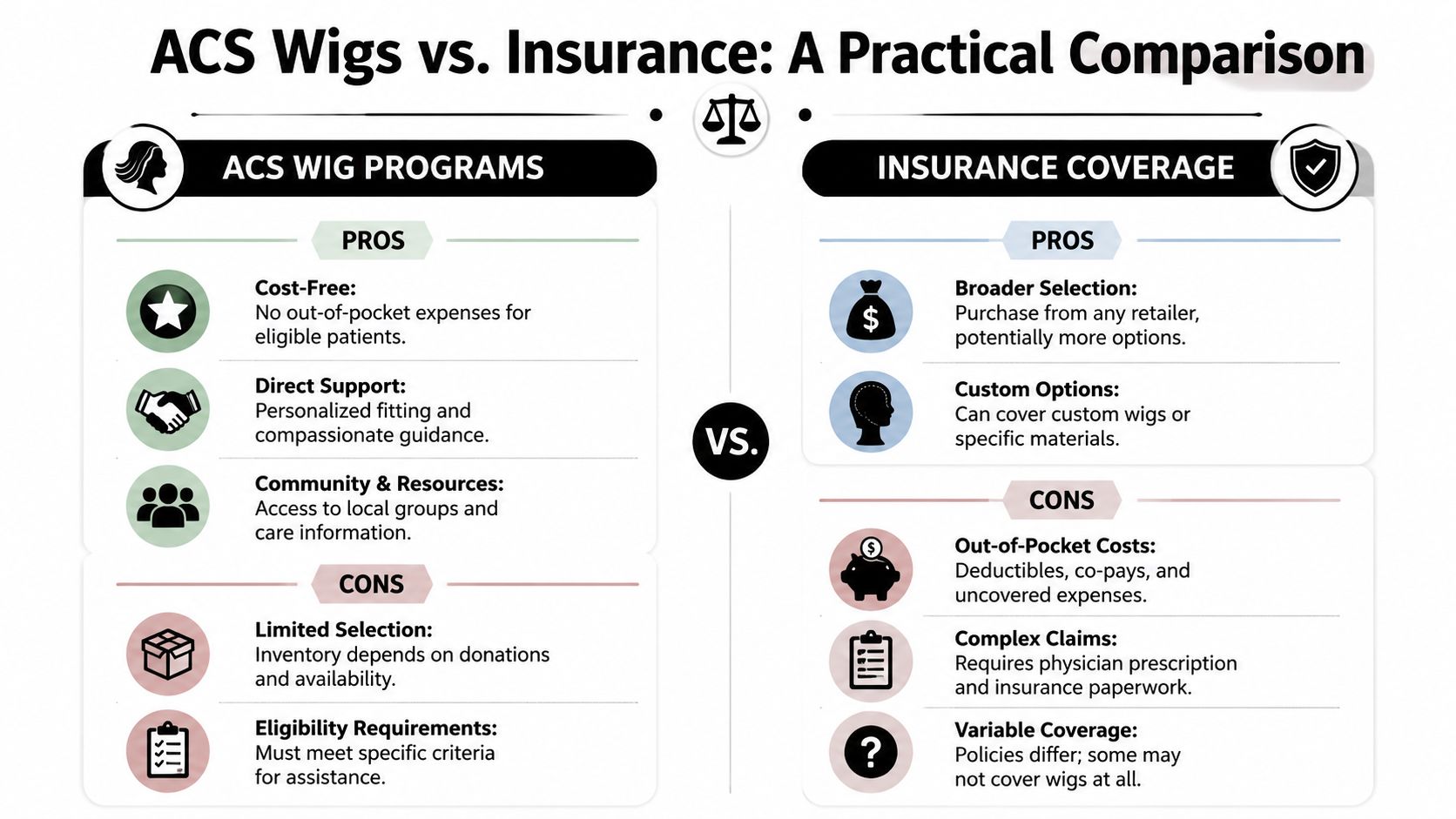
ACS Wigs vs Insurance Coverage A Practical Comparison
Many patients don't realize they may have more than one pathway. You might be deciding between a nonprofit wig resource, an insurance claim for a cranial prosthesis, or using both strategically.
The short version
Breastcancer.org advises patients to call their insurer first to ask whether a cranial prosthesis is covered, and notes that reimbursement usually requires a doctor's prescription, a receipt, and claim paperwork. Their guidance also points patients toward nonprofit help when coverage is absent, in this article on wigs and insurance for treatment-related hair loss. If you want a broader look at how coverage decisions can affect treatment costs and planning, this guide to insurance coverage for cancer patients is worth reading.
Side-by-side trade-offs
| Path | What tends to work well | What tends to be harder |
|---|---|---|
| ACS or local nonprofit route | Faster help, less paperwork, in-person support, lower financial pressure | Selection may depend on local inventory and eligibility |
| Insurance cranial prosthesis route | More freedom to choose retailer, style, or material | Requires prescription, claim steps, and confirmation before buying |
The practical question isn't which route is "better" in general. It's which route is better for you this week.
When ACS-style support is often the better first move
This route usually makes sense when you need something quickly, your energy is limited, or you're already overloaded with authorizations and bills. It also helps if you want a human being to guide the process instead of managing reimbursement forms on your own.
AARP previously reported that EverYou wigs started at about $30 and went up to $650, and that some patients could receive free wigs through financial assistance pathways, with support line guidance at 1-800-850-9445. If you're comparing appearance-based options beyond wigs alone, some patients also explore scalp solutions later, and this can help frame the decision: your complete SMP guide.
When insurance may be worth the effort
Insurance can be worthwhile if you want a specific wig, need broader selection, or expect to wear it often enough that personalization matters. The key is to call before purchasing. Many patients lose time and money by buying first and asking coverage questions afterward.
More Wig Resources in NYC and How We Can Help
If ACS-linked options don't come through quickly, don't stop there. Ask your treatment center's social worker about hospital boutiques, patient support programs, donated wig closets, and nonprofit referrals that are reachable from your neighborhood. In NYC, the best resource is often the one that is close enough to use during treatment, not the one with the best website.
For patients in Brooklyn, that means asking specifically for support you can access from Williamsburg, Bushwick, Bedford-Stuyvesant, Downtown Brooklyn, or lower Manhattan without turning the trip into an all-day project. Some programs focus on wigs. Others may offer scarves, caps, or fitting help even when wig inventory is limited.
What your care team can do
Your oncology team can often help in practical ways that patients don't always realize, including:
- Writing a prescription if you plan to pursue insurance for a cranial prosthesis.
- Connecting you with social work for local nonprofit and hospital-based support.
- Helping prioritize speed vs paperwork if you're deciding between immediate wig access and reimbursement.
- Addressing scalp discomfort if tenderness, rash, or friction is making wigs hard to wear.
If you need a broader starting point for local support beyond wigs, this page on cancer patient resources is a helpful next step.
One final reassurance
You do not have to solve this perfectly. You need a plan that matches your treatment, your energy, your budget, and how you want to look when you step outside. For many patients, the best answer is a combination: one practical wig, one soft head covering, and one backup option if the scalp is too sensitive.
If you need oncology care and practical support navigating treatment side effects in New York City, Hirschfeld Oncology can help you think through next steps, including prescriptions for cranial prostheses, resource navigation, and compassionate cancer care close to home in Brooklyn.
.png)
.png)