.png)


A CA 125 test is a simple blood test that measures the level of a protein known as Cancer Antigen 125. I often explain it to my patients as a kind of biological signal. It doesn't tell us the whole story on its own, but it’s an incredibly useful piece of information that helps us know when to investigate further.
What Is The CA 125 Test and Why Is It Used?

The protein this test looks for, Cancer Antigen 125, is a type of tumor marker. In oncology, we rely on these markers—substances that are often produced by cancer cells or by your body in response to cancer. They give us valuable clues about what's happening inside the body. If you're curious to learn more about how these signals work, we have a helpful guide explaining what cancer biomarkers are.
While CA 125 is most closely linked to ovarian cancer, it's very important to understand that its primary role is in monitoring the disease, not screening for it in the general population.
For a quick summary of what this test involves, take a look at the table below.
The CA 125 Test at a Glance
This table gives you the high-level view, but the real value of the test comes from how we use it in a specific clinical context.
Primary Uses in Oncology
When we order a CA 125 test, it's almost always for one of a few key reasons, tailored to a patient's unique journey:
- Monitoring Treatment Response: For a patient already diagnosed with ovarian cancer, tracking CA 125 levels is a powerful way to see if treatment is working. A steady drop in the number is often a great sign that chemotherapy is successfully shrinking the tumor.
- Detecting Recurrence: After a patient finishes treatment and is in remission, regular CA 125 tests act as an early warning system. A rising level can be the first indication that the cancer might be returning, often prompting us to order scans before any symptoms appear.
- Assessing a Pelvic Mass: If an ultrasound reveals a mass in the pelvic area, a CA 125 test can help us gauge the likelihood of it being cancerous. This is particularly helpful for postmenopausal women.
The test is especially reliable for tracking the disease once it's been diagnosed. For instance, compelling research shows that among women with epithelial ovarian cancer, 88.2% have elevated CA-125 levels. This figure climbs even higher for advanced disease, reaching 96.7% in stage IV cases, which highlights why it's so vital for managing a patient's care. You can read the full study in the JAMA Network Open publication.
Why It Is Not a General Screening Tool
Now, here’s a common and completely understandable point of confusion. Many people assume the CA 125 test is a routine screening tool for ovarian cancer, like a mammogram is for breast cancer. This is not the case, and there's a critical reason why: it isn't specific enough.
An elevated CA 125 level is not a definitive diagnosis of cancer. It is a biological signal that tells your oncologist, "we need to look closer."
Many perfectly benign conditions can cause a temporary rise in CA 125. Things like endometriosis, uterine fibroids, pelvic inflammatory disease, and even just menstruation can cause the number to go up.
If we used this test to screen all women, it would create a huge number of "false positives." This would lead to immense anxiety and trigger a cascade of unnecessary and invasive follow-up procedures for countless healthy women. Its true power lies in its targeted application—as one important tool among many in a comprehensive and personalized cancer care plan.
How the CA 125 Test Works: A Step-by-Step Guide

Hearing your doctor mention a CA 125 test can bring on a wave of questions and, understandably, some anxiety. But the good news is that the test itself is incredibly simple and routine. Knowing exactly what to expect can go a long way in making the process feel less intimidating.
It all starts with your doctor’s order, whether to investigate new symptoms or monitor how a treatment is working. From there, it’s just a standard blood draw.
What to Expect During the Test
One of the best things about this test is its simplicity. There’s no special preparation needed. You don’t have to fast or change anything about your daily routine, and the test can be done at any time of day.
The blood draw itself is quick and follows the same steps as any other routine blood work:
- A nurse or phlebotomist will start by cleaning a small patch of skin on your arm, usually at the inner elbow.
- Next, they’ll insert a small, thin needle into a vein to collect a blood sample. You might feel a quick pinch, but the whole thing is typically over in less than a minute.
- Once the sample is collected, they’ll place a small bandage over the area.
And that’s it. You can get right back to your day. The risks are the same as any blood draw—just a slight chance of minor bruising or discomfort at the site.
A single CA 125 test provides a snapshot in time. For this reason, we oncologists rarely make decisions based on one number. Instead, we look for the trend—is the level rising, falling, or staying consistent over several tests? That pattern tells the real story.
From Your Arm to the Final Report
Your blood sample is then sent off to a clinical laboratory. There, skilled technicians use a highly accurate and automated process called an immunoassay to measure the amount of CA 125 protein in your blood.
Results are usually ready within a few business days. The lab sends the report directly to your oncologist, who will then put that number into context.
Your doctor is the one who translates the lab result into something meaningful for your specific situation. They’ll review it alongside your medical history, imaging scans, and current health status. Once they have the full picture, they will contact you to discuss what the results mean and what the next steps should be.
How to Interpret Your CA 125 Results
Waiting for test results can be one of the most nerve-wracking parts of any health journey. When the report finally arrives, seeing that single number—your CA 125 level—can feel overwhelming. But that number is just a starting point, and my job as your oncologist is to help you understand exactly what it means.
The widely accepted "normal" range for CA 125 is anything below 35 U/mL (units per milliliter). If your result falls in this range, it’s often a good sign. But if it’s higher, it’s crucial to remember that an elevated CA 125 level is a signal, not a diagnosis. It simply tells us we need to look closer.
The Single Number vs. The Overall Trend
It’s completely natural to fixate on one test result, but in oncology, we almost never make a major decision based on a single data point. Think of a single CA 125 number like a single day's weather report. It gives you a snapshot—today is 75 degrees and sunny—but it can't tell you if a heatwave is coming or if temperatures are about to drop.
What we really care about is the trend over time. This is more like watching the weather forecast over several weeks. By collecting a series of CA 125 results, we can see which way the wind is blowing. Is the number climbing, falling, or holding steady? That pattern tells a much more meaningful story about what's happening inside your body.
A single elevated CA 125 test result is a point of information, not a conclusion. The trend over time—whether the levels are rising, falling, or remaining stable—is what truly guides your oncologist’s next steps.
For a patient being treated for ovarian cancer, the trend is everything. Here’s how we might look at it:
- A Decreasing Trend: If your CA 125 was high and is now consistently dropping with each test, that’s a fantastic indicator that your treatment is working as it should.
- A Stable Trend: Perhaps your level is slightly elevated but isn't changing much over several months. This might point to a benign condition or a very slow-moving cancer that we can simply continue to monitor closely.
- A Rising Trend: A steady, persistent rise in your CA 125 is the pattern that gets our attention. This can be an early warning that the cancer might be growing or recurring, which is why we monitor it so carefully. To understand more about what to watch for, you can read our guide on ovarian cancer recurrence symptoms.
This is exactly why your doctor will schedule a series of tests instead of relying on just one. The story unfolds over time.
Understanding Sensitivity and Specificity
To really understand the CA 125 test, it helps to know two important terms: sensitivity and specificity. In simple terms, sensitivity is how well a test catches what it’s looking for (in this case, cancer). Specificity is how well it avoids flagging people who don't have the disease.
The CA 125 test is quite sensitive, especially for advanced ovarian cancer. One major study found that CA 125 levels were elevated (above 35 U/mL) in 69% of women with malignant ovarian tumors.
But here’s the catch. The same study revealed the test’s specificity was only 68%. That means 32% of women who had elevated levels actually had a benign, non-cancerous condition. You can explore these findings on the CA-125 test's performance for yourself. This is precisely why a high number, on its own, doesn’t tell the whole story.
The Importance of Clinical Context
Your CA 125 result is just one piece of a much larger puzzle. Here at Hirschfeld Oncology, we never interpret that number in a vacuum. We always place it in the context of your whole health picture.
We’ll consider factors like:
- Your Medical History: Do you have conditions like endometriosis or uterine fibroids that are known to raise CA 125 levels?
- Your Menopausal Status: Pre-menopausal women often have higher CA 125 levels for completely benign reasons.
- Physical Exam Findings: What did we find during your most recent physical and pelvic exam?
- Imaging Results: How does your CA 125 trend line up with what we’re seeing on your latest ultrasound, CT, or PET scan?
Ultimately, that number on your lab report is the start of a conversation, not the end of one. It helps guide our decisions, but it doesn't make them for us. By looking at the trend and putting it together with everything else we know about you, we can create a clear, personalized plan that makes sense for you.
What Else Can Cause a High CA 125 Reading?
Getting a high CA 125 test result can be unsettling, but it’s important to know that this number is rarely a straightforward answer. It’s more like a sensitive alarm system—it tells us something is happening, but it can’t distinguish between a serious issue and a minor disturbance. Many common, non-cancerous conditions can trigger this alarm.
This visual helps put the standard CA 125 lab values into perspective.
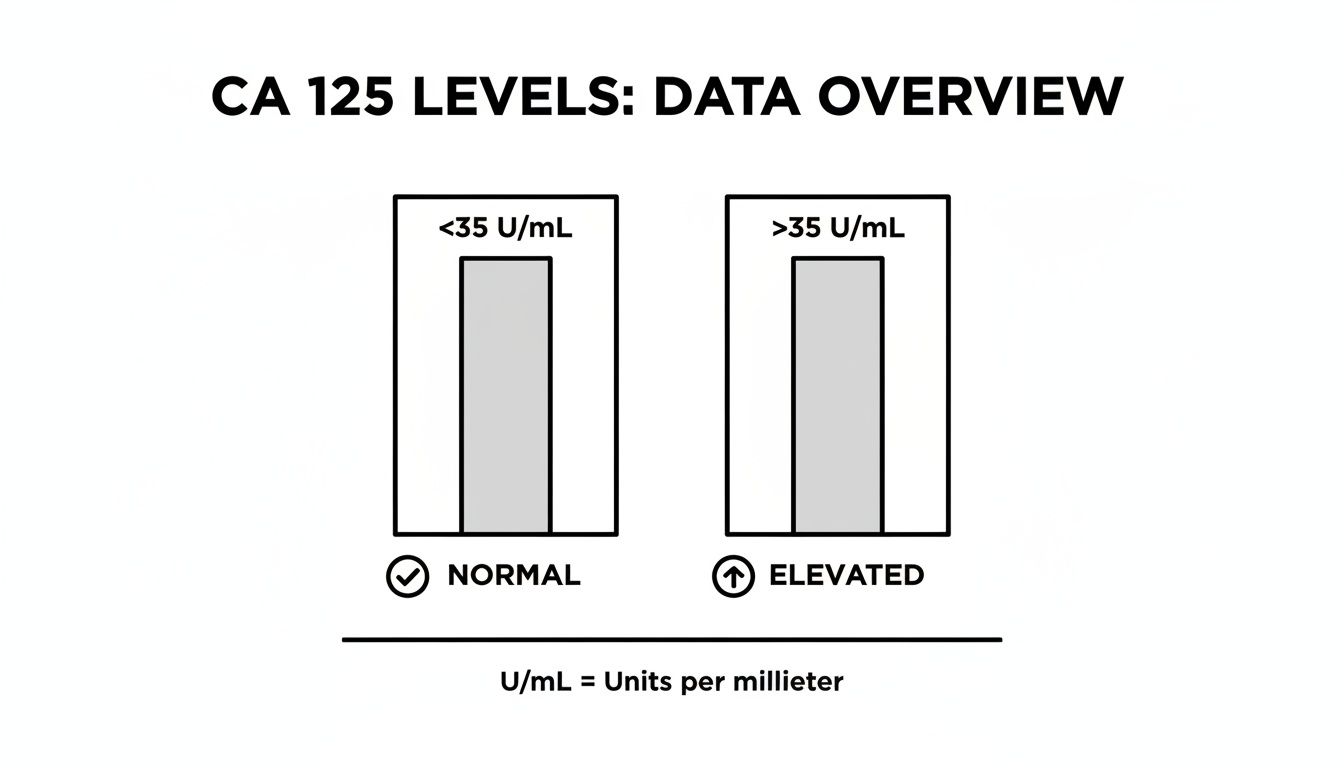
A result over 35 U/mL simply tells us we need to investigate further. It doesn’t automatically mean cancer.
Benign Conditions That Can Raise CA 125
So, what kind of "minor disturbances" are we talking about? The CA 125 protein is produced by cells lining the abdomen and pelvis. When these tissues become inflamed or irritated for any reason, they naturally release more of this protein into the bloodstream.
Even a normal menstrual cycle can cause temporary spikes in CA 125 for premenopausal women. Other very common, non-cancerous culprits include:
- Endometriosis: Tissue that normally lines the uterus grows elsewhere, causing chronic inflammation.
- Uterine Fibroids: These are common, benign growths on the uterus that can sometimes affect CA 125 levels.
- Pelvic Inflammatory Disease (PID): A significant infection of the reproductive organs that triggers a strong inflammatory response.
- Liver Conditions: Diseases like cirrhosis or hepatitis can throw off various protein levels in the body, including CA 125.
- Pregnancy: It’s quite normal to see a temporary rise in CA 125 during the first trimester.
Because the list of possibilities is so long, an elevated number is just the beginning of the story, not the end.
To help organize these possibilities, this table breaks down the common causes of an elevated CA 125 level, separating them by category.
Common Causes of an Elevated CA 125 Level
As you can see, the list of non-cancerous causes is quite extensive. This is why we never rely on this single number for a diagnosis.
How Other Cancers Affect CA 125
While we often connect CA 125 with ovarian cancer, it's what we call a "non-specific" tumor marker. This means other cancers can produce it, too, which is another crucial reason why a single high reading requires a careful, comprehensive evaluation.
Other cancers that might cause a spike in CA 125 include malignancies of the:
- Endometrium (uterus)
- Fallopian tube
- Pancreas
- Breast
- Lung
- Colon
As your oncologist, my job is to look at your entire clinical picture—your symptoms, your physical exam, and imaging results—to connect the dots and decide on the most logical next steps.
Why Your Personal Context Is Crucial
It’s also fascinating how a person's background can influence test results. Research shows that CA 125 test performance can differ by ethnicity. For example, Black women have shown the highest test sensitivity at 90.7%, a vital piece of information for a diverse urban practice like ours in New York City.
Even at the standard 35 U/mL cutoff—where the estimated cancer risk was found to be only 2.4%—many benign issues like fibroids or ascites (fluid in the abdomen) also caused elevated levels. This data perfectly illustrates why CA 125 is not a general screening tool. You can discover more insights on CA-125 accuracy across different populations to explore these nuances further.
This is exactly why a personalized interpretation is non-negotiable. At Hirschfeld Oncology, we look at everything from your unique health history to these broader demographic insights to make sense of your results.
A high CA 125 level is a question, not an answer. It prompts a deeper investigation into your health, considering all possible benign and malignant causes before reaching any conclusions.
Navigating Next Steps After an Abnormal Result
Seeing an abnormal CA 125 test result on your report is understandably jarring. It’s easy for your mind to race, and a wave of anxiety is a completely normal reaction. The most important thing to remember is that this number isn't a diagnosis—it's a signal. Think of it as a blinking light on your car's dashboard; it tells us we need to look under the hood, not that the engine has failed.
An elevated CA 125 reading simply means it’s time to gather more information. This is where your oncologist's work really begins, piecing together the full story of your health.
Building a Clearer Picture with Imaging
The very first step is to get a visual. We need to see what’s happening in your pelvic region to understand what might be causing that number to be high.
Your doctor will almost always start with a transvaginal ultrasound. It’s a straightforward and non-invasive procedure that uses sound waves to give us a remarkably detailed look at your ovaries, uterus, and other nearby structures. This is our go-to first-line tool for spotting any cysts, masses, or other physical changes that could be the culprit.
If the ultrasound isn't perfectly clear or reveals something that needs a closer look, we’ll bring in more powerful imaging:
- CT (Computed Tomography) Scan: A CT scan gives us a series of cross-sectional images, like looking at individual slices of a loaf of bread. This helps us see the exact size, shape, and position of any mass and determine if it’s affecting other organs or lymph nodes. We have a great resource that goes into more detail on this topic: a CT scan can detect ovarian cancer.
- PET (Positron Emission Tomography) Scan: This is a different kind of scan that looks for function, not just structure. It highlights areas in the body with high metabolic activity, a common sign of cancer cells. A PET scan can be incredibly helpful in telling benign and malignant growths apart.
Together, these tools help us turn an abstract number from your blood work into a concrete picture of what's going on.
Looking Beyond CA 125
While imaging tells us where to look, other blood tests can help clarify what we’re looking at. Since CA 125 can be elevated for many reasons, your doctor may order other tumor marker tests, especially if a pelvic mass has been found.
A key one is HE4 (Human Epididymis Protein 4). On its own, it has limited value, but when we combine the HE4 and CA 125 results using a formula called the Risk of Ovarian Malignancy Algorithm (ROMA), we get a much more predictive score for how likely it is that a pelvic mass is cancerous.
An abnormal CA 125 result is the beginning of a conversation. It triggers a series of logical steps—imaging, further bloodwork, and expert consultation—designed to give you and your doctor a complete and accurate picture of your health.
Navigating these steps requires open and clear communication with your medical team. Sometimes, technology can help bridge gaps, especially for follow-ups or second opinions. This guide on how providers use Video Conferencing for Healthcare offers a good overview of these tools.
If all the evidence—your CA 125 trend, imaging results, and other markers—points to a high suspicion of ovarian cancer, the next crucial step is a referral to a gynecologic oncologist. These are surgeons who have dedicated their careers to treating cancers of the female reproductive system. They are the experts you want in your corner for performing surgery and managing your treatment.
At Hirschfeld Oncology, we are your partners in this process. We sit down with you and explain what every test means, what the possible paths are, and what we recommend doing next. Our entire focus is on creating a clear, personalized plan that helps you feel supported, informed, and in control. We are here to turn that initial uncertainty into a clear path forward.
Common Questions About the CA 125 Test
It's completely normal to have questions when you're faced with a test like the CA 125. Understanding what it can—and can't—tell us is key. Let's walk through some of the most common concerns I hear from patients every day.
Can the CA 125 Test Be Wrong?
This is a great question, and the short answer is yes. The results can sometimes be misleading, which is precisely why we never rely on a CA 125 test alone to make a diagnosis.
Think of it this way: the test isn't "wrong" in the sense of being broken, but it can point in the wrong direction. This happens in two main ways:
- False Positives: A result can come back high even when cancer isn't present. Many non-cancerous conditions, from endometriosis and uterine fibroids to something as simple as pregnancy, can temporarily raise your CA 125 levels.
- False Negatives: It's also possible for someone to have ovarian cancer, but their CA 125 level remains perfectly normal. In fact, this protein isn't produced by every ovarian cancer, and its ability to pick up on early-stage disease is only around 50%.
Because of this, we always look at the bigger picture. Your CA 125 number is just one piece of information that we consider alongside imaging scans, a physical exam, and your overall health history.
How Often Will I Need This Test?
There’s no single, universal schedule for CA 125 testing. How often you'll need the test is tied directly to your unique situation.
Your testing schedule is a personalized plan based on your diagnosis, treatment phase, and risk factors. It's a dynamic tool that your oncologist adjusts as your health journey evolves.
Here are a few examples of what this might look like in practice:
- During Treatment: If you're undergoing chemotherapy for ovarian cancer, we might check your CA 125 levels every few weeks. Watching this number fall is a powerful indicator that the treatment is working as intended.
- After Treatment (Remission): For the first couple of years post-treatment, we may test you every 2-4 months. This helps us monitor for any signs of a recurrence as early as possible. As time goes on with stable results, we can often stretch this out to every six months, and eventually, just once a year.
- High-Risk Monitoring: For women with a strong family history of ovarian cancer or a known genetic mutation like BRCA1 or BRCA2, we might use periodic CA 125 tests as part of a wider surveillance plan.
Does a Normal CA 125 Guarantee I Am Cancer-Free?
No, and this is probably the single most important thing to understand about this test. A normal CA 125 level (typically anything below 35 U/mL) is reassuring, but it is not a guarantee that you are cancer-free.
As we covered, about half of all early-stage ovarian cancers don't release enough CA 125 to move the needle on a blood test. This is the main reason why we don't use the CA 125 test to screen the general population for ovarian cancer.
Its true value emerges when we're monitoring a diagnosed cancer over time. In that context, the trend—whether the numbers are steadily rising or falling—tells a far more reliable story than any single snapshot result.
If you have more questions about your CA 125 results or want to get a second opinion on your cancer care plan in the New York City area, the team at Hirschfeld Oncology is here to offer clarity and guidance. We believe every patient deserves to understand all aspects of their care. To schedule a consultation, please visit us at honcology.com/blog.
.png)
.png)