


.png)


When you hear the words, "you have cancer," your world doesn't just stop—it shatters. That shockwave doesn't just hit you; it radiates outward, touching every single relationship in your life. It’s like a sudden, violent storm rolling in on a calm day, instantly testing the foundation of your connections with your partner, family, and friends.
The Unspoken Impact of Cancer on Your Relationships

The moment cancer enters the conversation, the familiar rhythm of your relationships changes. The diagnosis itself can hang in the air, thick with fear, uncertainty, and a profound sense of helplessness for everyone. That initial shock rarely stays simple; it quickly evolves into more complex, long-term changes that can feel incredibly difficult to manage.
Think of your relationship like a boat you’ve been sailing together for years. You know its every creak and groan. A cancer diagnosis is the rogue wave that comes out of nowhere, threatening to capsize you. The journey ahead is going to be rough, and it's completely normal to feel like everything has been thrown off course.
The Immediate Emotional Aftermath
The first emotional wave is almost always a tsunami. As the person with cancer, you’re trying to process the diagnosis itself. But for your partner, family, and friends, the pain is different—it’s the agony of watching someone you love face this, combined with the frustration of not being able to make it go away. It’s a period defined by a raw, shared vulnerability.
It's common for a whole host of feelings to surface for everyone involved:
- Fear and Anxiety: The constant "what ifs" about the future, treatment, and the unknown can be a source of relentless stress.
- Sadness and Grief: It is perfectly okay—and necessary—to grieve the life you had before the diagnosis.
- Anger and Frustration: Feeling furious at the sheer unfairness of it all is a completely valid response for both you and your support system.
How Roles and Responsibilities Change
One of the most profound shifts happens in the day-to-day. A spouse might suddenly become a full-time caregiver. A child may have to step up and care for a parent. Friends find themselves in roles they never imagined. These new responsibilities often appear overnight, without any training or preparation.
The ways relationships can change are both immediate and far-reaching. Here’s a look at how different connections are often impacted.
Common Relationship Shifts After a Cancer Diagnosis
Recognizing these shifts is the first step toward navigating them. The person who was always the "rock" may now be the one who needs support, and the caregiver has to learn to balance this huge new role with their own well-being.
This guide is here to help you navigate these choppy waters. We’ll walk through real-world strategies for keeping your bonds strong, opening up lines of communication, and finding support for everyone. The storm is real, but you can learn to sail through it together. You might even emerge with connections that aren't just intact, but deeper and more resilient than ever before.
Navigating Love and Intimacy as a Couple

When cancer enters a relationship, it often feels like an uninvited guest has moved in—one who demands constant attention, upends your routines, and puts an enormous strain on the connection you’ve built. All of a sudden, conversations that once flowed easily from shared dreams to daily frustrations are now consumed by appointment schedules, treatment side effects, and a pervasive anxiety about what comes next.
It's a jarring shift. One moment you're partners, and the next you can feel like you've been cast into the roles of "patient" and "caregiver." It happens so fast it can leave you both feeling completely disoriented. One of you is navigating the physical and emotional turmoil of the illness itself, while the other is juggling logistics, trying to offer the right support, and wrestling with their own fear and exhaustion. This dynamic is a profound challenge, but it doesn't have to break your bond.
Protecting Your Identity as a Couple
The key is to be incredibly intentional about not letting cancer become the center of your universe. You have to actively protect your identity as a couple—the “we” that existed long before the diagnosis. It’s a team effort, and it requires making a conscious decision to prioritize your relationship.
One of the most powerful things you can do is schedule cancer-free time. This isn't just a nice idea; it's a non-negotiable practice for your emotional survival. Set aside dedicated time—maybe an evening each week or a few hours on a weekend—where any and all talk of medicine, symptoms, and logistics is completely off-limits. This carves out a protected space where you can just be you again.
What does this look like in practice?
- Dust off old hobbies you used to enjoy together before life got so complicated.
- Plan a simple date night, even if it’s just ordering takeout and watching a favorite movie on the couch.
- Talk about anything else. Your work, your friends, a funny story, a book you’re reading—anything that reminds you of the world outside of cancer.
Doing this allows you both to step out of those rigid patient-caregiver roles and back into being partners, lovers, and best friends. It’s a powerful reminder that your relationship is so much bigger than this illness.
A strong, supportive partnership isn't just a comfort; it can have a real, measurable impact on health outcomes. In fact, research consistently shows that married cancer patients have better survival rates. A comprehensive analysis revealed that married individuals with metastatic breast cancer had a 19.0% reduced risk of overall mortality compared to their unmarried counterparts. You can learn more about the research linking spousal support to improved cancer survival rates on nature.com.
Redefining Intimacy and Physical Closeness
Cancer and its treatments often bring a wave of physical changes that can make intimacy feel complicated, if not impossible. Things like pain, crushing fatigue, nausea, and new anxieties about body image can create an emotional and physical distance between you.
This is where you have to remember that intimacy is so much more than sex. It's about connection, vulnerability, and simple affection. Your most important tool here is communication. It’s time for honest, gentle conversations about what feels good and what doesn’t, what you’re afraid of, and what you’re longing for. This is no time for assumptions. You have to create a safe space to talk about it all without judgment. We offer some practical guidance on this in our detailed article on how chemotherapy can affect your sex life.
Exploring New Avenues for Connection
When your usual forms of physical intimacy feel out of reach, it's an opportunity to explore other ways of staying close. These small acts can reinforce your bond and offer immense comfort when you need it most.
Think about incorporating some of these into your daily life:
- Simple physical touch: Never underestimate the power of holding hands, a gentle back rub, cuddling on the sofa, or just sitting close enough that your shoulders are touching.
- Emotional intimacy: Share your hopes and your fears. If talking feels too difficult, try writing letters or leaving little notes for each other to find.
- Shared experiences: Create small moments of togetherness. Listen to music, read a book out loud to one another, or work on a simple puzzle. It’s about creating a quiet sense of shared purpose.
By broadening your definition of intimacy, you open up a whole new world of ways to connect and show up for each other. It’s about finding what works for you, right now, in this new reality. It's about celebrating the small moments of closeness and reaffirming, day by day, that you are in this together.
Supporting Your Partner Without Losing Yourself
When your partner is diagnosed with cancer, you’re thrown into a role you never wanted and never prepared for. It’s a profound act of love, of course, but it's also a marathon you didn't train for. Your world shrinks, and your focus narrows to one thing: caring for the person you love most.
But in the rush of appointments, medications, and emotional support, it's incredibly easy to lose yourself. The relationship dynamic shifts completely, and everything starts revolving around the illness. It's so important to remember that taking care of yourself isn't selfish—it's absolutely essential. If you don't, you simply won't be able to keep going.
The Myth of the Tireless Caregiver
We have this image in our culture of the perfect caregiver who is endlessly patient, strong, and never complains. That's a myth, and a dangerous one at that. The reality is that caregiver burnout is real, and it can creep up on you without warning. It’s a state of complete physical, emotional, and mental exhaustion.
Research has shown that a huge percentage of cancer caregivers experience serious distress, anxiety, and depression. Ignoring those feelings doesn't make you stronger; it just digs a deeper hole that's harder to climb out of later. Recognizing the early signs is the first step.
- Emotional Exhaustion: Do you feel constantly on edge, irritable, or just plain numb?
- Physical Symptoms: Are you struggling to sleep? Getting more headaches than usual? Catching every cold that goes around?
- Withdrawal: Have you stopped calling your friends back or given up hobbies you used to love?
If any of this sounds familiar, see it as a red flag. It’s your mind and body telling you to hit the brakes. You can't pour from an empty cup, and trying to will only lead to feeling drained and resentful.
Practical Ways to Stay Afloat
Keeping yourself going isn't about grand, sweeping changes. It’s about building small, sustainable habits that protect your energy and your spirit. The goal is to find a rhythm that allows you to be there for your partner without completely disappearing in the process.
Here are a few simple, practical things you can start doing right now:
- Create a Shared Calendar: Use a simple digital tool like Google Calendar. Put everything on it—appointments, medication times, even tasks like grocery shopping. Then, share it with a few trusted friends or family members. This way, people can see concrete ways to help (like grabbing milk on Tuesday or driving to an appointment on Friday) without you having to make a dozen phone calls.
- Schedule "You" Time: Just like you block out time for your partner’s medical visits, you need to schedule appointments with yourself. It could be 30 minutes to read a book, a walk around the neighborhood, or a quick coffee with a friend. Put it on the calendar and treat it as a non-negotiable commitment.
- Find Your People: No one understands what you're going through quite like someone else who is also going through it. Look for a support group, either locally or online, specifically for caregivers. Just being able to talk to people who truly "get it" can make you feel so much less alone.
"When you ask for help, you’re giving that other person a gift. You’re allowing that person to show that they care about you." Thinking about it this way can make it so much easier to reach out when you're feeling overwhelmed. It turns a moment of vulnerability into a chance to connect.
It's Okay to Set Boundaries
This is probably one of the hardest things for a caregiver to learn, but it’s one of the most important: you have to set boundaries. It simply means knowing your limits and being able to communicate them kindly but firmly. It's about saying "no" to things that drain you so you have the energy to say "yes" to what truly matters—your own health, and your ability to be present for your partner.
This goes for your partner, too. It’s okay—and necessary—to be honest about how you're feeling. A simple, "I'm feeling really wiped out today and just need an hour to myself," isn't a complaint. It's just information, and it helps you both work as a team to get through this. Protecting your own well-being isn't a distraction from being a caregiver; it’s the very thing that makes it possible to provide loving care for the long haul.
How Family and Friends Can Truly Help
When someone you love gets a cancer diagnosis, the first instinct is to help. It’s a powerful, human response. But that well-meaning flood of support can sometimes feel like one more thing to manage, especially when it comes in the form of the vague but common phrase, "Let me know if you need anything."
That simple offer, while kind, unintentionally puts the burden back on the person living with cancer. They’re already juggling appointments, symptoms, and overwhelming emotions. The last thing they have energy for is creating a to-do list for others.
The key is to shift from passive offers to proactive, specific help. And for patients and caregivers, it’s about learning how to guide that help where it’s needed most. This isn't about being demanding; it's about giving your loved ones a clear, actionable way to show they care.
Asking For What You Actually Need
It can feel incredibly difficult to ask for help, almost like an admission of weakness. But being specific is a strength. It empowers the people who love you to provide support that genuinely lightens your load, rather than leaving them guessing.
Think of it as giving them a gift—the chance to do something truly meaningful.
Here are a few ways to frame a direct request:
- "Could you drive me to my appointment next Tuesday at 2 PM? It would be a huge help."
- "I'm feeling really drained. Would you be able to drop off a simple meal for us on Thursday night?"
- "The kids need a break from all this. Could you take them to the park for an hour on Saturday?"
These clear, concrete requests take the pressure off everyone. Your friend or family member knows exactly what to do and can feel confident that they’re making a real difference.
Replacing Platitudes With Actionable Kindness
If you're on the supporting side, your goal is to anticipate needs and make life easier without being asked. This means moving beyond well-intentioned but often hollow phrases like "You're so strong" or "Everything happens for a reason." These can inadvertently dismiss the fear and pain someone is feeling.
Instead, focus on specific actions. So often, the most helpful things are the most practical. Knowing what to say—and what not to say—can make all the difference.
Effective vs Ineffective Ways to Offer Support
The table below contrasts common, unhelpful platitudes with specific, actionable offers that provide real support.
For more ideas on how to be there for someone, our article on practical ways to help someone with cancer offers a much deeper dive.
This shift from passive sentiment to active support is one of the most powerful ways to show you care. It says, "I see you, I see how hard this is, and I'm right here with you."
Acknowledging the difficulty of the situation is far more comforting than offering false reassurances. A simple, "This must be so hard, but I'm here with you," validates their feelings and reinforces your unwavering presence, which is a cornerstone of strong cancer and relationships support.
This infographic breaks down the essential pillars of self-care for anyone in a supportive role, whether you're a partner, family member, or close friend.
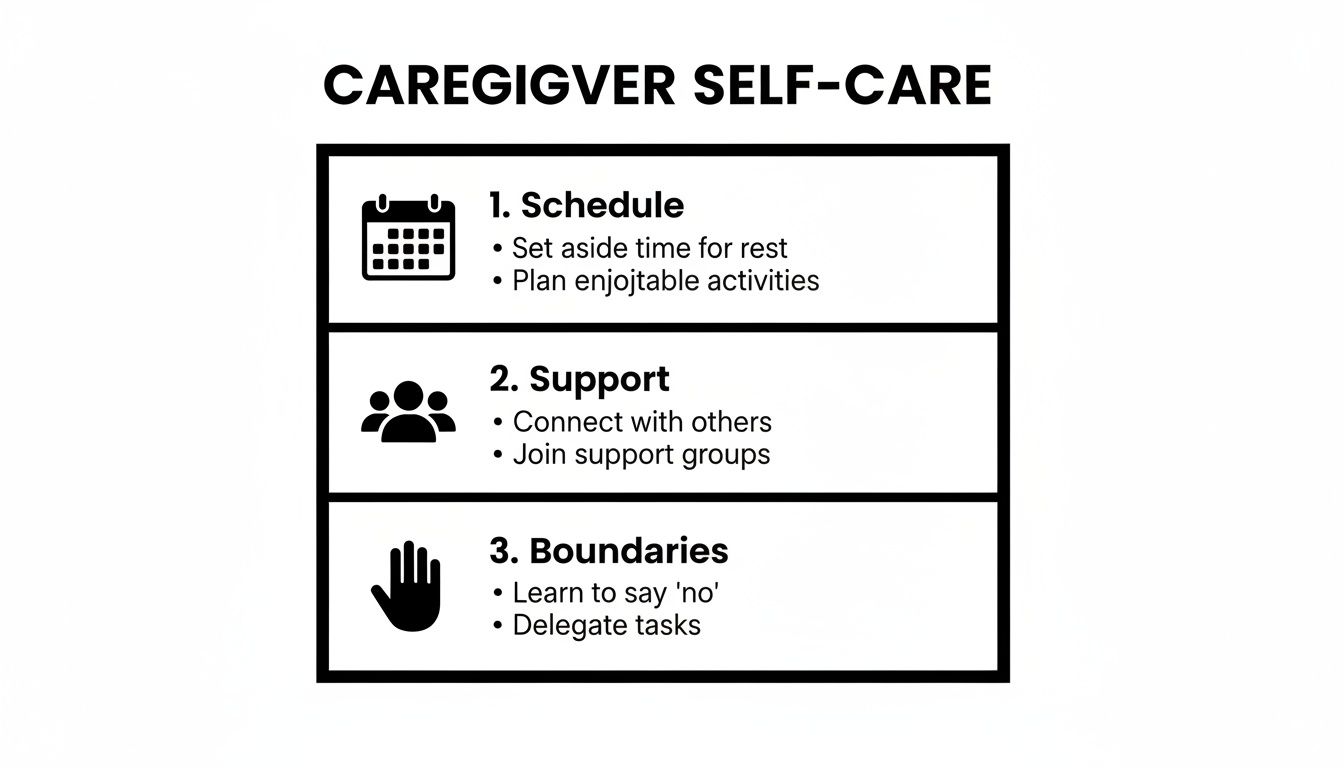
These principles—scheduling time for yourself, leaning on a wider support network, and setting healthy boundaries—are vital for ensuring that you can remain a strong, sustainable source of support for the long journey ahead.
Managing Difficult Conversations and Conflict
The stress of a cancer journey can feel like a pressure cooker. Between the financial worries, the sheer exhaustion, and the constant undercurrent of fear, it's no wonder that tempers can flare. It’s a perfect storm for tension, and even the smallest disagreement can suddenly feel monumental.
But here’s the thing: conflict doesn't mean your relationship is broken. It just means you’re human. The goal isn’t to sidestep every argument—that’s impossible. Instead, it’s about learning to talk to each other differently, especially when the pressure is on.
Identifying Common Triggers for Conflict
The first step is figuring out where the friction is actually coming from. While every family’s situation is different, most arguments that pop up during cancer treatment have roots in a few common areas.
Knowing what these triggers are can help you and your loved ones approach these tough spots with a bit more grace.
- Financial Strain: The bills don't stop. The cost of care, time off work, and all the unexpected expenses can put an enormous weight on any couple or family.
- Treatment Decisions: It's common to disagree over medical choices. Should you get a second opinion? What about alternative therapies? These are high-stakes decisions with no easy answers.
- Uneven Burdens: Sometimes, one person feels like they're carrying the entire load—whether it's managing appointments, doing all the emotional heavy lifting, or both. That feeling can quickly curdle into resentment.
- Communication Breakdowns: It’s tempting to avoid tough topics to keep the peace. This is often called "protective buffering," where you don’t say what you’re really feeling because you’re trying to shield the other person. But that silence usually just creates more distance and misunderstanding.
These aren't just logistical problems. Underneath it all, these conflicts are about a loss of control, a deep-seated fear, and a desperate search for a way forward.
A Framework for Constructive Communication
When emotions are high, it’s all too easy to slip into old habits—blaming, withdrawing, or just shutting down. To break that cycle, it helps to have a game plan for sensitive conversations. This isn’t about winning an argument; it’s about tackling a problem as a team.
First, pick your moment. Trying to talk something serious out when you're both exhausted after a long day of appointments is a recipe for disaster. Find a quiet, private time when you can both focus without being rushed or distracted.
Next, practice active listening. This is more than just waiting for your turn to talk. It's about genuinely trying to understand where the other person is coming from. When they’re speaking, focus completely on their words and feelings. Try repeating back what you heard—"So it sounds like you’re feeling completely overwhelmed by all the bills"—to show you're really hearing them.
"The couples that approach this as a ‘we’ problem—that is as a team—they just do better. They get through all of the difficult treatment better when they know they’ve got a partner in this." This mindset can shift a conflict from a battle against each other to a challenge you face together.
The Critical Role of a Stable Support System
The strength of your closest relationships has a real, measurable effect on your health. While married people often have a built-in support person, the road can be profoundly different for those who are unmarried. The emotional and practical backup a partner provides is a huge protective factor during a health crisis.
This is especially clear when you look at the research. For example, among unmarried patients, those who are separated when they're diagnosed face the toughest odds. Their 5-year relative survival rates are just 72%, a stark contrast to their married counterparts. This statistic highlights just how deeply acute emotional stress and a fractured support network can impact a person's physical health. You can read more about the research on marital status and cancer survival on pmc.ncbi.nlm.nih.gov.
Practical De-Escalation Techniques
When a conversation starts getting heated, a few simple tools can keep things from spiraling.
- Use "I" Statements: Instead of pointing fingers, talk about how you feel. For example, rather than saying, "You never help with the insurance paperwork," you could try, "I feel overwhelmed and scared when I have to handle the insurance calls by myself."
- Take a Time-Out: If you feel your own anger rising, it's okay to hit pause. Just say, "I need to take a 20-minute break before we finish this talk." It gives you both a chance to cool down and come back to the conversation with a clearer head.
- Focus on One Issue at a Time: It's easy to let one disagreement snowball into a list of every past grievance. Try to stick to solving the single problem at hand. It keeps the conversation focused and makes finding a solution feel much more achievable.
Conflict is a natural part of any close relationship, and it's almost guaranteed to surface under the strain of a cancer diagnosis. By learning to handle it with empathy and a few good strategies, you can get through these tough moments and come out the other side with a bond that’s stronger and more honest than ever.
Finding Professional and Community Support
Going through cancer isn't something you have to do alone. Your partner, family, and friends are an incredible source of strength, but sometimes you need guidance from people outside that inner circle. Professionals and peers can offer a different kind of understanding that’s just as vital.
Reaching out for this kind of help isn’t a sign of weakness; it’s a sign of strength. It’s an acknowledgment that the emotional and practical weight of a diagnosis is too much for any one person or family to carry by themselves. This wider network of care provides the tools and perspective you need to get through the toughest moments.
The Role of Oncology Counselors and Therapists
Working with a therapist who specializes in oncology can be a game-changer for both patients and caregivers. These professionals are trained to navigate the unique psychological terrain that comes with a cancer diagnosis. They offer a safe, confidential space to work through difficult emotions like fear, grief, and anger without the pressure of putting on a brave face for a loved one.
A counselor can also equip you and your partner with new ways to talk to each other and handle stress. Having that expert support can be the key to protecting even the strongest relationships from the strain of a long-term illness.
Finding Strength in Community Support Groups
There's a special kind of power that comes from connecting with people who are on a similar journey. Support groups, whether they meet in person or online, create a sense of community and validation that’s hard to find anywhere else. These are the spaces where you can share stories and swap advice with people who just get it.
Sharing your story with peers can dramatically reduce feelings of isolation. Hearing how others navigated similar relationship challenges offers both practical ideas and a deep sense of shared humanity, reminding you that you aren’t alone in this.
This is especially crucial for anyone who might not have a primary support person at home. We know from research that a strong social network improves outcomes. In fact, studies show that unmarried men often face a heavier burden and experience significantly worse survival rates than their married peers, highlighting just how critical community support can be. You can learn more about these gender-specific findings and relationship support at pmc.ncbi.nlm.nih.gov.
Integrated Support Services
Truly comprehensive cancer care looks beyond just the medical treatment. Here at Hirschfeld Oncology, we build that philosophy into our practice by offering integrated services that help ease the day-to-day burdens on families. These resources often include:
- Patient Navigators: These are your guides through the healthcare maze. They help with everything from scheduling appointments to coordinating between different doctors.
- Financial Advisors: These experts can help you make sense of insurance coverage, manage treatment costs, and connect you with financial assistance programs.
- Palliative Care Teams: This specialized team focuses on managing symptoms and improving your quality of life at any stage of illness. You can learn more about the differences in our guide to palliative care vs hospice care.
By tapping into these resources, you build a sturdy safety net for your family. Having experts handle the logistics allows you to focus more of your precious energy on what truly matters—healing and supporting each other.
We Get It: Your Questions About Cancer and Relationships Answered
When you're dealing with a cancer diagnosis, a million questions come up. Many of them are about your relationships—the tough, awkward, and deeply personal ones that often go unasked. We’ve been there with countless families, and here are some honest answers to the questions we hear most often.
How Can We Stop Cancer From Taking Over Our Entire Relationship?
This is a big one. It's so easy for cancer to become the third person in the room. The secret is to be deliberate about creating "cancer-free zones." This means carving out time—a date night, a walk, even just an hour watching a movie—where you both agree the topic is completely off-limits.
This isn't about ignoring reality; it's about protecting your identity as a couple. You are more than a patient and a caregiver. A shared calendar can be a surprisingly powerful tool here. Block out those protected moments, and maybe even schedule a specific, limited time to talk about medical stuff. This way, the logistics don't spill into every part of your day, allowing the rest of your relationship to breathe.
My Friends Are Acting Weird Since I Was Diagnosed. What Do I Do?
It hurts when friends pull away, but it’s rarely about you. More often than not, they’re scared. They don't know what to say, they're terrified of saying the wrong thing, or they feel helpless. The best thing you can do is take the lead.
Reach out with something specific and easy for them to do. Instead of waiting for them to guess, tell them what you need. It could be as simple as saying, “I’m tired of talking about me. Tell me about that crazy project at work,” or “I could really use a laugh. Send me the funniest video you’ve seen this week.” Giving them a clear task can break through the awkwardness. It’s also important to give yourself grace and recognize that some friendships might shift, while others, sometimes from unexpected places, will become stronger than ever.
The most powerful thing a loved one can say isn't a cure-all promise. It's a simple, grounded commitment: "I'm not going anywhere. We'll figure this out together." That kind of reassurance creates an anchor of stability when everything else feels adrift, reinforcing the real strength of your cancer and relationships support system.
How Can I Support My Partner Without Smothering Them?
Finding that balance between caring and controlling is tricky. The best approach is to stop guessing and start asking. Open, direct communication is your best friend. Try asking, “What would feel most helpful from me right now?” or “For this next appointment, would you rather I come with you or give you some space?”
Your partner is still an independent person. Respect that by offering concrete help instead of a vague, “Let me know if you need anything.” That puts the burden on them. Instead, try, “I can handle dinner tonight, you just rest,” or “Why don’t I take care of calling your parents with the update?” This shows tangible support while still honoring their autonomy.
At Hirschfeld Oncology, we know that cancer care goes far beyond medicine. It's about supporting the whole person—and the people who love them. To learn more about our approach and find resources for you and your family, please visit our blog.
.png)
.png)






