.png)


Facing a breast cancer diagnosis is a life-altering moment, and the path forward can seem uncertain. But there's a powerful option to consider: clinical trials for breast cancer. These research studies aren't just a last resort; they are the very engine driving every single advancement in oncology. They offer a direct line to the treatments of tomorrow, today.
Why Clinical Trials Are a Hopeful Path Forward
When standard treatments haven’t worked as hoped, especially with advanced or treatment-resistant breast cancer, a clinical trial can offer a clear, tangible next step. It’s a chance to receive care in a highly structured and closely monitored setting, where researchers are testing new therapies designed to be more effective, often with fewer side effects.
Think about it: every targeted therapy, every immunotherapy, every drug that is now a standard of care was once only available to patients in a clinical trial.
Choosing to participate is a deeply personal decision, but it comes with some incredible upsides:
- Access to New Treatments: You can receive promising new drugs or innovative therapies years before they're available to the public.
- Expert Medical Care: You'll be cared for by a dedicated team of top-tier doctors, nurses, and researchers who are at the forefront of breast cancer treatment.
- Contribution to Science: Your participation is a powerful act. You play a direct role in advancing medical knowledge and improving care for countless others who will face this disease in the future.
The Goal of Modern Breast Cancer Trials
The core goal, of course, is to find better ways to treat cancer. But "better" doesn't just mean shrinking tumors anymore. A huge focus in modern trials is on improving a patient's quality of life during treatment. Researchers are more interested than ever in how people actually feel day-to-day.
There’s still work to be done here. A comprehensive analysis of over 10,478 breast cancer trials revealed that while many studies track patient outcomes, only 37.9% used specific tools to let patients report on their own symptoms and well-being. For anyone living with advanced cancer, managing side effects is just as important as the treatment's effect on the tumor.
"A clinical trial is more than a scientific experiment; it’s a partnership between patients and researchers. Your participation helps redefine what's possible in cancer care, turning today’s research into tomorrow’s standard of care."
Ultimately, these studies are about pushing boundaries. They explore new drug combinations, test smarter screening methods, and seek to understand the unique biology of breast cancer in younger women. For a more detailed breakdown, check out our complete guide covering what are clinical trials for cancer. For many, joining a trial is a way to take an active, empowered role in their own treatment journey.
How to Find the Right Breast Cancer Trial
Looking for a clinical trial can feel overwhelming, like searching for a needle in a haystack. But with the right strategy, it's a process you can absolutely manage. Your oncologist is always the best person to start with, but knowing how to explore the options yourself is incredibly empowering. It really comes down to using a mix of powerful databases, patient advocacy groups, and smart search techniques.
Your search should always start with the specifics of your diagnosis. You’re not just looking for a "breast cancer trial." You need to get more granular—are you looking for trials for HER2-positive, hormone receptor-positive, or triple-negative breast cancer (TNBC)? The more specific you are, the more relevant the results will be.
This level of detail is critical because research has become incredibly specialized. Modern breast cancer treatment is being reshaped by a huge wave of clinical research, particularly for aggressive subtypes like TNBC, which makes up about 10–15% of all cases. To meet this need, over 1,500 TNBC trials have been launched since 2019 alone—that's roughly 30% of all breast cancer clinical trials. This surge is creating more options beyond standard chemotherapy for patients with advanced disease.
Navigating the Big Trial Databases
The two most powerful resources you'll use are government-run databases that list nearly every registered clinical trial in the world. They look a bit intimidating at first, but a few simple tips make them much easier to handle.
1. ClinicalTrials.gov
This is the largest and most comprehensive database out there, maintained by the U.S. National Library of Medicine.
- Start Simple: On the homepage, use the "Condition or disease" field for your specific diagnosis, like "metastatic HER2-positive breast cancer."
- Filter, Filter, Filter: Once you get your initial results, look for the filters on the left side of the page. The most important ones are setting the Recruitment Status to "Recruiting" and adding your state under "Location."
- Add Keywords: You can get even more specific. Use the "Other terms" box to add words like "immunotherapy," "PARP inhibitor," or the name of a specific drug you and your doctor have talked about.
2. National Cancer Institute (NCI) Search Portal
The NCI's portal is designed just for cancer trials and often feels more user-friendly. It pulls its data from ClinicalTrials.gov but presents it in a way that's a bit easier for patients and families to digest. The best part is that the filtering options are front and center, letting you select your cancer type, subtype, stage, and location right from the start.
Turning to Patient Advocacy Groups
Databases are essential, but they lack the human element. This is where patient advocacy groups come in. They offer curated trial finders, easy-to-understand resources, and real personal support.
Advocacy organizations are fantastic allies. They often have dedicated staff who can help you make sense of your options and sometimes even offer personalized trial matching services based on your medical history.
Here are a few great organizations to check out:
- Susan G. Komen: Offers a dedicated clinical trial helpline and an online matching service to connect you with studies.
- METAvivor: Focuses exclusively on Stage IV metastatic breast cancer, so all of their resources are tailored to advanced disease.
- BreastCancerTrials.org: A non-profit that provides a very user-friendly search and matching tool.
This infographic gives a great overview of what the clinical trial journey looks like, from the initial research phase through treatment and follow-up monitoring.

The structured flow from research to monitoring is what ensures both patient safety and the accuracy of the trial's findings.
Bring Your Shortlist to Your Oncologist
Once you've found a few trials that seem promising, it’s time to talk to your oncologist. Your doctor is the only one who can help you decipher the complex eligibility criteria and figure out if a trial is a good medical fit. They can also reach out to the trial site on your behalf to get the ball rolling.
At Hirschfeld Oncology, we often help patients in the NYC area sift through these databases and connect with local studies. Our team believes in exploring every possible avenue, and that absolutely includes clinical trials. Remember, finding the right trial is a team effort—a true partnership between you, your family, and your medical team.
You’ve done the research and found a few promising clinical trials for breast cancer. That's a huge step. But now comes the part that requires a closer look: figuring out if one of these trials is truly the right path for you. This is about moving beyond the trial's official title and digging into what participation would actually mean for your health, your schedule, and your life.
This process involves a careful review of the details, a commitment to asking tough questions, and an open, ongoing conversation with your entire medical team.

One of the first things you'll run into is the trial's eligibility criteria. It's easy to see this as just administrative red tape, but it’s actually the foundation of good, safe science.
Understanding Eligibility Criteria
Every single clinical trial operates with a very specific checklist called inclusion and exclusion criteria. These rules are incredibly precise, outlining exactly who can—and cannot—join the study. The goal here is twofold: keeping participants safe and making sure the research data is clean and reliable.
Inclusion criteria are the non-negotiables you must have to get in. For example, a trial might require:
- A Specific Diagnosis: You must have Stage IV, HER2-positive breast cancer.
- A Certain Treatment History: You must have already gone through at least two lines of therapy, including a specific drug like trastuzumab.
- Key Tumor Biomarkers: A recent biopsy must show a particular genetic mutation.
On the flip side, exclusion criteria are the factors that will prevent you from enrolling. These are almost always about safety. A trial might have to turn away patients with:
- Certain Health Conditions: Uncontrolled diabetes or significant heart disease could make the study drug risky.
- Recent Treatments: If you had chemotherapy within the last four weeks, it could interfere with the study's results.
- Brain Metastases: The study might exclude patients with active or untreated metastases in the brain.
I know these rules can feel frustratingly narrow, especially if one of them keeps you out of a trial you were hopeful about. But they are there for a reason. If a new drug is known to be hard on the kidneys, the study absolutely must exclude anyone with pre-existing kidney problems to avoid causing serious harm.
The Informed Consent Conversation
If you check all the right boxes and meet the initial criteria, the next step is the informed consent process. This is so much more than just signing a form. It’s designed to be a thorough, open conversation between you, your loved ones, and the research team.
The entire point is to make sure you understand every single thing the trial involves—the good, the bad, and the uncertain—before you agree to participate. You’ll be given a detailed document that lays out the study's purpose, what the treatment schedule looks like, all the potential risks and benefits, and your rights as a patient.
Informed consent isn’t a one-time event; it’s a continuous conversation. You should feel empowered to ask questions at any point, from day one until your last day on the trial.
This document is for you. Take it home, read it carefully, and use a highlighter on anything that feels unclear. Bring that document, with all your notes and questions, back to the research coordinator and your oncologist. Your signature simply confirms that you’ve received all the information you need to make a voluntary choice.
Critical Questions to Ask Your Team
Going into your meeting with the trial team prepared is the best way to make a decision you feel good about. This is your chance to get answers about the things that will impact your daily life and your treatment. Your oncologist is your go-to for the heavy medical questions, while the trial nurse or coordinator is often a great resource for the logistical details.
Think of this as your essential checklist:
- About the Treatment: What exactly is this new drug or therapy? What’s the science behind it that makes you think it could work for my type of cancer? What are the known side effects—both the common, annoying ones and the rare, serious ones?
- Trial Structure: Is this a "blinded" study, where I won’t know what treatment I'm getting? Is there any chance I could get a placebo? (This is very rare in advanced cancer trials; it’s almost always the new drug versus the current standard of care).
- Your Time and Logistics: Realistically, how many trips to the clinic will I need to make each month? What scans, blood draws, and other procedures are involved, and how often?
- Potential Outcomes: What’s the best-case scenario if this treatment works? And what is the plan if my cancer gets worse while I’m on the trial? How will you be monitoring my health?
- Your Rights: Can I change my mind and stop at any time? If I do leave the trial, what are my other treatment options?
Getting clear answers here helps you weigh the potential benefits against the very real risks and practical demands of the trial. It takes the abstract idea of a "clinical trial" and turns it into a concrete plan, empowering you to decide if it’s the right next step for you.
Juggling the Day-to-Day Realities of a Trial
The science behind a clinical trial for breast cancer can feel abstract and overwhelming. But once you’re in it, the day-to-day realities are often surprisingly practical. It’s one thing to grasp the potential of a new therapy; it’s another to figure out how to manage weekly infusions, frequent scans, and a packed appointment calendar while trying to live your life.
Thinking through these real-world challenges from the very beginning is the key to making a trial work for you, not against you.
The biggest adjustment for most people is the time commitment. A trial protocol is rigid by design, and it often involves a schedule of visits that’s far more demanding than what you might be used to with standard care. You could find yourself at the cancer center several times a week for blood draws, drug infusions, and check-ins with the research team. This requires a new level of organization and an honest look at your personal and professional calendars.
Taming Your Schedule and Travel
Before you even think about signing on, ask the trial coordinator for a sample schedule of the first treatment cycle. Seriously, get it in writing. Seeing the appointments laid out on a calendar makes the commitment tangible.
It immediately helps you answer the tough questions: Will you need to take significant time off work? Can you line up consistent childcare? Answering these questions upfront is absolutely critical.
For many people, especially those commuting into a major hub like NYC for treatment, travel becomes a part of the therapy itself.
- Getting There: Does the treatment center have validated or discounted parking? How painful is it to get there on public transit? It’s worth asking if the trial sponsor or an advocacy group offers any kind of travel stipend to help with these costs.
- Timing is Everything: See if you can schedule your appointments to avoid the worst of rush hour. Shifting from a 9 a.m. to an 11 a.m. slot might seem small, but it can dramatically reduce your stress and travel time.
- Stacking Appointments: Always ask if multiple visits—like a lab draw and a doctor's check-in—can be bundled together on the same day. The fewer trips, the better.
A little proactive planning can turn a potentially chaotic experience into a manageable routine, letting you focus on your health.
Getting a Clear Financial Picture
There's a common myth that clinical trials are completely free. The truth is a bit more complicated, but the goal is always that you shouldn't face extra costs compared to standard treatment. It's crucial to get the financial details sorted out before you sign the informed consent.
Here’s how it usually breaks down: The trial sponsor pays for anything directly related to the research. That includes the investigational drug itself, any special tests, extra scans, or procedures that are only required for the study.
Your health insurance is then billed for the "standard of care" costs—basically, the things you'd be getting anyway. This includes routine doctor visits, standard bloodwork, and any FDA-approved drugs being used alongside the trial therapy.
Before starting, have the trial’s financial navigator give you a clear, written breakdown of what the sponsor covers versus what gets billed to your insurance. This one conversation can save you from unexpected bills and a world of financial stress.
And always, always call your insurance provider to confirm they will cover the routine care costs of participating in a trial. Most are legally required to, but getting that confirmation provides invaluable peace of mind.
Before enrolling, it's wise to sit down and map out all these practical considerations. This checklist can help you organize your thoughts and ensure you've covered all your bases with the research team.
Your Clinical Trial Logistics Checklist
Taking the time to fill this out helps you walk into a trial with your eyes wide open, fully prepared for the journey ahead.
You Don't Do This Alone
No one gets through a clinical trial in a vacuum. The demands can be physically and emotionally draining, which makes having a strong support system non-negotiable. This isn’t just about getting a ride to the hospital; it's about having people who can offer genuine emotional encouragement and practical, on-the-ground help.
Think about who is truly in your corner—your partner, a few close friends, family members, or even a patient support group.
The trick is to be specific with your needs. Instead of a vague, "I could use some help," try asking, "Could you help me with meal prep on my infusion days?" or "Would you be able to just sit with me during my long appointments on Tuesdays?"
When you communicate your needs clearly, you empower your support network to help in real, tangible ways. This lightens your load and allows you to pour your energy into what matters most: your treatment and your well-being.
Managing Your Health and Well-Being on a Trial
Once you're enrolled in a trial, your relationship with the research team really begins. This isn't just about receiving a new treatment; it's a true partnership. Your experience and feedback are what make the study work, and more importantly, they're critical for maintaining your own quality of life. You are never just a data point—your well-being is always the top priority.
The most powerful tool you have during this time is your own voice. The research team is counting on you to be an honest observer of your body and how you feel from one day to the next. This isn't just about reporting major side effects; it's about noticing the small, subtle shifts, too.
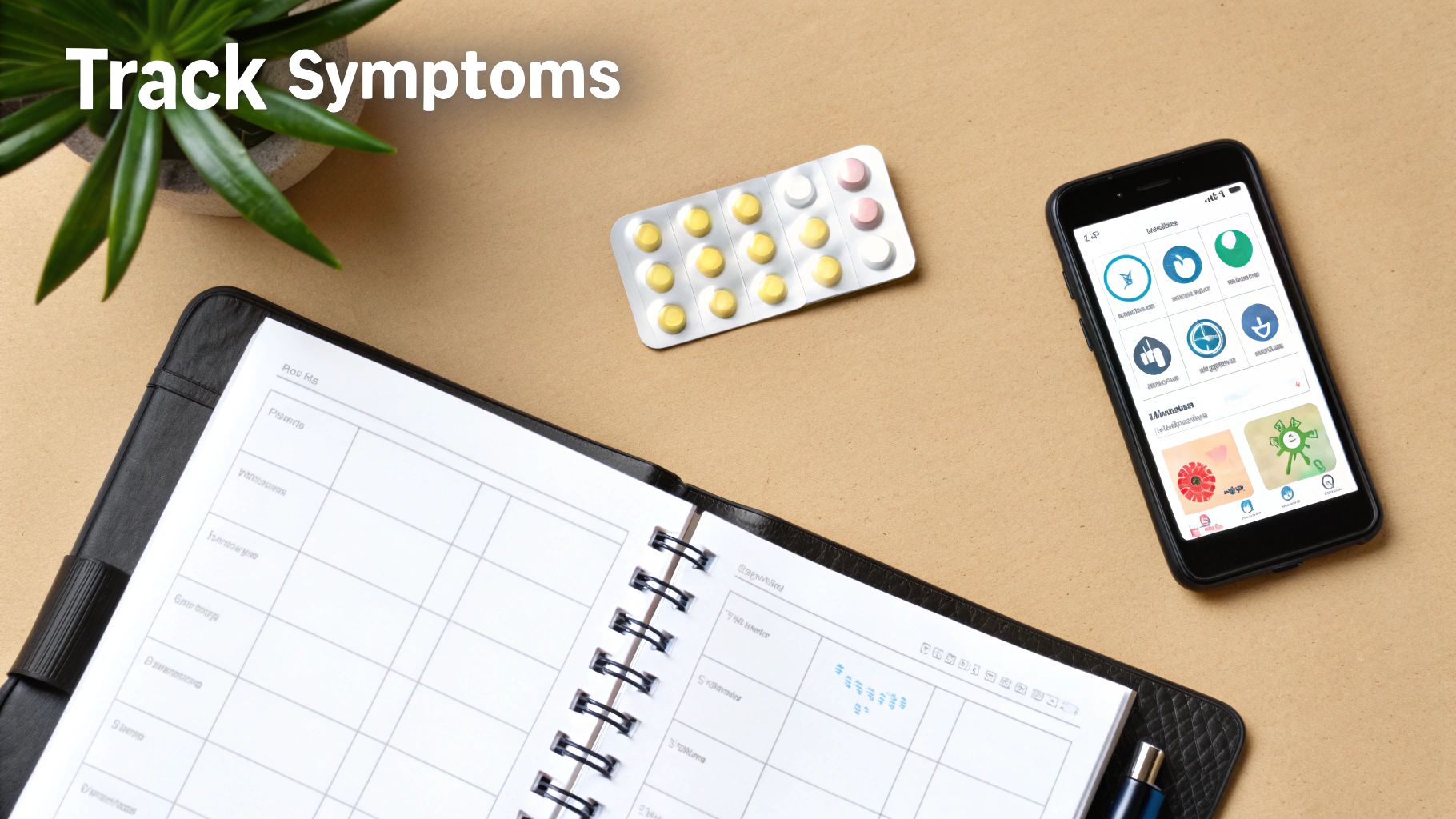
Keeping a detailed log of your symptoms helps your team make proactive adjustments to your care plan, often stopping a minor issue from becoming a major problem down the road.
The Importance of Open Communication
Think of your clinical trial nurse or coordinator as your dedicated support line. Their entire job is to help you navigate this process safely, and they can't do that without your input. Being completely open about what you're experiencing—no matter how insignificant it might seem—is absolutely crucial.
For example, mentioning mild but persistent nausea early on might allow the team to prescribe an effective anti-nausea medication before it starts affecting your appetite. If you wait, you could end up feeling much worse than you need to. The team's primary goal is to manage toxicity and keep you feeling as well as possible throughout the treatment.
"Your feedback is the most critical data the research team receives. Honest, frequent communication about your symptoms and side effects allows us to provide the supportive care you need to stay on trial safely and comfortably."
This open dialogue means any necessary changes—to your supportive medications or even the study drug dosage itself—can be made right away.
Navigating Frequent Monitoring and Tests
Clinical trial protocols are rigorous for a reason. You should expect a fairly demanding schedule of monitoring that can include regular blood draws, EKGs, and imaging like CT or MRI scans. This constant oversight is a fundamental safety measure built into every study.
These frequent tests serve two main purposes:
- Safety Checks: Regular bloodwork lets the team keep a close eye on your organ function, like your liver and kidneys, to catch any potential issues from the new treatment immediately.
- Efficacy Assessment: Scans give everyone clear, objective data on whether the treatment is actually working to shrink or control the cancer.
While the schedule might feel intense at times, this high level of attention means that any change in your health gets picked up almost instantly, allowing for rapid intervention. It’s one of the unique benefits of participating in a trial—you receive an exceptionally high level of personalized monitoring.
Practical Tips for Handling Side Effects
Getting a handle on side effects is a huge part of protecting your quality of life during a trial. The research team will give you specific guidance, but having a few of your own strategies can make a real difference.
- Keep a Symptom Journal: Grab a simple notebook or use an app on your phone to log any symptoms. Jot down the time of day, severity (on a 1-10 scale), and what you were doing when it happened. This log is incredibly valuable when you talk to your team.
- Stay Hydrated and Nourished: Make hydration a priority, even when you don’t feel like it. If you're dealing with nausea or fatigue, you might find that small, frequent meals are much easier to tolerate than three large ones.
- Allow for Rest: Fatigue is one of the most common side effects of cancer treatment, period. Listen to your body. Pushing through it rarely works, but building short rest periods into your day can help you conserve precious energy.
For a deeper dive into this topic, our guide on managing side effects of cancer treatment offers even more helpful information.
Addressing the Emotional Journey
Let's be honest: participating in a clinical trial is an emotional rollercoaster. It’s a mix of profound hope, anxiety, and a whole lot of uncertainty. It's completely normal to feel that "scanxiety" or pressure, wondering if the treatment is working in between your imaging appointments.
Finding healthy ways to cope is just as important as managing the physical symptoms. This could mean connecting with a support group, talking to a therapist, or practicing mindfulness. Whatever it is, remember to be kind to yourself. The emotional ups and downs are a real and expected part of this journey, and your clinical team is there to support you through all of it.
Got Questions About Breast Cancer Trials? Let's Clear Things Up.
Even after you've done your homework and talked with your oncologist, it’s completely normal to have more questions swirling around. Clinical trials can feel like a whole new world, and you should never hesitate to ask for clarity on the details that matter most to you and your family.
Let's walk through some of the most common questions and concerns we hear from patients every day.
Will I Get a Placebo?
This is probably the number one fear I hear, and I get it. The good news is that in cancer research, it's not what you might think. For advanced breast cancer, it is incredibly rare for anyone to get only a placebo if there's already an effective treatment available. That would be unethical.
Instead, most cancer trials are designed to compare a new, investigational treatment against the current standard of care. This means you’ll either get the new therapy being studied or the best available treatment already approved for your cancer.
So where do placebos come in? You might see them in a trial design that looks something like this:
- Standard Treatment + New Drug vs. Standard Treatment + Placebo
See the difference? In this setup, everyone gets the proven standard treatment. The placebo is simply used as a control to help researchers understand the true benefit of the added drug. The informed consent document will always spell out, in no uncertain terms, if a placebo is part of the study. No surprises.
What Happens if the Treatment Isn't Working for Me?
Your health and safety are the guardrails for the entire process. Every single trial has strict, built-in safety protocols that involve constant monitoring—regular scans, blood tests, and check-ins to see exactly how you're responding. This isn't just a suggestion; it's a core part of the study's design.
If your cancer shows signs of progressing, or if you're dealing with side effects that are just too much to handle, the research team will take you off the study. This isn’t a failure. It’s a planned-for safety measure.
Leaving a trial—whether it’s your decision or the team’s—is a normal part of the process. It just means it's time to pivot to the next best step for your care.
The moment that decision is made, the conversation immediately shifts to "what's next?" Your oncologist and the research team will lay out the options, which could be returning to a standard therapy, trying a different approved treatment, or even finding another clinical trial that might be a better fit. And remember, you have the right to leave a trial at any time, for any reason, and it will never impact the quality of your future care.
How Do I Know a Clinical Trial Is Safe?
Participant safety is the absolute bedrock of clinical research. Before a single person can enroll in a trial in the United States, the study must be reviewed, approved, and continuously watched over by an Institutional Review Board (IRB).
Think of an IRB as a watchdog committee. It's made up of an independent group of doctors, scientists, and even community members whose only job is to protect participants. They scrutinize the entire study plan to make sure it's ethical and that any potential risks are minimized. They give the green light to start, and they keep monitoring things until the very end.
On top of that, by the time a treatment gets to a later-phase trial, it has already been through years of intensive lab research and early-phase testing in a small number of people. That earlier work gives researchers a solid understanding of its safety and the right dosage to use. The informed consent process is designed to give you all of this information upfront so you can make a decision you feel good about.
Can I Still See My Regular Oncologist?
Absolutely. In fact, you must. A clinical trial doesn't replace your existing care team; it adds to it.
The research doctors and nurses will manage everything directly related to the trial treatment. But your primary oncologist is still the quarterback of your overall care. They know you and your history.
It's crucial that your oncologist and the trial team are in regular communication. This ensures your care is coordinated and nothing falls through the cracks. Your oncologist will help you make sense of trial updates, manage any health issues that pop up outside of the study, and start planning for what comes after the trial is over.
At Hirschfeld Oncology, we believe in exploring every possible avenue for our patients, and that often includes clinical trials. Dr. Hirschfeld and our team are here to help you navigate complex diagnoses and find promising treatments, making sure you feel supported and hopeful every step of the way. You can learn more about our patient-focused approach on our blog.
.png)
.png)