


.png)


When you're facing an advanced cancer diagnosis—whether it's pancreatic, colorectal, or breast cancer—it’s natural to feel like you're running out of options, especially if standard treatments aren't working anymore. It's a common misconception that clinical trials are a last-ditch effort. In reality, immunotherapy clinical trials are often the very next step, giving you access to the most promising new treatments in cancer care.
Beyond Standard Treatment: The Role of Immunotherapy Trials
Think of your immune system as a highly trained security force that’s constantly on patrol, protecting your body from invaders. Cancer cells can be tricky, though. They develop clever disguises to hide from this security force or even shut it down completely. Immunotherapy is a way of re-training your immune system—giving it new intelligence and specialized tools to see through the cancer’s camouflage and get back on the offensive.
Clinical trials are simply the way we test these new, innovative treatments to see if they are safe and, most importantly, if they work better than what we have now. These carefully managed research studies are the only way to access therapies that might not be available to the public for several more years. For anyone with an advanced or treatment-resistant cancer, that access can make all the difference.
Making Sense of Your Next Steps
We created this guide to cut through the confusion and give you a clear, straightforward path forward. Our goal is to break down the world of cancer research so you can feel confident and in control of your decisions. We'll walk you through everything from the science behind the treatments to the real-world logistics of joining a trial.
Here's what we'll cover together:
- The Science: We'll explain how different kinds of immunotherapy actually work inside your body.
- The Process: You'll learn what the different phases of a clinical trial really mean for you as a patient.
- The Search: We'll give you practical tools for finding trials that are a good fit for your specific cancer.
- The Experience: You'll get a better sense of what to expect, from the enrollment process to daily life on a trial.
For so many people, joining an immunotherapy clinical trial is about more than just trying a new medicine. It’s about taking an active role in your own care, helping to push science forward, and making sure you’ve explored every single option for a better outcome.
This is a complex journey, but you don't have to figure it all out on your own. With the right information and a team of experts by your side, you can navigate your options with clarity. We're here to provide that clarity, especially for patients in New York City looking for personalized support and guidance.
How Immunotherapy and Clinical Trials Actually Work
To really grasp how immunotherapy clinical trials work, you first have to understand the core idea behind immunotherapy itself. Think of your immune system as a highly trained, always-on-duty security force for your body. It's incredibly good at its job, but cancer cells are masters of deception. They have ways of putting on a "friendly" mask, tricking your immune system into ignoring them as they grow.
Immunotherapy is all about ripping off that mask. Instead of attacking the cancer directly like chemotherapy or radiation, it gives your body's own security team the intel and tools it needs to finally recognize cancer as an intruder and launch a powerful, targeted attack.
Training Your Immune System for the Fight
So, how do we re-educate the immune system? In clinical trials, you'll often see a few key approaches being tested. The two most common strategies are checkpoint inhibitors and CAR T-cell therapy, each representing a different way to empower your body's natural defenses.
- Checkpoint Inhibitors: Imagine cancer cells having a cloaking device that makes them invisible to your immune cells. These drugs essentially jam the cloaking signal. They block the specific proteins (or "checkpoints") that cancer uses to hide, allowing your immune T-cells to switch back on, see the threat, and go on the offensive.
- CAR T-cell Therapy: This is a bit more like creating a super-soldier unit. We take a small sample of your own T-cells out of your body. Then, in a lab, we genetically engineer them to have special receptors (called Chimeric Antigen Receptors, or CARs) that are custom-designed to hunt down a specific protein on your cancer cells. Those newly supercharged cells are then infused back into your body to do their job.
The real power of immunotherapy is that it doesn't just treat the cancer—it teaches your own body how to fight it. This can lead to responses that are not only effective but also potentially long-lasting, a concept we explore more deeply in our guide to how immunotherapy works.
This concept map shows how these ideas connect—from your body's natural defense mechanisms to the advanced therapies evaluated in a clinical trial setting.
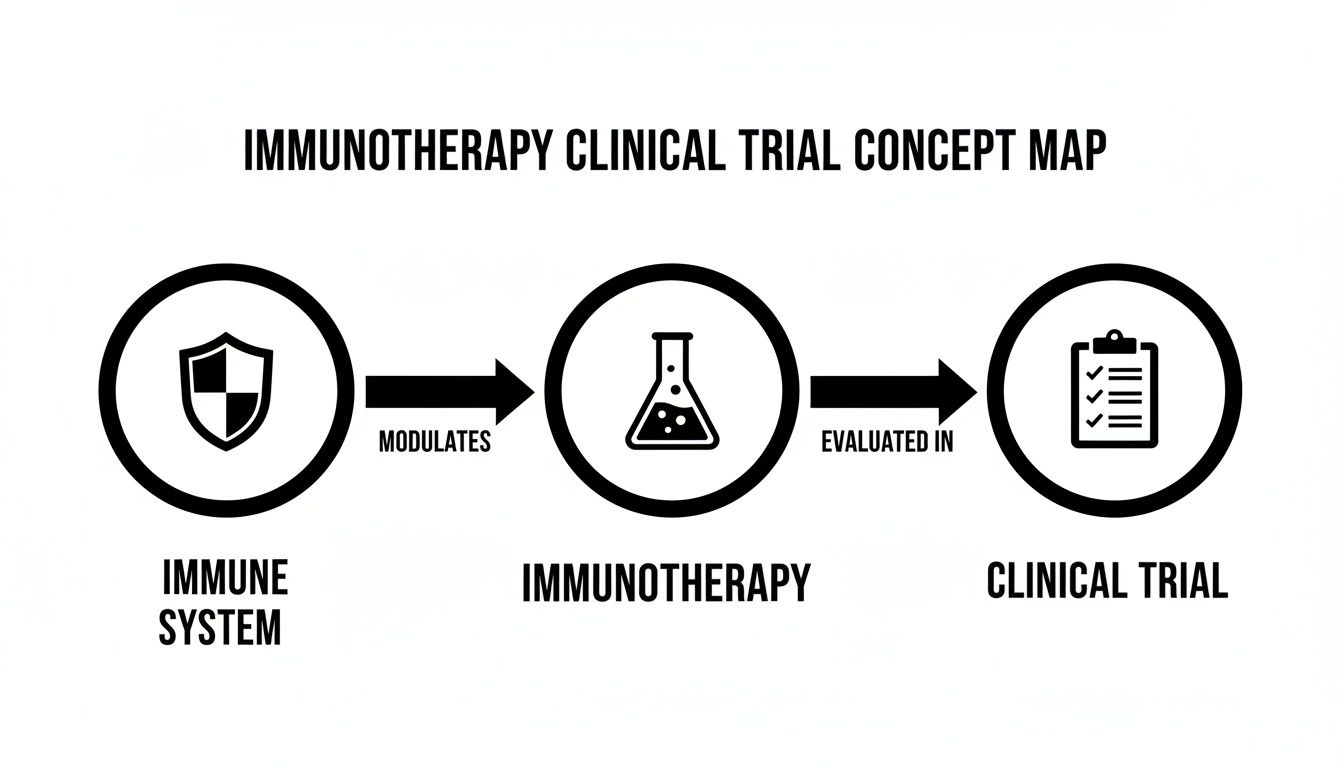
As you can see, the trial process is the essential bridge that takes a promising scientific idea and proves its worth for patients.
The pace of discovery here is just staggering. As of early 2026, there were over 2,300 immunotherapy agents in development, from checkpoint inhibitors to the next generation of cell therapies. This explosion in research is why the global oncology market continues to grow, driven by the real-world potential of these treatments.
The Four Phases of a Clinical Trial
Before any new immunotherapy can be offered to patients, it has to go through a carefully structured, multi-stage testing process. These are the clinical trial phases. Each one is designed to answer critical questions about the new treatment, ensuring it’s both safe and effective. Knowing what happens in each phase helps demystify the entire journey.
Here’s a simple breakdown of what researchers are looking for at each step.
The Four Phases of a Clinical Trial
| Phase | Primary Goal | Number of Participants | What Researchers Learn |
|---|---|---|---|
| Phase I | Safety & Dosage | 20-100 | Is the new treatment safe for humans? What are the side effects? What is the best dose to use? |
| Phase II | Effectiveness | 100-300 | Does the treatment work for a specific type of cancer? How does it affect the body? |
| Phase III | Comparison | 300-3,000+ | Is the new treatment better than the current standard treatment? Is it safer or more effective? |
| Phase IV | Long-Term Monitoring | Thousands | What are the long-term benefits and risks? This occurs after the drug is FDA-approved and on the market. |
This methodical process is the foundation of all modern medicine. It’s how we move from a promising idea in the lab to a proven treatment that can change lives, all while prioritizing patient safety above everything else.
Of course. Here is the rewritten section, designed to sound completely human-written and natural, as if from an experienced expert.
Why Trials Are So Important for Advanced and Resistant Cancers
For anyone dealing with an advanced or treatment-resistant cancer, the road can feel incredibly uncertain. It’s natural to feel like your options are narrowing when standard treatments, like chemotherapy, stop working or the cancer finds a way to grow again.
But this is exactly the point where we can get proactive. It’s the moment to look at immunotherapy clinical trials, which open up entirely new pathways of care and hope.
Unlike chemotherapy, which can be a bit of a blunt instrument attacking all fast-growing cells, immunotherapy is different. It’s a smarter, more targeted approach that teaches your own immune system how to recognize and fight the cancer. This is a game-changer, especially for patients with metastatic diseases like pancreatic, colorectal, or breast cancer.
A New Lifeline When Other Options Run Out
When we say a cancer has become "resistant," it means the cancer cells have figured out how to survive the current treatment. It's a lot like bacteria becoming resistant to an antibiotic—simply continuing the same drug won't work anymore. You need a completely new angle of attack.
Immunotherapy clinical trials provide that new angle. They give you access to the next generation of cancer treatments, often years before they’re widely available. For someone with an advanced cancer, this early access isn’t just a nice-to-have; it can be a true lifeline. These trials are specifically designed to test therapies that can overcome the very defenses your cancer has built up against previous treatments.
By joining a trial, you are moving to the very front of the line in cancer care. You're making a conscious choice to pursue a treatment designed for the specific challenges of your disease, instead of just trying another round of something that has stopped working.
The real focus in these trials is on creating durable, long-lasting responses. While chemo might shrink a tumor, the cancer can sometimes rebound quickly. Immunotherapy, on the other hand, aims to create a lasting "memory" in your immune system, empowering it to control the cancer on its own for the long term. For managing advanced disease, that’s a whole new ballgame.
Better Results and a Focus on Quality of Life
Living well is just as important as fighting the cancer itself. We all know the toll that conventional chemotherapy can take—the crushing fatigue, nausea, and hair loss can be draining. Because immunotherapy works with your immune system instead of waging war on your whole body, its side effects are often very different and, for many people, much more manageable.
This idea of minimizing harsh side effects is a central part of modern immunotherapy clinical trials. The goal isn't just to find a more powerful drug; it's to find a treatment that lets patients keep their strength, their independence, and their ability to enjoy daily life. That balanced approach is absolutely essential when you're living with cancer as a chronic condition.
Driving the Future of Cancer Treatment
Every person who participates in a trial doesn't just get access to a new treatment; they help rewrite the future of oncology for everyone. It's no surprise that immunotherapy clinical trials are the fastest-growing area of cancer research today.
Just look at the recent results from a trial of pelareorep for HR+/HER2- metastatic breast cancer. Patients on this immunotherapy saw a 30% response rate—more than double the 13.8% benchmark for the FDA-approved standard. Even better, those responses were incredibly durable, lasting a median of 15.5 months compared to just 9.5 months. For patients looking for less toxic options for stage 4 cancer, that kind of long-term benefit is huge. You can explore more about how immunotherapy is delivering these results and what it means for the future.
This is the kind of powerful data that forward-thinking oncologists use to shape their treatment plans for all patients. By staying connected to the latest research, we can make smarter recommendations and design truly personalized strategies. Your participation helps build a library of knowledge that directly leads to better, more effective therapies for the patients who will come after you.
Finding and Evaluating the Right Immunotherapy Trial for You

Starting the search for an immunotherapy clinical trial can feel overwhelming, but it’s a journey you don't have to navigate alone. Your first, and most important, conversation should always be with your oncologist. They are your trusted partner who deeply understands your medical history, your cancer's unique profile, and what you hope to achieve with treatment.
Together, you can weigh the potential benefits and risks. If you both decide that a clinical trial is a promising path forward, the next step is to start identifying potential studies that could be a good fit.
Where to Search for Immunotherapy Trials
Fortunately, several excellent, free databases act as central registries for immunotherapy clinical trials happening all over the country and the world. While your oncologist's office can certainly help you search, you can also explore these resources on your own to see what's out there.
Think of these as powerful search engines for medical research. The best places to begin are:
- ClinicalTrials.gov: This is the big one. Run by the U.S. National Library of Medicine, it’s the most comprehensive database of clinical studies available anywhere. You can filter your search by cancer type, location, and even the names of specific drugs.
- National Cancer Institute (NCI): The NCI’s website provides a well-organized database focused specifically on cancer trials. It also offers a wealth of educational materials to help you make sense of what you find.
- Patient Advocacy Groups: Don't overlook groups dedicated to specific cancers, such as the Pancreatic Cancer Action Network or the Colorectal Cancer Alliance. They often curate their own lists of relevant trials and can be an amazing source of support.
At this stage, your goal is simply to gather possibilities. Don’t get bogged down in the technical details just yet. You're building a list of options to review and discuss with your medical team.
Understanding Trial Eligibility
Once you have a list of promising trials, the next step is figuring out if you're a potential match. Every clinical trial operates under a strict set of rules known as eligibility criteria, which outline exactly who can and cannot participate. These rules are there to protect you and ensure the scientific results are reliable.
When looking at a trial, you'll see a list of requirements for participation, often called inclusion criteria. Common factors include:
- Cancer Type and Stage: The trial will specify the exact cancer it’s studying, for instance, metastatic pancreatic cancer.
- Treatment History: Many studies are designed for patients who have already had certain standard treatments, while others are for those who haven't started treatment yet.
- Biomarkers: Your tumor might need to have specific genetic markers that the immunotherapy is designed to target.
- Overall Health: You’ll need to meet basic health benchmarks to ensure you can safely tolerate the study's procedures and treatments.
This is where having a close partnership with your oncologist is so crucial—they can help you interpret these requirements based on your specific medical records. You can explore this topic in more detail by learning more about finding and qualifying for cancer clinical trials in our related guide.
Questions to Ask the Research Team
If it looks like you meet the criteria for a trial, you’ll have an opportunity to meet with the research team. This is your chance to get a complete picture of what participation would mean for you. Going in with a prepared list of questions can help you make a confident, well-informed decision.
Here are some key questions to consider asking:
- What is the primary goal of this study?
- What are the potential benefits and the known risks of this new treatment?
- What specific tests, scans, and procedures will be required of me?
- What is the time commitment? (e.g., How frequent are the visits? How long do they last?)
- What costs will I be responsible for, and what does insurance or the trial sponsor cover?
- Can I continue seeing my regular oncologist while I’m on the trial?
- What happens if my health declines during the study?
Choosing to join an immunotherapy clinical trial is a major personal decision. By working closely with your doctor and asking thoughtful questions, you can approach this opportunity with the clarity and confidence you deserve.
Enrolling in a Trial and What to Expect Day-to-Day
Once you and your doctor have decided an immunotherapy clinical trial is a promising path forward, the next phase begins: enrollment. This part can feel like it comes with a mountain of paperwork and information, but it's a very deliberate process built entirely around your safety and clear understanding. It all kicks off with informed consent.
Informed consent isn't just about signing a form; it's a real, ongoing conversation. The research team will sit down with you and walk through every detail of the study—what it’s for, what the procedures involve, and a frank discussion of the potential risks and benefits. This is your time. No question is too small or silly, and the goal is for you to feel completely clear and comfortable with the plan before taking another step.
The Screening and Baseline Period
After you’ve given your consent, you’ll move into what’s called the “screening period.” This is where the trial team does its due diligence to double-check that you meet all the specific eligibility criteria. We need to create a detailed health blueprint before any treatment starts.
To build that blueprint, you’ll go through a series of baseline assessments. These tests provide the starting point—the "before" picture—that all future results will be compared against. You should expect a few things during this time:
- Physical Exam: A full, comprehensive health check-up.
- Imaging Scans: This usually involves CT, PET, or MRI scans to get precise measurements and locations of any tumors.
- Blood Work: A panel of lab tests gives us a clear look at your organ function and blood cell counts.
- Biopsy: In some cases, a fresh tissue sample from a tumor is needed for detailed molecular analysis.
This screening phase might take a couple of weeks, but every step is crucial. It confirms the trial is a safe fit for you and ensures we can accurately measure how well the treatment is working down the line.
Your well-being is always the top priority. Remember, you have the absolute right to leave a study at any time, for any reason, without it affecting your future care.
Your Guide Through the Trial Journey
As you get started, you'll meet a key member of your support system: the clinical research coordinator. Think of this person as your personal navigator for the entire trial. They are your go-to contact for scheduling, logistical questions, and support throughout the whole process. They are your advocate, there to make sure your journey is as smooth as possible.
Life on an immunotherapy clinical trial eventually finds its own rhythm. The treatment schedule depends entirely on the study's design—some require weekly infusions, others every few weeks, and some follow a different cycle altogether. Each visit will typically involve a check-in with the research team, blood draws to monitor your health, and then the treatment itself.
Supportive care isn't an afterthought; it's woven into the very fabric of the trial. The team will be watching you closely for any side effects and will have a proactive plan to manage them right away. The goal is twofold: give the new therapy its best chance to work while fiercely protecting your quality of life. Helping you feel as good as possible is just as important as fighting the cancer.
Finding Immunotherapy Expertise and Hope in New York City
Exploring an immunotherapy clinical trial can feel like stepping into a world of complex science, but it's also a world filled with real hope. For anyone facing an advanced or treatment-resistant cancer, these trials are far more than just research—they’re a direct line to the next generation of cancer care. They offer a chance to access treatments designed to work with your body, not just against the cancer.
Of course, you shouldn't have to walk this path alone. It requires a trusted guide, an expert who can cut through the jargon and map out a clear path forward. Here in New York City, Hirschfeld Oncology was founded to be that partner for patients and their families. Dr. Azriel Hirschfeld and his team specialize in helping people from Brooklyn, Williamsburg, and across the five boroughs find and enroll in the right clinical trials.
Your Partner in Personalized Cancer Care
At Hirschfeld Oncology, we don’t just follow a standard playbook. Our focus is on crafting a treatment plan that makes sense for you, blending cutting-edge science with a deep respect for your quality of life. That often means finding an immunotherapy clinical trial or another innovative therapy that gives you the best shot at success while minimizing difficult side effects. Our goal is a treatment that you can live with, not just one you have to endure.
For a patient who has run out of standard treatment options, the right clinical trial can change everything. Our entire philosophy is built on matching rigorous science with compassionate, one-on-one care to find that best next step.
The science is advancing at an incredible pace, and a lot of that progress is happening right here in North America. This is great news for patients. We're seeing exciting results for hard-to-treat cancers, like pancreatic and colorectal cancer. For instance, a new drug candidate called pelareorep recently posted a 33% response rate in a trial for metastatic colorectal cancer—that’s triple the effectiveness of the standard treatment and a huge leap forward. You can read the full research on immunotherapy drug projections to get a sense of the momentum.
We're here to help you understand what these breakthroughs could mean for you and whether a trial is the right fit. If you'd like to learn more about how this works locally, you might find our guide on finding immunotherapy for cancer near you helpful.
Your cancer journey deserves expertise, compassion, and a clear plan. We invite you to schedule a consultation with us at Hirschfeld Oncology to explore your options together.
Answering Your Questions About Immunotherapy Trials
Thinking about a clinical trial brings up a lot of questions, and that's completely normal. This is a big decision, and you deserve straightforward answers. Let’s walk through some of the most common concerns we hear from patients to help you feel more confident about the path ahead.
Will My Insurance Cover a Clinical Trial?
This is a big one, and thankfully, the answer is often better than people expect. The costs of a clinical trial are generally split into two buckets.
First, you have the research costs. This includes the investigational drug itself, plus any extra scans or lab work that are only required for the study. The trial sponsor, usually a pharmaceutical company, pays for 100% of these costs.
Then, there's what's called "routine care"—the appointments and treatments you would need for your cancer anyway, whether you were in a trial or not. Your health insurance is typically responsible for these costs. Thanks to the Affordable Care Act, most insurers are required to cover routine care for patients participating in approved immunotherapy clinical trials.
The bottom line: you should never have to guess. Before you sign anything, make it a point to sit down with the trial’s financial coordinator and call your insurance provider. They can give you a clear, complete picture of the finances so there are no surprises.
Is It Possible I'll Just Get a Placebo?
The fear of getting a "sugar pill" instead of a real medicine is a major worry for many people. Let's be clear: receiving only a placebo is almost unheard of in modern cancer research. Your safety is the absolute top priority.
In the rare event a placebo is used, it is almost always given in addition to the best existing treatment. The trial isn't comparing a new drug to nothing; it's comparing the standard treatment to the standard treatment plus the new drug.
For instance, a study might look like this:
- Group A: Receives the Standard Treatment + the New Immunotherapy Drug
- Group B: Receives the Standard Treatment + a Placebo
In this design, every single person in the trial is getting a proven, effective therapy. The only question is whether the new drug adds an extra benefit. The informed consent paperwork you'll receive will always state plainly if a placebo is involved.
A core ethical rule for any cancer clinical trial is that you will receive, at minimum, the best known standard of care. You are never left untreated.
What if the Treatment Doesn’t Work or the Side Effects Are Bad?
Your health and safety are watched like a hawk by the research team throughout the entire trial. If you start having difficult side effects, they will step in immediately. This could mean pausing the treatment, adjusting your dose, or providing other medicines to help you feel better.
You are always in the driver's seat. If the cancer isn’t responding to the treatment, or if you simply decide the trial isn't a good fit for you anymore—for any reason at all—you have the absolute right to leave the study. Withdrawing will not impact your relationship with your oncology team or your ability to receive other standard medical care.
At Hirschfeld Oncology, we’re here to help you understand all your options, from standard therapies to the possibilities of an immunotherapy clinical trial. You can find more insights on how we’re helping patients across New York City find hope and clarity on our blog at https://honcology.com/blog.
.png)
.png)






