


.png)


The call often comes at the end of a long oncology visit. You've just heard the treatment plan, you're still processing the diagnosis or the next line of therapy, and then one more task lands in your lap. Find an infusion center near me.
For most families, that search starts with geography and quickly turns into something much bigger. Which site can handle this drug? Who manages side effects well? Will insurance approve it there? How long will scheduling take? If the cancer is advanced or treatment-resistant, those questions matter even more because the “closest” option isn't always the right clinical fit.
A good infusion decision can lower stress, prevent delays, and make repeated visits more manageable. A poor one can create insurance friction, extra travel, rushed communication, or a setting that doesn't match the intensity of the treatment plan. The right approach is practical. Build a short list, compare center types, pressure-test the insurance details, and prepare for the first visit with clear expectations.
Your Guide to Finding the Right Infusion Center
Families usually begin this process in a rush. A patient leaves the oncologist's office with a referral, a caregiver opens a phone map, and everyone hopes the first result will solve the problem. Sometimes it does. Often it doesn't.
For advanced oncology patients, the right infusion center has to do more than offer a chair and an IV pole. It has to match the treatment itself. A patient receiving a straightforward supportive infusion may do well in one setting, while someone starting a newer regimen, dealing with treatment toxicity, or needing closer monitoring may need something very different.
Practical rule: Don't choose a center on distance alone. Start with medical fit, then compare access, insurance, and comfort.
That's the lens to use when you search for an infusion center near me. Location matters. So do parking, transit, and hours. But in cancer care, the stronger question is this: Can this site safely deliver my treatment and help me stay on schedule?
When families approach the search that way, the process gets less overwhelming. You're no longer scrolling through random listings. You're screening for a treatment partner.
How to Locate Potential Infusion Centers
The first search should be broad. The second should be specific. If you start and stop with a generic map result, you'll miss important options.

Start with the oncologist's referral network
Ask the prescribing oncology team which infusion sites they use most often for your exact treatment category. That question is better than asking for “a recommendation” in general. It pushes the conversation toward drug familiarity, scheduling reliability, and real-world coordination.
Useful wording:
- For this regimen: “Which centers administer this treatment routinely?”
- For coordination: “Which sites communicate quickly if labs are off or symptoms change?”
- For access: “Which centers are usually easiest to schedule without unnecessary delays?”
A strong referral source already knows which centers handle ports smoothly, which ones are responsive on authorizations, and which ones struggle with oncology-specific logistics.
Use your insurance directory early
Before you get attached to a location, check your plan's portal or call the member services line. Search by facility type, infusion services, outpatient hospital department, and oncology if those filters exist.
Build a list with three columns:
| Center | In network status | Notes |
|---|---|---|
| Hospital outpatient department | Confirm directly | Ask if both facility and clinicians are in network |
| Stand-alone infusion center | Confirm directly | Ask whether your drug is administered there |
| Physician office infusion suite | Confirm directly | Ask how oncology coordination works |
The insurance directory is not perfect. Listings can be incomplete or outdated. Still, it gives you a starting point and helps you avoid spending days chasing centers that won't be covered.
Search by ZIP code, not just by hospital name
Outpatient infusion now operates as a distributed network rather than a single hospital basement unit. Some health systems list 7 infusion centers across central Pennsylvania, which shows how care is spread across a region for patient access, and an infusion center may be located in a doctor's office, hospital, or stand-alone facility according to UPMC's regional infusion locations.
That matters because the best result for “infusion center near me” may not be the nearest hospital. It may be a smaller satellite site, a physician-linked infusion suite, or a specialized outpatient center that's easier to reach and schedule.
Build a real shortlist
Don't aim for one option. Aim for three.
Include:
- One hospital-based option in case your regimen needs a higher-acuity setting.
- One stand-alone or physician-office option for convenience and outpatient efficiency.
- One backup in case insurance or scheduling becomes a problem.
A short list lowers stress. If one site can't get authorization through or can't book quickly, you're not starting from zero.
Evaluating Your Options Beyond Location
A family often gets to this stage after a long day of calls. They finally have three center names, one is close to home, one has better parking, and one answered the phone quickly. The next question is the one that affects treatment safety and day-to-day stress. Which setting fits the regimen, the patient's condition, and the insurance rules attached to that drug?
Compare the setting types
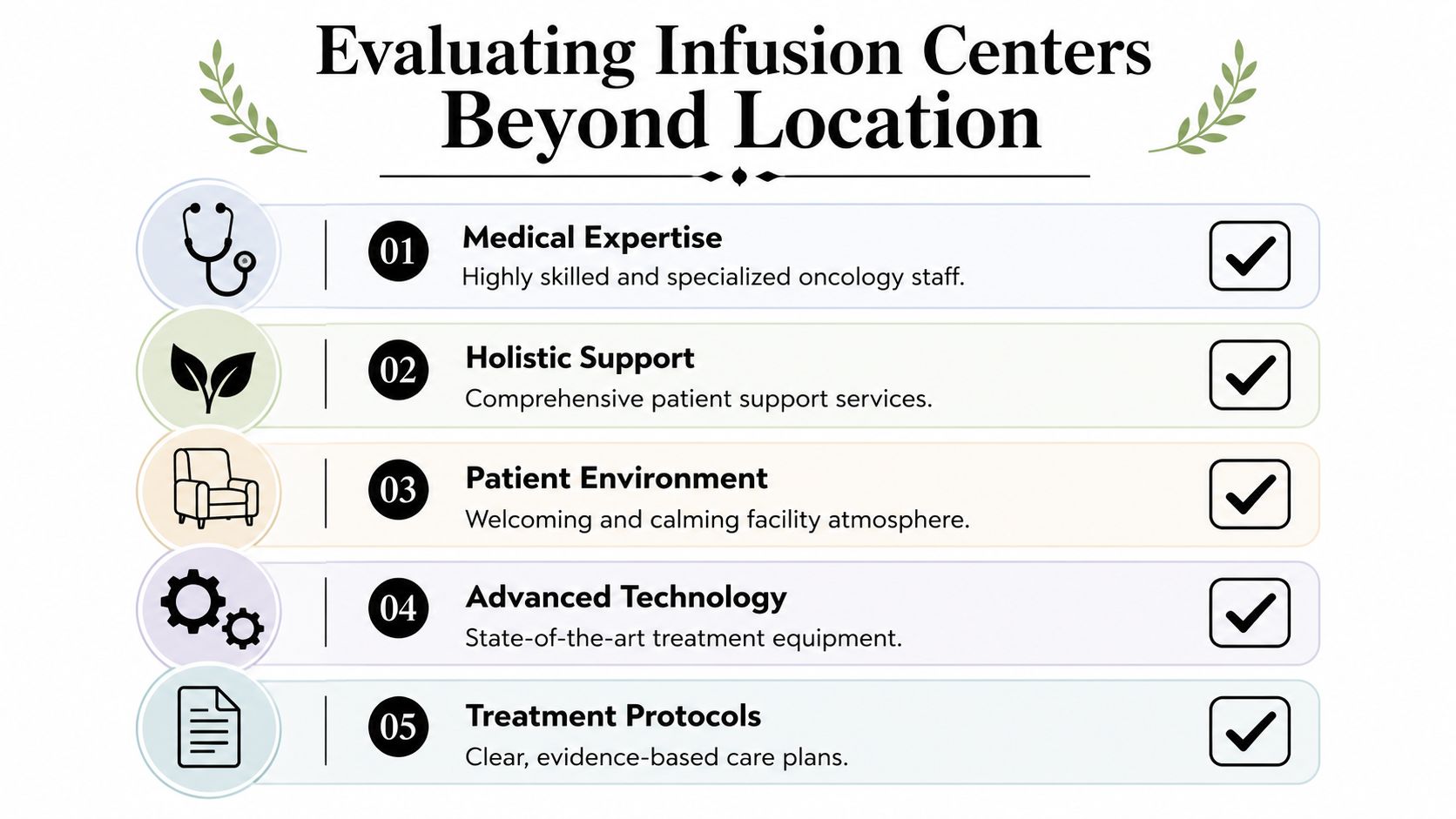
For advanced oncology patients, “infusion center near me” is only the starting point. The comparison to make is between a hospital outpatient department, a stand-alone infusion center, and home infusion. The right setting depends on reaction risk, how closely the patient needs to be observed, whether port or PICC support is needed, and how quickly the team can respond if labs or symptoms change.
Here is the practical trade-off:
| Setting | Often works well for | Watch-outs |
|---|---|---|
| Hospital outpatient department | Higher-acuity treatments, patients who may need closer observation, complex oncology care | More facility logistics, longer time on site, and in some plans a higher cost-sharing structure |
| Stand-alone infusion center | Repeated outpatient visits, convenience, easier access near home or work | May have narrower drug lists, less onsite backup, or stricter limits on supportive oncology services |
| Home infusion | Selected therapies with lower monitoring needs and reliable home support | Not suitable for every cancer drug, reaction risk, or line-care situation |
Families can save themselves a bad fit. If a patient has advanced disease, unstable symptoms, frequent infusion reactions, difficult venous access, or a regimen that sometimes needs same-day escalation, ask the oncologist and the center the same direct question: “Is this site appropriate for this exact treatment plan?”
Look past convenience and ask about oncology capability
General infusion experience is not the same as oncology depth. A center can be pleasant, easy to reach, and still be the wrong place for a complex regimen.
Ask questions that force a specific answer:
- Drug familiarity: “How often do you give this exact therapy?”
- Reaction protocol: “If symptoms start during infusion, what medications and staff are onsite right away?”
- Line care: “Do you routinely access ports and manage PICC lines?”
- Labs: “Are labs drawn onsite, and who clears treatment if results are borderline?”
- Supportive care: “Can you provide hydration, injections, transfusion coordination, or symptom support if treatment day changes?”
- Same-day communication: “Who contacts my oncologist if there is a problem?”
Vague answers are a warning sign.
For families comparing options, it also helps to review the basics of insurance coverage for cancer patients before choosing a site, because the safest clinical setting and the insurer-approved setting are not always the same.
Check scheduling like it will matter for months, because it will
Repeated treatment changes what “convenient” means. A center that feels acceptable for one visit can become draining after weeks of fatigue, lab checks, traffic, and caregiver coordination.
Published outpatient models show that some centers offer extended daily schedules and year-round appointments, which can make recurring cancer care easier to organize in real life, as seen in UM BWMC's outpatient infusion center information.
Ask:
- Hours: “Do you offer early, late, or weekend appointments?”
- Consistency: “Can future visits stay at about the same time of day?”
- Wait times: “If my labs are delayed, what usually happens to the chair time?”
- Space: “Is care delivered in private rooms, shared bays, or both?”
- Caregiver access: “Can someone stay with me during treatment?”
These details affect endurance. Patients receiving advanced cancer treatment often tolerate the medical plan better when the visit flow is predictable and the environment is reasonably calm.
Pay attention to insurance-driven site differences
Two centers can both say they provide infusion care and still handle insurance very differently. One may verify benefits before scheduling. Another may book first and sort out approvals later. One may know how to work through oncology drug billing issues. Another may not catch a site-of-care restriction until treatment is delayed.
That is why it helps to understand insurance medication coverage while you compare centers, not after you pick one.
Ask each site:
- Benefit review: “Do you check both the drug benefit and the infusion administration benefit?”
- Site-of-care rules: “Has this insurer ever required this drug to move to a different setting?”
- Authorization workflow: “Who follows the approval, and who updates me if there is a problem?”
- Appeals experience: “If the insurer denies this site, does your team help with medical-necessity review?”
Signs a center is a strong fit
What usually works:
- The center confirms it can administer the exact regimen before offering a chair.
- Staff can describe reaction management and escalation steps clearly.
- The team understands oncology timing, including lab-dependent delays and schedule changes.
- Financial clearance staff can explain what is being checked and what could hold up treatment.
What often creates problems:
- The conversation stays focused on parking, snacks, and décor.
- Staff speak in broad terms about “most infusions” instead of your regimen.
- No one can explain who handles authorizations or how quickly the oncologist is contacted if something changes.
- The center says it can “probably” do the treatment without reviewing the order set or support needs.
For advanced oncology care, the best choice is rarely the one that looks easiest on a map. It is the one that can safely deliver the regimen, coordinate with the oncology team, and avoid preventable delays when the treatment plan gets complicated.
Navigating Insurance and Financial Logistics
This is the part families dread most, and for good reason. Insurance problems can delay treatment even when the medical plan is clear.

Many centers market convenience but don't answer the questions patients need answered: What will I owe? Is prior authorization required? Is this site in network? Could site-of-care rules move me to a different setting? Those gaps are exactly why Metro Infusion Center's patient guidance highlights financial transparency as a major issue.
A practical overview helps before the paperwork starts:
Treat authorization as part of treatment
For most oncology infusions, scheduling doesn't begin with the calendar. It begins with benefit checks, referral review, coding alignment, and insurer approval if required.
Call the center and ask for the person who handles financial clearance or authorizations. Then call your insurer separately and compare answers. Don't rely on one side alone.
Ask the center:
- Authorization status: “Has prior authorization been submitted, and is anything missing?”
- Site-of-care rules: “Does my plan require this drug in a specific setting?”
- Billing structure: “Will I receive separate bills for the drug, the facility, and the clinician?”
- Network verification: “Are both the center and the supervising clinicians in network?”
- Patient estimate: “Can you give me a written estimate or benefits summary?”
Ask your insurer:
- Benefit type: “Is this covered under medical benefit, pharmacy benefit, or both depending on site?”
- Patient share: “How do my deductible, copay, and coinsurance apply to outpatient infusion?”
- Alternative site rules: “Would my cost change at a hospital outpatient department versus a stand-alone center?”
- Referral requirements: “Do I need a referral on file before treatment?”
Watch for the hidden cost issues
The word “covered” doesn't mean “affordable.” A center can be in network and still leave you with a large bill if the drug, administration fee, facility fee, or clinician charges fall into different buckets.
These resources can help you frame the conversation better. For a plain-language breakdown of pharmacy and benefit issues, this guide on insurance medication coverage is useful. For cancer-specific questions around what plans may and may not pay for, Hirschfeld Oncology's article on insurance coverage for cancer patients gives a focused overview.
Bring a notebook to every insurance call. Write down the date, the representative's name, and the exact wording they use.
What good financial navigation looks like
A well-run center doesn't dodge cost questions. Staff should tell you what they know, what still needs verification, and what could change based on site-of-care policies.
What helps:
- Clear acknowledgment that estimates can shift.
- Early discussion of authorizations before a chair is booked.
- Fast correction when a referral, diagnosis, or ordering detail is incomplete.
What creates trouble:
- “You'll find out after the claim.”
- “We usually don't know until treatment day.”
- “The doctor's office handles that,” with no named contact and no follow-up.
When families push for clarity early, they often avoid the worst surprises.
How to Prepare for Your First Infusion Visit
The night before a first infusion, families usually have the same questions. What should we bring, how long will we be there, and what happens if something feels wrong once treatment starts?
Preparation helps because it turns an unfamiliar day into a series of manageable steps. For patients with advanced cancer, that matters even more. The first visit is often the point where you learn how this specific center handles symptom reporting, schedule changes, access issues, and communication after hours.
What to wear and bring
Dress for comfort, but also for access. Staff may need to reach a port or your arm easily, and infusion rooms often feel cooler than expected. A layered outfit usually works better than a single heavy item.
A practical infusion bag should include:
- Layers: A zip hoodie, cardigan, or small blanket.
- Access-friendly clothing: A shirt that lets staff reach a port or IV site without a struggle.
- Food and water: Only if your care team says eating and drinking are fine that day.
- Comfort items: Lip balm, headphones, glasses, tissues, and a phone charger.
- Medical basics: Your medication list, photo ID, insurance card, and written questions.
- Something to do: A book, downloaded show, music, light work, or a simple puzzle.
If the treatment plan is complex, bring a caregiver if possible. One person can listen while the other focuses on getting through the visit.
What to clarify before the IV starts
Day one is not the time to stay quiet. The safest patients are often the ones who ask clear, specific questions early.
Start with these:
- How long should today take from check-in to discharge?
- What side effects do you want reported right away during the infusion?
- What symptoms later tonight would be expected, and what would be a reason to call?
- Who handles after-hours concerns for this center?
- Will labs, medication review, and the next appointment happen before I leave?
Listen for direct answers. In a well-run oncology infusion center, staff can usually explain the sequence of the day, what they are watching for, and who is responsible if a problem comes up after you get home.
How caregivers can help
Caregivers often catch details patients miss. That is especially true when the visit includes new medications, premedications that cause drowsiness, or a lot of instructions given quickly.
Ask the caregiver to track:
- Arrival and start times
- Medications given
- Any symptoms during the infusion
- Instructions for home
- Names of the nurse, scheduler, or triage contact
Those notes become useful if side effects show up later, the plan changes between cycles, or another specialist asks what happened at the first treatment.
If you want a broader day-of checklist, Hirschfeld Oncology's guide on how to prepare for chemotherapy is a practical companion. Many of the same planning steps apply to infusion visits, even when the regimen is not traditional chemotherapy.
The first visit is a working session. It helps you learn how your body responds, how the center communicates, and what support you can count on between treatments.
A Local Option for Advanced Cancer Care in Brooklyn
For patients in Brooklyn dealing with advanced, recurrent, or treatment-resistant disease, the decision often turns on one question. Is this center built for routine throughput, or for individualized oncology care?

Some modern oncology infusion centers are designed for high-volume delivery with privacy features such as private rooms. One published example includes 23 private rooms plus a three-person suite, which shows how outpatient oncology spaces often balance comfort with efficient patient flow. That model can work well for many patients.
But families seeking an infusion center near me in New York City often need something more customized than a standard high-throughput setup. That's especially true when the regimen is less conventional, the cancer has progressed through standard options, or the patient's tolerance and goals require closer adjustment over time.
When a more individualized model matters
A specialized cancer practice may be a better fit when:
- Standard protocols have been exhausted and the patient is evaluating newer combinations or less toxic approaches.
- Side effects need tighter management because prior treatment was hard to tolerate.
- The plan changes frequently based on symptoms, labs, or disease response.
- The patient wants closer discussion of goals rather than a one-size-fits-all scheduling pathway.
In Brooklyn, one option is Hirschfeld Oncology's Brooklyn cancer center, which operates as a local cancer care and infusion site for patients who need outpatient treatment access tied closely to oncology decision-making.
What to look for in a local oncology center
A strong advanced-cancer infusion setting should offer more than chair availability.
Look for:
- Regimen flexibility: Can the team work with individualized treatment plans?
- Close monitoring: Is there active adjustment based on tolerability and response?
- Clinical continuity: Does the same oncology team remain involved, rather than handing everything off to a remote infusion site?
- Practical access: Is the location realistic for repeated visits in Brooklyn traffic, with family support and transit in mind?
For many NYC families, local access matters most when it supports continuity, not just convenience. Repeated treatment is easier when the infusion setting and the oncology strategy are tightly connected.
Taking Control of Your Treatment Journey
Choosing an infusion center feels administrative at first. In practice, it's one of the first decisions that lets a patient regain some control.
Administrative efficiency plays a real role here. In one survey of infusion workflows, 70% of programs obtained prior authorization before scheduling, while the average time from identified need to treatment was reported as same day by 46% of programs and 1 to 2 days by 29%, according to this survey of U.S. infusion program workflows. That doesn't guarantee speed for every patient, but it shows why organized intake and authorization processes matter.
The best path is usually straightforward. Make a shortlist. Confirm the center can safely deliver your treatment. Verify network status and authorization requirements. Ask direct questions until the answers are concrete enough to trust. Then prepare for the first visit in a way that reduces uncertainty.
Patients facing advanced cancer also benefit from understanding how treatment settings differ more broadly across medical transport and hospital systems. For readers who want that wider view, this overview of hospital and air ambulance equipment roles can help explain how levels of medical support vary by care environment.
A center is the right fit when you feel medically protected, practically supported, and clearly informed. That combination matters more than a map pin.
If you're exploring outpatient infusion options for advanced cancer treatment in Brooklyn, Hirschfeld Oncology offers information on individualized oncology care, infusion support, and practical guidance for patients and families navigating next-step decisions.
.png)
.png)






