.png)


Why Oral Chemotherapy Is Gaining Ground
Oral chemotherapy now represents roughly 10 % of all chemo prescriptions and is projected to reach 25 % within a few years, reflecting a rapid shift in oncology practice. By allowing patients to swallow pills at home, oral agents eliminate painful IV lines, reduce infusion fees, and free up travel time, markedly improving autonomy and overall quality of life. However, safe use demands strict handling: medications must be stored in original containers, handled with gloves, and never crushed or broken unless directed. Patients need clear counseling on food timing, drug‑drug interactions, and side‑effect monitoring, while clinicians employ double‑check pharmacy systems and adherence tools such as electronic pill caps to minimize errors and ensure therapeutic effectiveness. Routine labs and telehealth visits ensure dosing safety, and fewer infusion visits cut overall treatment expenses significantly.
Efficacy of Oral Chemotherapy Compared With IV Regimens

Clinical response rates for oral agents such as capecitabine, oral paclitaxel, and temozolomide have been shown to match their IV counterparts in colorectal, breast, pancreatic, and lung cancers. Survival outcomes—including progression‑free and overall survival—are comparable when dosing and pharmacokinetic monitoring are appropriate, as demonstrated in phase III trials of oral paclitaxel (35.8% response vs 23.4% IV) and capecitabine non‑inferior to IV 5‑FU. However, efficacy hinges on strict adherence; sub‑80% adherence raises mortality risk (hazard ratio 1.10 for tamoxifen). Monitoring tools—patient diaries, electronic pill caps, plasma drug levels, and regular labs—are essential to maintain therapeutic drug concentrations and manage side‑effects.
How effective is oral chemotherapy? Oral chemotherapy can be just as effective as IV regimens, often achieving comparable response rates and long‑term disease control for many solid tumors and blood cancers. Over 100 oral agents are approved and used across treatment lines, retaining potency while offering at‑home convenience.
Is oral chemo less effective than IV? Oral chemotherapy is not inherently less effective; when the appropriate agent is chosen, adherence ensured, and monitoring performed, outcomes are equivalent to IV therapy.
Boosting Survival: Adherence, Lifestyle, and Emerging Options

Improving survival hinges on three pillars. First, robust adherence tools—electronic pill caps, mobile reminder apps, and therapist medication diaries—enable real‑time monitoring and prompt dose adjustments, reducing non‑adherence rates that can exceed 20 %. Second, regular physical activity (e.g., brisk walking 150 minutes/week) and a plant‑rich, whole‑food diet lower inflammation, help maintain healthy weight, and have been linked to 40‑50 % reductions in cancer‑related mortality for many tumor types. Third, enrolling in clinical trials offers access to novel agents and combination regimens that may outperform standard care. To answer the core question—how to increase survival chances—follow your oncologist’s personalized plan, attend all imaging and lab appointments, stay active, eat nutritiously, use electronic adherence tools, and discuss trial eligibility with your care team. Together, these strategies maximize therapeutic effectiveness and overall outcomes.
Long‑Term Toxicities of Oral Chemotherapy and How to Manage Them

Peripheral neuropathy
Oral agents such as capecitabine and oral taxanes can cause persistent peripheral neuropathy, manifesting as numbness or tingling in the hands and feet that may last months or years after therapy ends. Dose‑adjustment, vitamin B12 supplementation, and early referral to neurology can mitigate severity.
Chronic fatigue
Patients frequently report chronic fatigue and reduced exercise tolerance long after treatment cessation. Energy‑conservation strategies, graded exercise programs, and treatment‑off anemia monitoring help restore functional capacity.
Organ‑specific toxicities and secondary malignancy risk
Some oral drugs carry organ‑specific risks—e.g., cardiotoxicity with certain TKIs, hepatotoxicity with capecitabine, and nephrotoxicity with high‑dose cyclophosphamide. Long‑term surveillance, including periodic cardiac imaging, liver function tests, and renal panels, is essential. Additionally, agents such as fluoropyrimidines have a modest risk of secondary malignancies, underscoring the need for lifelong follow‑up.
What are the long‑term side effects of oral chemotherapy?
Long‑term oral chemotherapy can lead to persistent peripheral neuropathy, chronic fatigue, organ‑specific toxicities (cardiac, hepatic, renal), and a small increased risk of secondary cancers. Regular monitoring, early intervention, and supportive care are essential to manage these effects and preserve quality of life.
New Oral Agents Bringing Hope for Pancreatic Cancer

Oral chemotherapy is expanding the treatment armamentarium for pancreatic cancer, a disease historically limited to intravenous regimens. The FDA is accelerating review of darolrasib, a targeted oral therapy that has shown activity against pancreatic tumors, offering renewed optimism for one of the deadliest cancers. In parallel, capecitabine—an oral pro‑drug of 5‑fluorouracil—is being combined with gemcitabine, an IV nucleoside analog, in multiple trials that aim to maintain efficacy while reducing central‑line complications and improving quality of life. Emerging targeted oral agents, such as oral PARP inhibitors and tyrosine‑kinase inhibitors, are also entering phase II/III studies, often in combination with standard IV drugs, to create hybrid regimens that preserve therapeutic intensity without the burden of frequent infusions. These strategies reflect a broader shift toward patient‑centered care, leveraging oral dosing to enhance convenience, adherence, and safety while striving for comparable survival outcomes.
Beyond the IV Line: Alternatives and Venous Access Devices
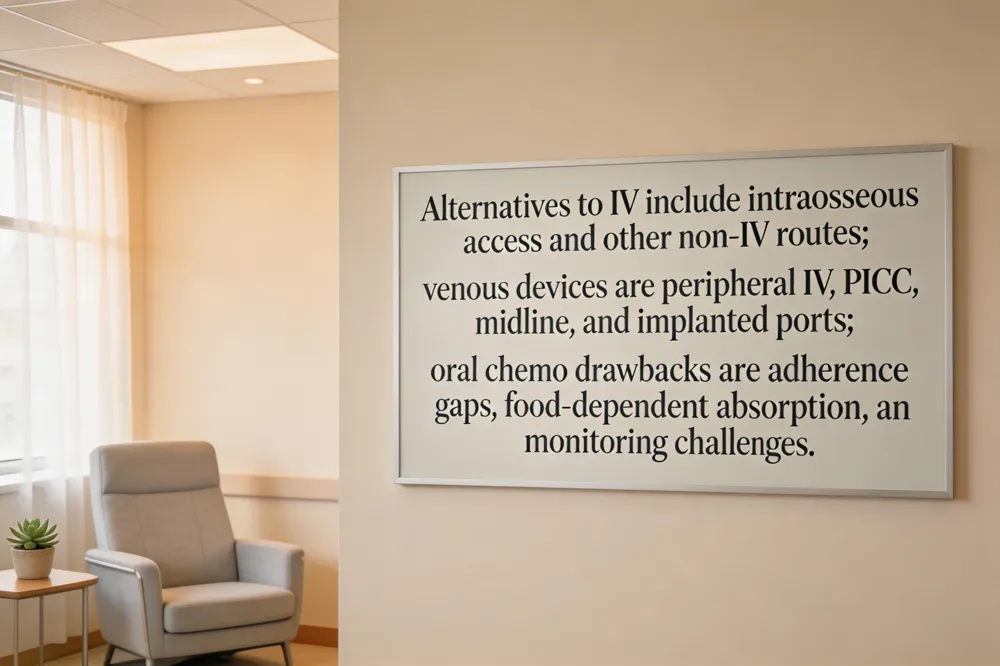
Are there alternatives to IV sites? Yes. When venous access is impossible, clinicians can use intraosseous (IO) access, which provides rapid vascular entry in <30 seconds and delivers drugs with pharmacokinetics comparable to IV. Other non‑IV routes include intratracheal, sublingual, intralingual, intrapenile, and even intracardiac administration, though these are less favored due to variable absorption and higher risk.
What are the alternatives to IV cannulation? Beyond IO, alternatives encompass intratracheal drug delivery, sublingual and intralingual injection, intrapenile routes, and, as a last resort, intracardiac injection in emergency settings.
What are the four types of venous access devices? The main categories are peripheral IV catheters (PIVCs), peripherally inserted central catheters (PICCs), midline catheters, and implanted ports (CICCs).
What are the disadvantages of oral chemotherapy? Oral agents can suffer from missed doses (non‑adherence rates 12‑30 %), variable food‑dependent absorption (e.g., high‑fat meals alter capecitabine levels), drug‑interaction risks (warfarin + capecitabine), and side‑effects such as gastrointestinal upset, hand‑foot syndrome, and myelosuppression that may be harder to monitor without in‑person visits.
Oral Chemotherapy: A Cornerstone of Modern, Patient‑Centric Cancer Care
Oral chemotherapy has transformed cancer treatment by markedly reducing the need for intravenous (IV) access. Patients no longer require central venous catheters or frequent infusion‑center visits, which lowers the incidence of catheter‑related infections, thrombosis, and procedural complications while enhancing autonomy and quality of life. Successful implementation relies on seamless integration of oncology pharmacists, nurses, physicians, and telehealth services. Pharmacists verify dosing, assess drug‑interaction risks, and educate patients on food timing and safe handling; nurses reinforce adherence tools such as pill boxes and electronic caps; physicians monitor labs and adjust therapy; remote platforms enable real‑time symptom reporting. Looking ahead, research focuses on novel oral prodrugs, nanocarrier delivery systems, and pharmacogenomic testing to improve bioavailability and reduce toxicity. Ongoing trials are evaluating oral formulations of traditionally IV‑only agents, aiming to expand the oral armamentarium and further diminish reliance on invasive vascular access. Future protocols will incorporate AI‑driven adherence monitoring for optimal outcomes worldwide.
.png)
.png)