.png)


Getting to and from your cancer treatments is just as important as the therapy itself, yet it’s a hurdle that can feel overwhelming. For patients and their families, the sheer logistics of frequent appointments add a layer of stress to an already difficult journey. This guide is designed to be your roadmap, laying out clear, practical options to find the transportation help you need, right from the start.
The Hidden Hurdle: Just Getting to Your Appointments
When you first hear a cancer diagnosis, your mind understandably jumps to treatment plans, potential side effects, and the road ahead. What often gets overlooked is a very real, very practical problem: how are you going to get to all your appointments?
This isn't a small detail. Consistent, reliable transportation is a cornerstone of successful cancer care. Missed or delayed appointments can disrupt your treatment schedule and, in turn, affect your outcome.
Then there’s the financial and physical strain. The costs of gas, parking, tolls, or even daily subway fares add up fast, creating a new financial burden. For patients who use a wheelchair, just getting in and out of a car or navigating a home's entryway can be a major daily challenge. A practical guide to wheelchair ramps for home can be an invaluable resource in these situations, helping to maintain a sense of independence.
Where Do I Even Begin Looking for Help?
The good news is, you are not alone in this. A landmark 2023 survey found that an overwhelming 96% of major cancer centers have programs to help patients with transportation. These services are often coordinated by social workers or patient navigators.
Help is almost certainly available right where you get your care. You just have to know who to ask.
Your journey to recovery is the only thing you should have to focus on. Taking the first step to explore your transportation options frees you up to concentrate on what truly matters: your health and your healing.
Finding the right support really boils down to a simple process: figuring out what you need, connecting with the right program, and locking in your ride.
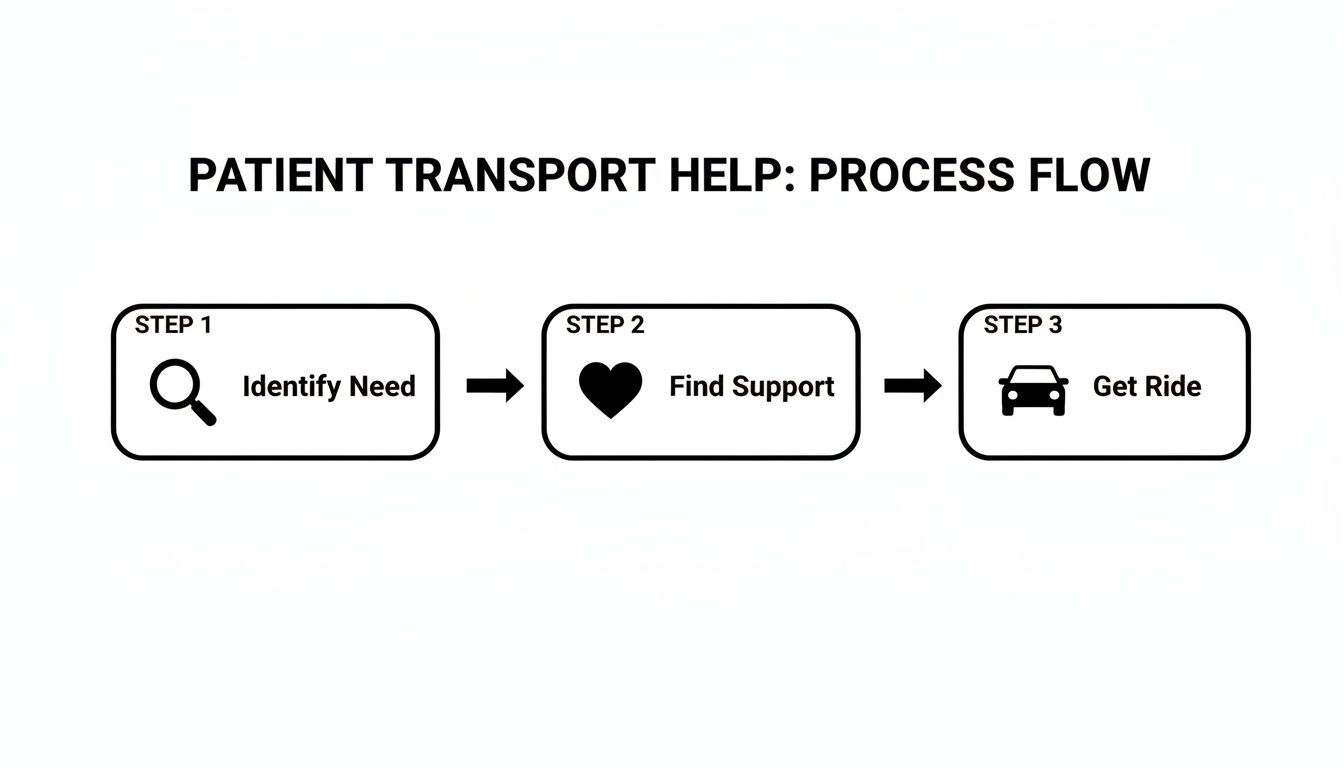
As you can see, the path always starts with taking that first step to ask for help. From there, you can bridge the gap between your home and the treatment you need.
Your Transportation Assistance Options at a Glance
To make it easier to see where you might fit, here’s a quick breakdown of the most common types of transportation support.
This table is just a starting point. Your social worker or patient navigator is your best ally in figuring out which of these options—or combination of them—is the right fit for your specific situation.
Getting to Your Appointments: Using Your Insurance for Transportation

It’s easy to overlook, but your health insurance card might just be your ticket to getting a ride. Many insurance plans have a specific benefit built-in to help patients get to their appointments, but most people don't even know it exists.
The benefit you're looking for is called Non-Emergency Medical Transportation, or NEMT. It’s a standard, required benefit in all state Medicaid programs and is also common in many Medicare Advantage plans. The whole point of NEMT is to make sure that a lack of transportation never stands between you and essential medical care, like your chemotherapy or radiation sessions.
This is a massive program. Back in 2019, Medicaid’s NEMT benefit was supported by about $5 billion in federal and state funds, helping countless people get to their doctors. Still, there can be gaps in the service, so it’s important to know exactly how to use it and what to do if you hit a snag.
How to Find Out If You Qualify for NEMT
Your first step is simple: call your insurance company. Just flip over your insurance card and find the number for "Member Services" or "Customer Service."
When you get someone on the line, be direct. Here are the questions you’ll want to ask to get straight to the point:
- Does my plan include Non-Emergency Medical Transportation (NEMT) benefits?
- What kind of rides are covered? (For example, taxis, rideshare services like Uber/Lyft, or ambulettes for wheelchair access?)
- How do I actually book a ride, and how far in advance do I need to call?
- Are there any caps on how many trips I can take each month or year?
This one phone call is your starting line. The answers you get will map out your next steps and give you a clear picture of what kind of support you can expect. Knowing all the resources at your disposal, including how to find a cancer infusion center near you, is a huge part of taking control of your care.
A Real-World Example: Booking Your Rides
Let’s think about a patient from Brooklyn named Maria. She has to get to our clinic for infusions every day for two straight weeks. The idea of arranging—and paying for—10 round-trip rides is completely overwhelming.
So, Maria calls the number on her Medicaid card and learns that she is, in fact, eligible for NEMT. The representative tells her the next step is getting a form from her oncologist to confirm that the trips are medically necessary for her treatment.
This document is critical. It’s often called a "Letter of Medical Necessity" or a provider certification form, and it's what officially tells the insurance company that these rides are an essential part of her cancer care.
A Quick Tip from Experience: The moment you get your treatment schedule, ask your oncologist’s office for this form. Getting the paperwork squared away before you call to book your first ride makes everything go much more smoothly and avoids frustrating delays.
Once our office faxes the completed form for Maria, she calls the NEMT scheduling line. She gives them all her appointment dates, times, and the clinic's address. Smartly, she requests all the rides for the full two-week period in that one call, which saves her from having to repeat the process every single day. The NEMT service takes it from there, arranging for a local car service to get her to and from each infusion, with the cost completely covered by her plan.
Finding Support Within Your Cancer Center

Sometimes, the best resources are hiding in plain sight. Your own cancer center is often the most direct and effective place to find transportation help, with support systems designed for the very challenges you're facing. It’s more than a place for treatment; it’s a hub of support. You just need to know who to ask.
The first people you should connect with are the hospital social workers and patient navigators. Think of them as your personal guides through the healthcare maze. Their entire job is to help patients overcome barriers to care, and transportation is at the top of that list.
These professionals are experts on all the available resources, both inside the hospital walls and out in the wider community. They can cut through the noise and point you directly to programs you qualify for, saving you a tremendous amount of time and stress.
What Kind of Help Can a Patient Navigator Provide?
Meeting with a patient navigator or social worker opens up a world of practical, real-world solutions. They don't just hand you a pamphlet; they actively coordinate support that fits your specific needs. This kind of hands-on help is a key part of what makes patient navigation programs that improve oncology care so valuable.
Based on the center's specific resources and local partnerships, the help they provide can look like this:
- Taxi Vouchers or Gas Cards: Perfect for patients who can drive but are feeling the pinch from fuel costs, or for those who just need a simple taxi ride.
- Public Transit Passes: In a city like New York, they can often provide MetroCards to make using the subway or bus completely free for your appointments.
- Direct Ride Coordination: Many cancer centers work directly with local car services or dedicated volunteer drivers who specialize in getting patients to and from their appointments safely.
- Rideshare Program Access: Your navigator will know if the hospital partners with services like Uber Health. This allows them to schedule a ride for you that is billed directly to an assistance fund, not to you.
Key Takeaway: Reaching out to your social worker isn't a sign of weakness—it's a smart, strategic move. Their expertise can lift a huge logistical and financial weight off your shoulders, letting you focus on what really matters: your health.
How to Start the Conversation with Your Care Team
Getting the ball rolling is simpler than you might think.
The next time you're at the clinic, just mention to your nurse or doctor that you’re struggling with transportation. That's usually all it takes for them to put in a referral to the social work team.
To get the most out of that first meeting, a little preparation goes a long way. Bring your full treatment schedule and be ready to explain your specific challenges. Are you having trouble physically getting into a car? Is cost the main issue? The more detail you provide, the better they can help. It's a good idea to jot down a few questions beforehand so you don't forget anything important.
How Volunteer Driver Programs Fill the Gaps

When insurance benefits don't cover a ride or hospital resources are stretched thin, the kindness of strangers can be a true lifeline. This is where nonprofit and volunteer driver programs step in, filling those crucial gaps with reliable rides powered entirely by community spirit.
These programs are built on a simple yet powerful idea: connecting local patients who need a ride with volunteers willing to donate their time and vehicle. What they offer goes far beyond just a trip to the clinic; it's a deeply personal and supportive experience.
The American Cancer Society's Road To Recovery
One of the most well-known and widespread options is the American Cancer Society's Road To Recovery program. For decades, this service has been giving free rides to and from treatment for people with cancer who simply have no other way to get there.
The process is refreshingly straightforward. You typically call a national hotline or use an online portal to request a ride, making sure to provide your appointment details several business days in advance. From there, the program matches you with a trained and vetted volunteer driver in your local area.
To qualify for a Road To Recovery ride, a patient generally must:
- Be traveling to a cancer-related medical appointment.
- Be able to walk on their own or with just a bit of help.
- Not need any medical care during the trip itself.
A patient we worked with, John, relied on Road To Recovery for his weekly chemotherapy in Brooklyn. His driver wasn't just a ride; she became a friendly, familiar face during a challenging time, offering encouragement and a listening ear. This kind of human connection is what makes volunteer programs so special.
Finding Local Transportation Assistance
Beyond the big national organizations, there's often a rich network of smaller, community-based groups providing similar help. Think local churches, synagogues, senior centers, or charities focused specifically on your borough or neighborhood.
Finding these hyper-local resources can take a bit of detective work, but it’s worth it. Your hospital social worker is always the best place to start, as they keep updated lists of trusted local partners.
You can also try a few practical steps on your own:
- Search Online: Use terms like "cancer patient rides Brooklyn" or "medical transportation volunteers [Your County]."
- Contact Local Charities: Call your local United Way or community foundation. Ask if they fund or know of any medical ride programs.
- Check with Faith-Based Groups: Many religious organizations have ministries dedicated to helping community members, which often includes rides to medical appointments.
Discovering how to best support a loved one can also lead you to these resources. For more ideas, you can explore our guide on how to help someone with cancer.
When you find a smaller organization, just be sure to ask about their driver screening process and any specific requirements for riders. These community-driven solutions offer more than just transportation; they deliver hope and a powerful reminder that you are not alone on this journey.
Rideshares and Other Modern Ways to Get to Your Appointment
Technology has really opened up new doors for getting to and from cancer treatments, giving you more direct and flexible options. Gone are the days when your only choice was a traditional van service. Now, hospitals and cancer centers are partnering with familiar names like Uber and Lyft to get you to your appointments reliably and on time.
These aren't just regular rides you book yourself. They're managed through special healthcare-focused platforms like Uber Health and Lyft Concierge. This is a huge plus because it means your hospital's patient navigator or social worker can schedule and pay for the ride for you. You don’t even need a smartphone or the app; they handle it all.
The biggest win here is the efficiency. Instead of a multi-stop shuttle that zig-zags across town, a rideshare car takes you straight from your home to the clinic. This simple change can drastically cut down on travel time and the stress that comes with it.
Why Are These Options Becoming So Popular?
The move towards using rideshare services in healthcare is all about the patient. It brings a level of convenience and dignity that can make a massive difference when you’re going through a tough treatment schedule.
Here’s what patients tell us they appreciate most:
- Less Waiting Around: Rides are booked for specific times, so you're not left waiting for a van that's running late from its last stop.
- A Straight Shot to Your Appointment: There are no other passengers to pick up or drop off. The trip is just for you, making it as quick and comfortable as possible.
- More Wiggle Room: We all know appointments can run late. With these services, rescheduling a pickup is much simpler than trying to rebook a large shuttle.
This isn't just about convenience—it’s a powerful tool for making sure patients can consistently get to their appointments. In fact, a recent pilot program for gynecologic oncology patients found that using rideshare services cut commute times by an average of 19.5 minutes compared to public transit. When you're facing daily treatments, that time saved is invaluable.
A Note From Our Team: For so many of our patients here in Brooklyn, the time and energy saved by a direct ride is just as important as the financial help. It means less time navigating transit and more time focused on what really matters: resting and recovering.
Don't Forget to Look at All Your Options
While a hospital-coordinated rideshare is a fantastic resource, it's always smart to consider every possibility. For instance, if your situation allows for it, or if you need a more personalized touch, looking into private car driver services can offer an added layer of comfort and reliability.
The best first step is always to have an open conversation with your social worker or patient navigator. They know the landscape inside and out and can help you figure out which combination of services will work best for you.
We’re Here to Help You Get to Your Appointments
At Hirschfeld Oncology, we know that figuring out how to get to and from your appointments is the last thing you should be worrying about. Your focus needs to be on your health and healing, not on logistics. That's why helping you solve transportation challenges is a core part of how we care for you.
From your very first visit, our team makes it a priority to understand your situation. We'll ask about your travel needs so we can connect you with the right resources before you ever miss an appointment. We're here to help you navigate the real-world obstacles that can get in the way of your treatment.
How We Personally Assist Our Patients
We take a direct, hands-on role in making sure you have a reliable ride to our Brooklyn infusion center. This isn't just a referral service; we're actively involved in finding a solution that works for you.
Here are a few of the practical ways our team can help:
Navigating NEMT Paperwork: The forms required for insurance-covered transport, like a Letter of Medical Necessity, can be confusing. We'll walk you through the paperwork and help you get it submitted correctly.
Connecting You to Trusted Programs: We have established relationships with dependable volunteer driver programs and local cancer support charities. We can make a direct introduction to the people who can help.
Coordinating Rides for You: When options are available through our hospital partners, we can often arrange the rides for you, taking that task completely off your plate.
Our goal is simple: to make sure a ride is never the reason you can't get the care you need. We are your partners in this, committed to supporting you every step of the way.
Common Questions About Getting to Your Appointments
Figuring out transportation when you're dealing with cancer treatment can feel overwhelming. It's totally normal to have a lot of questions. We get asked about these logistics all the time, so let's walk through some of the most common ones we hear from our patients and their families.
How Far in Advance Should I Book My Ride?
Honestly, the sooner, the better. As soon as you have your appointment scheduled, you should be thinking about booking your ride. These services get booked up quickly.
- Insurance-Provided Rides (NEMT): If you're using a service through Medicaid, they're pretty strict. You'll almost always need to book at least 48 to 72 hours ahead of time.
- Volunteer Driver Programs: Think about programs like the American Cancer Society's Road To Recovery. They're coordinating volunteers' schedules, so giving them several business days' notice is crucial to find a match.
- Hospital and Clinic Services: Even when your patient navigator is arranging a rideshare for you, giving them as much notice as possible helps everything run smoothly on the day you need it most.
What Paperwork Should I Have Ready?
This really depends on the program you're using, but it's smart to have a few key documents on hand from the start. For any insurance-based transport, you'll definitely need your Medicaid or Medicare card and a "Letter of Medical Necessity" from our office.
If you're applying for help from a nonprofit or a hospital-specific program, they'll likely ask for your treatment schedule to confirm you're eligible. No matter who you're calling, always have your exact appointment details ready: the date, the time, and the clinic's full address.
Here’s a little pro tip I always share: keep a folder—a real one or a digital one—with copies of your insurance card, ID, and treatment schedule. It makes applying for anything so much faster and cuts down on the stress of hunting for documents.
Can My Caregiver Come with Me?
Having someone with you for support can make all the difference, but policies vary. Most of the time, medical transportation services and volunteer drivers will allow one caregiver to come along, but you absolutely must mention this when you book. Don't just assume it's okay.
Rideshares that the hospital arranges, however, are often just for the patient. The best rule of thumb is to ask about their policy on guests every single time you schedule a ride. It prevents any surprises or difficult situations on the day of your appointment.
At Hirschfeld Oncology, our whole team is here to make sure you have the support you need, and that includes helping you sort out transportation. We can help you with the necessary paperwork and point you toward reliable services right here in the NYC area. To get a better feel for our patient-first approach, feel free to explore our blog.
.png)
.png)