.png)


The most popular advice about 2 liters of water a day sounds neat, but in the infusion chair it's too blunt to be useful. A fixed number is a shorthand for healthy adults, not a prescription for a person whose fluid balance is being pushed around by chemotherapy, vomiting, diarrhea, fever, kidney stress, or a day of heavy IV fluids.
For patients in active cancer care, hydration is not a wellness habit. It's a moving clinical variable. If you treat 2 liters like a universal rule, you can miss dehydration when the body is losing fluid faster than usual, or you can miss overhydration when the kidneys or heart can't clear extra volume well enough. That's how a simple rule turns into a bad decision.
If you're trying to make sense of bottles, cups, and bottle sizes, it helps to choose gear that makes tracking easy instead of obsessive. For a practical comparison, I'd start by compare tritan bottle designs so the bottle itself works with your routine instead of against it.
Why 2 Liters Is Not a Medical Rule
2 liters of water is a public slogan, not a medical order. It's useful because it's simple. It's also dangerous when people mistake simplicity for precision, especially when treatment is changing the body's needs from day to day.
The better way to think about it is this, 2 liters can be a rough reference point, but it is not a universal target. Modern hydration guidance is broader than that. The University of Roehampton summary of a 2022 analysis says a typical adult male in the US or Europe may need about 1.5 to 1.8 liters per day from water, while women may need about 1.3 to 1.4 liters per day from water, and it rejects a one-size-fits-all 2-liter policy Roehampton analysis summary.
The oncology problem
Cancer patients don't live inside that neat, healthy-adult framing. Fever, diarrhea, vomiting, appetite loss, mouth pain, kidney strain, and infusion-day fluids all shift the equation. A person who tries to “hit 2 liters” no matter what can end up underhydrated on a rough day or overdoing it on a day when the body can't move fluid normally.
Practical rule: Stop treating 2 liters like a daily exam score. In cancer care, the right question is whether today's intake matches today's losses.
The old habit of counting glasses can distract from the task, which is reading the body's signals and matching fluid intake to treatment side effects. That's a much better conversation to have with your care team than “Did I reach the magic number?”
Where the 2-Liter Idea Actually Came From
The modern slogan has a long, messy history. A broad fluid recommendation from 1945 helped create the pattern, then repetition turned a general nutrition message into a tidy wellness rule. That is how a practical fluid target slowly got flattened into 2 liters a day, even though the original idea was never a precise medical threshold for plain water alone historical overview.
That compression created the myth. A broad fluid recommendation is not the same thing as a bottle-counting rule. The historical guidance was about total fluid, and modern standards are still broader than the slogan suggests. The commonly cited U.S. National Academies adequate intake is 3.7 liters per day for men and 2.7 liters per day for women, and that total includes water from both beverages and food.
Why the public version stuck
People remember round numbers. Marketing loves round numbers. Bottled-water culture loves them even more. The result is a slogan that sounds authoritative because it is easy to repeat, not because it fits every body.
The clinical takeaway is more grounded. Hydration today is not just what you pour into a glass. It includes food, other drinks, treatment-day IV fluids, and the body's own losses. That is why the same 2-liter phrase can feel comforting in a grocery aisle and misleading in an oncology clinic.
A simplified public message can survive for decades even after modern evidence moves the goalposts.
How the Body Actually Handles 2 Liters
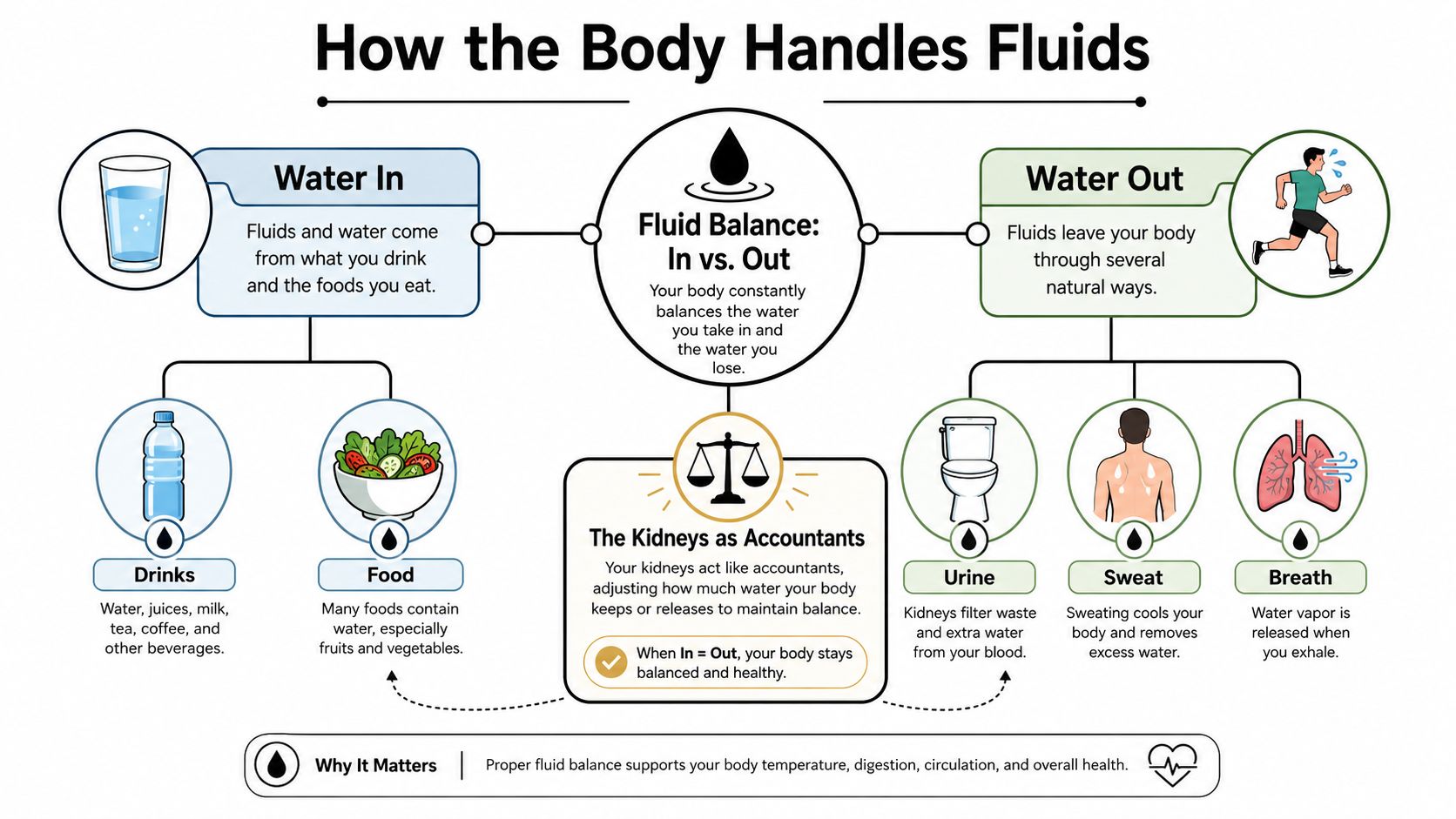
Your body runs fluid like a ledger. Water comes in, water goes out, and the kidneys do the accounting. If the numbers don't balance, you feel it. Sometimes you feel it fast.
Think of hydration like a leaky bucket. On an ordinary day the leak is small, so a normal intake may be enough. On a day with fever, vomiting, diarrhea, heavy sweating, or certain medicines, the leak gets bigger and the same intake may no longer cover it.
What changes the leak rate
Cancer treatment can increase losses in obvious and not-so-obvious ways. Diarrhea sends fluid out quickly. Vomiting does the same. Fever raises losses. Poor appetite makes people forget to drink at all. Some medicines and supplements can also change urine color, which can make the usual urine check less clear.
A useful bedside check is still urine color trending pale yellow, but don't overread it if medication or supplements have changed the color of the urine.
The old clinical rule of thumb still matters because it's simple and honest. Pale yellow urine often fits a reasonable hydration state, while clear urine can mean you're pushing beyond what you need water overview. That isn't a license to chase perfectly clear urine. It's a warning not to assume more is always better.
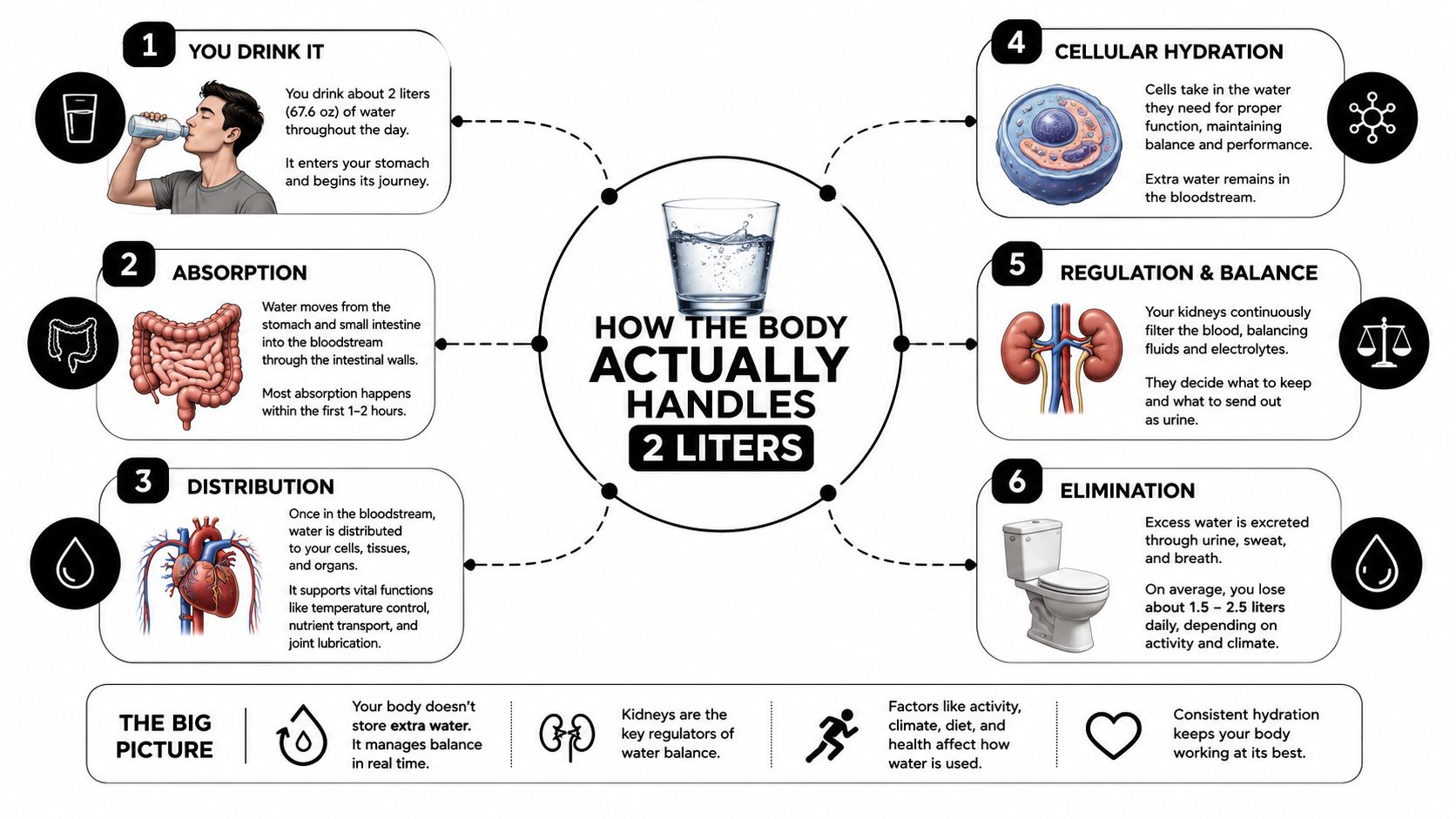
For a patient in active treatment, the issue is not whether the body “should” get 2 liters on paper. It's whether today's fluid input matches today's output. That balance changes with heat, infection, vomiting, diarrhea, and how hard the kidneys are being asked to work.
How Cancer Treatment Changes the Math
Cancer therapy changes hydration math in both directions. Some days you lose fluid faster than you can replace it. Other days you're getting so much support in the infusion chair that extra drinking can push you toward overload, especially if your kidneys or heart are already under strain.
When losses outrun intake
Chemotherapy-related nausea and diarrhea can wreck a normal drinking pattern. Immunotherapy can also trigger bowel inflammation that drives fluid loss. Fever after infusions, poor appetite, and a dry mouth all make it harder to keep up. In that setting, plain water may not be enough, because you're not just replacing water, you're replacing losses that include salts too.
A patient on a 5-FU-based regimen who develops grade 2 diarrhea can lose far more than a casual bottle count suggests, and the right response is often oral rehydration with electrolytes, not just more plain water. That's the difference between replacing fluid and replacing fluid well.
When too much fluid becomes the issue
Some patients have kidney or heart limitations that make overhydration a real risk. In those cases, extra intake can add to swelling, shortness of breath, or that heavy, puffy feeling people sometimes dismiss as “just tired.” Heavy IV hydration on infusion days can also change the picture, so the day after treatment is not always a day to force extra drinking.
| Factor | Direction of Fluid Need | Why It Matters |
|---|---|---|
| Nausea or vomiting | Up | Intake falls while losses rise |
| Diarrhea | Up | Water and electrolytes are both lost |
| Fever | Up | Fluid losses increase |
| Poor appetite or taste changes | Up | People forget or avoid drinking |
| Kidney or heart limitation | Down or individualized | Extra fluid can accumulate |
| Heavy IV hydration on infusion day | Down or individualized | Total volume may already be high |
For broader treatment context, effects of chemotherapy are not just about fatigue and nausea. They also change how carefully you need to think about fluid balance.
A Practical Daily Hydration Plan
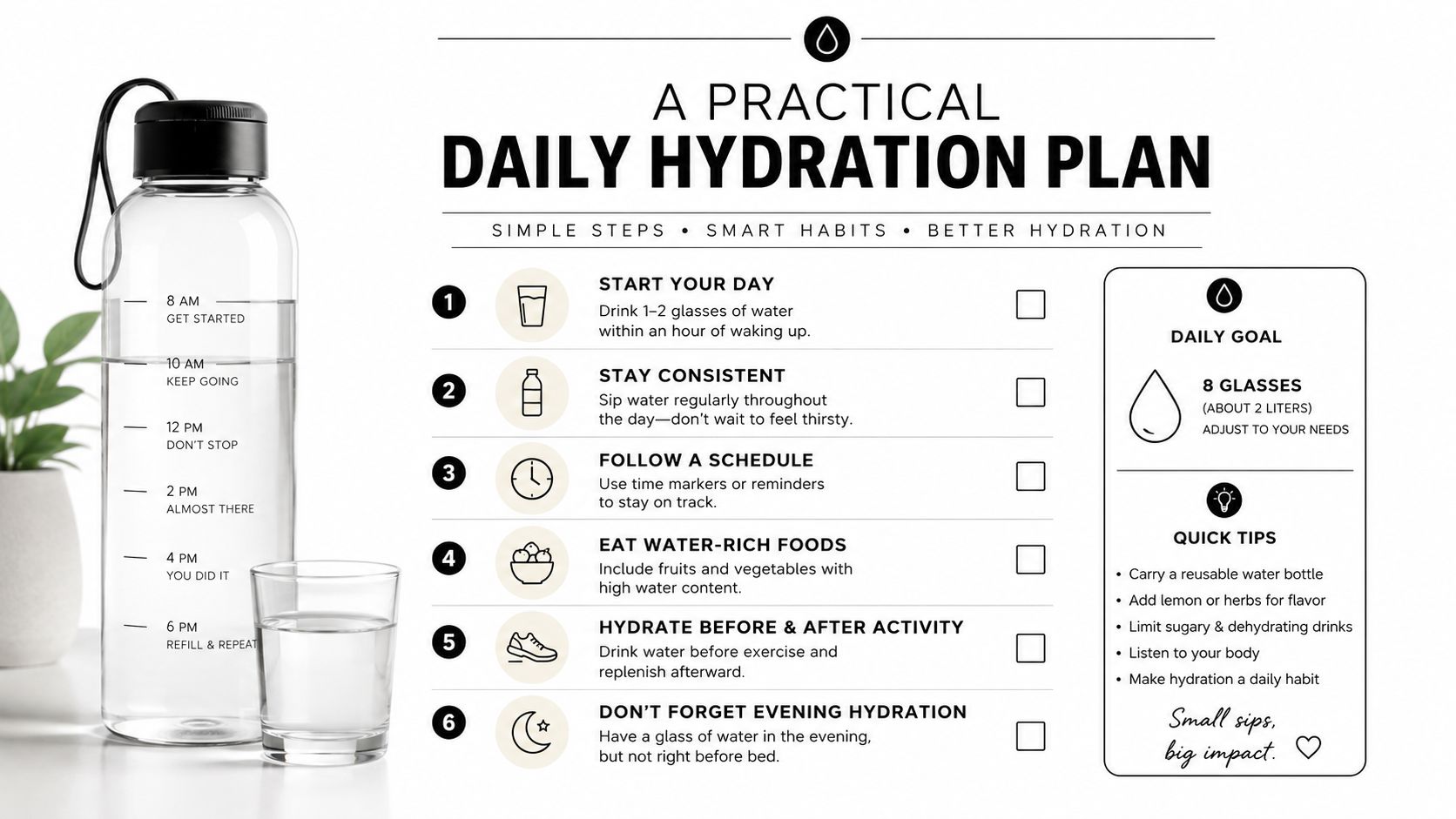
Stop aiming for perfection. Start with a plan you can follow while you're tired, queasy, busy, or stuck in traffic on the way to infusion. The best routine is boring on purpose.
Build the day around touchpoints
Begin with a measured bottle, not an untracked guess. Sip through the day instead of chugging at random. Pair drinks with medication times, because that's the easiest reminder most patients already have. If appetite is poor, broths and herbal teas can count toward intake. If diarrhea or vomiting is active, switch from plain water to an electrolyte solution so you're replacing what you've lost instead of diluting yourself.
Keep the goal practical, not heroic. A good hydration plan is the one you can repeat on a bad day.
For nutrition support that often overlaps with fluid advice, nutrition for cancer patients is worth reading alongside your treatment instructions.
Two simple sample days
Chemo day: start with a bottle you can measure, sip before and after medication, use broth if food feels impossible, and follow the infusion team's guidance on whether you need electrolyte drinks. If you've had vomiting or diarrhea, don't wait for thirst. Thirst is a late signal.
Rest day: spread your drinks across meals, keep a bottle visible, and use tea, soup, or flavored water if plain water feels stale. You do not need to turn hydration into a second job.
Mouth sores, swallowing trouble, and taste changes are not willpower problems. They're treatment problems. If drinking hurts, or everything tastes like metal, the infusion team needs to know so the plan can be adjusted instead of abandoned.
Warning Signs for Dehydration and Overhydration
Most patients only get warned about dehydration. That's incomplete advice. In oncology, both ends of the spectrum matter, and they can look annoyingly similar at first.
Dehydration warning signs
Watch for dizziness when standing, dark urine, dry mouth, reduced urine output, confusion, and fatigue. If several of those show up together, especially after vomiting, diarrhea, or fever, don't try to outthink it at home. Call.
Overhydration warning signs
Watch for sudden swelling in the ankles or hands, shortness of breath, chest tightness, and an unusual rapid weight gain over a day. If those appear, especially in someone with kidney or heart issues, the problem may not be “not enough water,” it may be too much fluid for the body to clear safely.
Call sooner rather than later if the same symptom keeps showing up but the context has changed. Fatigue can mean dehydration, treatment fatigue, anemia, or fluid overload.
The useful mental model is balance, not fear. A patient can feel lightheaded because they're dry, or because they're carrying too much fluid and the circulation is off. You need the full picture, not a guess based on one symptom.
When to Call the Oncology Care Team
Don't wait for a crisis. Call the same day if vomiting or diarrhea is prolonged, if you have fever above 100.4°F, if you can't keep fluids down for more than 12 hours, if swelling or shortness of breath appears suddenly, or if urine stays dark longer than a day. Those are not “watch and wait” symptoms in a patient on treatment.
If you call, be specific. Tell the team how much you drank, whether you're urinating less, whether your weight changed, what the urine looks like, and what medicines you took today. That's the information that helps them decide whether you need oral rehydration, an urgent visit, labs, or just a medication tweak.

For more on what infusion-day side effects can look like, cancer infusion side effects is a sensible companion read.
The right mindset is simple. You are the daily observer. The oncology team is the interpreter. When you give them the details early, they can often correct the problem before it turns into an ER visit.
The Real Takeaway for Patients and Caregivers
The question is not whether 2 liters of water is a good number in the abstract. The question is whether it fits the body you have today, on the treatment you're on today, with the symptoms you're dealing with today. That's why the same rule can be harmless in one setting and wrong in another.
Remember three things. First, stop treating the number as a law. Second, read the body's signals, not just the bottle label. Third, make hydration a clinical conversation, not a wellness chore you try to power through alone.
That's the standard I'd use at the bedside. Not “Did you hit the number?” but “Did your fluid plan fit the week?” If you're in Brooklyn or anywhere in New York City and you want that conversation to be direct, practical, and tied to your treatment plan, Hirschfeld Oncology is a good place to start.
A CTA for Hirschfeld Oncology.
.png)
.png)