


.png)


You're sitting in a chair after treatment, legs heavy, mind restless, and the idea of exercise feels bigger than it should. You don't need a workout plan that talks like you're training for a race. You need a 30 min walk that rebuilds confidence without draining the little energy you have left.
A walk of that length matters because it lines up with the World Health Organization's 150 minutes per week benchmark for moderate-intensity activity, which is often met by walking 30 minutes a day, 5 days a week. In adults aged 50–65, a randomized primary-care trial testing “30-min brisk walking, 5 days a week” found improved fitness and cardiovascular risk markers, and public-health guidance also links daily walking with better cardiovascular fitness, stronger bones, healthier body composition, and lower risk of heart disease and type 2 diabetes. For people in cancer treatment, that makes walking a practical, not precious, tool. Learn more about exercise for cancer patients
Why a 30 Min Walk Matters
A patient finishing chemotherapy often asks for one thing, a way to feel like life is moving again without making fatigue worse. A 30 min walk is often the right answer because it's modest enough to fit into a real day, but long enough to count as structured activity, not just casual movement. That balance matters when you're trying to regain momentum without provoking symptoms.
The benchmark is useful because it's simple
The 150 minutes per week target isn't abstract. It's the reason a 30-minute walk, 5 days a week shows up again and again in guidance, because it gives people a concrete rhythm they can plan around. In the trial mentioned above, the phrase “30-min brisk walking, 5 days a week” was tested in adults aged 50–65, and the result was better fitness and cardiovascular risk markers, which is exactly the kind of payoff many patients want from a safe routine.
Walking also fits survivorship life better than many forms of exercise. It doesn't require equipment, a gym, or a perfect day. It fits a lunch break, an infusion-center recovery day, or a slow loop around the block when you're trying to build back confidence.
Practical rule: If you can't imagine doing it three days in a row, it's probably too aggressive for a treatment week.
That's the core value of the 30 min walk. It gives you a standard, but it also gives you room to adapt without abandoning movement altogether.
Preparing for Your Walk
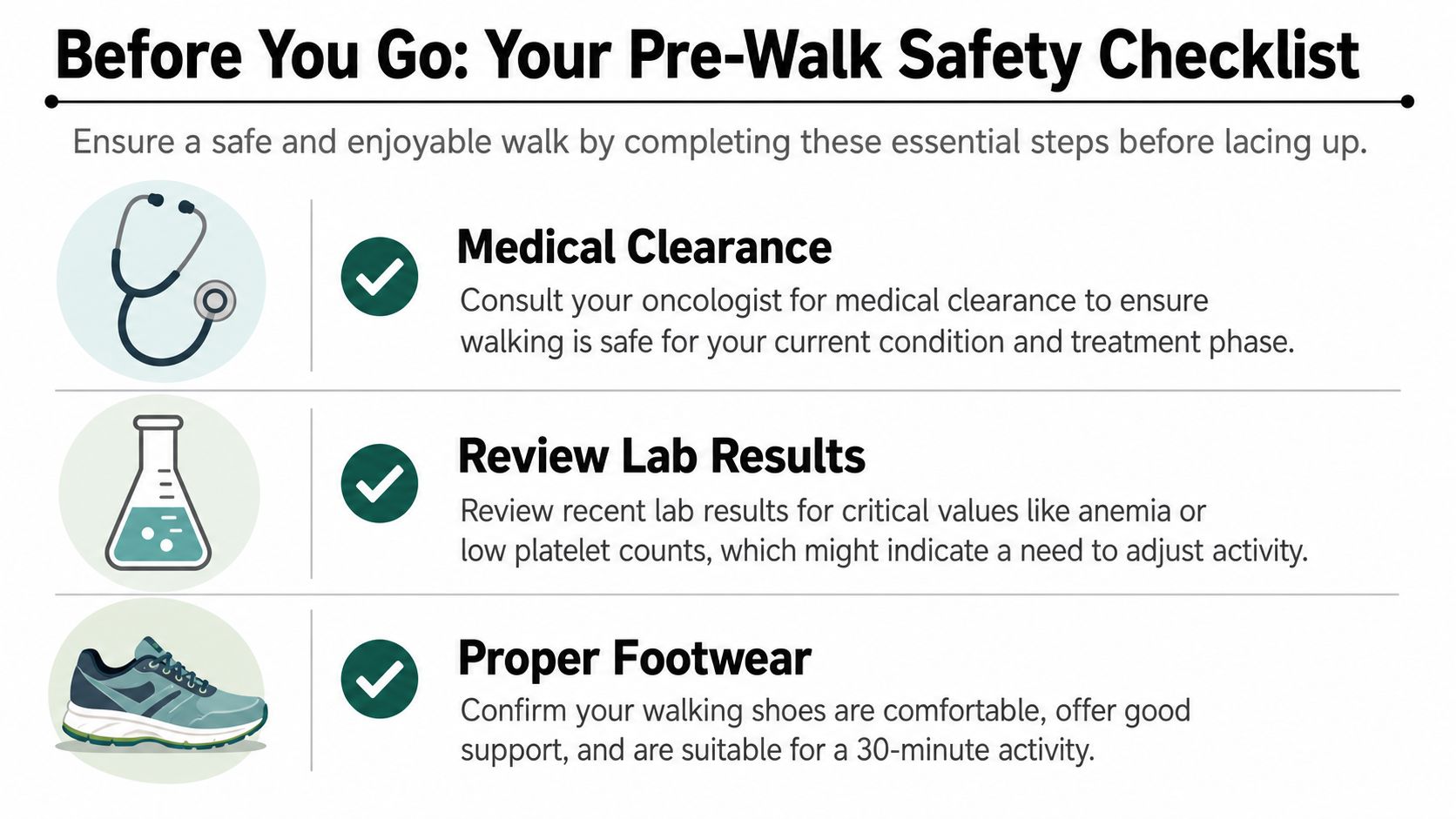
Before anyone laces up, they need a quick safety check, not a pep talk. In oncology, that check should start with your care team, because treatment phase, blood counts, pain, neuropathy, and infection risk all change what “safe” looks like on a given day. A walk that's fine on Tuesday might be the wrong call on Thursday.
Start with clearance, then check the basics
Your first filter is medical. If your oncologist has told you to limit activity, follow that instruction. If you've recently had low blood counts, dizziness, shortness of breath, unusual bleeding, or a new infection concern, the walk can wait or be shortened.
Then handle the practical details that keep a walk from becoming a hassle halfway through:
- Choose supportive shoes. Comfortable, stable footwear matters more than style when your energy is limited.
- Pick a predictable route. Benches, restrooms, shade, and even pavement are better than scenic chaos.
- Carry water. Don't assume you'll “get to it later.”
- Dress for the weather. Overheating or getting chilled can make fatigue hit harder.
- Walk when you're least wiped out. Many patients do better in their energy window, not after they've already spent the day pushing through.
This is also where hydration planning deserves attention. Even if you're not running, the same logic behind how to stay hydrated while running applies in simpler form, if you start underhydrated, the walk feels harder than it should.
A comfortable 30-minute pace can still cause local muscle fatigue and make balance worse on uneven ground, so route choice isn't optional, it's part of safety planning.
That matters especially if you have neuropathy, weakness, or unsteady gait. Flat ground, good lighting, and a fall-aware mindset beat scenic ambition every time.
Setting Safe Goals and Pacing
The biggest mistake people make is treating every 30 min walk like it has to look the same. It doesn't. What matters is whether the walk is moderate enough to support conditioning without tipping you into exhaustion. For some patients, that means a brisk, continuous walk. For others, it means a pace that's honest but sustainable.
Use pace, not ego
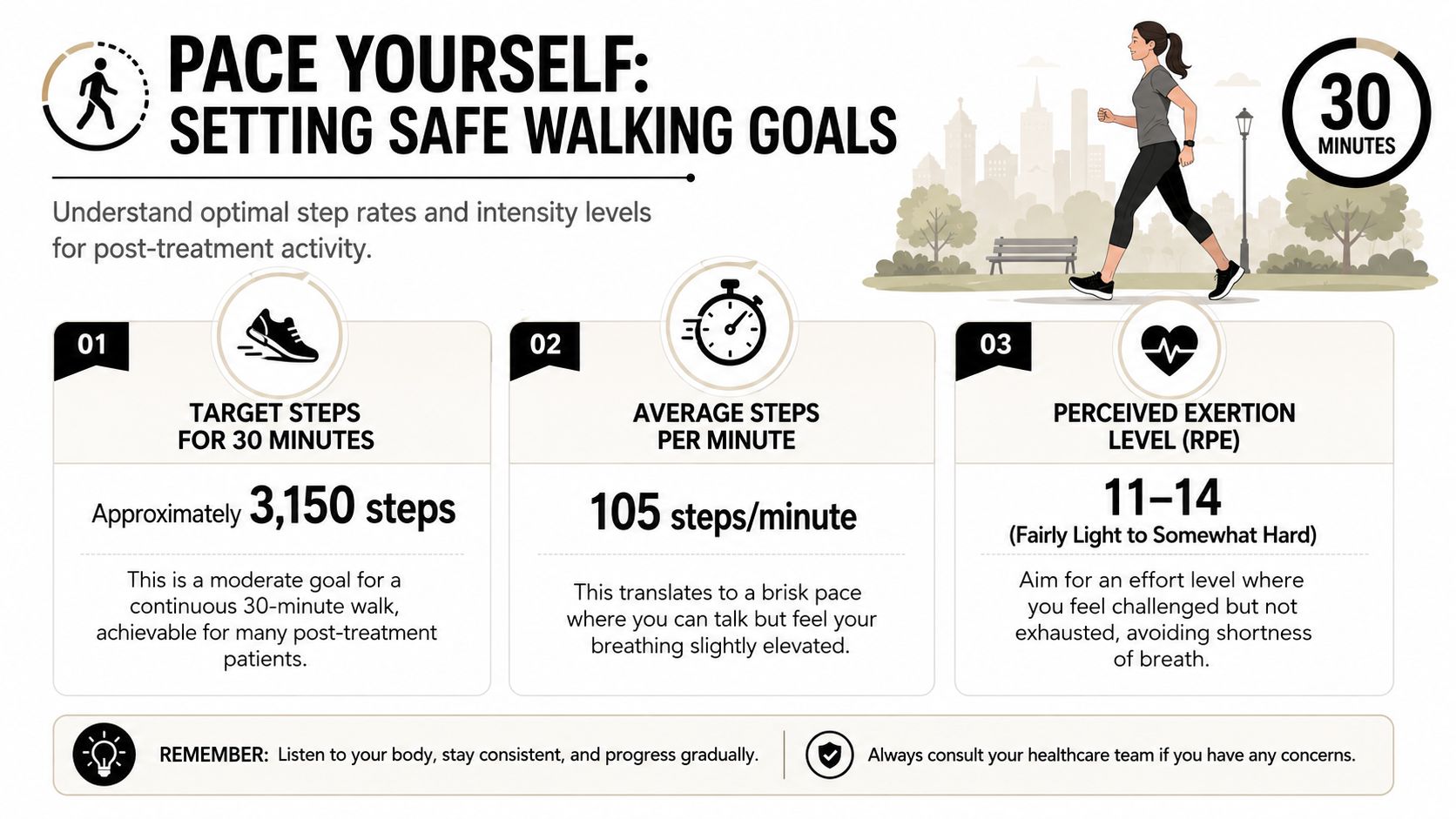
A study in young adults showed that walking 30 minutes at 105 steps per minute, or about 3,150 steps, meets moderate-intensity guidelines, which is a useful benchmark when you want structure without overthinking distance. It's a pace where you can still talk, but you'll feel your breathing working a little harder than at rest. That's the zone you're after, not a breathless grind.
The same logic applies to step counts in a gentler way. Targeting roughly 3,000 steps in 30 minutes, including three 10-minute bouts of about 1,000 steps each, can satisfy weekly activity goals without continuous exertion, which is a real advantage on treatment days when stamina is unpredictable. A tracker can help, but don't let a number override how you feel.
Bottom line: If the walk leaves you wiped out for the rest of the day, it wasn't the right pace for that day.
Pay attention to effort, not just steps
Heart rate can help some people, but treatment, medication, anemia, and steroids can make it misleading. That's why perceived effort matters. You want a walk that feels challenging, not punishing. If you're panting, slowing repeatedly, or needing long recovery just to finish, back off.
For patients who like a training mindset, the guide on preventing overtraining for lifters is a useful reminder that recovery is part of progress. Cancer treatment makes that lesson even more important. Pacing isn't softness, it's strategy.
Managing Fatigue and Side Effects
Cancer-related fatigue changes the rules. A plan that looks perfect on paper can fall apart if you're dealing with sleep disruption, neuropathy, nausea, or steroid effects. That's why I don't tell patients to force a rigid walking prescription. I tell them to fit the walk to their present day.
Shorter bouts can be the smarter choice
A controlled study found that both 10-minute and 30-minute walks after glucose intake lowered overall 2-hour glucose exposure compared with no walking, and the 10-minute walk lowered peak glucose more effectively than the 30-minute walk. That's a useful reminder for oncology patients, especially when blood sugar swings are part of the picture. Sometimes the better move is immediate, brief, and repeatable, not longer and harder.
That idea fits fatigue management too. If a full 30 minutes feels like too much, split the effort. A morning walk, a midday loop, and an evening stroll can be easier to tolerate than a single continuous block. You still respect the habit without overwhelming the body.
Treat symptoms like signal lights
- Neuropathy: If your feet feel numb or unreliable, choose a flat route and slow down.
- Joint stiffness: Start with a few easy minutes before settling into pace.
- Steroid sleep disruption: Don't assume tiredness means weakness. Sometimes the body is just poorly rested and needs a gentler plan.
- Dizziness or chest discomfort: Stop. Don't bargain with those symptoms.
The internal guide on reducing chemotherapy-induced fatigue and boosting daily energy pairs well with that mindset, because energy conservation is part of treatment survival, not a luxury.
If you want a clean comparison, think of a 30 min walk as a flexible tool, not a test. On a strong day, you can take the full route. On a weak day, the win is showing up, moving safely, and stopping before the fatigue becomes a setback.
Sample Walk Plans and Modifications
A good walking plan has options baked in. Patients do better when they're given a clear default, plus a smaller version for rough days. Caregivers do better too, because they know what “adjusting” means instead of guessing in the moment.
Choose the version that matches the day
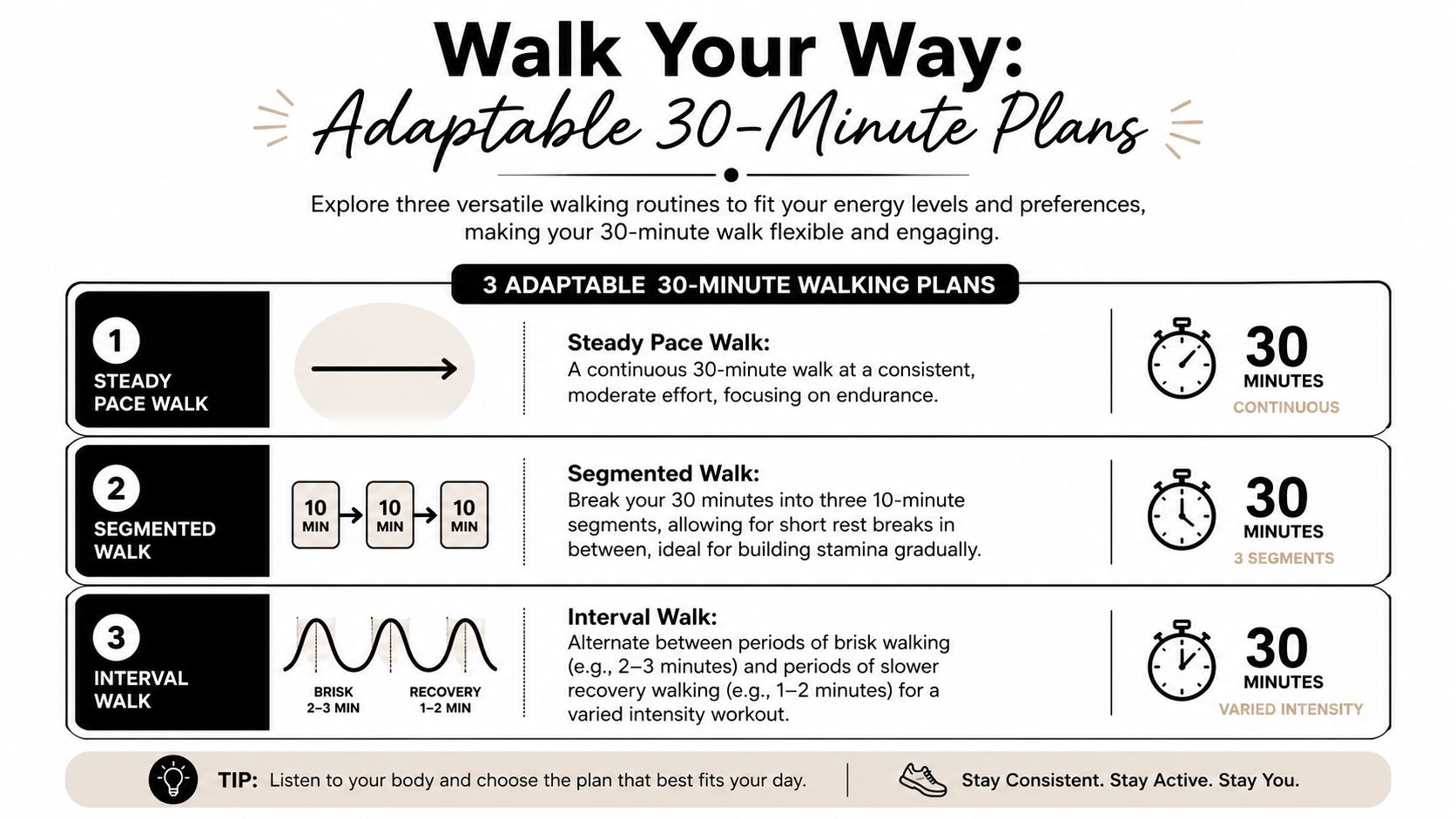
- Steady pace walk. Keep the effort moderate for the full 30 minutes if your energy is solid and your gait feels steady. This works best when you want continuity and your symptoms are quiet.
- Segmented walk. Break the session into three 10-minute bouts with short rests in between. This is the safest fallback when fatigue is real but you still want the day to include movement.
- Interval walk. Alternate a few minutes of brisk walking with slower recovery walking. Use this only when you're already tolerating movement well, because the goal is variation, not strain.
The 3 x 10-minute approach deserves special attention. It's the easiest way to preserve the habit without forcing a continuous block on a day when the body says no. That structure also works when you're pacing around appointments, infusion days, or unpredictable symptom windows.
Warm up and cool down like it matters
Start slowly for a few minutes. End the same way. That simple bookend helps your body transition into and out of activity, which is especially important if you're deconditioned or dealing with stiffness. If your walk starts to feel sloppy, shorten it. If you need to stop and sit, stop and sit.
Caregivers should help with the plan, not police it. If a patient looks unsteady, is dragging a foot, or keeps asking to pause, that's not weakness, that's data.
Tracking Progress and Knowing When to Stop
Tracking makes the walk useful. Without it, people remember only whether they felt tired or proud, and that memory gets fuzzy fast. A simple log gives your oncology team something better than “I think it went okay.”
| Metric | Description | Target or Threshold |
|---|---|---|
| Time walked | How long you actually moved | About 30 minutes total, or a shorter segmented total if needed |
| Step count | Basic activity volume | Roughly 3,000 to 3,150 steps when using step-based pacing |
| Effort level | How hard it felt | Moderate, not exhausting |
| Symptoms | Dizziness, nausea, pain, breathlessness, instability | Stop if symptoms rise or don't settle quickly |
| Recovery time | How long it takes to feel normal again | Short recovery is better than a walk that wipes out the rest of the day |
Stop early when the body says stop
Persistent dizziness, chest tightness, uncontrolled nausea, or a clear change in gait are not “push through it” signals. They're stop signals. If the walk becomes unsafe, end it. A shorter, safer session is better than a stubborn one that leads to a fall or a symptom flare.
Low-tech tracking is fine. A notebook, phone note, or step app can all work. The point is to notice patterns. If you consistently crash after a certain time of day, or if a route with hills leaves you dragging, those details help you adjust instead of repeating the same mistake.
Caregiver Support for Walking
Walking goes better with another set of eyes. A caregiver doesn't need to be athletic. They need to be observant, calm, and willing to help the patient stay safe without turning the walk into a performance.
Give the caregiver a job list
- Scout the route. Flat pavement, shade, benches, and restrooms make the outing easier.
- Carry the water. If hydration is in reach, the patient is more likely to use it.
- Watch the gait. Shuffling, limping, or hesitation can mean it's time to slow down.
- Offer simple cues. “Let's take a short break.” “This part is uneven.” “We can head back now.”
- Record what happened. Note symptoms, stops, and recovery so the oncology team gets real information later.
For adult children who are stepping into this role, the guide for adult children supporting parents can help frame the emotional side of caregiving without adding pressure.
The internal guide on how to help someone with cancer is also worth using as a reminder that practical support often matters more than perfect words. A walk can become low-pressure connection time, which is sometimes just as important as the exercise itself.
If you're in treatment and want a walking plan that respects fatigue, balance, medication effects, and caregiver realities, bring your current symptoms and routine to your oncology team and ask what 30 min walk plan fits your week. If you want help making that plan safer and more realistic, contact Hirschfeld Oncology to talk through your treatment phase, side effects, and activity limits with a team that understands cancer care.
.png)
.png)






