.png)


The day after treatment often feels smaller than you expected. You may wake up tired, stiff, slightly nauseated, and unsure whether the right choice is to push yourself, rest all day, or make it through the next few hours. For many patients, exercise sounds unrealistic in that moment.
That reaction makes sense. Cancer treatment can make your body feel unfamiliar, and for people with advanced or treatment-resistant disease, energy can change quickly from one day to the next. Still, movement can become one of the few parts of care that you actively control.
The key is to stop thinking about exercise as a hard workout. In oncology care, movement often starts with a few minutes of walking in the hallway, ankle pumps in a chair, gentle stretching before bed, or standing up and sitting down with support. Done safely, those small actions can help you feel more steady, less deconditioned, and more confident in your body.
Starting Your Movement Journey During Cancer Treatment
A common pattern looks like this. A patient finishes an infusion, goes home, and tells me, "I know I should move, but I can barely imagine doing anything extra." Usually, that patient isn't avoiding exercise. They're protecting themselves from doing too much and crashing afterward.
That's why the first step isn't a full program. It's a smaller question. What kind of movement feels possible today without making symptoms worse?
For some people, that's five to ten minutes of slow walking around the apartment. For others, it's shoulder rolls, gentle marching in place, or a few sit-to-stands from a sturdy chair. The goal at the start isn't performance. It's reconnecting movement with safety.
A strong reason to take that first step comes from survivorship research. A 2019 National Cancer Institute physical activity fact sheet notes that the most physically active breast cancer survivors had a 42% lower risk of death from any cause and a 40% lower risk of death from breast cancer compared with those who were least active.
Start where your body is, not where it was before diagnosis.
What a realistic beginning looks like
Early success usually comes from choosing movements that feel manageable enough to repeat. That may include:
- Short walks: One brief walk after breakfast or dinner.
- Chair-based movement: Seated leg lifts, ankle circles, or gentle torso turns.
- Mobility breaks: A few minutes of stretching after long periods in bed or on the couch.
- Simple support tools: A timer, a hallway route, supportive shoes, or a caregiver nearby.
If you're trying to restart activity after surgery, treatment, or a long period of inactivity, practical resources can help you think in smaller steps. This overview of Zing Coach personalized fitness advice is useful for rebuilding confidence when exercise feels far away from normal life.
For a cancer-specific view of how movement fits into recovery, Hirschfeld Oncology also shares guidance on optimizing physical rehabilitation programs for patients undergoing cancer treatment.
Why Exercise Is Essential During Cancer Treatment
Exercise during cancer care isn't a side project. In many cases, it's part of protecting function while treatment places repeated stress on the body.
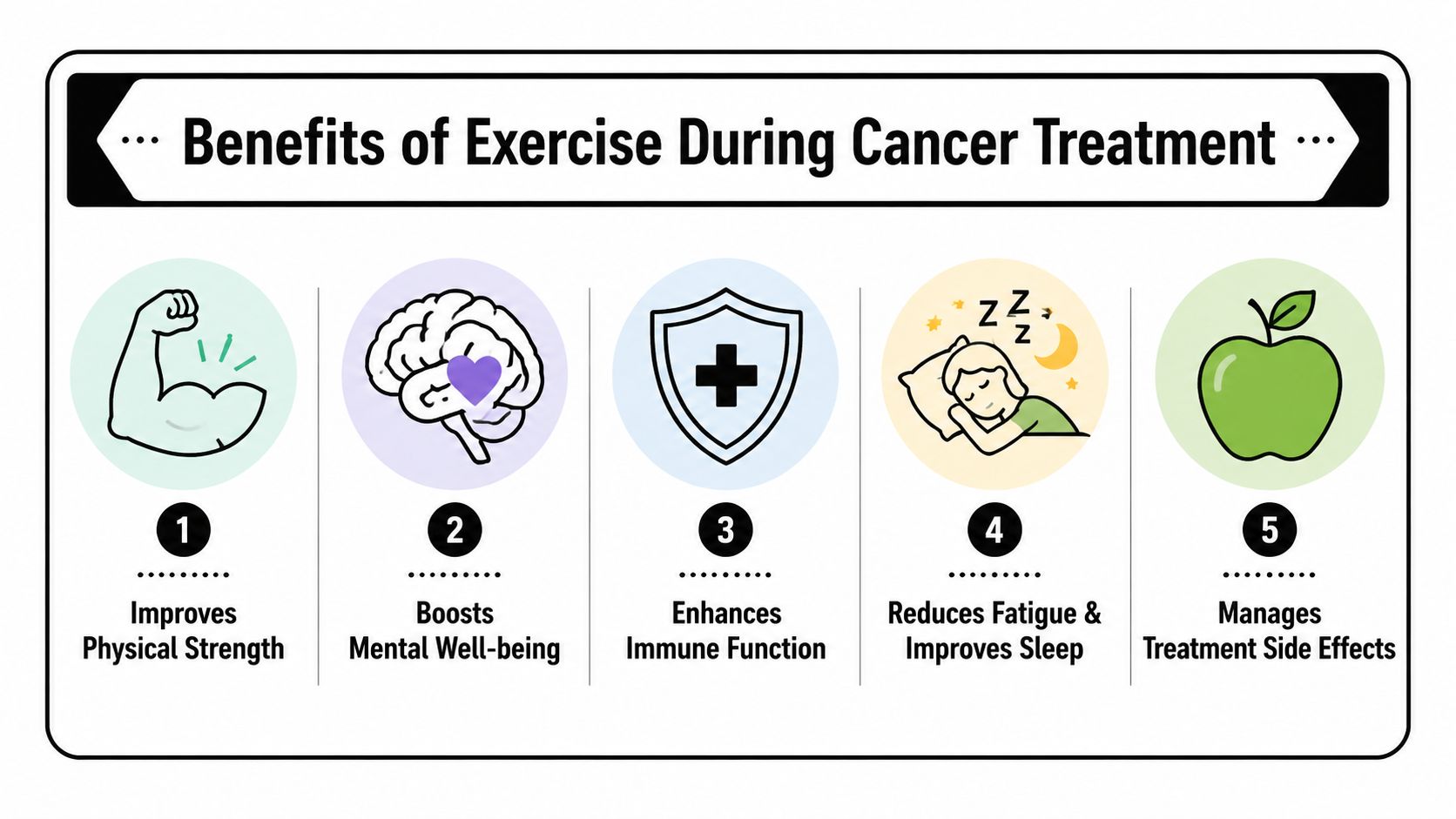
When patients move consistently, even at a modest level, they often tolerate daily life better. Walking to the bathroom feels easier. Getting out of a chair takes less effort. Balance can improve. Sleep may become less fragmented. Mood often lifts when the day includes some physical activity instead of only appointments and recovery.
What exercise helps most
Cancer treatment commonly affects the same core areas again and again:
- Strength: Muscle loss happens quickly when patients spend long stretches inactive.
- Fatigue management: Rest matters, but complete inactivity often deepens weakness.
- Mood and anxiety: A small routine gives structure to difficult days.
- Physical independence: The ability to climb stairs, dress, cook, and shower matters.
For patients recovering from procedures, it's also helpful to understand how rehabilitation fits into healing. This article on faster healing with physical therapy gives a practical overview of how guided movement can support recovery after surgery.
Exercise affects more than comfort
The evidence goes beyond energy and mobility. In the CHALLENGE clinical trial, regular physical activity in colon cancer patients was associated with a 37% reduction in overall mortality, and at eight years the overall survival rate was 90.3% in the exercise group versus 83.2% in the non-exercising group, as summarized by Yale School of Public Health.
Practical rule: If an intervention can help preserve function, reduce treatment burden, and support long-term outcomes, it belongs in the care conversation.
That doesn't mean every patient should train the same way. It means exercise for cancer patients deserves the same careful planning as nutrition, medications, and symptom control.
What doesn't work
Patients usually run into trouble in one of two ways.
The first is doing nothing because they're waiting for a "good week" that never fully arrives. The second is trying to return to their old routine too quickly, then ending up discouraged by pain, dizziness, or exhaustion. Neither approach respects the reality of treatment.
The middle path works better. Choose a level that your body can recover from, repeat it, and build slowly.
Your Pre-Exercise Safety Checklist
A patient starts the week feeling steady, plans a walk, then wakes up two days later with more numbness in the feet, poor sleep, and a new ache near the ribs. The right decision on Monday may be the wrong one on Wednesday. That is why a safety check belongs before you start and before you increase anything.
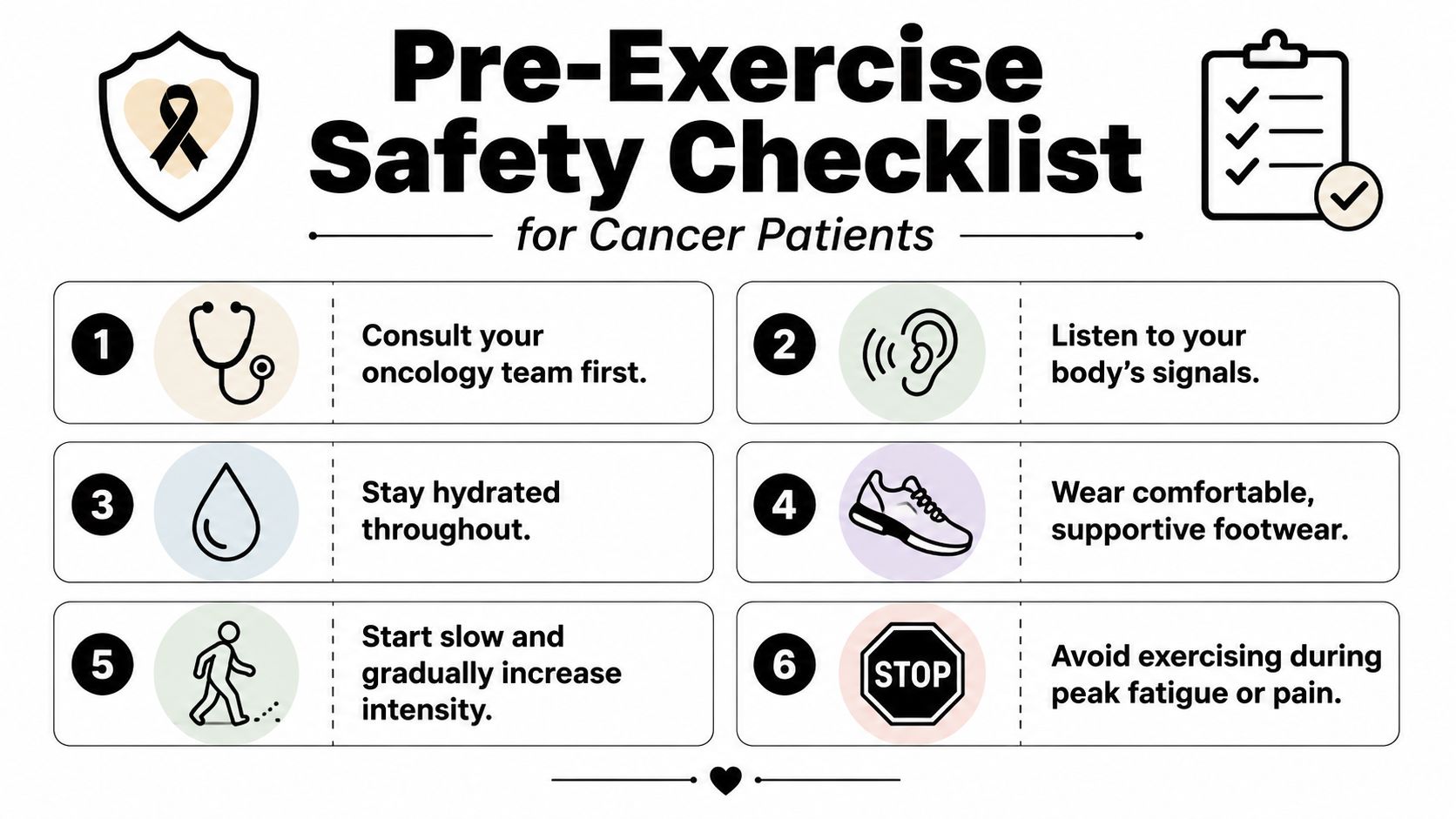
Before you change your routine, get clearance from your oncology team. For patients with complex diagnoses, exercise decisions often depend on details that are easy to miss at home. Recent surgery, low blood counts, bone metastases, lymphedema risk, neuropathy, heart or lung symptoms, drains, ports, ostomies, and active treatment side effects can all change what is safe.
Questions to bring to your oncology visit
Bring specific questions. Specific answers lead to safer plans.
- Blood counts: Ask whether low platelets, anemia, or neutropenia should change intensity, resistance work, or where you exercise.
- Infection risk: Ask if home exercise is safer than a public gym during treatment cycles when your immune system is suppressed.
- Recent surgery or radiation: Clarify lifting limits, pulling, overhead motion, abdominal strain, and skin protection in treated areas.
- Bone involvement: If you have bone pain, known lesions, or fracture risk, ask which movements, loads, and impact levels to avoid.
- Neuropathy or balance changes: Ask whether you should use a rail, chair, walker, or supervised setting.
- Heart and lung symptoms: Report shortness of breath, chest pressure, palpitations, lightheadedness, or swelling before starting a program.
- Devices and healing sites: Confirm how to move around ports, PICC lines, drains, ostomies, or healing incisions.
This conversation works best when you describe symptoms, not just goals. “I want to get stronger” is helpful. “I get dizzy after standing, my toes are numb, and stairs leave me short of breath” is much more useful.
A few practical supports matter here too. Hydration, timing meals around nausea, and getting enough protein can make activity more tolerable, especially on treatment weeks. Patients who need help with that piece often benefit from a simple nutrition plan for cancer patients.
Use a stoplight check before each session
A simple red, yellow, green system helps patients adjust without guessing.
| Day type | What it means | Better choice |
|---|---|---|
| Green day | Symptoms are stable and energy is acceptable | Walking, light strength work, stretching |
| Yellow day | Fatigue, nausea, poor sleep, or mild dizziness is limiting you | Shorten the session, lower the intensity, choose seated or indoor movement |
| Red day | Fever, chest symptoms, new severe pain, marked weakness, or significant dizziness | Stop and contact your care team |
This approach is especially useful for older adults, who may already be balancing arthritis, deconditioning, or fall risk alongside treatment. Families who want simple movement ideas can also review this guide to senior physical activity, then bring those ideas back to the oncology team for approval.
If you live locally and you are unsure where to start, ask your cancer team for a referral pathway instead of trying to sort it out alone. At Hirschfeld Oncology, that often means matching the symptom pattern to the right next step, such as medical clearance, physical therapy, lymphedema support, or a supervised exercise plan.
Some days the safest session is a five-minute walk in the house. Some days it is seated range-of-motion work only.
That still counts.
Building Your Personalized Exercise Plan
A personalized plan should fit the body you have today, not the body you had before diagnosis. For one patient, that may mean a 15-minute walk and two sets of sit-to-stands. For another, it may mean three short movement breaks between treatment-related naps. Both can be appropriate.
The goal is a weekly pattern you can recover from and repeat. In practice, that usually means mixing four types of movement: aerobic activity for stamina, strength work for daily function, flexibility for comfort and range of motion, and balance practice for safety. They do not need equal time, and they do not need to happen every day.
The core framework
General cancer exercise guidelines support a combination of regular aerobic activity, strength training on a few nonconsecutive days each week, and ongoing flexibility and balance work as tolerated. Some patients can build toward standard public health targets over time. Others need a lower starting point because of active treatment, metastatic disease, recent surgery, anemia, neuropathy, or pain.
That is still a real exercise plan.
A useful starting structure is simple. Pick a few days for walking or another easy cardio option. Add strength work two or three days a week with at least a day between sessions for the same muscle groups. Layer in brief stretching after activity or at another predictable time, such as after a shower. If balance is a concern, include a few minutes of supported practice near a counter or sturdy chair.
Four types of movement to include
Aerobic exercise
Aerobic work supports endurance for ordinary tasks such as showering, shopping, and climbing stairs. Walking is often the easiest place to start. Stationary cycling can be more comfortable for patients who feel unsteady outdoors or need a controlled indoor option. If standing tolerance is limited, seated marching or a pedal exerciser may be a better fit.
Use the talk test. A pace that still lets you speak in short sentences is usually a reasonable starting intensity.
Strength training
Treatment can reduce muscle mass quickly, especially during long periods of inactivity or steroid use. Strength work helps preserve independence with transfers, stairs, and carrying light household items.
Start with controlled movements that match your current function. Good options include wall push-ups, sit-to-stands from a chair, seated knee extensions, light resistance-band rows, or heel raises while holding support. Patients with recent surgery, lines or ports, bone involvement, or lymphedema risk need site-specific precautions before adding resistance.
Flexibility
Flexibility work is often the difference between feeling stiff all day and moving with less guarding. After surgery or radiation, even gentle range-of-motion work can make dressing, reaching, and sleeping positions more comfortable.
Focus on areas that commonly tighten during treatment, such as the chest, shoulders, upper back, hips, and calves. Stretch to mild tension, not pain.
Balance
Balance deserves a place in the plan for patients with neuropathy, weakness, dizziness, or deconditioning. Keep it practical and safe. Supported weight shifts, feet-together standing near a counter, tandem stance, and heel-to-toe walking with a hand close to support are usually enough to start.
If you are older or already adapting for arthritis or fall risk, some of the same strategies used in a guide to senior physical activity can be adapted for cancer care with oncology clearance.
Sample Weekly Exercise Plan for Beginners
| Exercise Type | Frequency (per week) | Intensity | Time (per session) | Examples |
|---|---|---|---|---|
| Aerobic | Most days as tolerated | Easy to moderate, able to talk | Short bouts building toward longer sessions | Hallway walking, outdoor walks, stationary bike |
| Strength | A few nonconsecutive days | Light resistance with good control | Brief sessions with rest between exercises | Wall push-ups, sit-to-stands, resistance band rows |
| Flexibility | Regularly | Gentle stretch, no bouncing | A few minutes per area | Calf stretch, chest opener, seated hamstring stretch |
| Balance | Several days if safe | Low intensity, close to support | Short focused practice | Counter-supported weight shifts, tandem stance, heel raises |
What makes a plan sustainable
Patients do better with clear rules than with ambitious intentions.
Three habits matter. Keep sessions small enough that you can repeat them. Build a shorter backup version for low-energy days. Track what you did and how your body responded later that day and the next morning.
Food and fluids also shape exercise tolerance. If intake has dropped because of nausea, mouth sores, taste changes, or early fullness, exercise may need to be shorter until nutrition improves. Hirschfeld Oncology's article on nutrition strategies for cancer patients can help patients and caregivers pair movement with realistic eating goals.
If you live near Hirschfeld Oncology and your symptoms make planning difficult, ask for a referral instead of guessing. The right next step may be physical therapy, lymphedema care, medical clearance, or a supervised exercise program based on your specific diagnosis and treatment course.
The best plan is one your body can tolerate, recover from, and repeat next week.
How to Modify Your Routine Based on Symptoms
Symptoms should guide the workout. That's especially true for people living with advanced disease, ongoing treatment, neuropathy, anemia-related fatigue, or rapid day-to-day changes in energy.

Successful exercise programs for cancer patients often use gradual progression, starting with 10 to 15 minute bouts and using perceived exertion scales to modify intensity based on daily health status and treatment phase, as described in these practical cancer exercise guidelines.
That approach works because symptoms are not random obstacles. They are useful signals. The goal is to respond to them early rather than pushing until you're wiped out.
If fatigue is heavy
If you're dealing with intense fatigue, don't force a full session. Cut the duration first.
Try one of these instead:
- Switch to shorter movement blocks: One or two brief walks rather than a long walk.
- Use seated options: Chair marching, ankle pumps, arm raises without weights.
- Move earlier: Some patients do better before treatment side effects build through the day.
If a session leaves you flattened for hours, it was too much.
If nausea is active
Nausea changes the body's tolerance fast. High-effort exercise usually feels worse, not better.
A better choice is upright, gentle movement:
- Slow walking indoors
- Easy stretching
- Breathing with light mobility
- Very short sessions after anti-nausea medication has had time to work
Avoid floor exercises if changing positions worsens symptoms.
If neuropathy affects your feet or hands
Peripheral neuropathy raises the risk of tripping, misjudging steps, and losing grip. That doesn't mean stop moving. It means reduce fall risk.
Use a stable surface, supportive shoes, and simpler movements:
- Choose seated cycling or chair exercises
- Walk indoors on clear, even flooring
- Skip fast direction changes
- Use hand support for balance drills
A short visual routine can help some patients get started safely at home:
If joint pain or stiffness flares up
Pain often responds better to gentle mobility than to complete stillness, but impact and heavy resistance may aggravate symptoms.
Try this sequence:
- Warm the body first: A slow walk around the room or warm shower before exercise.
- Reduce load: Use body weight or a lighter resistance band.
- Shorten range if needed: Partial chair squats can be better than deeper ones.
- Finish with stretching: Especially for hips, calves, chest, and upper back.
If you had surgery or abdominal weakness
Protect the healing area. Avoid sudden twisting, heavy lifting, straining, and floor transfers that feel unstable unless you've been cleared for them.
Safer options often include walking, gentle posture work, shoulder mobility if allowed, and guided physical therapy exercises.
Red flags that mean stop
Stop exercising and contact your medical team if you develop symptoms that feel new, intense, or concerning. Examples include:
- Chest pain
- Sudden shortness of breath
- Severe dizziness
- New confusion
- Sharp or escalating bone pain
- Fever or signs of infection
- Bleeding or unusual bruising
- A sudden change in leg swelling or calf pain
Listening to your body doesn't mean vague guessing. It means making specific changes when specific symptoms show up.
Finding Support with Hirschfeld Oncology
Exercise works best when it fits the reality of treatment. That means accounting for symptom burden, blood counts, surgical recovery, nutrition, fatigue patterns, and the patient's actual home environment. A plan that looks good on paper but ignores those details usually falls apart.
For patients in Brooklyn and nearby New York City neighborhoods, support is easier when the oncology team treats movement as part of the broader care plan rather than an afterthought. That may include helping patients clarify restrictions, coordinating with physical therapists, or identifying when home-based exercise is safer than a public setting.

At Hirschfeld Oncology, patients with complex and advanced-stage cancers can discuss treatment goals alongside practical quality-of-life strategies, including how to approach movement safely during active care. In practice, that often means identifying the right referral path, such as oncology-focused rehabilitation, a local physical therapist, or a supervised exercise specialist who understands cancer-specific precautions.
A local referral pathway that patients can use
A sensible path often looks like this:
- Start with oncology clearance: Review current treatment, symptoms, and restrictions.
- Match the symptom pattern to the provider: Neuropathy and falls may call for physical therapy. Deconditioning may respond well to structured cancer exercise support.
- Choose the setting: Home, outpatient rehab, or a supervised community option depending on infection risk and stability.
- Reassess regularly: The plan should change when treatment changes.
Good exercise advice isn't generic. It should match the patient's diagnosis, symptoms, and treatment week.
The most important takeaway is simple. Exercise for cancer patients doesn't have to be intense to be meaningful. It has to be safe, consistent, and adaptable.
If you'd like help thinking through treatment options, symptom management, and practical wellness strategies that fit your diagnosis, request a consultation with Hirschfeld Oncology. Their team works with patients and families in Brooklyn and across New York City to build care plans that support both treatment goals and daily function.
.png)
.png)