.png)


Antibody-drug conjugates have changed the treatment conversation in breast cancer. A systematic review of randomized trials found that ADCs reduced the risk of disease progression by 50% and the risk of death by 30% compared with control treatments, with benefits across HER2-positive, HER2-positive residual disease, and metastatic triple-negative breast cancer settings (randomized-trial meta-analysis). These medicines aren't just chemotherapy with a new label. They combine a biological targeting system with a cancer-killing payload, creating a treatment class that can outperform standard chemotherapy for carefully selected patients.
The difficult part comes after the headline. Which ADC fits your breast cancer subtype? What does “HER2-low” mean? How do doctors monitor lung inflammation, low blood counts, nausea, eye symptoms, or mouth sores? And when the first ADC stops working, is another ADC automatically the next step? The answers depend on the target, payload, prior treatments, biopsy results, and your tolerance for risk.
What an Antibody Drug Conjugate Actually Is
An antibody drug conjugate, or ADC, is a three-part medicine. It has an antibody that recognizes a protein on or near a cancer cell, a linker that connects the antibody to the drug, and a cytotoxic payload that damages or kills the cell. The design resembles a guided delivery system, but the analogy has limits: ADCs still affect healthy tissues, and the antibody doesn't make treatment completely selective.
The antibody is the navigation component. It attaches to a target such as HER2 or TROP-2, proteins found on the surface of some breast cancer cells. After binding, the cancer cell may pull the ADC inside. The linker then releases the payload under conditions designed to favor release inside the cell rather than during circulation through the bloodstream.
The payload is the warhead. Depending on the ADC, it may interfere with topoisomerase I, an enzyme cancer cells need to copy DNA, or disrupt microtubules, structures required for cell division. The antibody and payload work together, but they also contribute different risks. The target influences where the drug binds, while the payload and linker influence how much exposure healthy tissues receive.

The three components and why they matter
- Antibody: Finds a surface antigen, such as HER2 or TROP-2, and helps the medicine concentrate around cells carrying that target.
- Linker: Holds the payload during circulation and releases it after the ADC reaches the intended cellular environment. Some linkers are cleavable, while others are designed to remain more stable.
- Payload: Produces the direct anticancer effect. Topoisomerase I inhibitors and microtubule-disrupting agents are important payload families in breast cancer ADCs.
Some payloads can cross the cell membrane after release. This creates a bystander effect, meaning nearby tumor cells may also be damaged even if they don't carry the same high level of target. That feature can matter in tumors with uneven HER2 expression, where one cell displays abundant HER2 and another displays much less.
Drug-to-antibody ratio also affects design. A higher ratio can increase the amount of payload delivered per antibody, but it can also change stability, distribution, and toxicity. ADC development is therefore a balancing exercise, not a simple race to attach more chemotherapy.
A plain monoclonal antibody, such as an antibody used to block or mark a cancer pathway, doesn't carry a chemotherapy payload in the same way. An ADC adds a chemical drug to that targeting framework. To understand the antibody portion on its own, see this explanation of how monoclonal antibodies work.
The ADCs Approved for Breast Cancer in 2026
A breast cancer diagnosis does not identify one universal ADC. In practice, I match the drug to three pieces of information: the tumor's receptors, the treatments already given, and whether the disease is early or metastatic. The same target can lead to a different choice depending on that sequence.
For HER2-positive metastatic breast cancer, trastuzumab deruxtecan, or T-DXd (Enhertu), is commonly used after prior anti-HER2 treatment. It binds HER2 and delivers a topoisomerase I inhibitor. Because the released payload can affect nearby cells, it may remain useful when HER2 levels differ from one tumor cell to another. The FDA granted accelerated approval on December 17, 2019, for unresectable or metastatic HER2-positive disease after two or more prior anti-HER2 regimens, as described in the FDA regulatory history.
Trastuzumab emtansine, or T-DM1 (Kadcyla), also targets HER2 but carries a microtubule inhibitor. Its clearest early-stage role is HER2-positive breast cancer with residual invasive disease after preoperative treatment. In metastatic disease, it can still be considered, depending on which HER2-directed drugs the patient has already received. T-DM1 and T-DXd are therefore not interchangeable entries on a medication list. Their order depends on the clinical setting and prior exposure.
For hormone receptor-positive, HER2-negative metastatic breast cancer, sacituzumab govitecan, or SG (Trodelvy), may be appropriate after endocrine therapy and several other treatments. SG targets TROP-2 and releases SN-38, the active payload related to irinotecan. It also has an evidence-based role in heavily pretreated triple-negative breast cancer. Trial findings support earlier use for selected metastatic triple-negative patients who are not candidates for PD-1 or PD-L1 therapy, as reported in the TROPiCS-02 and phase 3 trial evidence01245-X/fulltext).
Datopotamab deruxtecan, or Dato-DXd (Datroway), is another TROP-2-directed ADC. It carries a deruxtecan topoisomerase I payload and is used for selected HR-positive, HER2-negative metastatic disease after endocrine therapy and chemotherapy. Its role also includes certain metastatic or unresectable triple-negative cases when immunotherapy is not suitable, as discussed in the National Breast Cancer Foundation discussion of Datroway.
Before choosing an ADC, the biopsy and receptor report must still be current enough to guide treatment. HER2 status, hormone receptors, prior therapies, and immunotherapy eligibility determine which row of the table applies. For clinicians organizing that workup in high-risk patients, the Premiere Education clinical screening article describes risk assessment and screening conversations, which are separate from metastatic treatment selection.
| ADC | Target | Payload class | Subtype | Pivotal trial | Typical line |
|---|---|---|---|---|---|
| T-DXd, Enhertu | HER2 | Topoisomerase I inhibitor | HER2-positive and selected HER2-low disease | DESTINY-Breast03, DESTINY-Breast04 | After prior therapy, depending on subtype |
| T-DM1, Kadcyla | HER2 | Microtubule inhibitor | HER2-positive | KATHERINE, EMILIA | Residual early disease or later metastatic treatment |
| SG, Trodelvy | TROP-2 | SN-38 | Triple-negative and HR-positive/HER2-negative disease | ASCENT, TROPiCS-02 | Later line, with selected earlier use |
| Dato-DXd, Datroway | TROP-2 | Topoisomerase I inhibitor | HR-positive/HER2-negative, with expanded triple-negative use | TROPION-Breast01, TROPION-Breast02 | After prior therapy or selected first-line use |
The most common sequencing error is treating all TROP-2 ADCs as interchangeable, rather than checking the subtype, prior treatment, and eligibility for immunotherapy before choosing SG or Dato-DXd.
Efficacy Data Patients Can Actually Use
Clinical trial results become more useful when they answer two practical questions: how long treatment delayed progression, and how many tumors shrank. Progression-free survival, or PFS, measures the time until scans show growth or treatment changes because of progression. Overall survival, or OS, measures how long patients live from a defined point in the study. A hazard ratio compares the relative risk of progression or death between groups. A value below one favors the ADC, but it cannot predict an individual patient's duration of benefit.
Ask two questions at the appointment: how the trial's comparator matches the treatment you would receive next, and whether the enrolled patients resemble your subtype and treatment history.
| Trial | Population | Median PFS, ADC vs comparator | Hazard ratio | Objective response rate |
|---|---|---|---|---|
| DESTINY-Breast03 | HER2-positive metastatic breast cancer after prior trastuzumab emtansine | 25.1 vs 13.2 months | 0.28 | About 79% vs 34% |
| DESTINY-Breast04 | HER2-low metastatic breast cancer | 9.9 vs 5.1 months | 0.28 | 52.3% vs 16.8% |
| ASCENT | Metastatic triple-negative breast cancer | 4.8 vs 1.7 months | 0.43 | 35% vs 5% |
| TROPION-Breast01 | HR-positive, HER2-negative metastatic breast cancer | 6.9 vs 4.9 months | 0.63 | 31.2% vs 15.1% |
DESTINY-Breast03 shows why T-DXd became a preferred option over T-DM1 for many patients with HER2-positive metastatic disease after prior treatment. DESTINY-Breast04 supports a different pairing: T-DXd for metastatic breast cancer classified as HER2-low, including disease that is hormone-receptor positive or negative. The antibody target therefore matters at the treatment-selection stage, not only in the laboratory report.
ASCENT places sacituzumab govitecan with later-line metastatic triple-negative disease, while TROPION-Breast01 supports datopotamab deruxtecan for HR-positive, HER2-negative disease after prior therapy. These trials should not be read as a single ADC ranking. Each tested a different population and comparator, so subtype, treatment history, and available alternatives determine how much the result applies to you.
The broader randomized-trial meta-analysis found ADCs reduced progression risk by 50%, with a hazard ratio of 0.50, and death risk by 30%, with a hazard ratio of 0.70, across the included studies (meta-analysis of randomized ADC trials).
A median is the midpoint of a study population, not a personal forecast. Tumor burden, organ involvement, previous treatments, general health, biomarker accuracy, and treatment interruptions can all change an individual result. Cross-trial comparisons can also mislead when the patients and comparator regimens differ.
T-DXd pooled evidence showed improved PFS and OS versus control, with odds ratios of 0.37 for PFS and 0.61 for OS (pooled T-DXd evidence). Benefits should be weighed alongside the safety plan, especially when choosing an ADC for a specific subtype and treatment line.
Side Effects and the Monitoring Rules That Matter
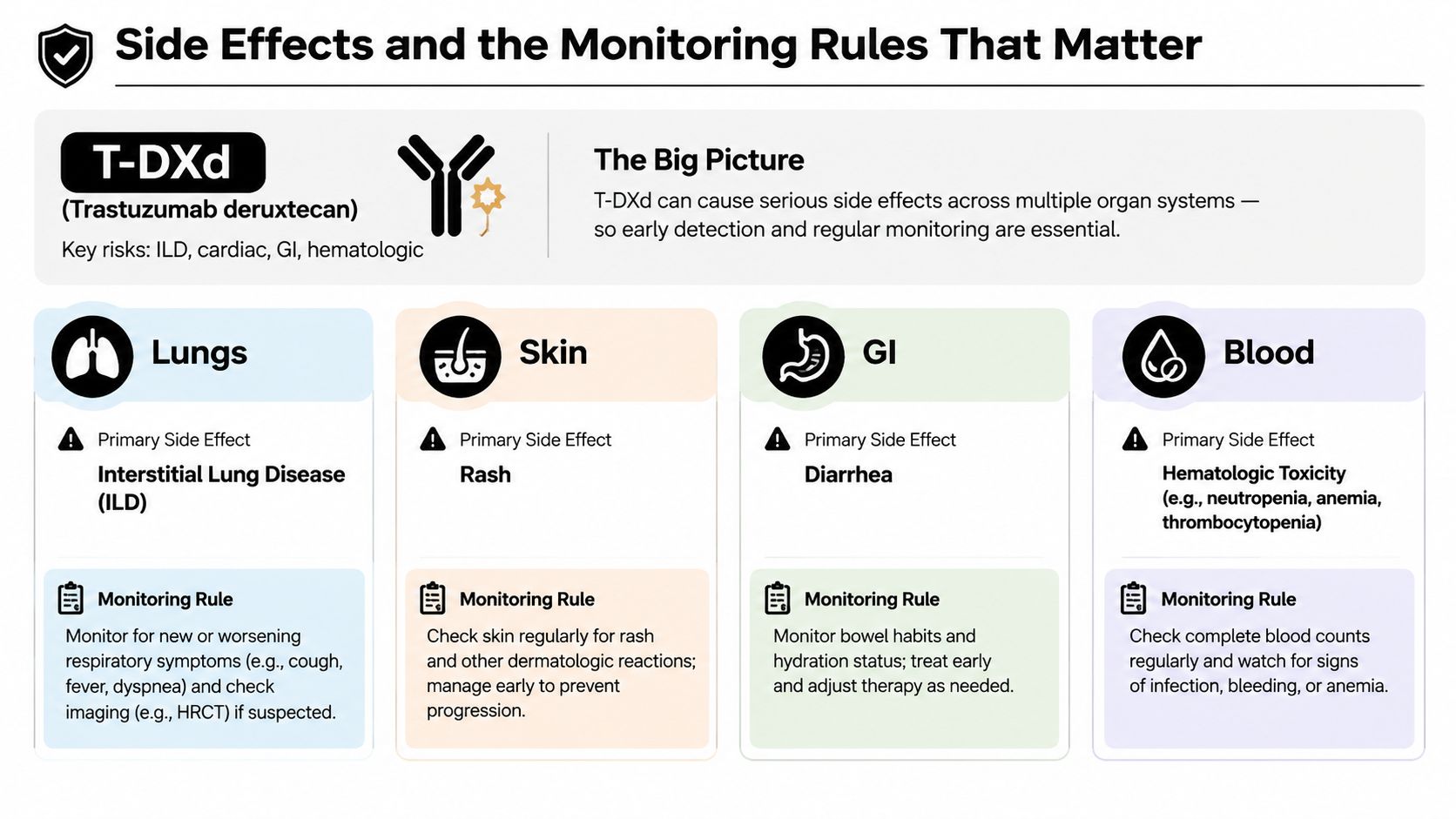
ADC toxicities often reflect the organs exposed to the payload more than the antibody's brand name. The antibody directs treatment toward a tumor target, but the payload can still affect healthy cells, especially tissues that divide quickly. The linker and bystander effect may also increase exposure beyond the intended cancer cell.
Lungs first with T-DXd
With trastuzumab deruxtecan, the safety issue requiring the clearest plan is interstitial lung disease, or ILD, also called pneumonitis. Report a new cough, shortness of breath, fever, chest discomfort, or reduced exercise tolerance promptly. These symptoms may look like infection, cancer progression, or ordinary fatigue, so waiting for the next infusion can be unsafe.
Most protocols obtain baseline chest CT before the first dose and repeat imaging every few cycles during the first six months, then adjust the schedule according to symptoms and risk. If ILD is suspected, the oncology team may pause treatment, arrange chest imaging and an evaluation for infection, and involve a pulmonary specialist. A pooled T-DXd safety analysis found higher odds of drug-related ILD, with an odds ratio of 10.89 (T-DXd safety analysis). That finding supports prompt assessment whenever respiratory symptoms appear.
Practical rule: A new respiratory symptom during T-DXd treatment deserves a call to the oncology team, not a wait-and-see approach.
Blood counts and gastrointestinal symptoms
Sacituzumab govitecan often creates day-to-day management problems involving neutropenia, anemia, fatigue, nausea, diarrhea, and hair thinning. Your team will monitor blood counts and may provide growth-factor support when appropriate. Fever during neutropenia requires urgent attention because infection can worsen quickly when white blood cell defenses are reduced.
Nausea prevention works best when started before symptoms become severe. Tell the infusion team whether you can eat, drink, sleep, and take your medicines. Diarrhea, constipation, mouth irritation, and dehydration can each affect whether the next dose is given on schedule.
Eyes, mouth, nerves, and the heart
TROP-2 ADCs can cause oral and ocular problems, particularly with datopotamab deruxtecan. Report mouth sores, blurred vision, eye pain, pronounced dryness, or light sensitivity early. Lubricating eye drops and preventive mouth care may be included in the plan, but follow the specific instructions from your treatment team.
Microtubule payloads can cause peripheral neuropathy, which may feel like tingling, numbness, burning, or weakness in the hands and feet. Tell the team before symptoms interfere with fastening buttons, walking, driving, or sleeping. HER2-targeted treatment can also require periodic heart-function checks, often with an echocardiogram that measures the left ventricular ejection fraction.
For a broader symptom guide, see this overview of side effects of targeted cancer therapy.
Use this monitoring checklist:
- Before treatment: Review prior lung disease, heart history, medicines, baseline blood counts, and relevant imaging.
- During treatment: Check bloodwork and ask about breathing, bowel function, nausea, neuropathy, vision, mouth sores, and fatigue.
- Before each dose: Decide whether symptoms require supportive medicines, a dose delay, a dose reduction, or treatment interruption.
- Between visits: Call urgently for fever, sudden breathlessness, chest symptoms, confusion, severe dehydration, or rapidly worsening weakness.
The right dose is the one that controls cancer while preserving enough function and quality of life to continue safely.
What Happens When the First ADC Stops Working
The difficult appointment often comes after a good initial response. A scan shows progression, and the patient asks whether another ADC will take over. Sometimes a different target offers a rational path. Sometimes the payload overlap, tumor biology, or limited evidence makes that assumption unsafe.
A 2026 systematic review focused specifically on ADC sequencing in metastatic breast cancer, reflecting how quickly clinical use has outpaced practical guidance (systematic review of ADC sequencing). Target-switching alone may not solve the problem. A tumor can become resistant to the payload, alter drug transport, change target expression, or develop mixed resistance across different metastases.
A practical sequence after progression
For HER2-positive disease progressing on T-DXd, the next plan may include a non-ADC HER2 regimen such as tucatinib, trastuzumab, and capecitabine, depending on prior treatment and clinical circumstances. A new biopsy can also be useful because HER2 expression may differ between the original tumor and a later metastasis.
For HER2-low disease after T-DXd, validated standard options are more limited. The next decision may involve chemotherapy, another biomarker-directed treatment if a new test identifies one, or a clinical trial. A second HER2-directed ADC isn't automatically effective just because the first medicine found HER2.
For triple-negative disease after sacituzumab govitecan, options may include conventional chemotherapy, a PARP inhibitor for a patient with an appropriate BRCA-related indication, or a clinical trial involving a different TROP-2 construct or a HER3-directed ADC. Prior payload exposure matters. Two drugs aimed at different targets may still deliver similar intracellular damage.
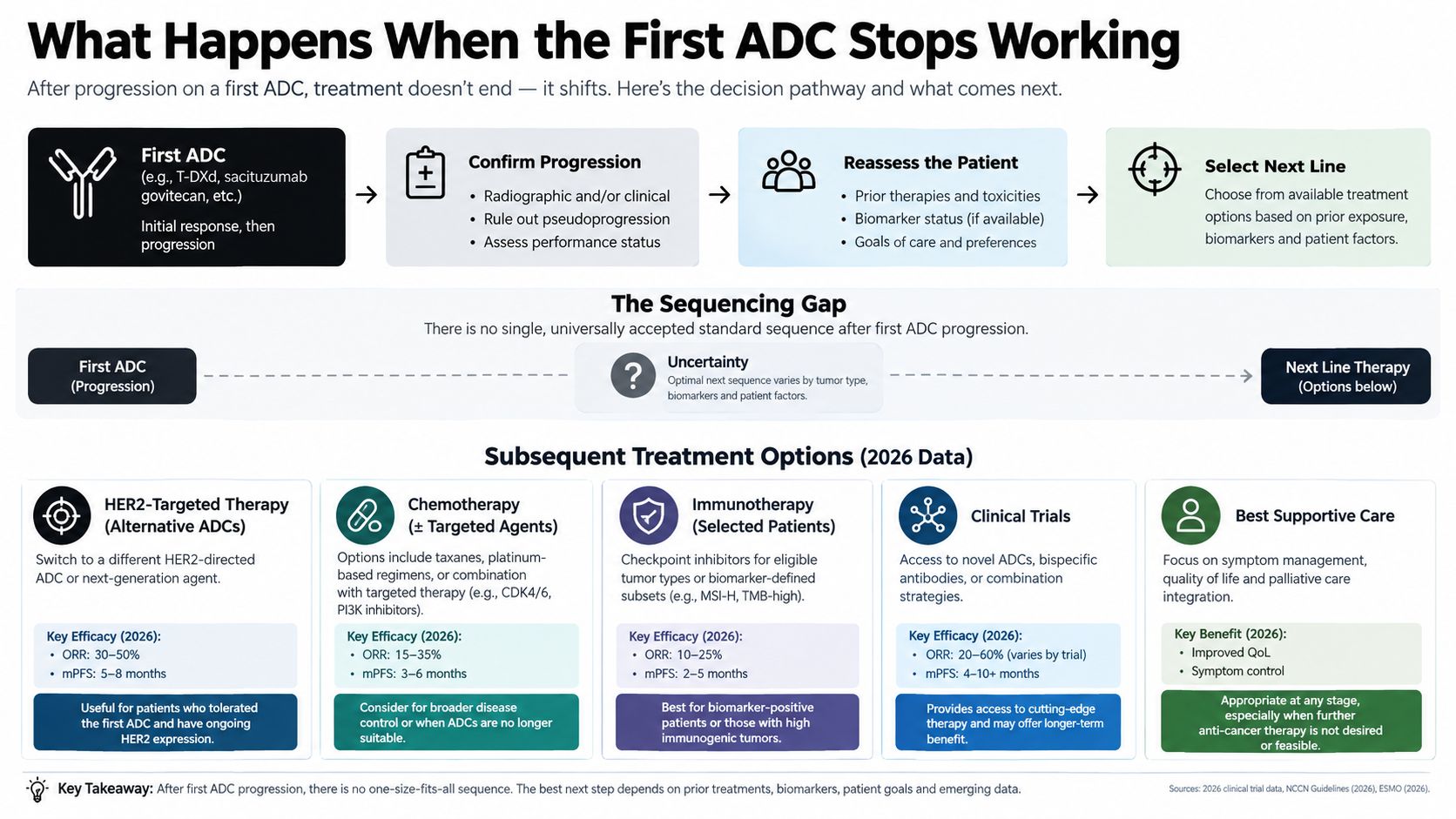
At a progression visit, I want four questions answered:
- Has the target changed? Consider a biopsy or validated molecular reassessment when the result could alter treatment.
- Has the cancer seen a similar payload? Target switching doesn't eliminate concerns about shared resistance.
- Is there a standard treatment with meaningful evidence for this exact setting? A trial result from another subtype may not apply.
- Would a clinical trial offer a better biological match? Trials can provide access to a new target, linker, payload, or combination.
Here is the clinical discussion that accompanies this decision:
The goal isn't to collect ADCs one after another. It's to understand what failed, what remains targetable, and which available treatment best fits the patient's current disease and priorities.
Emerging ADCs and How to Explore Clinical Trials
The next generation of ADCs is being designed around several problems that current drugs don't fully solve: uneven target expression, resistance after a prior ADC, payload toxicity, and the need to treat more than one tumor population. Datopotamab deruxtecan has already moved into clinical use for selected settings, while other agents remain investigational.
HER3-directed drugs, including patritumab deruxtecan, are being studied particularly in breast cancer populations where HER3 biology may provide another route after resistance. New TROP-2 constructs are testing different linkers, payloads, and dosing strategies. Bispecific ADCs are also being explored as a way to bind more than one tumor-associated feature, an approach that could address heterogeneity in HER2-low disease.
| ADC | Target | Lead breast cancer setting | Trial phase |
|---|---|---|---|
| Patritumab deruxtecan | HER3 | Selected advanced breast cancer populations | Investigational |
| Next-generation TROP-2 ADCs | TROP-2 | HR-positive/HER2-negative and triple-negative disease | Investigational |
| Bispecific ADC platforms | More than one target | HER2-low or heterogeneous tumors | Investigational |
| Datopotamab deruxtecan | TROP-2 | HR-positive/HER2-negative and selected triple-negative disease | Approved and continuing clinical evaluation |
Trial phase changes what patients should expect. A phase 1 study primarily examines dose, schedule, and early safety, although expansion groups may focus on a specific biomarker. A phase 2 study usually asks whether the drug shows enough activity in a defined population to justify larger testing. Combination studies may pair an ADC with immunotherapy, a CDK4/6 inhibitor, or another targeted treatment, but combinations can also add overlapping toxicity.
Finding a trial that fits
Start with ClinicalTrials.gov and search using the exact subtype, target, prior ADC, metastatic status, and treatment history. “Breast cancer trial” is usually too broad. More useful terms may include the target name, “HER2-low,” “TROP-2,” “HER3,” “ADC,” or the specific drug you previously received.
An academic cancer center or molecular tumor board can help interpret whether a trial's eligibility criteria fit the tumor's current biology. A second opinion can also clarify whether a new biopsy, germline testing, or additional molecular testing could change the available options. Patients in the New York City area may also review this practical guide to clinical trials for breast cancer.
Bring these questions to the oncology appointment:
- Biomarker testing: Should a new metastatic biopsy reassess HER2, hormone receptors, or another target?
- Prior ADC exposure: Does the trial allow a previous ADC, and does the prior payload matter?
- Washout period: How long must pass after the last treatment before screening?
- Organ monitoring: What lung, heart, blood, eye, or neurologic testing is required?
- Quality of life: Which symptoms are most likely, and how quickly can supportive care respond?
- Treatment logistics: Where are infusions given, how often are visits required, and what happens if a dose is delayed?
Hirschfeld Oncology is a Brooklyn cancer care practice and infusion center that evaluates individualized treatment strategies, including targeted therapy, immunotherapy, low-dose chemotherapy, symptom management, and access to discussions about emerging options. If an ADC has stopped working or you need help interpreting a treatment choice, visit Hirschfeld Oncology to review educational resources and request a consultation.
.png)
.png)