.png)


Let's get right to the big question: "Will I be asleep during my colonoscopy?"
The straightforward answer is that for most people, it’s not quite like being put under for major surgery. Instead, you'll be in a deeply relaxed state, often called "twilight sleep." This means you'll be comfortable, won't feel any pain, and, in all likelihood, won't remember a thing about the procedure afterward. The entire goal is to make sure you're at ease so the doctor can conduct a smooth, thorough exam.
What Does Colonoscopy Sedation Actually Feel Like?
If the thought of being awake during a colonoscopy makes you anxious, you're in good company. It's one of the most common worries people have, but it’s a concern that modern medicine has pretty much solved. The overwhelming majority of patients get some type of sedation to keep them comfortable and still.
This isn't just a local trend; it's a global standard. An international study of over 6,000 patients revealed that a staggering 83% received sedation for their colonoscopy. This really shows how committed doctors are to making this a comfortable experience for patients everywhere. You can read more about sedation practices in that study if you're curious about the data.
This relaxed state comes from medications that make you feel very drowsy and also cause amnesia, which is why you won't remember what happened. It’s less about being totally unconscious and more like having the deepest, most refreshing nap you can imagine. You won't be aware of any discomfort, which is exactly what allows your gastroenterologist to focus and perform a high-quality examination.
To help you understand what this might look like for you, let’s break down the different levels of sedation you might be offered.
Your Colonoscopy Sedation Options at a Glance
The type of sedation you receive can vary, and each one offers a different experience. This table gives you a quick snapshot of the most common options so you can feel more prepared for the conversation with your doctor.
Ultimately, the goal of sedation is the same across the board: to ensure you are safe, comfortable, and still, allowing for the best possible examination. Your doctor will recommend the level that’s right for you based on your health and the specifics of the procedure.
Understanding the Different Levels of Sedation
To really get to the bottom of what happens during a colonoscopy, we need to talk about the specific types of sedation your medical team might use. While most people say you're "asleep," the medical reality is a bit more detailed. Your doctor carefully chooses the right level of sedation based on your specific health profile to make sure the procedure is both safe and successful.
Think of it like a spectrum, with being fully awake on one end and a deep, unresponsive sleep on the other. The whole idea is to find your sweet spot somewhere in the middle. This keeps you comfortable and perfectly still, which is crucial for the gastroenterologist to do a thorough and careful exam.
This diagram helps visualize the different states, from being wide awake to being under general anesthesia.
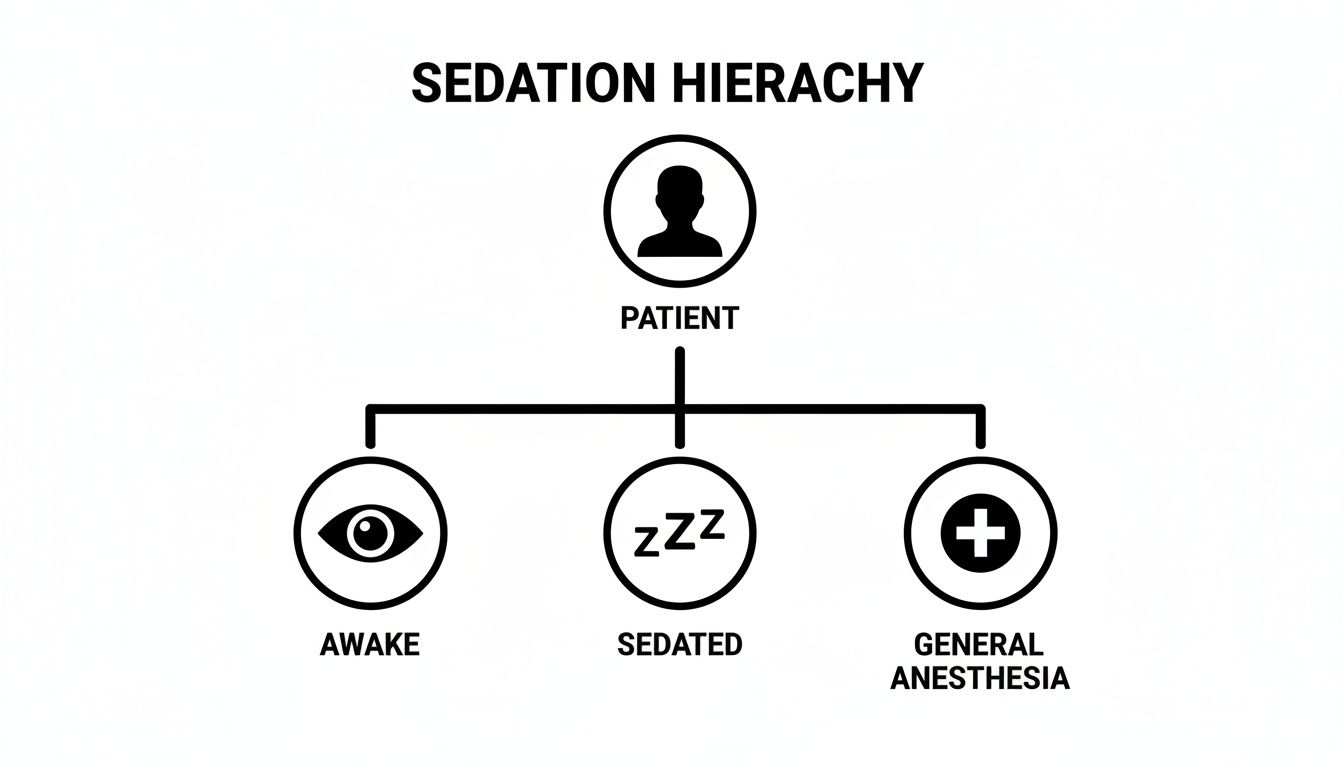
As you can see, sedation is that middle ground. It's very different from being fully awake, and it's also not the same as general anesthesia, which is rarely needed for a routine colonoscopy.
Moderate Sedation or “Twilight Sleep”
This is probably the most common option you'll hear about, often called “conscious sedation” or, more descriptively, "twilight sleep." It doesn't mean you're knocked out completely. Instead, it puts you in a very relaxed, hazy, and dream-like state.
It's a lot like dozing off on the couch with a movie on. You might stir if someone gently nudges you, but afterward, you probably won't remember a single thing about the plot. That's a great way to think about moderate sedation. You won't feel any pain, and a key benefit is the amnesia effect—you simply won't have any memory of the procedure.
For this type of sedation, the team typically uses a combination of medications:
- Midazolam (Versed): This is fantastic for easing anxiety and is the main reason you won't remember anything.
- Fentanyl: A powerful, fast-acting pain reliever that keeps you comfortable from start to finish.
During moderate sedation, your gastroenterologist usually has a dedicated nurse right there with you, constantly monitoring your heart rate, breathing, and blood pressure.
Deep Sedation with Anesthesia Care
Deep sedation takes things a step further. With this approach, you are completely unaware of what’s happening and won't respond to voice or touch. For all intents and purposes, you are truly "asleep" for the entire colonoscopy.
The go-to medication for deep sedation is Propofol. It works incredibly fast to put you to sleep and, just as importantly, wears off quickly once it's stopped, leading to a much faster and clearer recovery.
Because this is a more profound level of sedation, it requires an expert. An anesthesiologist or a Certified Registered Nurse Anesthetist (CRNA) will be dedicated entirely to you during the procedure. Their only job is to manage the sedation and watch your vital signs like a hawk. This option is often preferred for patients with certain health conditions or for procedures that might take a bit longer. This level of dedicated monitoring is common in other medical tests, too; you can read about a similar setup in our guide to the bone marrow biopsy procedure.
How Sedation Leads to a Better Colonoscopy
While the idea of a comfortable, memory-free procedure is certainly a huge relief for patients, sedation offers benefits that go far beyond just peace of mind. It actually plays a direct role in how effective your colonoscopy is at finding what it’s supposed to find. Think of it as the key that unlocks the best possible conditions for your doctor to conduct a highly detailed and thorough examination.
When you're relaxed and completely still, the gastroenterologist can navigate the colonoscope smoothly and meticulously through every twist and turn of your colon. This stillness is absolutely critical for spotting those subtle, flat polyps that can be notoriously easy to miss. If you're comfortable, your doctor can take all the time they need to inspect every fold and crevice without causing you any discomfort or having to rush.

Unlocking Better Detection Rates
In the world of gastroenterology, doctors rely on specific benchmarks to measure the quality of a colonoscopy. Two of the most important ones are the Adenoma Detection Rate (ADR) and the Cecal Intubation Rate (CIR). These might sound like technical jargon, but they have a very real, direct impact on your health.
- Adenoma Detection Rate (ADR): This is simply the percentage of procedures in which a doctor finds at least one precancerous polyp, known as an adenoma. A higher ADR is a great sign—it means your doctor is skilled at finding these potentially dangerous growths before they have a chance to turn into cancer.
- Cecal Intubation Rate (CIR): This metric tracks how often the doctor successfully guides the scope all the way to the very beginning of the large intestine, a landmark called the cecum. Reaching this point is non-negotiable for a complete exam, as it's the only way to be sure the entire colon has been inspected.
So, how does sedation tie into all this? It directly improves both of these critical metrics. When a patient is fully relaxed, the colon itself is less likely to spasm, which makes it much easier for the doctor to advance the scope and get a clear, unobstructed view of the entire colon lining.
The Proof Is in the Numbers
The link between sedation and better colonoscopy outcomes isn't just a theory—it's backed by a mountain of data. There’s a good reason sedation has become the standard of care for colonoscopies in the U.S.: it just works.
A large-scale review of sedation practices revealed a dramatic shift, with its use skyrocketing from 36.42% of procedures in 2012 to 92.72% by 2019. More importantly, this trend was directly linked to better clinical results.
The Adenoma Detection Rate (ADR) was 22.5% with sedation compared to just 17.0% without it. In the same vein, the Cecal Intubation Rate (CIR) reached an impressive 94.7% in sedated patients, while only hitting 91.2% in those who weren't sedated. You can explore the full findings on these clinical benefits to see the data firsthand.
This data clearly shows that sedation isn't just about ensuring you don't have to worry about being awake during the procedure. It's a fundamental component of a high-quality, potentially life-saving screening.
Ultimately, opting for sedation empowers your medical team to perform their absolute best. It turns the procedure from what could be an uncomfortable and challenging experience into a smooth, efficient, and far more effective tool in the fight against colorectal cancer.
Is Deeper Sedation Better for Finding Polyps?
Since good sedation makes for a better exam, you might be wondering if "deeper" is always "better." It’s a great question. Should you push for the strongest sedation possible to make sure your doctor finds every last polyp? The answer isn't a simple yes or no. It really boils down to a conversation with your doctor about the benefits, the risks, and what makes the most sense for you.
The heart of the debate is usually about moderate sedation versus deep sedation, which often involves the anesthetic Propofol. The theory is straightforward: a completely still patient means a completely still colon. When your colon isn't moving or spasming, it gives the gastroenterologist a perfectly clear and stable view, making it easier to spot those tricky polyps—especially the flat or subtle ones that can otherwise be missed.
And this isn’t just a theory. A growing body of evidence suggests this stillness can lead to a real, measurable difference in finding what we’re looking for.
The Trade-Offs of Deep Sedation
While finding more polyps sounds like a slam dunk, deep sedation has its own set of considerations. For starters, it requires an anesthesia professional, like an anesthesiologist or a Certified Registered Nurse Anesthetist (CRNA), to be in the room. Their entire job is to manage your sedation and monitor your breathing and vitals, which adds a significant layer of safety but also makes the procedure more complex and costly.
Because of this, endoscopy centers have to weigh the clinical benefits against the extra resources. For most healthy people undergoing a routine screening, moderate sedation works wonderfully and is more than enough to get the job done right.
Ultimately, the choice becomes a personalized one. Your doctor will look at your overall health, your personal medical history, and what you’re trying to achieve with the procedure. If you’ve had polyps that were hard to find in the past or have other specific risk factors, your doctor might suggest that deep sedation is the better route.
What the Data Suggests
So, what does the research say? A recent study looked at data from the New Hampshire Colonoscopy Registry between 2015 and 2020 and found a pretty interesting difference.
- Colonoscopies using Propofol for deep sedation had a polyp detection rate of 34%.
- Those using moderate sedation had a polyp detection rate of 24.5%.
If you'd like to dig into the details, you can learn more about these sedation findings from the study.
This suggests that while you are comfortably "asleep" during a colonoscopy with either method, the deeper state may give your doctor a measurable advantage in finding precancerous growths.
In the end, this is a team decision. Your medical team will weigh all the factors—your health, the clinical evidence, and the practical logistics—to recommend the sedation plan that gives you the safest and most thorough exam possible.
Special Sedation Considerations for Cancer Patients
When you’re navigating a cancer diagnosis, any medical procedure—even a routine one like a colonoscopy—can feel more complicated. You're likely wondering how your current treatments might interact with sedation or if it's even safe to proceed right now. These are completely valid concerns, and rest assured, your oncology and gastroenterology teams will work in lockstep to map out the safest, most effective plan for you.
For patients with cancer, the question "Are you asleep during a colonoscopy?" involves a bit more careful thought. The primary goal is always your comfort and safety, but certain factors tied to your cancer treatment demand special attention. Think of your medical team as a coordinated unit, with every decision filtered through your complete health picture.
How Cancer Treatments Affect Sedation
Recent cancer treatments can change how your body handles sedation medications. Imagine your body as a complex system; powerful treatments like chemotherapy and immunotherapy can temporarily alter how that system processes drugs. That's why clear, open communication between you, your oncologist, and your gastroenterologist is non-negotiable.
Your team will need the full story on your treatment plan, specifically:
- Recent Chemotherapy: Certain chemo drugs can impact your heart, lungs, or kidneys. Your anesthesia provider will use your recent lab work and overall health to select the sedation medications that are safest for your body.
- Immunotherapy: These game-changing drugs can sometimes trigger inflammation in different organs. Your team will do a thorough evaluation to make sure there are no new issues that could pose a risk during sedation.
This meticulous review process ensures you get the right type and dose of medication, keeping risks to a minimum and paving the way for a smooth recovery.
Managing Low Blood Counts
One of the most frequent hurdles during cancer treatment is low blood counts. This becomes particularly important for a colonoscopy, especially if there's a chance a polyp might need to be removed during the procedure.
Thrombocytopenia, a low platelet count, is a major consideration. Platelets are the tiny blood cells responsible for clotting. If this count dips too low, removing a polyp could carry a much higher risk of bleeding.
Your team will run a complete blood count (CBC) before your procedure to check your levels. If your platelets are below a safe threshold, they have a couple of options:
- Postpone the procedure until your counts have a chance to bounce back.
- Arrange for a platelet transfusion just before your colonoscopy.
This proactive strategy is all about protecting you from potential complications. The same principle applies to neutropenia (low white blood cells), as your team will take extra precautions to minimize any infection risk. You can learn more about how cancer treatments impact the body in our comprehensive guide to colon cancer.
Coordinating Blood Thinners
Many people, including those with cancer, take anticoagulants (blood thinners) to prevent dangerous blood clots. These medications require very careful management ahead of a colonoscopy. Stopping them for too long could raise your risk of a clot, but continuing them could lead to serious bleeding if a polyp is taken out.
This is where your oncologist and gastroenterologist will collaborate on a precise "bridging" plan. This is a detailed schedule outlining exactly when to stop your blood thinner before the procedure and when you can safely start it again afterward.
It's critical that you never adjust your blood thinner schedule on your own. Always follow the specific instructions from your doctors. Their guidance is designed to perfectly balance the risks and keep you safe.
Your Colonoscopy Journey: From Prep to Recovery
Thinking about a colonoscopy can be a little nerve-wracking, but understanding the entire process—from start to finish—really helps take the mystery out of it. When you know what’s coming, you can feel much more confident and in control. Let's break down the whole timeline.

Before the Procedure: The Prep Phase
Everything really kicks off a few days before your actual appointment. The single most important part of this stage is the bowel prep. This is all about cleaning out your colon so your doctor gets a crystal-clear view inside. It usually involves following a special diet for a day or two, followed by drinking a liquid laxative solution.
Your medical team will provide very specific instructions on what you can and can't eat. As you get closer to the procedure, you'll switch to a clear liquid diet. You can find all the details on what that means in our guide here: https://honcology.com/blog/can-you-eat-before-a-colonoscopy.
Following the prep instructions to the letter isn't just a suggestion—it's essential. If the prep isn't complete, your doctor could miss seeing small polyps, and in some cases, you might even have to cancel and reschedule the whole thing.
Your doctor may also have you get some routine pre-surgery blood tests to make sure everything looks good for sedation. It’s also crucial to talk to your doctor about every medication you take, particularly blood thinners or diabetes medications, as you may need to pause or adjust them.
During the Procedure: Arrival and Sedation
On the day of the procedure, you'll head to the hospital or clinic to check in. A nurse will bring you to a pre-op area where they'll go over your medical history, take your vital signs, and place an IV line, usually in your hand or arm. This IV is the key to a comfortable procedure—it's how you'll receive the sedation.
You'll also get a chance to meet with the gastroenterologist performing the exam and the anesthesiologist or nurse anesthetist. This is a great time to ask any final questions you have. Once everyone's ready, you’ll be brought into the procedure room and helped onto a bed, usually lying on your side.
The sedative is then given through your IV. It works incredibly fast. You’ll feel yourself relax and then drift off. For most people, it's a deep, comfortable "nap," and you won't feel or remember the procedure at all. The actual colonoscopy is surprisingly quick, generally lasting only 20 to 45 minutes.
After the Procedure: Recovery and Heading Home
Once the exam is done, you'll be moved to a recovery area to wake up. While the sedation wears off pretty fast, you can expect to feel a bit groggy and out of it for a little while. The nursing staff will keep a close eye on you as you become more alert.
It’s common to have some bloating or feel a bit gassy. This is just from the air that was used to gently inflate the colon during the exam, and it passes quickly. After you're awake and stable, your doctor will come by to share the initial results with you.
Because the effects of sedation can stick around for up to 24 hours, you absolutely must have a responsible adult drive you home. Plan on taking it easy for the rest of the day. That means no driving, operating any kind of machinery, or making big, important decisions until the next day.
Your Top Questions About Colonoscopy Sedation
Let's tackle some of the most frequent questions people have about sedation. We want to clear up any lingering concerns so you can walk into your procedure feeling confident and prepared.
Will I Feel Any Pain During the Colonoscopy?
No, you shouldn't feel any pain. The entire point of sedation is to make sure you're comfortable. The medications we use are designed to provide both amnesia, so you won’t remember the procedure, and analgesia, which is a fancy word for pain relief.
While the procedure itself is painless, it's completely normal to wake up with some mild cramping or a gassy feeling. This usually passes pretty quickly.
How Long Does It Take for the Sedation to Wear Off?
You’ll start feeling more like yourself within about an hour in the recovery room. But don't be fooled—the medication is still in your system, even if you feel alert.
This is why, for your own safety, you must not drive, operate machinery, or sign any important legal or financial documents for a full 24 hours. It's crucial to arrange for a responsible adult to drive you home and ideally stay with you for a bit.
What Are the Common Side Effects of Sedation?
For most people, any side effects are mild and don't last long. You might feel a bit groggy, have a minor headache, or experience some nausea. Thankfully, serious complications are very rare.
Remember, a dedicated medical team is by your side the entire time, constantly monitoring your breathing, heart rate, and blood pressure to keep you safe.
At Hirschfeld Oncology, we know that being well-informed is a powerful part of your health journey. If you're dealing with a cancer diagnosis and have questions about a colonoscopy or any other procedure, our team is ready to offer clear answers and compassionate care. You can find more helpful information on our patient resources blog or reach out to request a consultation.
.png)
.png)