


.png)


For years, any conversation about hereditary breast cancer has revolved almost exclusively around the BRCA genes. And while they're incredibly important, they aren't the whole story. A mutation in the ATM gene is also a major factor in breast cancer risk, acting as another critical piece of the genetic puzzle that many families need to understand.
Looking Beyond BRCA for Breast Cancer Risk

The focus on BRCA1 and BRCA2 in hereditary breast cancer is understandable, but the genetic landscape is much wider and more complex than just two genes. For countless families, another gene called ATM plays an equally vital role in their story of cancer risk.
If you or a loved one are navigating a breast cancer diagnosis or simply trying to make sense of your genetic background, this guide is for you. We’ll break down what the ATM gene does, why it matters, and how it fits into the bigger picture of your health.
The Role of a DNA Guardian
Think of your DNA as the master instruction manual for your body's trillions of cells. The ATM gene's job is to create a protein that acts as a first responder—a guardian, really—that spots and repairs DNA damage before it can cause problems. A healthy ATM gene keeps your cells stable and functioning correctly.
But what happens when a mutation—a typo in the instructions—compromises this guardian? The whole DNA repair system gets weaker. Damaged cells can then start to divide without proper checks and balances, which can lead to the uncontrolled growth that defines cancer. This is especially critical for people who may not have a "classic" family history of cancer but still carry this risk. Understanding the connection between your breast cancer family history and genes like ATM is the first step toward truly personalized care.
Why ATM Gene Mutations Matter
Knowing your ATM status isn't just about satisfying a curiosity; it's about gaining actionable information that can empower you to take charge of your health.
- Proactive Prevention: If you know you have an ATM mutation, we can build prevention strategies that are tailored specifically to you, moving beyond one-size-fits-all guidelines.
- Enhanced Screening: This knowledge helps us create a more rigorous screening schedule. For many, this means adding breast MRIs to annual mammograms to catch any potential issues as early as possible.
- Tailored Treatment: For patients diagnosed with an atm gene breast cancer, this genetic detail can open the door to specific, targeted therapies that are more effective against cancers with this particular vulnerability.
A mutation isn't just a number or a risk percentage; it's a roadmap. It allows us to shift from a reactive to a proactive partnership with our patients, making informed decisions that can protect their health and the health of their families for generations.
To get a clearer picture of what we're talking about, let's look at the numbers.
ATM Gene Mutation At a Glance
The table below offers a quick summary of the most important facts about ATM gene mutations and their link to breast cancer.
As you can see, the ATM gene is one of the most significant genetic risk factors for breast cancer outside of the well-known BRCA mutations. At Hirschfeld Oncology, we believe that understanding these deep genetic insights is fundamental to creating a care plan that truly fits your unique profile.
How the ATM Gene Protects Your Cells

To really grasp how a faulty ATM gene can lead to breast cancer, it helps to first see what a powerhouse it is in our healthy cells. Think of your DNA as the master blueprint for your entire body. Every day, this blueprint is under assault from things like UV radiation or even just simple errors that happen when cells copy themselves.
The ATM gene’s job is to be the lead supervisor on the construction site, making sure every copy of that blueprint is perfect. It produces a protein that acts as the ultimate quality control manager.
The First Responder to DNA Damage
When a break happens in a strand of DNA, the ATM protein is one of the very first on the scene. It immediately recognizes that something is wrong and sounds the alarm.
Its first move is to hit the brakes on the cell division process. It’s like a foreman shouting "Stop everything!" the second a crack appears in a foundation. This pause is critical because it prevents the damaged cell from dividing and passing that error on to new cells. One bad cell quickly becomes two, then four, and the problem escalates. The ATM protein stops that from happening.
Next, it acts as a dispatcher, calling in the specialized repair crew. The ATM protein doesn't fix the DNA itself, but it activates and directs the right proteins to the exact spot of the damage, making sure the genetic code is patched up correctly.
Making the Tough Calls for Cell Health
But what if the DNA damage is too extensive? A quick fix might just make things worse, creating an even more unstable situation. When faced with this scenario, the ATM protein has to make an executive decision.
It triggers a process called apoptosis, which is essentially programmed cell death.
This isn't a chaotic implosion. Apoptosis is a clean, orderly self-destruct sequence that allows the body to safely dismantle and recycle a cell that's damaged beyond repair.
By eliminating these compromised cells, the ATM gene acts as a powerful tumor suppressor. It stops potential cancers before they even have a chance to start, a vital protective role it plays constantly behind the scenes.
What Happens When the Supervisor Is Flawed
Now, let's consider what happens when there's an ATM gene mutation. The instructions for building that vigilant supervisor protein are flawed.
The resulting ATM protein might be misshapen, inefficient, or simply not made at all. This hobbles the cell's entire emergency response system.
- Delayed Response: DNA damage might go undetected for longer. The crucial "stop" order doesn't come, allowing a faulty cell to keep dividing and replicating its error.
- Ineffective Repairs: The repair team might not get the signal to show up, or they might do a sloppy job, leaving behind genetic mistakes that pile up over time.
- Failed Demolition: The most dangerous cells—those that should be destroyed via apoptosis—are allowed to survive, multiply, and continue accumulating more damage.
This failure of quality control is at the heart of the link between the atm gene and breast cancer. With each unrepaired error, a cell in the breast tissue gets one step closer to becoming cancerous. The defenses are down, creating an environment where a tumor can eventually take root and grow.
How ATM Mutations Dial Up Cancer Risk
Think of your body's genetic instruction manual. Not every typo has the same consequence. A small smudge might be harmless, but a ripped-out page can stop a whole process in its tracks. It’s the same with mutations in the ATM gene—they don’t all carry the same weight for your breast cancer risk.
Figuring out the specific type of mutation you have is the first step in painting a truly accurate picture of your personal risk. This is where the conversation shifts from broad statistics to a much clearer understanding of how your unique genetics can influence your health.
Truncating vs. Missense Mutations: A Tale of Two Errors
Geneticists generally place ATM mutations into two buckets, and the difference between them is crucial for understanding how the ATM protein gets made and does its job.
- Truncating Mutations: Imagine a critical page is simply torn out of the instruction manual. These mutations insert an early "stop" sign into the gene's code. As a result, the cell stops reading the instructions too soon, creating a shortened, useless protein—or sometimes, no protein at all.
- Missense Mutations: This is more like a single typo on the page. A missense mutation changes just one amino acid, one single building block, in the final protein. You still get a full-length protein, but it's flawed and may not work as well as it should.
For a long time, the thinking was that truncating mutations were the real troublemakers because they completely knocked out the ATM protein's function. Missense mutations were often seen as less of a concern. But that picture has changed.
Not All Typos Are Minor: The Impact of High-Risk Variants
We now know that some of those "minor typos" are anything but. Groundbreaking research has revealed that certain missense mutations can create a protein so faulty that it elevates a person's cancer risk to a level on par with some BRCA mutations.
Our understanding has really evolved here. A major breakthrough was realizing that specific missense mutations create their own distinct risk profiles. For instance, the c.7271T>G variant was found to be a major player, increasing the odds of developing breast cancer by 3.76 times—a risk significantly higher than most other ATM missense variants.
This was a game-changer. It drove home the point that the type of mutation matters just as much as the gene it's in. It also highlighted why detailed genetic analysis is so essential for getting an accurate risk assessment.
Living with Half a Repair Crew
When you inherit one mutated copy of the ATM gene, every cell in your body is left with only one healthy, working copy. This situation is called haploinsufficiency, which is a technical way of saying one good copy isn't quite enough to handle the full workload.
Essentially, your cells are operating with about half the ATM protein they need to effectively manage DNA repair. While this isn’t enough to cause the rare and severe childhood syndrome seen when someone inherits two mutated copies, it does create a lifelong vulnerability. Your body's ability to fix DNA damage is permanently dialed down.
Over time, this reduced defense system makes it much more likely that a cell—in the breast tissue, for example—will accumulate enough uncorrected errors to turn cancerous. Making sense of what this means for you personally is a crucial conversation to have with a genetic counselor. You can learn more about how to understand your genetic test results and use that information to make proactive decisions about screening, prevention, and your long-term health plan.
The Broader Cancer Risks of an ATM Mutation
When we talk about an ATM gene mutation, it’s easy to focus solely on breast cancer. But the reality is, its impact is much wider, touching on a whole spectrum of other cancers. For many families, learning about an ATM mutation is the key that finally unlocks a confusing family health history, explaining why different types of cancer have appeared across generations.
Discovering you carry an ATM mutation isn't just a diagnosis; it's a powerful tool for proactive health. It’s the reason you can tell your brother or son to start talking about prostate cancer screening years earlier than his friends. It empowers your entire family to take control, shifting from a reactive stance to a preventative one.
A Spectrum of Increased Risks
Thanks to major recent studies, the links between ATM mutations and other cancers are clearer than ever. One landmark study, which analyzed data from over 627,000 patients, gave us some solid numbers to work with.
It revealed that people with ATM mutations face a staggering four-fold increased risk for pancreatic cancer. The same research pointed to a three-fold increased risk for stomach cancer and a two to three-fold increased risk for prostate cancer. The study also confirmed connections to several other cancers, which you can read about in the full multi-cancer association findings.
This diagram helps visualize how different types of mutations can affect the ATM gene and the protein it's supposed to create.
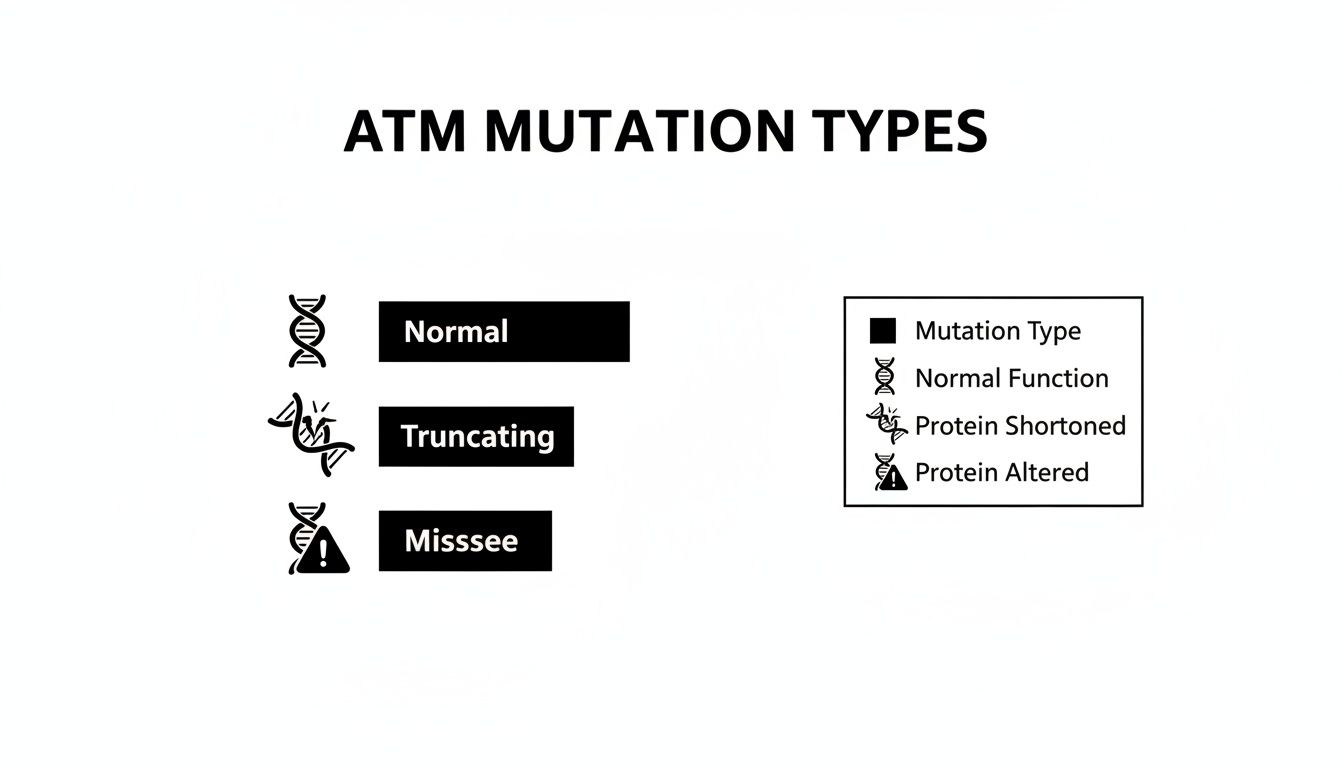
As you can see, a "truncating" mutation essentially cuts the protein-making instructions short—a major error. A "missense" mutation, on the other hand, is more like a typo in the instructions, creating a flawed protein. This is why not all mutations carry the same level of risk.
Below is a summary of the estimated cancer risks for individuals with an inherited ATM mutation.
Cancer Risks Associated with ATM Mutations
This table breaks down the estimated increased risk for various cancers linked to an inherited ATM gene mutation when compared to someone in the general population.
These figures highlight why a personalized screening plan is so crucial. The knowledge of these specific risks allows you and your healthcare team to focus surveillance on the areas that matter most.
Pancreatic Cancer and ATM Mutations
The link to pancreatic cancer is perhaps one of the most critical findings. For families carrying an ATM mutation, this piece of information is invaluable.
Pancreatic cancer is notoriously difficult to detect early because it often has no symptoms until it's advanced. Knowing you have a genetic predisposition completely changes the game. It opens the door to specialized screening programs that aren't available to the general public.
This knowledge empowers you to discuss advanced screening options, like endoscopic ultrasounds or MRIs, with your doctor to catch any potential issues as early as possible.
Prostate Cancer Screening Implications
For men with an ATM mutation, the risk of developing an aggressive form of prostate cancer is significantly higher. This fact should reshape the entire conversation around screening.
Instead of waiting until 50, male relatives should be talking to their doctors about PSA testing much sooner—often starting at age 40. It’s a simple shift in timing that can make all the difference, leading to earlier detection and better outcomes.
Other Associated Cancers
While the risk for some other cancers isn't as dramatically elevated, they are still an important part of the complete picture.
- Ovarian Cancer: The risk is moderately increased, but it's enough to warrant a serious conversation with a gynecologic oncologist about surveillance strategies.
- Stomach Cancer: While less common in the U.S., a three-fold increased risk is a major consideration, especially if there's a family history of gastric cancer.
- Melanoma: This connection reinforces just how important regular skin checks with a dermatologist and diligent sun protection are for anyone with an ATM mutation.
Understanding these broader risks transforms a personal diagnosis into a family-wide health strategy. It gives every relative the knowledge they need to build a truly personalized screening plan with their own doctors, one that directly addresses their genetic blueprint.
How an ATM Mutation Shapes Your Treatment Plan

Finding out you have an ATM gene mutation does more than just explain your cancer risk—it completely changes the conversation about your treatment. This single piece of genetic information becomes a roadmap for your oncology team. It allows us to look beyond standard protocols and craft a strategy that hits your cancer right where it's most vulnerable.
This knowledge puts you in the driver's seat during discussions with your care team. It ensures every decision we make together is based on a deep understanding of your unique genetic makeup, steering us toward therapies with the highest chance of success.
Exploiting Cancer's Weakness with PARP Inhibitors
For breast cancer linked to an ATM mutation, one of the biggest breakthroughs has been a class of drugs called PARP inhibitors. These therapies are a masterclass in precision medicine, designed to cleverly exploit the very weakness that let the cancer grow in the first place.
Here’s a way to think about it: healthy cells have a full toolkit for DNA repair, including the ATM protein and another set of proteins called PARP. Cancer cells with a faulty ATM gene are already working with a broken tool. A PARP inhibitor drug comes in and takes away their only backup.
When both repair pathways are blocked, the cancer cell can no longer fix its own DNA damage. This triggers a state of cellular chaos called "synthetic lethality," and the cancer cell effectively self-destructs. Meanwhile, your healthy cells, which still have working ATM proteins, are largely spared.
This approach is incredibly strategic. Instead of a broad attack that affects all fast-dividing cells, PARP inhibitors selectively target the cancer cells by taking advantage of their inherent genetic flaw.
For patients with an ATM-mutated breast cancer, this opens up powerful new treatment options. These drugs can be especially effective when other treatments haven’t worked, offering a highly targeted way to fight the disease. For a deeper dive into how these and other smart drugs work, you can learn more about breast cancer targeted therapy and its growing role in modern oncology.
Navigating Radiation Therapy with Care
Radiation is a cornerstone of breast cancer treatment, but having an ATM mutation adds an important consideration to the planning process. The ATM protein plays a critical role in helping healthy cells recover from the DNA damage caused by radiation. When it isn't working properly, those cells can be more sensitive to radiation's effects.
This definitely doesn't mean radiation is off the table. It just means your radiation oncologist has to create a meticulously customized plan. When determining how an ATM mutation shapes your treatment plan, we often lean on advanced clinical decision support tools to weigh all the genetic data against established best practices.
Your care team will likely consider a few key adjustments to keep your treatment safe and effective:
- Dose Modification: We might carefully fine-tune the total radiation dose, striking the perfect balance between destroying cancer cells and protecting healthy tissue.
- Targeted Techniques: We can use sophisticated methods like Intensity-Modulated Radiation Therapy (IMRT) to precisely sculpt the radiation beams. This allows us to deliver a powerful dose to the tumor while minimizing exposure to nearby organs like your heart and lungs.
- Close Monitoring: Throughout your treatment, we'll watch you very closely for side effects, ready to make immediate adjustments to your plan if necessary.
This careful, personalized approach ensures you get the maximum benefit from radiation therapy while we proactively manage the increased sensitivity linked to your ATM gene. It’s a perfect example of how knowing your genetic profile allows us to tailor every single aspect of your care for the best possible outcome.
Charting Your Path Forward with Confidence
Learning you have an ATM gene mutation can feel like a lot to take in. It's completely normal to feel a mix of emotions. But this discovery is also the essential first step toward taking control of your health with a powerful, proactive strategy. This is where abstract genetic data becomes a blueprint for real, life-saving action.
This knowledge doesn't just explain your personal risk; it highlights why genetic testing is so important in the first place. It also gives you a concrete reason to open up a conversation with your family and unlocks the door to advanced, targeted treatments for ATM gene breast cancer.
Turning Knowledge into a Plan
The next step is translating the complex details of your genetic report into a care plan that feels right for you. At Hirschfeld Oncology, that’s exactly what we specialize in. We take the intricate data from your unique genetic profile and help you build a practical, effective health strategy.
Our whole focus is on designing treatments that give you the best possible chance of success while minimizing the physical and emotional burdens. We see this as a partnership. We make decisions with you, ensuring you always feel heard, understood, and confident about the path you’re on.
A genetic test result is not just a piece of data; it's a guide. It empowers us to create a personalized roadmap for your health, moving from uncertainty to a clear and actionable path forward.
Your Partners in Personalized Care
No two people are the same, and your care plan should reflect that. Whether you’re looking at prevention strategies, weighing the pros and cons of targeted therapies, or navigating a recent diagnosis, our team is here to support you. We believe in finding options, especially when standard treatments haven't worked.
- Discussing Your Unique Situation: We'll sit down with you to carefully review your genetic results, family history, and what matters most to you.
- Exploring Advanced Therapies: Our practice is deeply focused on treatments like immunotherapy and targeted drugs, which are often designed for specific genetic markers like ATM.
- Building a Collaborative Roadmap: We work together to chart a course that aligns with your personal needs and priorities, making sure you are an active participant in your own care.
Your diagnosis is just the beginning of the story. We invite you to request a consultation with Hirschfeld Oncology to see how your ATM gene breast cancer information can be used to build a sophisticated and compassionate care plan. Let our team help you navigate what comes next with confidence.
Common Questions About ATM and Breast Cancer
When you’re diving into the world of genetic testing and cancer risk, it's natural for a lot of questions to pop up. We've put together some straightforward answers to the things people most often ask about the connection between the ATM gene and breast cancer.
If I Have an ATM Mutation, Should My Family Get Tested?
Yes, absolutely. An ATM gene mutation is hereditary, which means your closest relatives—your parents, siblings, and children—each have a 50% chance of having the same mutation you do.
Letting them know about your test result is the most important first step you can take. It gives them the opportunity to talk to a genetic counselor and consider getting tested themselves. With that knowledge, they can be proactive about their own health, perhaps by adding breast MRIs to their yearly mammograms or making other informed decisions with their doctors.
How Is an ATM Mutation Different from a BRCA Mutation?
This is a great question. While both ATM and BRCA are critical players in our body's DNA repair team, they aren't the same. The mutations carry different risk levels and are tied to different patterns of cancer, which is why making this distinction is so important for building a personalized health plan.
Here’s a simple way to think about the difference in risk:
- BRCA Mutations: These are generally considered high-risk. A BRCA mutation means a very high lifetime risk for both breast and ovarian cancer.
- ATM Mutations: We usually classify this as a moderate-risk gene. That said, some specific ATM variants can push a person's breast cancer risk into a range that starts to look a lot more like a BRCA mutation.
It's also worth noting that an ATM gene mutation is linked to a wider variety of other cancers, including pancreatic, stomach, and prostate cancer. While some treatments, like PARP inhibitors, can work for both, knowing the exact gene involved is the key to getting precise, effective care.
Understanding the specific gene at play—whether it's ATM, BRCA, or another—is like knowing the exact blueprint of your risk. It allows us to move beyond generalized advice and create a screening and prevention strategy that is built just for you.
Does an ATM Mutation Mean I Will Definitely Get Cancer?
No, not at all. It does not guarantee you will get cancer. What it means is that your lifetime risk of developing certain cancers, like breast cancer, is significantly higher than average. Plenty of people with ATM mutations live long, healthy lives without ever developing cancer.
Think of it as having a built-in early-warning system. This genetic insight allows you and your medical team to be extra vigilant. We can put a more intensive screening plan in place, designed to catch any potential cancer at the earliest, most treatable stage. It’s all about managing risk, not accepting a predetermined fate.
Can I Still Have Radiation Therapy If I Have an ATM Mutation?
Yes, radiation is still a very effective and common treatment, but your plan will need to be carefully thought out. Because the ATM protein is supposed to help healthy cells repair DNA damage—the very thing radiation is designed to cause—a mutation can make your cells more sensitive.
An experienced radiation oncologist knows exactly how to handle this. They will:
- Fine-tune the dose to hit that sweet spot between being tough on cancer and gentle on your body.
- Use highly precise targeting techniques to zero in on the tumor and spare as much healthy tissue as possible.
- Monitor you very closely for side effects to make sure your treatment is going smoothly.
With this kind of careful planning, radiation therapy remains a safe and powerful tool for treating atm gene breast cancer, even with the unique considerations of the mutation.
At Hirschfeld Oncology, our specialty is translating complex genetic reports into clear, actionable care plans. If you have questions about your ATM status or want to explore personalized treatment options, our compassionate team is here to help you chart a path forward with confidence. Visit us at our blog to learn more.
.png)
.png)






