.png)


You're sitting in an infusion chair, your arm taped in place, and a nurse has just said you may need a blood transfusion for leukemia. That moment can feel confusing and heavy at the same time. Those affected understand that leukemia affects the blood, but they haven't been told why transfusion support becomes part of treatment, why it can happen so often, or what the day at the infusion center looks like.
The short answer is that leukemia can crowd out healthy blood-making cells in the bone marrow, and treatment can push those counts even lower. Transfusions step in to help carry oxygen, reduce bleeding risk, and keep treatment moving safely when the marrow can't keep up on its own. The details matter, though, because the exact plan depends on the type of leukemia, the treatment phase, the lab values, and how the patient is feeling.
Understanding Why Leukemia Patients Need Blood Transfusions
A person may hear the word transfusion for the first time while already feeling wiped out, short of breath on the way to the bathroom, or noticing bruises that seem to appear too easily. On the surface, the moment can look ordinary, a chair, a blanket, a nurse reviewing the chart. The reason behind it is not ordinary at all. Leukemia cells crowd the bone marrow, so there is less room for the body to make healthy red cells and platelets.
Chemotherapy can add to that problem. During induction therapy, the marrow is intentionally suppressed so the leukemia can be treated, but that suppression also lowers the blood counts the body depends on each day. That is why transfusion support becomes part of the treatment plan, not a separate step. As noted in anemia from chemo guide, low blood counts during treatment can leave patients feeling drained and limited in ways that are hard to ignore.
In acute leukemia care, the support burden can be substantial. One review of transfusion practice reported 30 to 60 red blood cell units in the first 2 months of induction therapy, though that burden has been falling as transfusion practice becomes more standardized and restrictive. The review on acute leukemia transfusion practice makes clear that transfusion is part of early treatment planning, not an afterthought.
Why low counts feel so different from one person to another
Some people notice fatigue first. Others feel winded, lightheaded, or unusually weak before the lab values look dramatic. That is why a blood transfusion for leukemia is not decided by a number alone. The team weighs the counts against what they mean in daily life, because the same blood level can affect two people in very different ways.
The answer is not always identical from one clinician to another. Thresholds vary because doctors consider the leukemia subtype, the treatment phase, bleeding history, fever, infection risk, and whether the person is trying to stay active between visits. A transfusion plan can resemble adjusting the support under a house, the goal is not to give the same amount to everyone, but to keep the structure steady based on what is happening right now.
Platelets raise a different concern. When they fall, the issue is not tiredness, it is bleeding, bruising, nosebleeds, gum bleeding, or more dangerous internal bleeding. For some leukemia subtypes, bleeding risk can become urgent quickly, so the team may plan transfusion support early rather than waiting for a crisis.
Repeated transfusions also change the conversation over time. Each new transfusion means another donor exposure and another round of blood bank matching, and that can make later support more complex, especially for patients who need ongoing care. The blood bank works to match products carefully, but repeated needs can narrow the pool of compatible units and make planning more important as treatment continues.
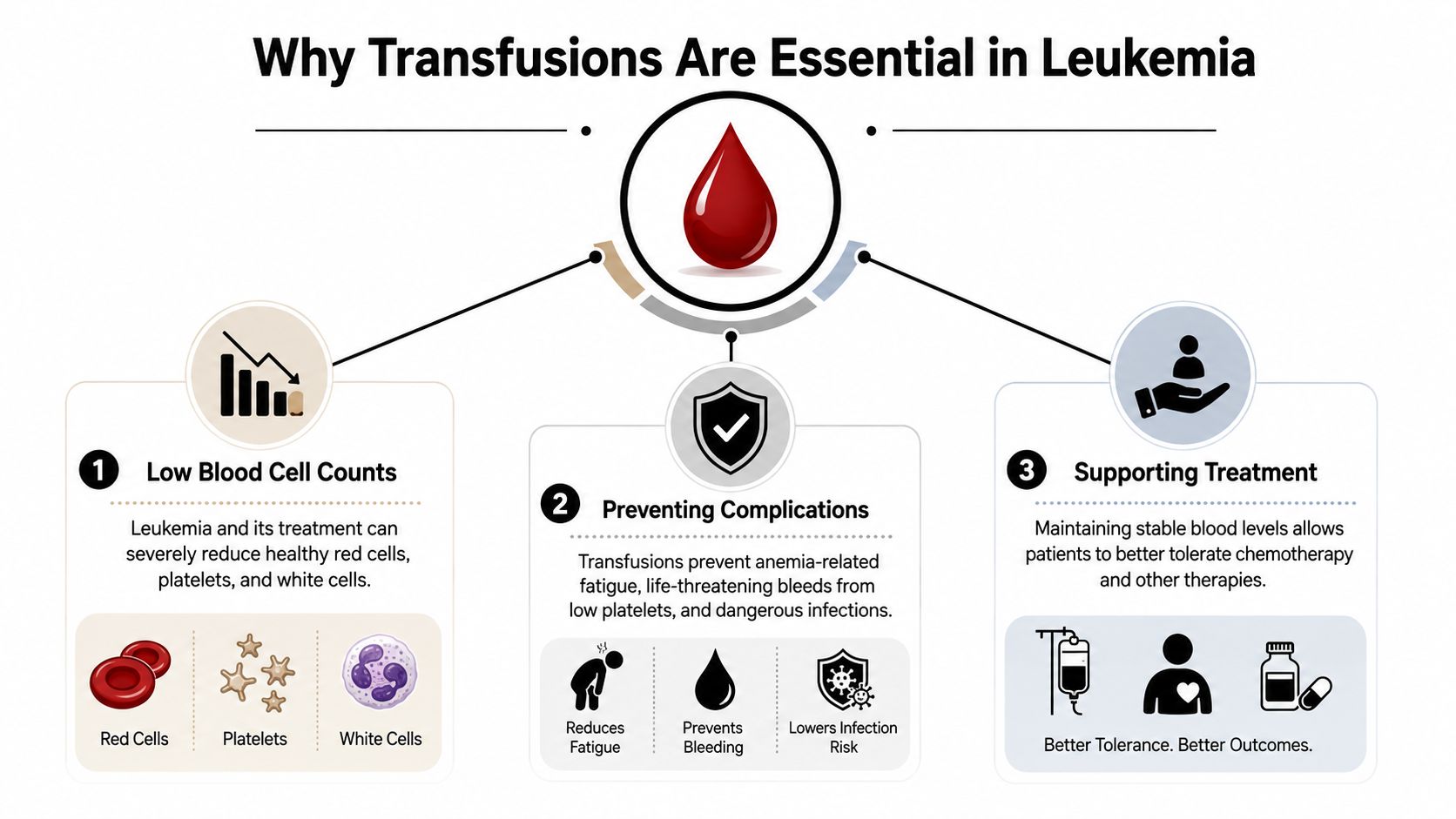
Practical rule: transfusion support is often part of getting through induction safely, not something added at the last minute.
If you are also trying to understand why anemia can feel so overwhelming during chemotherapy, this anemia from chemo guide can help connect the dots.
Types of Blood Products Used in Leukemia Care
The blood bank doesn't send one generic product. The team chooses a specific component based on what's missing and what problem needs fixing. That's why leukemia transfusion care can sound technical at first, even though the logic is straightforward once you separate the pieces.
Red blood cells, platelets, plasma, and cryoprecipitate
Packed red blood cells are used when anemia is the issue. Red cells carry oxygen, so replacing them can ease fatigue, reduce shortness of breath, and help someone function better while treatment is ongoing. If a patient says, “I feel like I can't get enough air when I stand up,” the team thinks about whether red cell support would help.
Platelets are different. They don't carry oxygen. They help blood clot, so platelet transfusion is about reducing the risk of bleeding or stopping bleeding that's already started. Patients often think a platelet transfusion should make them feel more energetic, but that isn't usually the point.
Fresh frozen plasma is used when clotting factors need replacement. In leukemia care, that can matter when the coagulation system is strained and the team needs support for clotting proteins, not red cells or platelets.
Cryoprecipitate is a concentrated clotting product used when fibrinogen replacement is needed. In some leukemia emergencies, it becomes a part of bleeding control.
| Product | Main purpose | What patients usually notice |
|---|---|---|
| Red blood cells | Improve oxygen delivery | Less fatigue, less breathlessness |
| Platelets | Support clotting | Less bleeding risk, fewer bruises |
| Plasma | Replace clotting factors | Used when clotting labs are abnormal |
| Cryoprecipitate | Raise fibrinogen | Used in specific bleeding or coagulopathy settings |
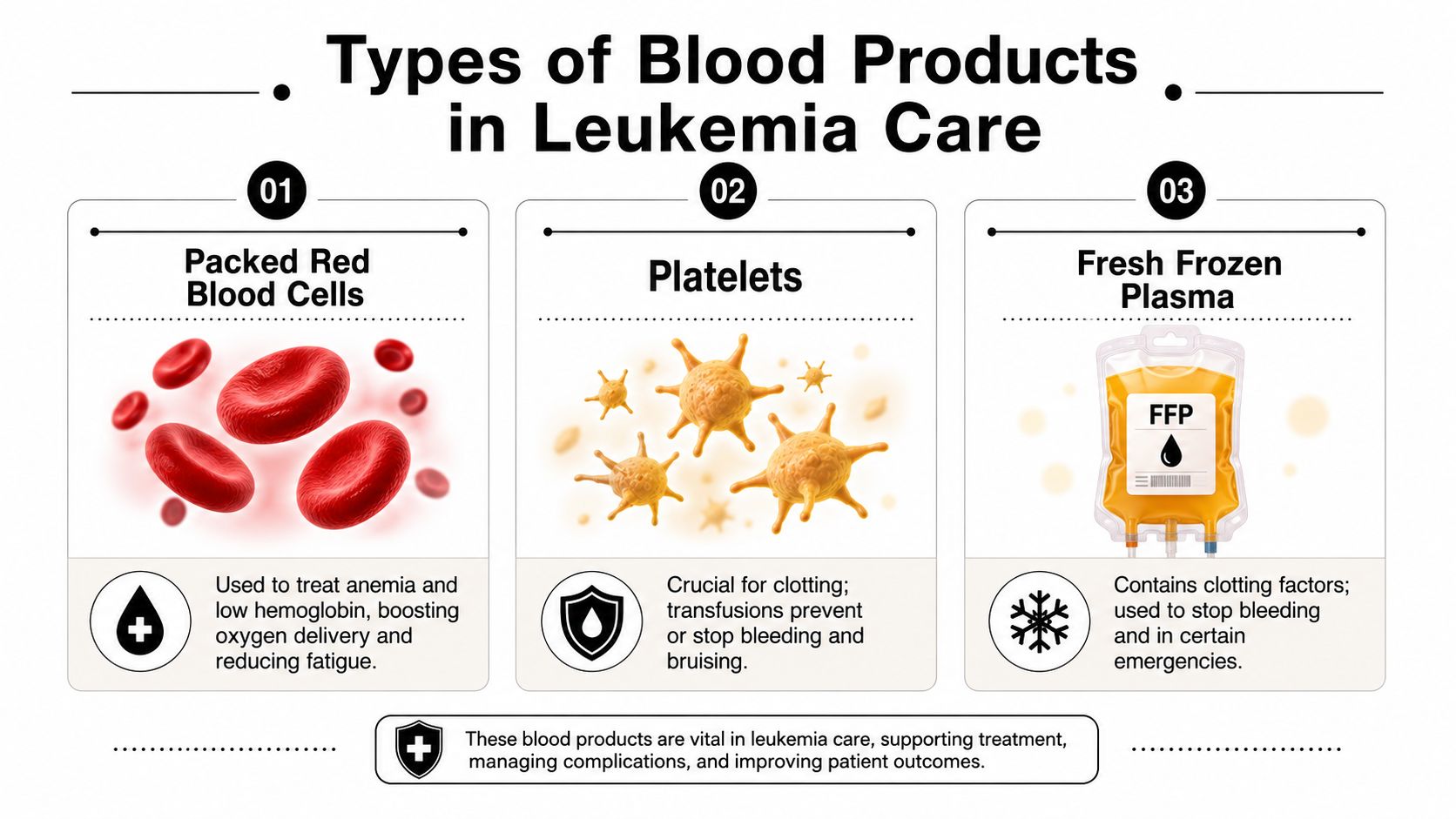
The most important thing to understand is that transfusion isn't “one size fits all.” The order reflects the patient's lab pattern, symptoms, treatment phase, and the kind of support the marrow needs at that moment.
Blood products are chosen the way a clinician chooses a key, they match the problem, not just the diagnosis.
What Happens During a Blood Transfusion at an Outpatient Infusion Center
A transfusion visit can feel intimidating before you arrive, especially if you picture a busy room and a long wait. In a good outpatient infusion center, the pace is careful and deliberate. Staff confirm identity, review symptoms, and match the blood product to the current plan at every step, because the goal is safety as much as treatment.
From check-in to IV placement
The visit usually starts with check-in and vital signs. The team confirms your identity, reviews the order, and checks blood pressure, temperature, and other basics. That first pass matters because transfusion care depends on the latest information, and a product that fit yesterday may not fit today if labs or symptoms have changed.
Then the nurse does a focused assessment. You may be asked about fever, chills, rash, breathing changes, pain, or whether anything has felt different since the last visit. An IV is placed, often in the arm or hand, and baseline vitals are recorded before the transfusion begins.
If you want a broader look at the setting itself, this cancer infusion center overview helps explain how an outpatient treatment space is organized.
What the transfusion itself feels like
The blood product is given slowly. Many patients notice the chair, the room temperature, and the waiting more than the infusion itself. Some read, rest, or talk with a family member. Others sleep.
A video can help you see the flow of the visit.
A transfusion is a bit like a monitored handoff. The blood enters through the IV while the nurse keeps checking whether your body is tolerating it well, because small changes are easier to address early than after they build.
What happens before discharge
Nurses continue watching for new symptoms while the product runs. If the transfusion is complete and you are stable, the IV is removed, a final check is done, and you head home. The day can still feel long, but the steps are familiar, and that predictability helps many patients feel less anxious on later visits.
Behind the scenes, a clear infusion routine also supports blood handling, cleanup, and safety work. For teams that want a practical operations reference, this guide for facility safety managers is a useful example of how careful preparation supports a safe clinical environment.
Risks, Side Effects, and How Patients Are Monitored During Transfusion
No transfusion is completely free of risk, and patients deserve a direct answer about that. The reassuring part is that infusion-center staff expect this and watch closely, so if something is off, they can pause, assess, and respond quickly.
What can happen and what the team watches for
The most common reactions patients are told about are fever, chills, itching, and rash. Those symptoms can be mild, but they still need to be reported right away because they may signal a transfusion reaction. More serious allergic reactions are rarer, but the staff are trained to look for breathing trouble, chest discomfort, or sudden changes in how the patient looks and feels.
Monitoring starts before the first drop of blood enters the line. Vital signs are checked again during the transfusion and after it's done. The nurse wants to know whether the patient suddenly feels cold, flushed, itchy, short of breath, dizzy, or just “not right.” That wording matters, because patients often sense a change before the monitor shows it.
Speak up early. A small symptom is easier to address than a big one.
What patients should report immediately
- Fever or chills: These can be early signs of a reaction and should be reported at once.
- Itching, hives, or rash: Skin symptoms can signal an allergic response.
- Shortness of breath or chest tightness: These need immediate attention.
- Back pain, dizziness, or sudden anxiety: Don't brush these off, tell the nurse right away.
The transfusion team also uses blood typing, crossmatching, and product verification to reduce preventable problems before the visit even begins. That behind-the-scenes work is one reason repeated transfusions can still be delivered safely over time, even though each visit is taken seriously.
How Often Do Leukemia Patients Need Transfusions and What the Thresholds Mean
A family may ask this question on the first day, then ask it again a week later, because the answer can change with the treatment phase and the blood counts on that day. Some people need support only around treatment peaks. Others need it more often while the marrow is still recovering. The answer depends on symptoms, the type of leukemia, and how hard the treatment is pressing on blood production.
Why different clinicians choose different thresholds
Clinicians do not all transfuse at the exact same number because they are weighing the same problem from slightly different angles. A 2016 U.S. survey of acute leukemia clinicians found wide variation in hemoglobin goals, fibrinogen goals, and the use of certain platelet and red-cell products. That variation reflects the gray areas in practice, where symptoms, other medical conditions, and treatment goals can change the decision. The survey also called for randomized trials to reduce unnecessary transfusions without harming outcomes, which shows that transfusion care is still being refined. The clinician survey and evidence review helps explain why there is no single universal script.
What the burden can look like in real practice
Repeated transfusion support can become a large part of leukemia care. In one review of acute leukemia practice, patients sometimes needed 30 to 60 red blood cell units in the first 2 months of therapy. A randomized trial summarized in that review found that the lower-transfusion arm received a mean of 8.0 units per patient compared with 11.7 units in the higher-threshold arm. That matters because it shows some settings can safely use a more restrictive approach while still giving patients the support they need. The acute leukemia transfusion review gives the clearest summary of those figures.
The same review also reported that a nationwide Swedish analysis found that within 2 years after diagnosis, patients with acute myeloid leukemia diagnosed at ages 0 to 65 years received on average 30 to 40 red blood cell and platelet transfusions, with direct material costs close to 200,000 SEK, approximately 23,809 USD, per patient. For families, that is a reminder that transfusion support is not a small side issue. It is part of the day-to-day workload of treatment.
| Practical question | What it means in real life |
|---|---|
| How often will I need blood? | The answer can shift from week to week, especially during induction |
| Why did one clinician transfuse sooner than another? | Thresholds vary because symptoms and risks are part of the decision |
| Can transfusions be reduced? | Sometimes yes, with more restrictive strategies and careful monitoring |
That variability also explains why planning matters. Repeated transfusions can make blood-product matching more important over time, especially when a patient needs support across many visits rather than a single admission. For teams that want to reduce preventable problems and keep care running smoothly, a set of actionable healthcare risk management steps is a useful reminder that transfusion safety depends on reliable systems as well as clinical judgment.
Alternatives and Supportive Measures Alongside Transfusion
Transfusion is important, but it isn't the only support tool in leukemia care. The care team also looks at what can be done to reduce the need for transfusion, slow down further decline, or protect the patient while the marrow recovers.
Sometimes the answer is a medication strategy. Sometimes it's adjusting the cancer treatment schedule. Sometimes it's watching closely and waiting, because a count that looks low on paper doesn't always mean a transfusion is needed right that minute. The decision is usually made in context, not in isolation.
What else the team may consider
Dose delays or treatment adjustments can be appropriate when blood counts are the limiting factor. If the marrow is too suppressed to keep up, the oncology team may change timing or sequence so the patient stays safe.
Nutritional support matters too, even though it won't replace transfusion when counts are dangerously low. Good hydration, adequate calories, and attention to iron, folate, or B12 deficiencies can help support recovery when those problems are present.
Medications that stimulate blood production may be considered in some situations, depending on the cancer type and treatment goals. They're not a substitute for transfusion in urgent settings, but they can be part of a larger plan.
For patients who need repeated support over time, the question becomes less “Will I ever need another transfusion?” and more “What is the plan for managing dependence safely and with the least disruption?” That's where individualized care matters. The team weighs symptoms, lab trends, goals of treatment, and how much burden the visits are placing on the patient and family.
The right plan isn't always the most aggressive one. It's the one that fits the disease, the numbers, and the person living with them.
Common Questions About Blood Transfusion for Leukemia Patients
A patient may ask whether repeated transfusions become harder to match over time. Sometimes they can, especially for people who need specialized support or have unusual blood requirements. That's one reason recent transfusion literature has emphasized rare blood programs and the practical barriers that can show up in recurrent recipients, including access limits in lower-resource settings. The transfusion literature on rare blood and access barriers is a good reference point for that reality.
Another common question is whether a donor has to be found for each transfusion. Usually, no. Blood comes from the community supply, then it's typed, matched, and prepared for the patient. When a person needs unusually specific matching, a rare-blood program may be involved, but that's different from asking a family member to donate for every visit.
People also ask what transfusion dependence means. In palliative-care guidance, it refers to regular RBC and/or platelet transfusions more often than every 8 weeks, and leukemias are among the diagnoses most associated with it. That definition helps explain why some patients live in a cycle of frequent support, especially when disease or treatment keeps the marrow from recovering.
| When to Seek Urgent Care During Transfusion | Why It Matters | What to Do |
|---|---|---|
| Fever or chills | May signal a transfusion reaction | Tell the nurse immediately |
| Shortness of breath | Can indicate a serious reaction | Stop and alert staff at once |
| Chest pain or tightness | Needs urgent assessment | Call for help right away |
| Hives, swelling, or itching | May be allergic in nature | Report symptoms without delay |
| Dizziness or faintness | Could mean the body isn't tolerating the transfusion | Ask for immediate evaluation |
If you're wondering what happens after recovery or whether blood donation is ever part of the picture for survivors, this blood donation guidance for cancer survivors can help clarify that question in a separate context.
If you're navigating leukemia care and transfusions are becoming part of your routine, Hirschfeld Oncology can help you understand the plan, the tradeoffs, and the day-to-day realities of treatment support. Visit Hirschfeld Oncology to explore practical oncology guidance and learn how a patient-centered team approaches complex blood cancer care.
.png)
.png)