.png)


You're sitting in a waiting room with a folder on your lap, trying to keep track of names, appointments, and the next step after a new cancer diagnosis. The word infusion may already sound familiar, but the place where treatment happens can still feel unclear. A cancer infusion center is where that uncertainty starts to turn into a plan, with nurses, pharmacy staff, and oncologists working around one shared goal, getting the right therapy to the right patient safely and on time.
What a Cancer Infusion Center Actually Does

The first visit to an infusion suite can surprise families who expected a quiet room with a few chairs. What happens instead is a coordinated clinical workflow, check-in, vital signs, medication review, line access, pharmacy verification, and monitoring, each step timed so the next one can begin without delay. A cancer infusion center is an active treatment environment, built for repeated systemic therapy and organized to keep care moving safely.
More than chairs and IV poles
The center's purpose is to deliver systemic cancer therapy, meaning treatment that travels through the body rather than staying in one place. That can include intravenous delivery, subcutaneous delivery, and monitoring during and after the medication goes in. In practice, the center functions like a controlled workspace, with pharmacy preparation, nursing assessment, and physician oversight all needing to line up.
That structure matters because infusion care is repeated over time, not handled in a single visit. Each appointment depends on lab checks, symptom review, dosing, and reassessment, much like a relay race where the baton has to pass cleanly from one team member to the next. A center that handles this well is organized to keep treatment on schedule while protecting comfort and safety.
Why operations and medicine are joined together
The operational side of infusion care shapes the clinical side more than many families expect. An ACCC infusion-center benchmarking report described how patient flow depends on staffing, chair use, and scheduling, with the average infusion-center nurse handling multiple chairs per day and a large yearly volume of infusion encounters. The same report described a median of many infusion chairs and many annual infusion visits across responding oncology pharmacies, with community centers operating at a smaller but still busy scale. Those aren't small rooms, they are high-throughput clinical operations that have to stay coordinated.
If you're trying to understand billing or visit classification along the way, a practical guide to cutting billing errors can help show how administrative details and treatment delivery intersect.
The main point is straightforward. A cancer infusion center is a treatment engine, and its chairs are only one part of the system. The people, the timing, the pharmacy checks, and the handoffs determine whether therapy is given on time and tolerated well.
Treatments Offered and Who They Serve
A good infusion center doesn't offer one kind of treatment and call it enough. It has to match the drug to the disease, the disease to the treatment history, and the schedule to the patient's ability to tolerate it. That's why the most useful way to think about infusion care is by therapy family, not by brand name or chair number.

Immunotherapy
Immunotherapy works like helping the body's own security system recognize a threat it had been overlooking. In everyday terms, it doesn't attack cancer in the same way chemotherapy does. It changes how the immune system responds, which is why people often hear about it in cancers where immune signaling has become part of the treatment strategy.
For patients with advanced or treatment-resistant cancers, immunotherapy is often considered when the care team wants a nontraditional route that may still offer disease control. It can be used in combination with other therapies, or after earlier plans have stopped working. The exact choice depends on tumor biology, prior treatment exposure, and how much toxicity a person can safely handle.
Targeted therapy
Targeted therapy is more like aiming at the lock instead of swinging at the whole door. These drugs are designed to interfere with specific molecular drivers that cancer cells rely on. That precision matters when the tumor has a known vulnerability, especially in cancers such as pancreatic, bile duct, colorectal, gastric, breast, ovarian, and esophageal cancers where treatment plans may need to be individualized.
Targeted therapy can be especially useful when standard approaches have been exhausted or when the goal is to reduce broad toxicity. It's not automatically gentler, but it can be more selective. That selectivity is one reason infusion centers that offer targeted treatment can adapt to changing disease behavior.
Low-dose and metronomic chemotherapy
Metronomic therapy is low-dose, continuous treatment given on a schedule that's meant to control growth while limiting the intensity of side effects. Think of it less like a knockout punch and more like steady pressure. For some people, that steady approach offers a workable balance between efficacy and quality of life.
Practical rule: the right infusion plan is often the one a patient can actually keep receiving, not just the one that looks strongest on paper.
The key decision is always tolerance. Some patients need a combination regimen. Others need a sequence of options, where one therapy gives way to another as the cancer changes. A center that can offer all three families, immunotherapy, targeted therapy, and metronomic chemotherapy, can pivot with the disease instead of forcing every patient into the same lane.
What Happens During an Infusion Visit
The day usually starts before the patient reaches the center. Bloodwork, medication review, and clearance from the oncology team often happen ahead of time so the visit doesn't stall once the patient is in the chair. That preparation is why one person's infusion can take a few hours while another's stretches much longer.

When the patient arrives, the visit usually follows a familiar sequence. Check-in comes first, then a nurse confirms symptoms, allergies, and the treatment plan. If the regimen calls for it, pre-medications may be given to reduce nausea or lower the chance of an infusion reaction. The line or port is accessed, the drug is started, and monitoring continues while the medicine runs.
Some patients want to know exactly why the schedule varies so much. The answer is in the regimen itself, because the planned chair time differs widely across drugs and combinations. In a national survey, planned chair time ranged from 270 to 420 minutes for FOLFIRINOX, 255 to 380 minutes for paclitaxel plus carboplatin, 120 to 350 minutes for rituximab, and 85 to 240 minutes for doxorubicin plus cyclophosphamide. Published survey of infusion-center practice
Midway through the visit, the team watches for side effects, line problems, or changes in how the patient is feeling. The discharge part is just as important as the start. A nurse may review next steps, home symptom management, and when to call if fever, rash, swelling, or other concerns appear.
For a plain-language overview of common reactions and home planning, the cancer infusion side effects guide is useful to keep nearby.
The most reassuring thing to remember is that infusion visits are structured, but they're not identical. If a nurse pauses, rechecks a line, or adjusts a pace, that's not a delay for its own sake. It's part of keeping the treatment safe.
Safety and Quality Standards Behind the Scenes
Infusion safety starts long before the patient sits down. The room itself, the pumps, the airflow, and the staff workflow all shape whether treatment can be delivered safely. A center can have excellent clinicians and still fall short if the physical environment or device setup is weak.
The room has to support the therapy
Facility guidance for freestanding cancer treatment and infusion spaces requires at least 10 total air changes per hour, all room air exhausted directly outdoors, and no recirculation by room units. It also sets minimum clearances such as 70 sq ft per bay, 80 sq ft per cubicle, and 100 sq ft per room. Those aren't cosmetic rules. They support infection control, emergency access, and safe movement around patients who may be neutropenic or otherwise immunocompromised. Facility guidance for infusion spaces
Practical rule: infusion safety is a system property, not a single feature.
The same logic applies to drug delivery devices. Technical specifications used in cancer-care settings commonly require flow-rate accuracy of ±10% and drip-rate accuracy of ±2%. More demanding pump standards call for programmable rates from 0.1 to 1200 mL/hr, selectable occlusion thresholds such as 300/500/900 mmHg, and alarm coverage for occlusion, air-in-line, door open, low battery, AC failure, and near-end-of-infusion. Pump specifications for cancer-care equipment
What to compare when you look at a center
| Specification | Standard Value | Why It Matters |
|---|---|---|
| Air changes | 10 total air changes per hour | Helps reduce airborne contamination risk |
| Exhaust | All room air exhausted outdoors | Supports infection control and cleaner room air |
| Recirculation | No recirculation by room units | Lowers the chance of reusing contaminated air |
| Bay clearance | 70 sq ft per bay | Allows safe movement and emergency access |
| Cubicle clearance | 80 sq ft per cubicle | Supports workflow and privacy |
| Room clearance | 100 sq ft per room | Helps staff monitor and manage reactions |
| Flow-rate accuracy | ±10% | Reduces dosing error risk |
| Drip-rate accuracy | ±2% | Improves delivery precision |
| Battery backup | At least 2 hours | Keeps therapy going during brief interruptions |
That table gives you a usable way to ask questions. If a center can't explain its ventilation, pump standards, or emergency backup, that's a signal to keep asking. The right place won't just promise comfort. It will be able to describe the specific systems that keep treatment reliable.
How to Choose the Right Infusion Center
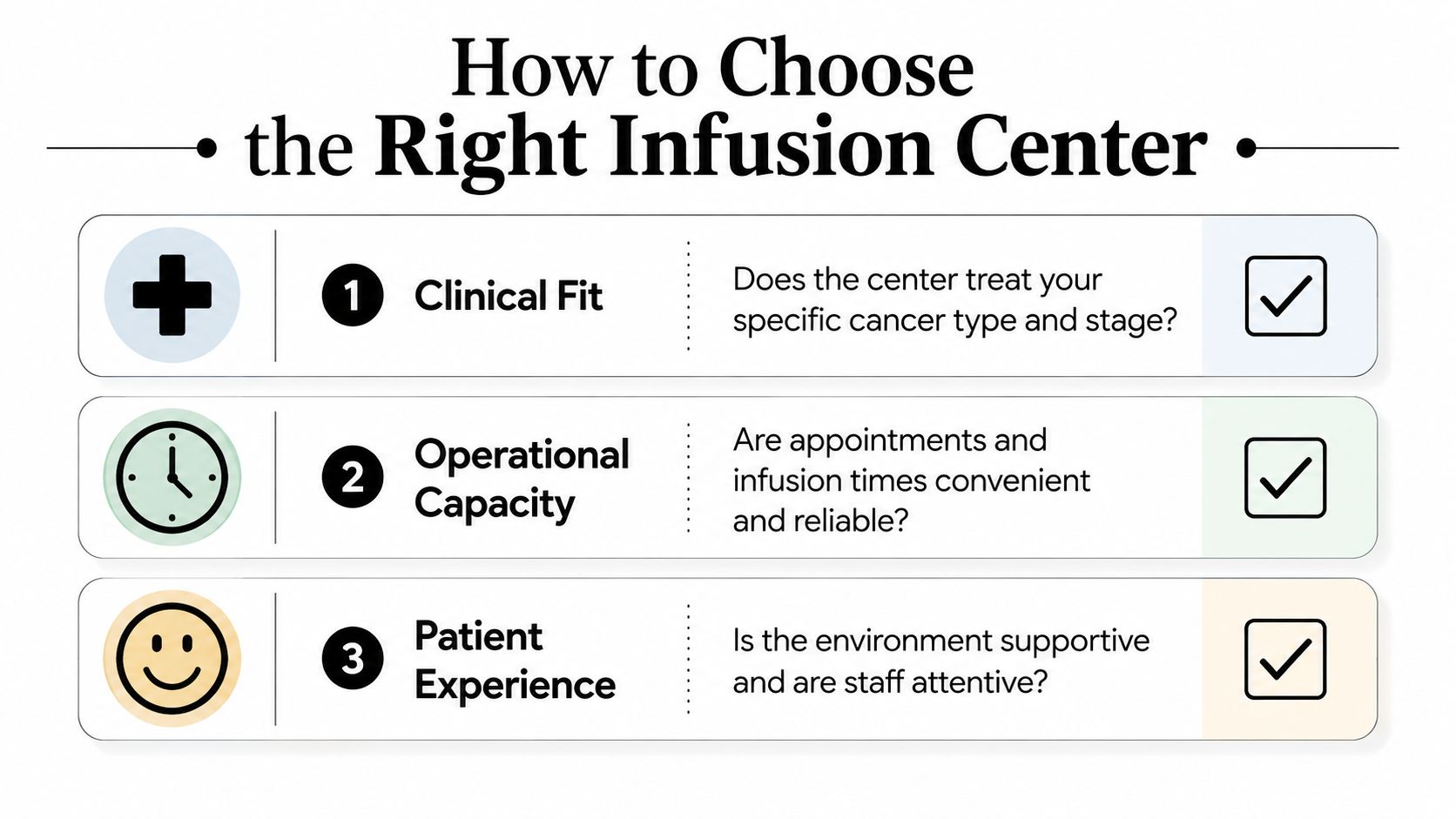
Picking a center is part medical decision, part logistics decision, and part trust decision. Families often focus on whether the oncologist seems knowledgeable, but the core question is whether the whole operation can support repeated treatment without avoidable disruption. That includes therapy fit, capacity, and the ability to respond when plans change.
Start with the disease, then check the workflow
A strong center should treat your cancer type and stage, but that alone isn't enough. Ask whether it offers the specific therapies your oncologist is considering, whether it has experience with advanced or treatment-resistant disease, and how often the plan changes after the first cycle. A center that can only administer a narrow menu of infusions may work fine for straightforward care, but not for complex cases.
Operational capacity matters just as much. A 2022 survey summarized by Leantaas and ACCC found that 40% of infusion-center leaders said they had already run out of space and would need physical expansion to absorb more volume, while 13% said they lacked the resources to add chairs or space for growth. The same report pointed to chair shortages, nurse shortages, pharmacy throughput, and EHR or workflow limits as top bottlenecks. Survey summary on infusion-center operations
Questions worth asking before you commit
- Does the center offer the regimen I'm being told to consider? Some places can administer common infusions but don't have the flexibility for complex sequencing.
- How are delays handled? Ask about pharmacy preparation, waiting patterns, and whether staff can explain what happens if a lab result changes the plan.
- Who reviews symptoms between visits? You want to know whether there's a clear process for urgent concerns, not just a front desk number.
- What support is available for billing and authorizations? For many families, the financial side affects treatment continuity as much as the medical side.
A practical place to compare these questions with what local centers offer is finding a cancer infusion center near you. If you're in the discussion phase, Hirschfeld Oncology is one option among others that provides outpatient infusion care alongside individualized oncology planning.
The best center for one patient may not be the best for another. If you need frequent reassessment, flexible scheduling, and a team that can adapt quickly, choose the place that matches that reality instead of the one with the most polished brochure.
Access, Logistics, and Reaching Care in Brooklyn
A nearby infusion center sounds convenient until you're trying to get there every week, or more often, while juggling work, childcare, and fatigue. In Brooklyn, that reality can look very different from one neighborhood to the next. Williamsburg and Bushwick may both be “close,” but access still depends on subway lines, bus connections, caregiver schedules, and whether the center can see patients when life gets messy.
What families often miss is that access isn't the same as distance. The review on underserved cancer care notes barriers such as health literacy, navigation problems, financial constraints, language and cultural barriers, and distance to services. ASCO's underserved-populations task force also highlights transportation, childcare, elder-care burdens, multilingual needs, and distrust as persistent obstacles. Review of underserved cancer care barriers
The local question is bigger than the map
A center can be physically close and still hard to use. If appointments are rigid, if the staff can't communicate clearly in the patient's preferred language, or if the waiting pattern doesn't fit a work schedule, treatment gets harder to complete. That's why satellite infusion models and virtual check-ins were proposed in the first place, because a chair on a map doesn't solve safety, coordination, or travel burden by itself.
For Brooklyn families, it helps to ask practical questions before the first visit. Can the center adjust for a late bus or a caregiver who works mornings? Can a nurse triage symptoms by phone or telehealth between infusions? Is there a same-day process for urgent changes so a patient doesn't lose a full day to avoidable back-and-forth?
A good location is helpful, but a workable schedule is what keeps treatment from falling apart.
Transportation planning matters too. The transportation assistance guide for cancer patients can help families think beyond mileage and focus on the full burden of repeated visits.
Brooklyn patients deserve more than proximity. They need a center that can fit into real life, including the days when pain, fatigue, money, or family obligations make travel the hardest part of treatment.
Patient Stories and Requesting a Consultation
A representative patient pathway often starts with uncertainty and ends with a plan that feels more manageable. A newly diagnosed patient with advanced disease may come in expecting standard chemotherapy, then learn that immunotherapy, targeted therapy, or low-dose treatment better matches the tumor's biology and past treatment history. The care conversation usually centers on two questions, what has the best chance of helping, and what can the person realistically tolerate.
That kind of individualized discussion is where a team such as Hirschfeld Oncology fits naturally into the picture. The practice focuses on advanced and treatment-resistant cancers, close monitoring, and collaborative decision-making, and a patient can also find support for emotional strain from resources like Penticton depression counselling when the diagnosis is weighing heavily on the family.
A first consultation usually goes better when patients bring a medication list, recent scan reports, pathology results, and a short summary of symptoms and priorities. Families should also be ready to talk about transportation, work schedules, and who will come to visits. Those details help the oncology team build a plan that can be carried out, not just discussed.
If you want to explore treatment options, learn how infusion care works, or ask whether an individualized outpatient plan makes sense for your situation, visit Hirschfeld Oncology and request a consultation.
.png)
.png)