.png)


A lot of people search this question in the first few hours or days after diagnosis: can you survive stage 4 lung cancer? Usually that search happens after a conversation that feels unreal, when you're sitting in a car, at a kitchen table, or awake at night replaying the words over and over.
If that's where you are, the first thing to know is this: stage 4 lung cancer is serious, but the answer isn't a simple yes or no. Some people decline quickly. Some respond to treatment and live much longer than older statistics might suggest. The most useful question isn't only “Can I survive?” It's “What does survival look like for someone with my cancer, my biomarkers, my overall health, and my treatment options today?”
That shift matters. It moves you from a frightening average to a more personal, more practical conversation.
Hearing the Words "Stage 4" and Asking "Can I Survive?"
When people hear “stage 4,” they often hear only one thing: finality. That's understandable. Stage 4 means the cancer has spread beyond the lung, and in most cases it is not considered curable. But “not curable” and “nothing can be done” are not the same thing.
What makes this diagnosis so confusing is that the course of metastatic lung cancer varies a great deal from person to person. In one large cohort of stage IV non-small cell lung cancer, 25% to 30% of patients died within 3 months, yet among those who survived beyond that early period, 10% to 15% went on to live for a very long time, according to a study of long-term survivors with stage IV NSCLC.
That range is why broad statements often feel unsatisfying or even misleading.
Why the first question needs a better follow-up
After “Can I survive stage 4 lung cancer?” the next questions should be more specific:
- What type of lung cancer is it? Lung cancer is not one disease.
- Has biomarker testing been done? This can change treatment options dramatically.
- How well is the cancer causing symptoms right now?
- What is the immediate goal? Shrink cancer quickly, control symptoms, or both.
Some people need urgent symptom relief first. Others need rapid molecular testing before choosing treatment. Others are deciding between standard treatment, a clinical trial, or a more personalized plan.
Practical rule: Don't let one survival statistic stand in for your personal prognosis. Ask what features of your cancer matter most right now.
What “survival” often means today
For many patients, the realistic goal is durable disease control. That means keeping cancer contained, reducing symptoms, preserving strength, and changing treatments over time as needed. In some cases, people live for years while the disease is managed more like a chronic illness than a short, fixed timeline.
That doesn't erase the seriousness of stage 4 disease. It does mean hope should be based on biology, treatment strategy, and close follow-up, not on panic or outdated assumptions.
What Stage 4 Lung Cancer Survival Statistics Really Mean
Statistics matter. They give families a starting point. But they're often misunderstood.
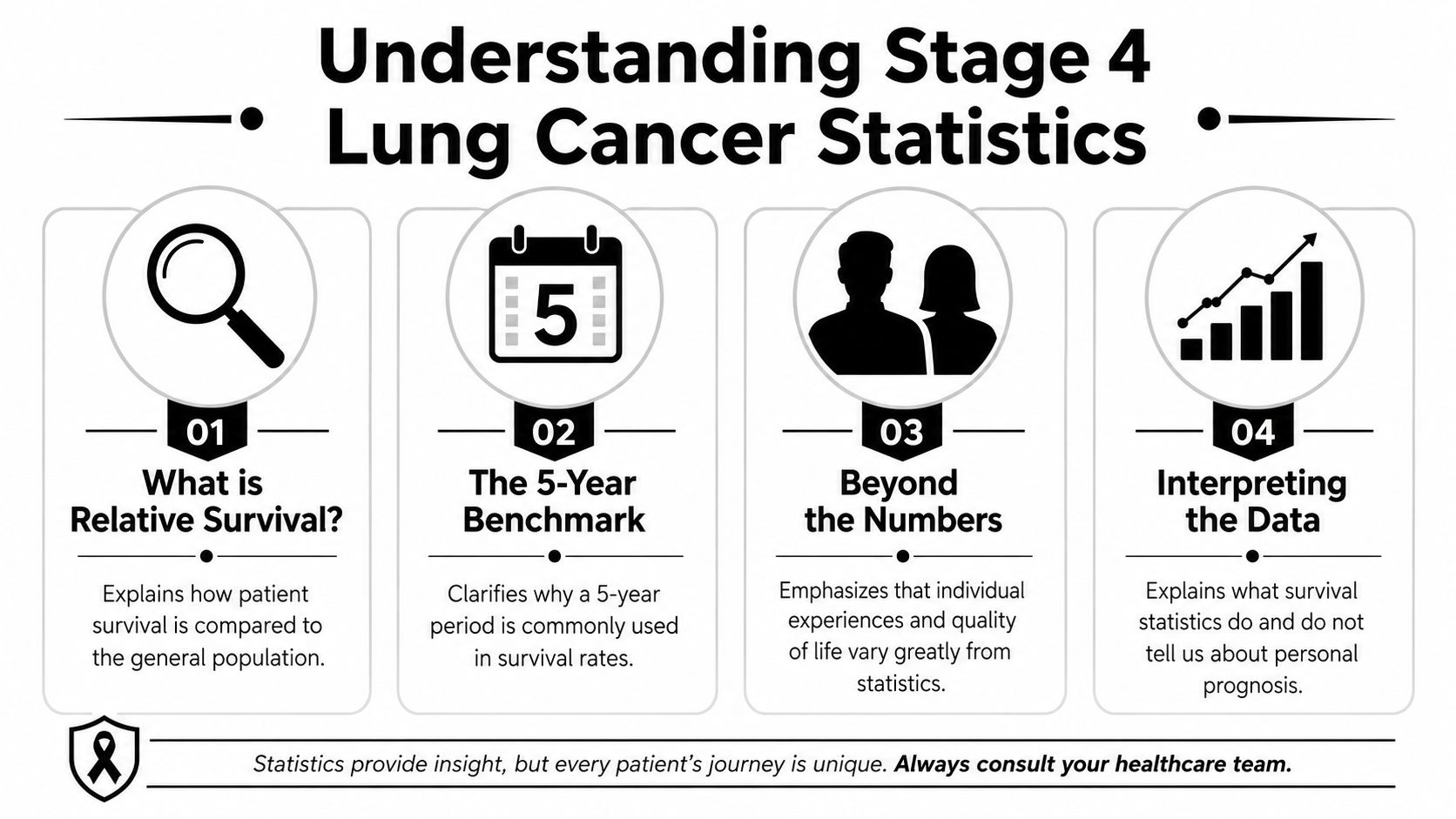
The most quoted number is the 5-year relative survival rate. In the U.S. SEER program, the 5-year relative survival for distant lung and bronchus cancer is 10.5%, as reported in SEER lung and bronchus cancer statistics. That tells you how a large group of people with metastatic disease did over time compared with the general population.
It does not tell you exactly what will happen to one individual sitting in one exam room today.
Think of it like a weather average
A national weather average can tell you something about climate. It can't tell you whether your street will flood this afternoon.
Survival statistics work the same way. They reflect large populations treated across different years, with different health conditions, and often with older therapies. Your own outlook depends on things those broad numbers don't fully capture, such as tumor genetics, how well you're functioning day to day, and whether you can receive a treatment designed for your cancer's specific biology.
What the benchmark does and doesn't say
The 5-year benchmark is useful because it gives a shared reference point. Doctors and researchers need common definitions to compare outcomes.
But families often hear “5-year survival” as if it means a person either lives exactly five years or doesn't. That's not what it means. It tracks how many people in a group are alive five years after diagnosis.
A second limitation is that averages hide the tails of the curve. In smaller observational reports, a minority of patients with stage IV NSCLC lived substantially longer than expected, and around 5% were still alive at 10 years. That doesn't mean long-term survival is common. It means it is possible.
Statistics describe groups. Treatment decisions are made for people.
The question to ask instead of “What's the number?”
A better appointment question is: “Which features of my case make me more like the average, and which features could move me away from it?”
That opens the door to a more accurate discussion about subtype, molecular findings, treatment tolerance, and whether a long response is plausible.
The Personal Factors That Shape Your Prognosis
Once the shock of diagnosis settles a little, prognosis becomes much more personal. Two patients can both have stage 4 lung cancer and still have very different outlooks because their cancers behave differently and their bodies tolerate treatment differently.
One of the most important ideas to understand is that biology drives treatment.
Biomarker testing changes the treatment map
Rapid biomarker testing can identify actionable changes such as EGFR, ALK, ROS1, BRAF, MET, RET, NTRK, KRAS G12C, and PD-L1. A clinical summary from the Lung Cancer Center on whether stage 4 lung cancer is curable notes that finding these markers can shift care away from nonspecific chemotherapy and toward targeted or immune-based treatment with substantially longer disease control in selected patients.
That's why those letter combinations matter. They aren't abstract lab jargon. They can point to a treatment that fits the cancer more precisely.
A simple way to think about it is this:
- No target identified may lead toward broader systemic treatment choices.
- A clear mutation or high immunotherapy-relevant marker may open a more personalized path.
- Incomplete testing can leave important options hidden.
Age and physical reserve matter
Age isn't everything, but it does influence survival and treatment selection. The same clinical summary reports age-stratified 5-year survival for stage 4 lung cancer of 11% under age 50, 7% at ages 50 to 64, and 4.7% at age 65+ in one source, with other summaries also showing better outcomes in younger groups in some analyses.
Doctors care about age partly because it overlaps with something even more important: physiologic reserve. In plain language, that means how much stress your body can handle. Can you walk across a room comfortably? Are you eating? Losing weight? Spending most of the day in bed? Needing oxygen? These details often shape treatment more than a person expects.
The details that often matter most
When families ask what affects prognosis, I'd focus on these factors first:
| Factor | Why it matters | What to ask |
|---|---|---|
| Cancer subtype | Different lung cancers respond differently | “What exact subtype do I have?” |
| Biomarkers | May unlock targeted or immune-based therapy | “Has full molecular testing been completed?” |
| Performance status | Stronger day-to-day function usually means more treatment options | “How do you assess my current fitness for treatment?” |
| Symptom burden | Severe symptoms may require a faster or different approach | “What needs attention first?” |
A pathology report tells you what the cancer is. Biomarker testing tells you what it depends on.
If you only remember one practical point from this section, remember this: ask whether testing is complete before assuming the treatment plan is final.
Modern Treatments Changing the Outlook on Survival
Treatment for metastatic lung cancer isn't one thing anymore. It's a set of options chosen according to the cancer's features and the patient's priorities.
The biggest change in recent years is that doctors can sometimes match treatment more closely to the biology of the tumor. That is very different from the old model where most patients received the same broad treatment approach.
Targeted therapy and immunotherapy work differently
Targeted therapy works like a key designed for a specific lock. If the cancer cell is driven by a particular mutation, the drug may block that exact pathway.
Immunotherapy works differently. Instead of aiming directly at the tumor mutation, it helps the immune system recognize and attack cancer more effectively. A common way to explain it is that it can release the brakes on immune cells that were being held back.
Traditional chemotherapy still has an important role. It can be the right choice in many situations, especially when the cancer is causing symptoms that need prompt treatment or when no actionable target is found. But chemotherapy is broader. It attacks rapidly dividing cells rather than a single molecular driver.
Comparing the main treatment approaches
| Treatment Type | How It Works | Best For | Key Consideration |
|---|---|---|---|
| Targeted therapy | Blocks a specific mutation or pathway the cancer relies on | Tumors with actionable biomarkers | Only works when the matching target is present |
| Immunotherapy | Helps the immune system attack cancer | Selected patients based on tumor features and clinical judgment | Benefit varies widely |
| Chemotherapy | Attacks rapidly dividing cells more broadly | Many patients, including those needing systemic treatment quickly | Side effects and tolerance differ by person |
| Local radiotherapy | Treats a defined area causing symptoms or needing local control | Painful or threatening sites, or selected combined strategies | Usually part of a larger plan, not the whole plan |
For readers trying to understand how immune treatment fits into advanced disease, this guide to immunotherapy for stage 4 cancer offers a useful overview.
Why combination planning matters
Expert discussion highlights that while “cure” usually isn't the word used for stage 4 lung cancer, some patients now live for years with controlled disease when systemic treatment is combined with local radiotherapy, with outcomes described as better than ever in this expert video discussion on stage 4 lung cancer.
That matters because survival today often depends on sequencing, not just selecting, treatment. A person might receive systemic therapy first, then focused radiation to a troublesome spot, then a change in treatment later if the cancer adapts.
What patients should listen for in treatment discussions
A strong consultation usually answers four practical questions:
- Is there a target? If yes, that can reshape the whole plan.
- How fast do we need to act? Some situations call for treatment before every test is back. Others don't.
- What is the goal of this treatment right now? Shrinkage, symptom control, longer control, or all three.
- How will quality of life be protected? That should be built into the plan, not added as an afterthought.
The best treatment plan is rarely the most aggressive-sounding one. It's the one that fits the cancer and the person living with it.
The Critical Role of Symptom Management and Quality of Life
Families sometimes hear “palliative care” and think it means giving up. In modern cancer care, that's a misunderstanding. Symptom management should begin early, often from the day of diagnosis, because patients do better when pain, breathlessness, nausea, anxiety, and fatigue are treated promptly.

A patient who can sleep, eat, move, and breathe more comfortably is often better positioned to continue treatment and recover between cycles. Quality of life is not separate from cancer care. It is part of cancer care.
What symptom support can include
Symptom management can involve several kinds of help at the same time:
- Breathing support: Oxygen planning, inhalers when appropriate, and techniques for shortness of breath.
- Pain control: Medication, radiation for painful sites, and specialist input when pain is complex.
- Digestive support: Help with nausea, constipation, appetite loss, or trouble eating.
- Emotional support: Counseling, medication when needed, caregiver support, and practical planning.
Some families also want to understand financial and insurance issues that can surface during advanced illness. If life insurance questions come up, My Policy Quote explains ADB in clear plain language, which can help families prepare without feeling overwhelmed.
Why early palliative care is a strength
When symptoms are ignored, people lose weight, become dehydrated, stop moving, and often end up in the emergency room. When symptoms are treated early, patients often stay stronger and more engaged in decision-making.
Good symptom control isn't a backup plan. It helps patients stay well enough to benefit from treatment.
This short video offers another practical look at supportive care during serious illness:
Questions worth asking right away
You don't need to wait for symptoms to become severe. Ask early:
- “Who should I call if breathing gets worse at night?”
- “What side effects should we treat immediately rather than wait on?”
- “Can palliative care or symptom management be involved now?”
- “What's the plan if I lose appetite or strength?”
Patients often feel more in control once there is a symptom plan on paper. That alone can reduce fear.
Accessing Emerging Therapies and Clinical Trials
Clinical trials can sound intimidating, but they're often one of the most practical ways to access newer cancer treatments. They are not only for the very end of the road. In many cases, a trial is worth discussing early, while a patient is still well enough to qualify and compare options carefully.
The key is to treat trial research as part of routine decision-making, not as a desperate measure.
A simple way to approach trials

Here's a straightforward process patients can use:
Learn the basics
Understand whether the trial is testing a new drug, a new combination, or a new treatment sequence.Match the trial to the biology
Some studies are open only to patients with a specific mutation or marker. That's one reason complete testing matters so much.Review the eligibility rules carefully
Trials may have requirements related to prior treatment, organ function, symptoms, or brain metastases.Ask what extra visits or scans are involved
The logistics matter. Travel, time, and support at home all affect whether a trial is realistic.
Questions to bring to your oncologist
A better trial discussion happens when patients ask specific questions:
- “Is there a trial that fits my biomarker profile?”
- “Would joining now make more sense than waiting?”
- “What standard treatment would I receive if I don't join?”
- “What are the added risks, tests, and time commitments?”
A detailed overview of how studies work and how to evaluate them is available in this guide to cancer clinical trials.
Practical issues people forget to plan for
Many patients with advanced lung cancer also need help managing day-to-day function while pursuing treatment. If breathing support becomes part of your care, this resource on understanding portable oxygen devices can help families think through mobility, travel, and home routines.
A good clinical trial is not “trying anything.” It is a structured treatment option with defined rules, monitoring, and a clear scientific question.
The best trial is not only the newest one. It's the one that matches your cancer, your goals, and your ability to participate safely.
Your Next Steps and Finding Expert Care in New York City
After all of this information, the most important takeaway is simple: don't reduce your future to one statistic. If you're asking can you survive stage 4 lung cancer, the meaningful answer depends on your subtype, biomarkers, current symptoms, physical reserve, and access to the right treatment strategy.
Bring these questions to your next appointment:
- “What exact subtype of lung cancer do I have?”
- “Has full biomarker testing been completed, and if not, when will it be?”
- “What treatment are you recommending first, and why this one?”
- “Is the goal quick shrinkage, durable control, symptom relief, or a combination?”
- “Should local radiation be part of the plan?”
- “Would I be a candidate for a clinical trial now?”
- “What symptoms should trigger an urgent call?”
- “How will you protect my quality of life during treatment?”
If you're in New York City and want care close to home, it also helps to identify a center that understands advanced disease, infusion support, symptom management, and personalized treatment planning. Patients in Brooklyn and nearby neighborhoods can review options for coordinated outpatient cancer care through this Brooklyn cancer center resource.
You don't have to know every answer before the next visit. You just need the right questions, complete testing, and a team willing to think carefully about what your survival can look like now, not what it looked like years ago.
If you or someone you love is facing an advanced cancer diagnosis, Hirschfeld Oncology offers patient-centered care in Brooklyn with a focus on thoughtful treatment planning, immunotherapy, targeted therapy, low-dose chemotherapy, and supportive outpatient infusion care. For patients and families who want clear guidance, close follow-up, and a team committed to exploring every appropriate option, reaching out for a consultation can be a meaningful next step.
.png)
.png)