.png)


You've just left an appointment with a new diagnosis, or maybe you're already in treatment and the pain keeps changing shape. Some days it's a dull ache that sits in the background. Other days it spikes hard enough to stop sleep, make walking harder, or turn a family dinner into a round of guessing games. That unpredictability is why cancer pain management has to be more than a prescription. It needs a plan.
Pain is common across the cancer journey, not just at the end. The U.S. National Cancer Institute reports pain in 20% to 50% of all patients with cancer, and roughly 80% of patients with advanced-stage cancer have moderate to severe pain. A widely cited systematic review found pain in 39.3% after curative treatment, 55.0% during anticancer treatment, and 66.4% in advanced, metastatic, or terminal disease, with 38.0% of all patients reporting moderate to severe pain (National Cancer Institute). Those numbers matter because they show pain isn't rare, and it isn't a sign that you're somehow failing treatment.
What Cancer Pain Really Feels Like and Why a Plan Matters
A person with stage 4 pancreatic cancer may tell you one thing in the morning and another by evening. After chemotherapy, the pain may be steadier in the abdomen, then flare sharply after eating, walking, or trying to sleep on one side. That doesn't mean the pain is “in their head,” and it doesn't mean the disease has suddenly changed course every time the pain changes character.
Cancer pain usually comes in layers. There's the background pain that lingers, the breakthrough pain that arrives in waves, and sometimes the pain from treatment itself, such as surgery, chemotherapy, or radiation. A patient can have more than one of these at once, which is why one pain medicine by itself often isn't enough.
Why a roadmap helps
Families often ask what they should expect, and the honest answer is that pain control usually takes adjustment. The right plan starts with describing the pain clearly, then matching treatment to the kind of pain and the goals of care.
Practical rule: if pain is changing, the plan should change too. Waiting for the next routine visit can leave people undertreated for too long.
This guide follows the same path many cancer teams use in real life. It starts with the language of pain, then moves into how clinicians choose medicines, what else can help, and what to do when standard opioid treatment isn't enough. The goal is simple, give you and your family a way to talk with the care team without feeling overwhelmed.
The Different Types of Cancer Pain and What Causes Them

Pain is easier to manage when you can name it. Think of it the way you'd describe a home repair problem. A sore, bruised feeling is not the same as an electric shock, and neither feels like a deep cramp or a crushing ache. Cancer pain works the same way.
The main pain patterns
Nociceptive pain is the “tissue injury” type. Patients often describe it as aching, throbbing, or pressure-like. It can come from a tumor pressing on organs or tissues, from surgery, or from inflammation around the cancer.
Neuropathic pain comes from irritated or damaged nerves. It often feels burning, tingling, shooting, or like pins and needles. Chemotherapy-induced neuropathy is a common example, and the LifeWorks Integrative Health guide is a useful plain-language resource for families trying to understand nerve pain symptoms and how they differ from ordinary soreness.
Visceral pain comes from internal organs. People usually call it deep, cramping, or hard to localize. It can be difficult to point to with one finger, and that vagueness is often a clue that an organ, not a skin surface, is involved.
Bone pain often feels deep and stubborn, sometimes worse with movement or at night. For people with metastatic disease, this category matters a lot, and the clinical discussion often includes the bone-metastasis treatment options explained in this bone metastases treatment overview.
What usually causes each type
Cancer itself can cause pain by pressing on nerves, stretching organs, or irritating bone. Treatment can also be the source, especially after surgery or radiation, and chemotherapy can cause nerve injury that lingers even after the infusion is over. Radiation fibrosis and post-treatment tissue scarring can add another layer of discomfort, so it's a mistake to assume every pain flare means the cancer is growing.
That's why the pain description matters so much at appointments. Instead of saying only “it hurts,” try to tell the team where it hurts, whether it's burning or aching, what makes it worse, and whether it comes and goes. Those details guide the treatment choice more than a single label ever could.
How Doctors Assess Cancer Pain and Choose Medications
A pain score can feel abstract until a clinician explains what it is for. A numeric rating scale does not judge your toughness or how well you are coping. It gives the care team a common language for intensity, so they can see whether treatment is helping or whether the plan needs to change.
How the assessment works in practice
A typical visit starts with four plain questions. Where does it hurt, when does it happen, what does it feel like, and how is it affecting daily life? Those answers help the team understand more than a number on a chart. They show whether pain is interrupting sleep, appetite, walking, or time with family.
The Brief Pain Inventory is one tool clinicians use to track that pattern over time. A person may report the same pain score at two visits, yet be sleeping better and moving more, which suggests the plan is helping. The reverse matters too. If the score has not changed and function is worse, the team needs to look again at what is driving the pain.
That is why it helps to describe pain the way you feel it. Burning, aching, stabbing, pressure, or cramping all point the team in different directions. If you can say what sets it off and what eases it, the medication choice becomes more accurate.
Where medications fit
The old pain ladder still gives a useful starting point. Mild pain may improve with non-opioid medicine or adjuvant medicines, while moderate-to-severe cancer pain often needs immediate-release opioids at the lowest effective dose with early reassessment and frequent titration. In practice, that means the first dose is often only the beginning of the plan. The team is looking for the smallest amount that lets you rest, move, and get through the day.
Breakthrough medication matters because cancer pain often comes in waves. A long-acting medicine can steady the background pain, while a rescue dose is used for flare-ups. That is the same reason bowel medicines are usually started right away, because constipation is expected with opioids, and nausea prevention is often part of the first prescription set.
Families often worry that opioid treatment for cancer pain works the same way as casual long-term pain prescribing. It does not. In cancer care, clinicians are trying to preserve comfort and function while keeping side effects and risk as low as they can.
When opioids need to be changed, the team may use equianalgesic tables and a cautious rotation approach. They often start below the full calculated equivalent because cross-tolerance is incomplete (PMC review). That is one reason a medication list should never be treated as a fixed script. Dose changes, rescue doses, and side-effect checks are part of the same plan.
A plain-language overview of common options is also available in this guide to cancer pain medication, which can help patients and families know what questions to bring to the visit.
Adjuvant Medicines and Non-Drug Therapies That Often Help
A pain plan is not always improved by raising an opioid dose. Some pain responds better when treatment matches the pattern behind it. That is why clinicians often add adjuvant medicines, especially when pain has a nerve component or when swelling is making symptoms worse.
Medicines that fit specific pain patterns
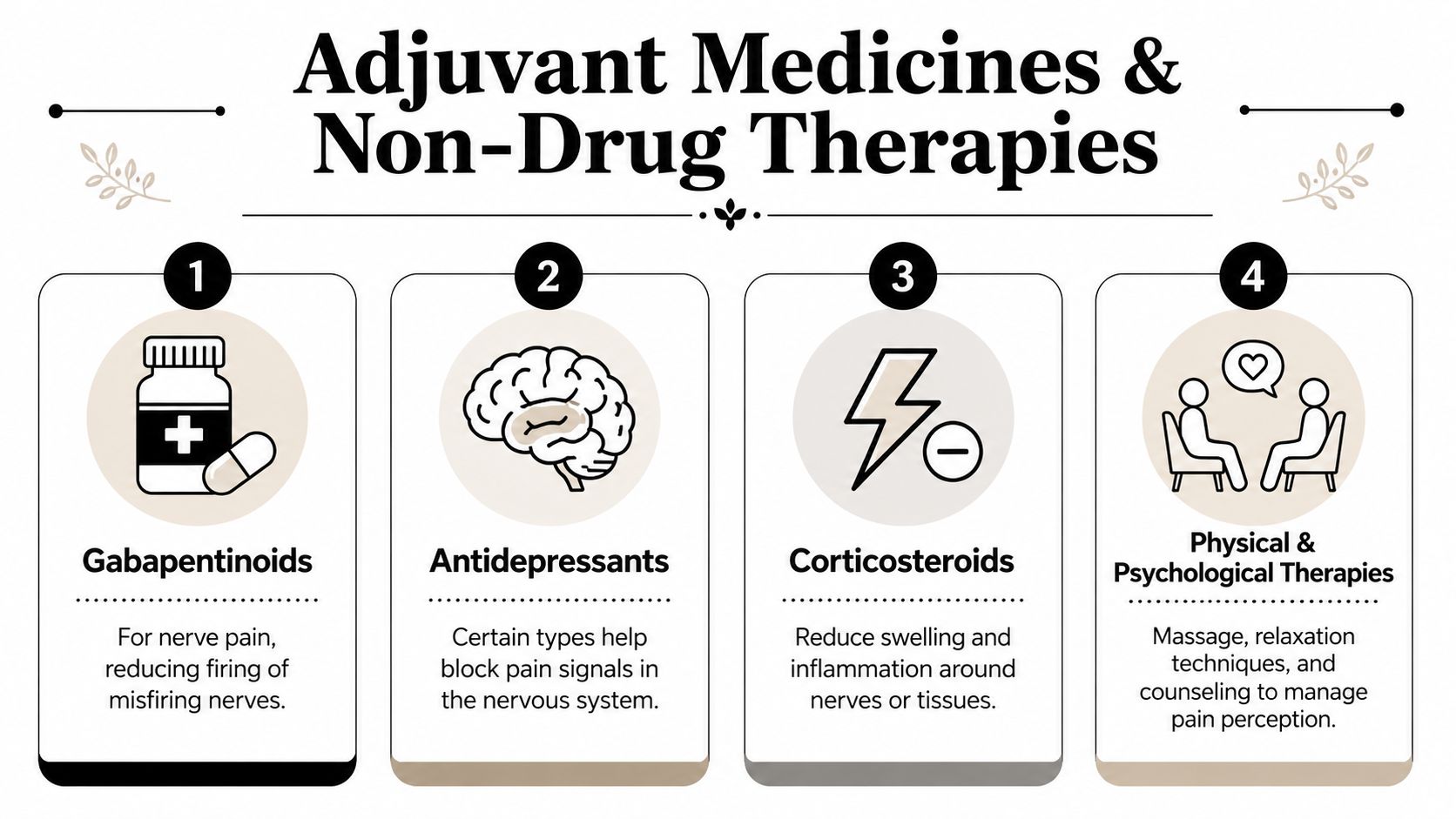
Gabapentinoids and certain antidepressants are often used when pain feels burning, shooting, or electric. They do not replace cancer treatment, and they do not help every kind of pain, but they can quiet irritated nerves in ways opioids often cannot.
Corticosteroids can help when swelling, inflammation, or pressure around tissues is part of the problem. People usually notice them in situations where pain seems tied to mass effect, nerve compression, or appetite loss. They are often one piece of a larger plan, not the whole plan.
Bisphosphonates belong in the conversation when bone metastases are part of the picture. The NCI notes that bone pain from metastatic cancer has been an important area of treatment development, and bisphosphonates are used to help maintain bone integrity and reduce cancer-related bone pain (National Cancer Institute).
Non-drug approaches that make sense
The strongest non-drug plans are usually practical, not trendy. Physical therapy can help with movement, stiffness, and deconditioning. Occupational therapy helps people save energy and protect function during ordinary tasks. Massage, relaxation techniques, cognitive-behavioral therapy, and mindfulness can lower the strain that makes pain feel louder.
The NCI also notes growing interest in acupuncture, yoga, Tai Chi, and mindfulness approaches for cancer-related pain, and that behavioral strategies are usually used alongside medication rather than instead of it (National Cancer Institute). In real life, combining drug and non-drug care often gives families more flexibility, especially when pain is mixed, changes from day to day, or is tied to activity. If your team is also talking about support around the end of life, it can help to compare hospice and palliative care so you know what each service is meant to do.
Ask what each therapy is trying to do. Some approaches reduce nerve firing, some reduce swelling, and some help you cope better with pain that cannot be erased completely.
When Standard Treatment Is Not Enough and What Comes Next

For many families, the hardest point comes after the first prescription. The pain may improve only partly, or the side effects may start taking up more of the day than the cancer pain itself. That does not mean the plan has failed. It means the next layer of care needs to be considered.
The next layer of care
Some pain signals can be interrupted before they travel as far. For stubborn abdominal cancer pain, doctors may consider a celiac plexus block or another nerve block. When pain is difficult to control, intrathecal drug delivery places medicine closer to the spinal cord so smaller amounts can work in a more focused way. Spinal cord stimulation and cordotomy are also part of advanced care in selected cases, usually when standard approaches have not worked well or have not been tolerated.
Bone pain sometimes needs local treatment aimed at the source. Radiotherapy and bisphosphonates can help with pain from bone metastases, because they target the bone problem itself instead of only dulling pain throughout the body.
Who manages these options
A medical oncologist often begins the pain plan. When symptoms become more complex, a palliative care clinician or pain specialist may need to join the team. If you want a plain explanation of how those services differ, this guide to compare hospice and palliative care can help. Many families also find it useful to read about palliative care versus hospice care so they know which service is meant for symptom support and which one is meant for end-of-life care.
Palliative care is often the right next call when pain is taking over the day. It can work alongside oncology, not in place of it, and it gives the family another set of eyes on symptoms, side effects, and practical decisions.
Access is uneven, and that matters. Expert reviews describe wide variation in how available procedures like spinal cord stimulation, intrathecal drug delivery, and cordotomy are, especially for people dealing with fragmented systems or community settings (PMC review). If the same prescription keeps getting repeated without a fresh look at the pain pattern, that is a clear time to ask for a referral and a broader plan.
Managing Side Effects, Daily Routines, and Red Flags at Home
Pain control works better when the home routine is organized. A notebook, phone note, or one-page log can make a big difference because it turns vague memory into usable information. Write down the pain score, where it hurts, what you took, when you took it, and what changed afterward.
The daily toolkit
Constipation prevention should start early if you're on opioids, not after three uncomfortable days. Nausea may settle after the body adjusts, but if it doesn't, the care team may need to change the medicine or add a supportive drug. Sleepiness can be normal at first, but worsening sedation, new confusion, or trouble waking up needs prompt attention.
Keep opioids in a locked place, away from children, guests, and anyone not prescribed the medication. If you travel, bring the pill list, dosing schedule, and the number for the oncology office, because pain doesn't respect hotel check-in times or holiday weekends.
Red flags that need same-day contact
- Sudden severe pain: especially if it's new, sharp, or completely different from the usual pattern.
- New weakness or numbness: particularly if it affects walking, grip, or the legs.
- Fever with back pain: this can point to a problem that needs urgent evaluation.
- Unmanageable sedation: if the person is hard to wake or too confused to take medicine safely.
- Pain plus vomiting or inability to keep medicine down: the plan may need to change quickly.
The guide to comfortable healing after surgery can also help families think about recovery-related pain, especially when surgery is part of the cancer treatment path. Even if your situation isn't surgical, the practical habits around tracking symptoms and calling early still apply.
Finding the Right Specialist and How Hirschfeld Oncology Fits In
Cancer pain care gets messy when no one owns the whole picture. A medical oncologist focuses on the cancer plan, a palliative care clinician focuses on symptom relief and goals of care, and a pain anesthesiologist may handle blocks, pumps, or other procedures. When the system is fragmented, the patient often has to connect the dots.
Ask for the referral in plain terms. You can say, “My pain is still breaking through,” or “The side effects are making the treatment hard to use,” and request palliative care or pain specialist input. If language barriers, low health literacy, insurance pre-authorization, or the digital divide are slowing follow-up, say that directly. Those barriers are part of the care problem, not a personal failing.
Hirschfeld Oncology in Brooklyn, New York, led by Dr. Azriel Hirschfeld, a board-certified oncologist with over 20 years of experience, provides personalized regimens, symptom monitoring, and collaborative decision-making for complex and advanced-stage cancers. For patients in Williamsburg, Bushwick, and across NYC who want an outpatient consultation for less toxic or more individualized options, it's one place to ask how pain control can be coordinated with the cancer treatment plan.
The best referral is the one that reaches the right team quickly, with a clear description of what's not working and what the patient still wants to be able to do.
Your Next Steps and Common Questions About Cancer Pain
Start with one sentence. “My pain is worst at night, burning in my feet, and it's keeping me from sleeping.” Bring your medication list, your symptom log, and one question about what happens if the first plan doesn't work. Ask who to call after hours, because that answer matters before the first flare, not during it.
Three questions to ask:
- What type of pain do you think this is?
- What should I do if the medicine only helps partway?
- When should palliative care or a pain specialist get involved?
FAQ, briefly
How fast should pain relief work? It depends on the medicine and the pain type. Some drugs are meant for immediate relief, while others need careful adjustment over days.
Do strong opioids mean treatment is over? No. They're one tool, not a verdict.
Are non-drug options worth it? Yes, especially when pain affects function, sleep, or stress.
When should palliative care start? As soon as symptoms are affecting daily life, not only at the end.
If you're still trying to make sense of pain that keeps changing, Hirschfeld Oncology can help you review what's been tried, what's still missing, and what should happen next. Visit Hirschfeld Oncology to request a consultation and discuss a pain plan that fits your cancer treatment, your side effects, and your goals.
.png)
.png)