.png)


You're staring at a diagnosis, a treatment calendar, and a stack of paperwork, and one question keeps showing up before the first infusion even starts, how much is this going to cost? That fear is normal. In cancer care, the bill isn't just a bill, it's a stressor that can shape treatment choices, daily routines, and family planning.
In New York City, that pressure can feel even sharper because every decision has a price tag attached to it, from where you get infused to how often you have to cross town for appointments. The good news is that cancer treatment cost isn't one mysterious number. It's a set of moving parts, and once you can name those parts, the whole picture gets easier to manage.
The Financial Shock of a Cancer Diagnosis
A diagnosis can turn an ordinary week into a blur of calls, referrals, and appointments. One person may leave the oncologist's office thinking about scans and staging, while another is already worrying about copays, time off work, and whether a specialty drug will be covered. Both reactions are valid, because cancer care brings two crises at once, medical urgency and financial uncertainty.
The scale of the problem is not small. In the United States, cancer care cost an estimated $183 billion in 2015, and the National Cancer Institute projected that it would rise to about $246 billion by 2030, a 34% increase driven largely by an aging and growing population. Those are system-level figures, but they matter to patients because the larger the system burden, the more pressure there is on families to absorb pieces of the cost themselves. AACR's summary of rising cancer care costs lays out that broader trend clearly.
Why the first bill feels so confusing
The first financial shock often comes from not knowing what's coming next. A scan may be followed by a biopsy, a consult, a drug authorization, then another appointment to review results. Each step can carry a separate charge, and each charge can land on a different day.
Practical rule: Don't judge the total cost by the first estimate you hear. Cancer care often unfolds in phases, and the price changes with the phase.
That phase effect is real. Per-patient annualized medical-service costs are much higher in the last year of life than in earlier care stages, which shows how sharply expenses can rise when disease is advanced or treatment is intensive. For patients and caregivers, that means the financial story is often less about one bill and more about a sequence of bills that can change as the plan changes.
The emotional burden matters too. Financial strain can make patients hesitate, delay, or second-guess treatment, even when the medical recommendation is clear. A calmer approach is to treat cost questions as part of good care, not as a distraction from it.
Deconstructing Your Total Cancer Care Bill
The easiest way to understand a cancer bill is to view it as an itemized receipt. The total is usually built from direct costs, the things that show up on medical claims, and indirect costs, the expenses that show up in the family budget. When people only look at the clinic bill, they miss half the picture.
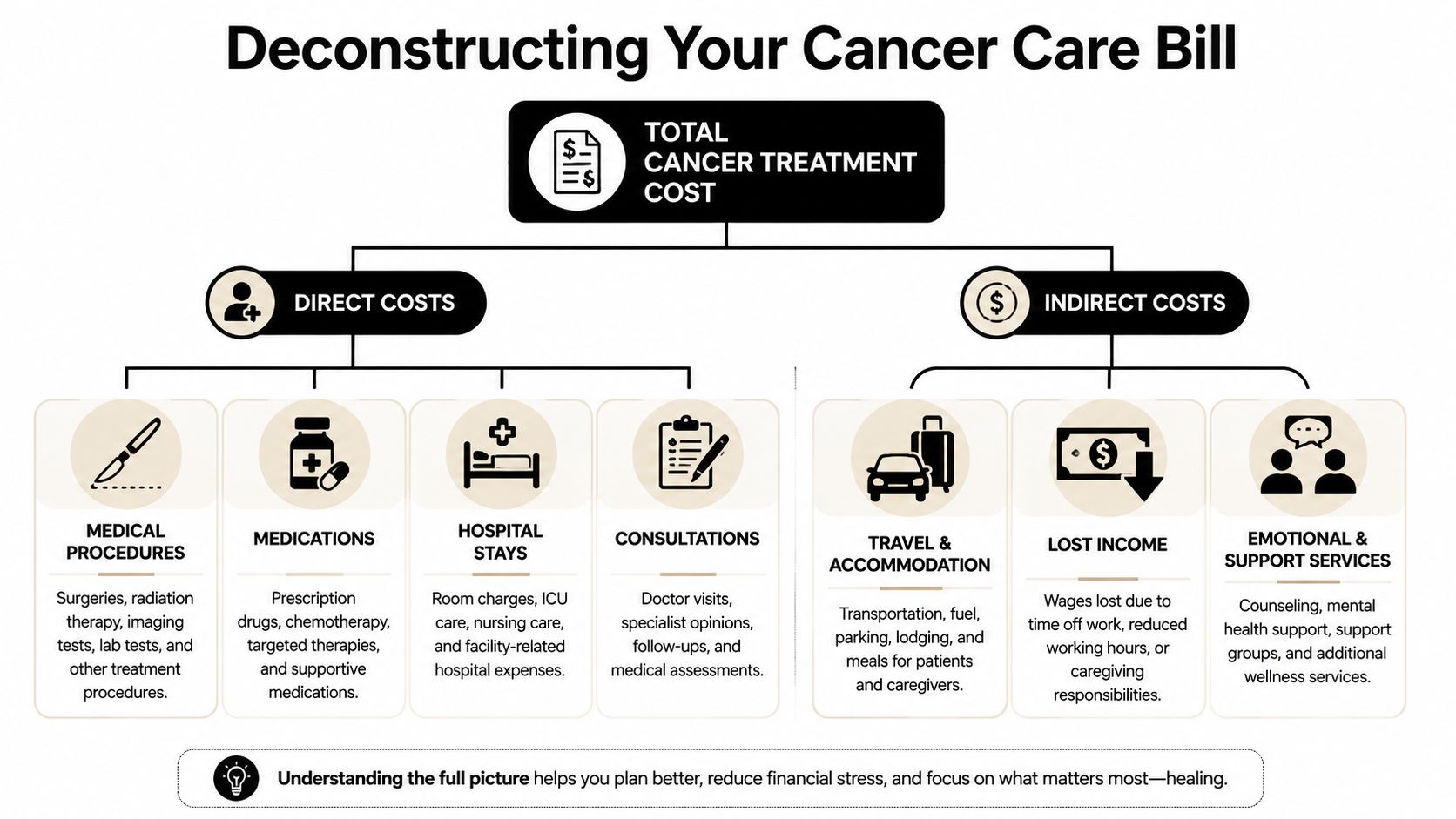
Direct costs that usually appear on medical statements
Direct costs include the parts of care typically expected, like doctor visits, lab work, imaging, drug administration, and facility fees. If you're getting treatment in an outpatient infusion center, there may be charges for the drug itself plus the time and setting where it's given. If care happens in a hospital, the billing often becomes more layered.
These charges also shift over time. Per-patient annualized medical-service costs were $109,727 in end-of-life care, compared with $43,516 in the first year after diagnosis and $5,518 in continuing care. Oral prescription drug costs were $4,372, $1,874, and $1,041, respectively. Those figures show why two people with the same diagnosis can have very different financial experiences depending on timing and treatment intensity.
Indirect costs that families feel right away
Indirect costs are easy to overlook and hard to ignore. They can include lost wages, parking, subway or rideshare expenses, childcare, meals near the hospital, and time spent coordinating care. A family may never see these items on an explanation of benefits, but they still affect what treatment feels like in real life.
A useful question to ask is simple, “What will this plan cost me outside the clinic?” That question can surface travel burdens, work disruptions, and support needs before they become emergencies. If you need a plain-language framework for benefit terms later on, this insurance guide for cancer patients is a helpful companion.
If a treatment plan looks affordable on paper but requires repeated long trips across the city, the real cost is already higher than the invoice shows.
Typical Cost Ranges for Modern Cancer Therapies
A treatment plan can look straightforward on paper and still create a large bill once drug pricing, infusion fees, and pharmacy charges are added together. That disconnect is often what surprises patients most, especially when the care is happening in a busy outpatient center where the visit itself feels brief but the financial footprint is much larger.
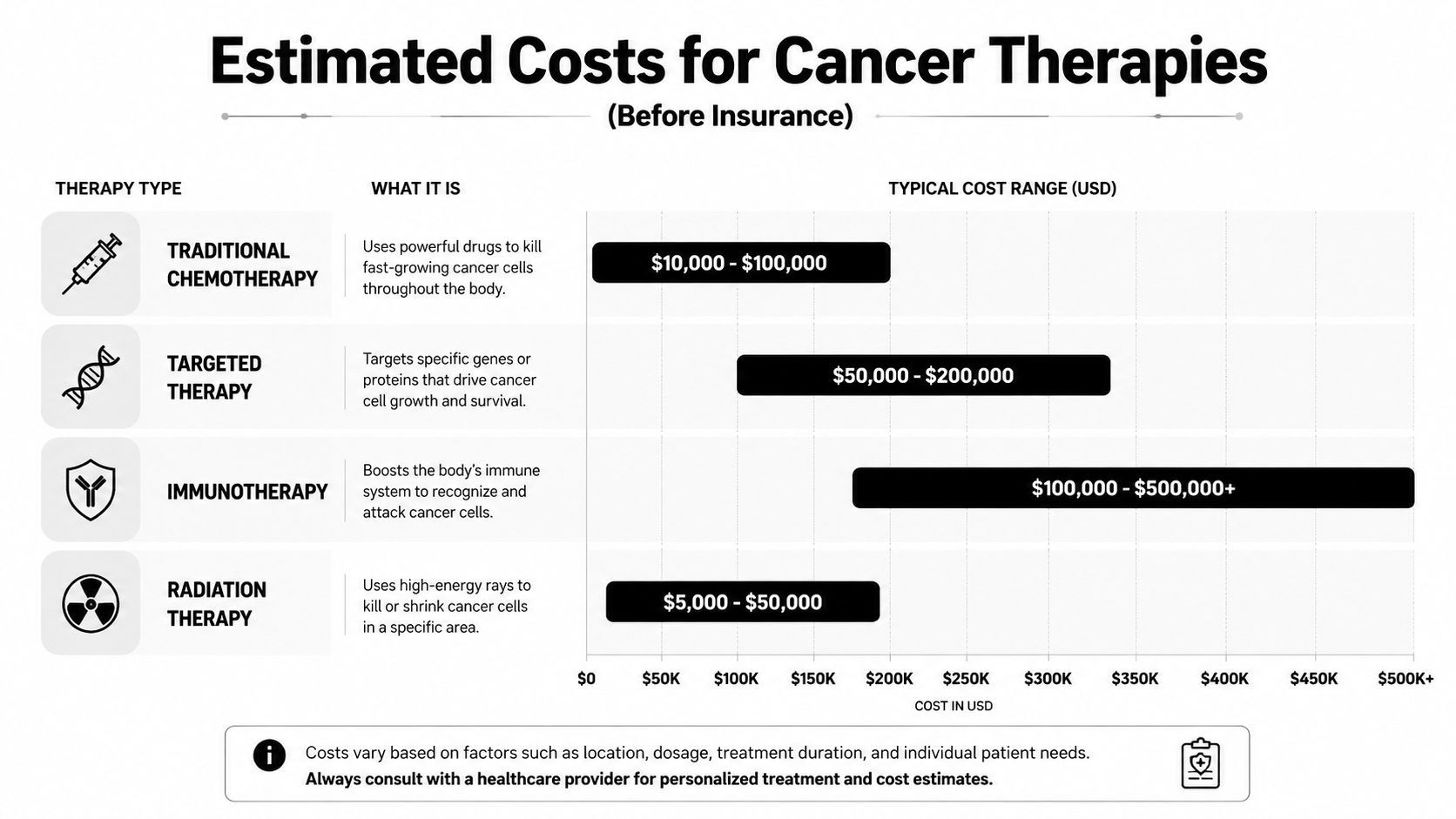
The spread is widest with newer therapies. CAR-T cell courses are priced around $375,000 to $475,000, and checkpoint inhibitor combinations can exceed $150,000 per year. Those numbers help explain why a treatment can be medically promising and still feel out of reach for many families. DelveInsight's market overview reflects that access challenge.
Why infusion and oral drugs can cost so differently
How a drug is given changes the bill. Infusion treatment may bring facility fees, nursing time, and chair time, while oral medicine shifts more of the process to the pharmacy benefit and the patient's home routine. That difference affects the invoice and the daily burden of care.
Good question to ask your team: Is the cost coming from the medicine itself, the delivery setting, or both?
A care team can also shape cost by choosing a setting that fits the regimen. An outpatient infusion center may reduce some overhead compared with a hospital-based unit, and a lower-toxicity plan can sometimes mean fewer add-on medications, fewer urgent visits, and less time away from work or family. In a city like NYC, those details matter because the total cost includes both the clinic charge and the strain of getting through treatment.
The NCI notes that newer cancer drugs can carry very high prices, and that outcome data are often limited when those prices are set. That does not mean higher-priced treatment is always the wrong choice, but it does mean the price tag alone does not tell you how much benefit a patient may receive. NCI's financial toxicity resource explains why cost discussions need to happen early.
In practice, the bill can include the drug itself, infusion center charges, premedication, lab work, and follow-up visits. A treatment plan that fits the patient's disease and the care setting can change those totals in meaningful ways, which is why the setting and the philosophy of care matter as much as the medicine label.
Key Factors That Influence Your Final Cost
Two patients can receive the same diagnosis and still have very different bills. That happens because cancer treatment cost is shaped by the cancer itself, the treatment plan, the setting, and the support services that keep treatment tolerable. The total is personal, not generic.
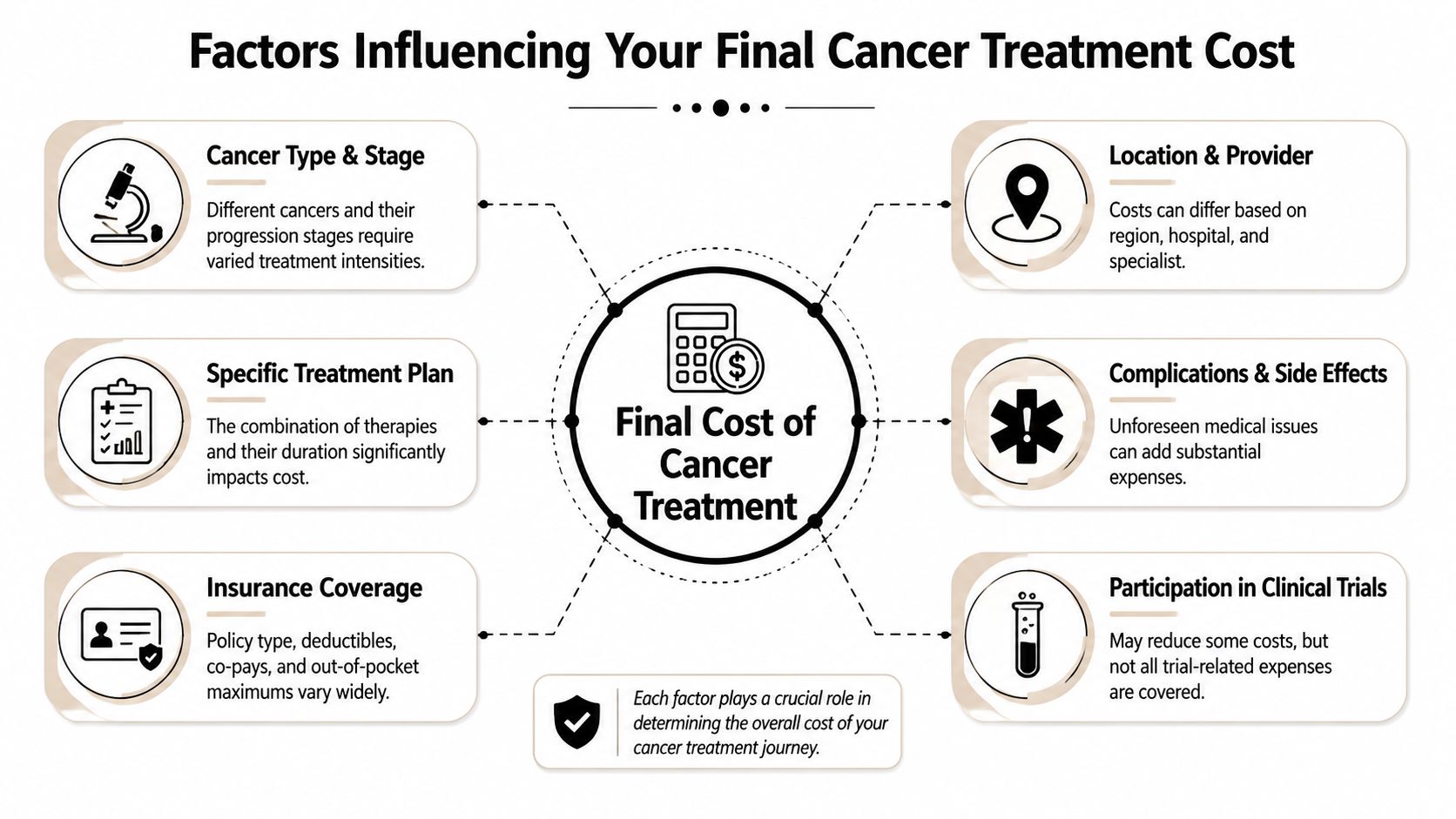
The disease and the plan drive most of the variation
Cancer type and stage shape how intensive treatment needs to be. Some regimens rely on short courses of therapy, while others require ongoing treatment, repeated scans, and careful symptom management. The more complex the disease, the more likely the financial picture will include multiple service lines.
The exact drug combination matters too. One plan may use one infusion agent and routine monitoring, while another may involve several drugs, dose adjustments, and extra supportive medications. Those details change the bill even when the diagnosis sounds similar on paper.
The setting changes both price and daily burden
Where you receive care matters. An academic medical center, a private outpatient clinic, and a hospital-based infusion unit can all produce different cost structures and different out-of-pocket experiences. In a city like NYC, the difference can show up not only in the bill, but in commute time, waiting time, and how disruptive treatment feels to work and family life.
Complications add another layer. Side effects can require extra visits, medications, or urgent care, and those costs often arrive without much warning. Clinical trial participation can also alter what's covered, since some trial-related care may be paid differently than standard treatment.
The core question is not, “What does cancer cost?” The better question is, “What does this specific plan, in this specific place, with this specific support structure, cost me?” That framing helps patients compare options more accurately.
Navigating Insurance and Out-of-Pocket Expenses
Insurance language can feel like a second diagnosis, but the terms are manageable once they're translated into plain English. A premium is what you pay to keep coverage active. A deductible is the amount you pay before the plan starts sharing more of the bill. A copayment is the fixed amount you owe for certain services, and coinsurance is the percentage you pay after the deductible is met.
The most important number is often the out-of-pocket maximum. That's the cap on what you'll pay for covered services in a plan year, though it doesn't usually include every possible expense. If you know those numbers early, you can budget with much less guesswork.
A systematic review found that out-of-pocket spending on cancer care consumed about 16% of annual income for patients in high-income countries, showing that even insured patients can carry a heavy burden. That helps explain why the sticker price and the out-of-pocket cost are not the same thing. The review on cancer-related out-of-pocket spending is useful for understanding that gap.
What to check before treatment starts
- Ask for the benefit category: Find out whether a drug is billed under the medical benefit or the pharmacy benefit, because that changes how cost sharing works.
- Request a written estimate: A treatment estimate won't be perfect, but it can show where the largest charges are likely to appear.
- Compare in-network settings: The same therapy can cost differently depending on whether it happens in a hospital, an outpatient center, or a specialist office.
- Track your yearly total: Once you approach the out-of-pocket maximum, your share of covered costs may drop sharply for the rest of the plan year.
Strategies to Manage Financial Toxicity
A cancer diagnosis can make every cost choice feel heavier. The treatment plan is medical, but the budget side has to be handled at the same time. Waiting for the first large bill usually leaves fewer options and more stress, so it helps to ask about cost early, compare settings, and use every support resource that fits your situation.
Some newer cancer drugs carry very high monthly prices, and the value is not always as clear as the price tag suggests. That does not mean patients should avoid newer therapy. It does mean they should ask whether a lower-cost option, a different schedule, or a less intensive care setting could reach the same medical goal. The NCI's cost and value guidance explains why those conversations matter.
Practical ways to lower the pressure
- Use manufacturer and foundation support: Many drug makers and nonprofit groups offer help with medication copays, coinsurance, and related expenses. A good place to start is Hirschfeld Oncology's financial assistance guide, which shows the kinds of support patients often look for.
- Talk to a hospital navigator: Financial navigators and patient advocates can help interpret bills, find paperwork, and point you toward aid. They can also help you sort out which charges belong to which part of care, so the numbers feel less confusing.
- Ask about clinical trials carefully: Trials can lower some treatment costs, but they do not cover every expense. Ask exactly what the study site pays for, what your insurance still bills, and what costs may remain your responsibility.
- Bring up cost in the exam room: If a plan does not fit your budget, say so directly. Oncologists can sometimes consider similar alternatives with different cost profiles, or adjust the plan in ways that still protect the medical goal.
Cost conversations go better before the medication is ordered than after the first claim is processed.
The most helpful mindset is collaborative. Your oncology team cannot address a cost issue it does not know about, but once it knows, it can often adjust the plan, involve support staff, or point you to the right resource.
Smarter Care in NYC at Hirschfeld Oncology
In a city where every appointment has a commute attached to it, the care setting itself can change the total burden. An outpatient infusion model can reduce some hospital-related friction, and individualized regimens can sometimes ease the side effects that trigger extra medications, urgent visits, or missed work. That matters because the financial cost and the quality-of-life cost often rise together.

For NYC patients, the goal is usually not the cheapest care in isolation. It's the best balance of medical value, tolerability, and practicality. A plan that reduces nausea, fatigue, or clinic time can also reduce the indirect costs that accumulate around treatment.
That's where care coordination matters. When a team helps coordinate labs, infusions, symptom checks, and follow-up, patients are less likely to fall into avoidable emergency care or miss appointments because the plan became too hard to carry out. For families in Brooklyn, Hirschfeld Oncology's Brooklyn cancer center is one local option that brings outpatient treatment and coordination into the same setting.
Hirschfeld Oncology, a Brooklyn practice and infusion center, uses individualized regimens, including immunotherapy, low-dose chemotherapy, and targeted therapy, for patients who need treatment that fits both the disease and the person. That kind of approach can be especially important when standard protocols have already been exhausted or when the patient's priorities include preserving daily function while staying on treatment.
If you're trying to make sense of your own numbers, bring your insurance card, your medication list, and your latest bill to your next oncology visit. Ask what can be treated in an outpatient setting, what support services are available, and whether there's a way to simplify the plan without losing momentum. A clear conversation today can prevent a much harder one later.
If you're in New York City and the cost of cancer care is starting to shape your choices, reach out to Hirschfeld Oncology to ask about outpatient treatment options, individualized regimens, and practical care coordination that can help you plan your next step with more clarity.
.png)
.png)