.png)


You open your patient portal, scan past the usual blood counts and chemistry panel, and then stop at a term you may never have seen before: Chromogranin A. The number is flagged. Maybe it's marked high. Maybe you've already searched it and found words like “tumor marker,” “neuroendocrine,” and “cancer,” which can make a routine afternoon feel very different.
That reaction is normal.
A chromogranin A blood test often creates more confusion than clarity when patients first encounter it. It isn't a standard screening test. It's a specialized lab used in a very specific clinical setting, most often when doctors are evaluating or monitoring neuroendocrine tumors, often called NETs. These are uncommon tumors that arise from neuroendocrine cells, which are cells that help the body release hormones and chemical signals.
If your doctor ordered this test, it usually means they're being thorough, not that they've already reached a conclusion. That distinction matters. So does the fact that CgA can rise for reasons that have nothing to do with cancer, especially common acid reflux medicines and kidney problems. If you've been staring at a result and wondering whether one abnormal number tells the whole story, it doesn't.
For a broader foundation on how tumor markers fit into cancer care, this overview of cancer biomarkers is a useful companion.
Decoding Your Lab Report an Introduction to CgA
A chromogranin A blood test is best understood as a clue, not a verdict. Doctors use it as one piece of information when they suspect a neuroendocrine tumor or when they're following a known diagnosis over time. It can be helpful, but it can also be misleading if it's read in isolation.
Many patients assume that any “tumor marker” works like a yes-or-no cancer test. CgA doesn't work that way. A high level does not automatically mean cancer is present. A normal level does not completely rule it out. That uncertainty is frustrating, especially when you're trying to make sense of a portal result before you've spoken with your doctor.
A CgA result only becomes meaningful when it's interpreted alongside your symptoms, medications, imaging, and the reason the test was ordered in the first place.
The name itself doesn't help. “Chromogranin A” sounds technical because it is. In plain language, it's a protein released by neuroendocrine cells. Since some neuroendocrine tumors come from those cells, doctors sometimes measure this protein in the blood to look for abnormal activity.
A practical way to think about it is this:
- If CgA is ordered during an evaluation, your doctor may be looking for evidence that supports or weakens the suspicion of a neuroendocrine tumor.
- If CgA is ordered after diagnosis, your doctor may be tracking the disease over time rather than trying to diagnose it from scratch.
- If CgA is high unexpectedly, the next question usually isn't “Is this cancer?” It's “What else could be affecting this result?”
That last question is where many patients get tripped up. The number may be real, but the explanation may not be what you fear.
What Chromogranin A Actually Measures
A common point of confusion is the word “tumor marker.” It can sound as if the blood test is measuring a tumor directly, the way a ruler measures length. Chromogranin A, or CgA, does something different. It measures a protein that neuroendocrine cells release into the bloodstream.
Those neuroendocrine cells are specialized cells that make, store, and secrete chemical messengers. CgA is one of the proteins packaged inside those cells. When those cells are active, more of that protein may show up in the blood. That is why doctors use CgA as a biomarker. It gives a clue about neuroendocrine cell activity. It does not identify a tumor by itself, and it does not tell you exactly where a problem is coming from.
A practical comparison helps here. CgA works more like smoke than fire. Smoke can tell you that something is happening somewhere, but it does not tell you what started it, how large it is, or whether the source is dangerous. That distinction matters because patients often see an abnormal result and assume it answers more than it really can.

CgA can be helpful in several neuroendocrine tumor settings, but its performance is uneven. A review in PMC on biomarkers in neuroendocrine tumors found that CgA rises more reliably in some tumor types than others, and that reported sensitivity and specificity vary widely across different neuroendocrine neoplasms. In plain language, the test may be informative in one patient and much less informative in another, even when both have neuroendocrine disease.
That uneven performance is one reason CgA results create so much anxiety. A mildly increased number can look alarming in a patient portal, yet the explanation may be far more ordinary than cancer growth. Acid reflux medicines in the proton pump inhibitor family and reduced kidney function are two of the most common reasons a CgA level appears high even when the result does not reflect tumor behavior. So the lab value is real, but the meaning is often uncertain until a clinician reviews the full picture.
Here is the patient-friendly version of what the test can and cannot do:
| What CgA may reflect | What it cannot tell you on its own |
|---|---|
| Increased activity of neuroendocrine cells | The exact location of a tumor |
| A possible clue that supports other findings | Whether cancer is definitely present |
| A trend that may become useful over time | Which treatment you need |
One more detail matters, especially if CgA is followed over months or years. Different laboratories may use different assay methods, and those methods are not always interchangeable. A result from one lab cannot always be compared cleanly with a result from another. For patients, that means the number matters less than it seems unless you also know how the test was performed, why it was ordered, what medicines you were taking, and whether kidney function could have affected the result.
Preparing for Your CgA Blood Test to Ensure Accuracy
This is the part many patients wish someone had explained before the blood draw. A chromogranin A blood test can look alarming when it's high, but sometimes the result reflects interference, not tumor activity.
The biggest source of confusion is proton pump inhibitor therapy, often shortened to PPI. These are familiar acid reflux medicines such as omeprazole. The single most common cause of falsely high CgA is treatment with PPIs, and renal failure is the second primary factor because reduced kidney function can impair clearance of the protein, as explained by the Neuroendocrine Tumor Research Foundation patient guide.
The medication issue that causes the most false alarms
If you take a reflux medicine and your CgA is high, that doesn't prove cancer is active. It may reflect the medication.
A technical guide for CgA testing states that PPIs should be discontinued for at least two weeks before blood collection to reduce false-positive results, and it also notes that moderate H2-receptor antagonist therapy does not significantly increase CgA. The same guide discusses timing issues with somatostatin analog therapy and notes that grossly hemolyzed samples may be rejected because of test interference, according to this assay instruction document.

A helpful way to prepare is to treat the blood draw like a medication reconciliation visit, not just a lab appointment.
- Bring a complete medication list. Include prescription drugs, over-the-counter heartburn medicines, supplements, and injections.
- Ask specifically about PPIs. Don't stop them on your own, but do ask whether they need to be paused before the test.
- Tell your team about kidney disease. Even mild or moderate kidney problems can complicate interpretation.
- Mention pregnancy or steroid use. Both can add background noise to the result.
- Use the ordering doctor's instructions, not internet advice. The test only helps if it's done in a way your team can interpret.
Later in the same visit, this short explainer may help reinforce the basics:
Questions worth asking before the blood draw
Patients often feel they shouldn't “bother” the clinic with preparation questions. You should ask.
Try these:
- “I take omeprazole. Should I stop it before this test?”
- “My kidney function isn't normal. Will that affect the result?”
- “If this comes back high, how will you know whether it's the medication or the tumor?”
Practical rule: A CgA result is only as reliable as the preparation behind it.
That one conversation can prevent days of avoidable anxiety.
Interpreting Your Chromogranin A Results
Most patients want one thing from a lab test: a clear answer. CgA usually doesn't provide that. What it offers is context, especially when your doctor compares your current level with prior results.
The first thing to know is that the usual upper limit of normal is under 100 ng/mL, and the standard reference range is generally less than 93 ng/mL in one major catalog source. That same source notes that values between 93 and 100 ng/mL can be ambiguous without a meaningful rise from baseline, while levels greater than 300 ng/mL strongly suggest a neuroendocrine tumor, though not by themselves enough to make treatment decisions. Those details come from the Mayo Clinic test catalog entry for CgA monitoring.
A single value is a snapshot
If your result is just above the reference range, your oncologist may not react urgently. That can feel strange if you expected an abnormal test to trigger immediate action. But CgA is often more useful as a trend than as a one-time number.
The same test catalog defines a positive change for tumor progression as a serum CgA increase of more than 50% that also reaches an absolute value greater than 100 ng/mL. It notes that this threshold is associated with actual progression, with an observed sensitivity of 34%, and that the association was statistically significant with p <0.001.

Why trends matter more than isolated readings
Consider how doctors think about other medical tests. One blood pressure reading can be off because you were anxious. One glucose value can shift based on timing. CgA is similar in that your team wants to know whether the marker is consistently moving upward, staying stable, or falling over time.
A simple way to read the report is this:
| Pattern | Usual interpretation |
|---|---|
| Within the lab's reference range | Reassuring, but not a complete rule-out in every case |
| Borderline elevation | Often needs context, repeat testing, medication review |
| Rising over time | More clinically meaningful than one isolated high value |
When a doctor repeats a CgA test instead of acting on the first result, that usually reflects careful interpretation, not delay.
One more subtle point matters here. If your result was done at one lab and the next at another, direct comparison may be unreliable. That becomes especially important once you're in long-term monitoring.
Why CgA Is Not a Standalone Diagnostic Test
A chromogranin A blood test can support a diagnosis, but it can't carry the whole weight of one. That's true even when the number is clearly high.
One reason is performance. CgA works better in some neuroendocrine tumors than in others. For bronchopulmonary neuroendocrine tumors, which arise in the lungs, it performs poorly enough that many patients and even some clinicians overestimate what it can tell them. A 2019 analysis found CgA was clinically uninformative in 67% of BPNET cases, and the same review notes that treatment decisions should not be based solely on CgA changes, reflecting NCCN guidance discussed in this PMC review of circulating biomarkers in lung NETs.
What doctors use alongside CgA
When CgA is part of a cancer workup, it usually sits beside other tools:
- Imaging studies, such as CT or MRI, to look for a mass and define where it is
- Functional imaging, when appropriate, to characterize neuroendocrine disease more specifically
- Biopsy, which remains central when doctors need tissue confirmation
- Other blood or urine markers, depending on symptoms and tumor type
- Clinical history, including medications, kidney function, and symptoms like flushing or diarrhea
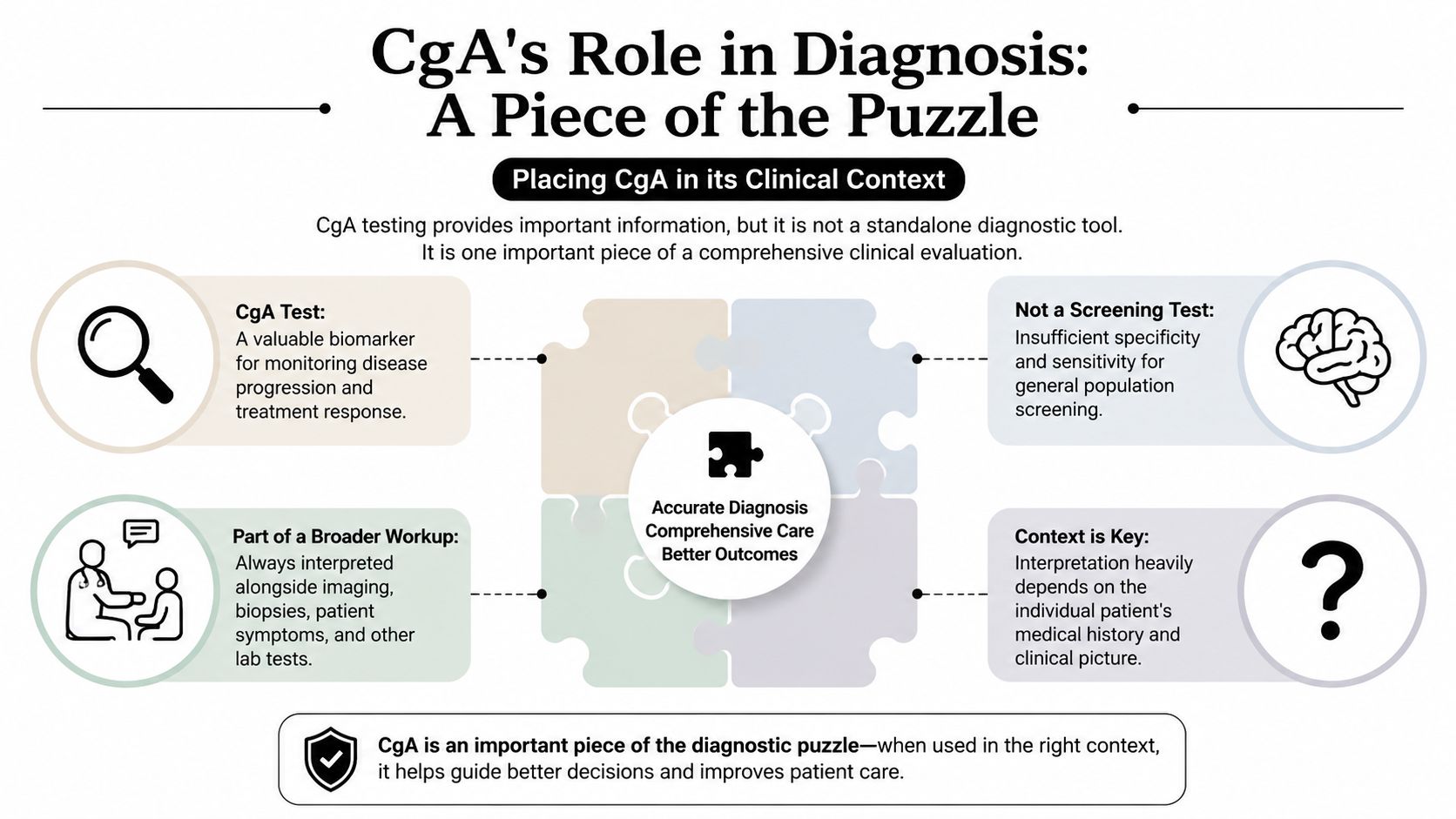
That broad approach is one reason patients shouldn't panic when they see either a normal or abnormal CgA result before speaking with a specialist. Neither result settles the question alone.
Where patients often misread the result
People understandably equate “tumor marker” with “cancer detector.” That shortcut creates problems.
A high CgA doesn't automatically diagnose cancer. A lower CgA doesn't guarantee safety. The test is adjunctive, meaning it assists clinical judgment rather than replacing it. If your symptoms or imaging point in a different direction, your doctor follows the larger pattern, not the lab value by itself.
For readers trying to understand how blood tests fit into gastrointestinal cancer evaluation more broadly, this article on blood testing in stomach cancer workups gives helpful context on the limits of markers in oncology.
The question isn't “What does CgA say?”
The better question is “How does CgA fit with everything else we know about this patient?”
That shift in thinking usually lowers anxiety and leads to better decisions.
Using CgA to Monitor Treatment Response in Oncology
A common moment in clinic goes like this. A patient logs into the portal, sees that the CgA number changed, and assumes the cancer must have changed too. Sometimes that is true. Often, it is not that simple.
After a neuroendocrine tumor has already been diagnosed, CgA can be more helpful because the question has changed. We are no longer asking, “Does this test find the cancer?” We are asking whether the marker is moving in the same direction as the rest of the story, including scans, symptoms, treatment timing, kidney function, and medications.
That is why oncologists usually start with a baseline. A baseline works like the first mark on a ruler. It gives us a reference point taken at the start of treatment, or during a stable stretch, so later results have context.
What oncologists look for over time
One isolated value rarely changes management by itself. Trends matter more.
If CgA stays fairly steady, or falls over time, that can support the impression that treatment is helping, especially when imaging and symptoms are also stable. If it rises repeatedly, your oncologist may look more closely with scans, a review of symptoms, or a discussion about whether treatment is still working as expected.
Even here, false alarms are common. Proton pump inhibitors can push CgA up. Reduced kidney function can do the same. So can other non-cancer influences already discussed earlier in the article. For patients, this is one of the most frustrating parts of the test. The number looks precise, but the meaning is often messy.
The lab method matters too. If your first result comes from one laboratory and the next comes from another, the difference may reflect how the test was performed rather than what the tumor is doing. That is why many oncologists prefer to follow serial CgA levels through the same lab whenever possible, using the same assay over time.
A small personal record can prevent a lot of confusion. Keep these details together:
- The date of each test
- The lab that performed it
- Any acid-reducing medicines, especially PPIs, around the time of the draw
- Any change in kidney function or major illness
That list may seem basic. It helps more than patients expect.
If you want a broader explanation of how repeated testing is used to follow cancer over time, this article on minimal residual disease monitoring in oncology offers useful context.
The best way to use CgA during treatment is to treat it as one clue among several. A changing number can be meaningful. It still needs expert interpretation, especially when the lab trend, the scan, and the way you feel do not line up neatly.
Your Next Steps in New York City
If you've received a new abnormal chromogranin A blood test result, your next move should be a focused conversation, not a rushed conclusion. Ask what medications may have influenced the test, whether kidney function could be affecting it, and whether the result is being used for diagnosis, surveillance, or treatment monitoring.
A specialist opinion is especially helpful in a few situations:
- You have an increased CgA with no clear explanation
- You've been told you may have a neuroendocrine tumor
- Your cancer is advanced, uncommon, or treatment-resistant
- Your current options feel limited or too toxic
- Your lab trend and your scans don't seem to match
In New York City, that often means seeking a team that's comfortable with complex oncology decision-making, not just routine follow-up. Patients with pancreatic, colorectal, gastric, or other advanced cancers often benefit from a second opinion when biomarker interpretation, imaging, and treatment planning don't line up neatly.
Families should trust their instincts here. If the explanation you've received still feels incomplete, or if the result has created more worry than clarity, that's a valid reason to seek another review. Good oncology care isn't just about ordering the right test. It's about helping you understand what the test means, what it doesn't mean, and what should happen next.
If you're in Brooklyn or elsewhere in New York City and need experienced guidance after a confusing lab result or a complex cancer diagnosis, Hirschfeld Oncology offers patient-centered oncology care with a focus on thoughtful interpretation, personalized treatment options, and clear communication for patients and families facing difficult decisions.
.png)
.png)