.png)


When you’re navigating a prostate cancer diagnosis, you'll encounter a lot of information about treatment options. One of the most important—and often misunderstood—of these is a clinical trial.
At their core, clinical trials are simply research studies involving people. They're designed to find new and better ways to prevent, diagnose, or treat prostate cancer. Think of them as the final, critical step before a promising new therapy, like an advanced hormone treatment or a novel immunotherapy, becomes the standard of care for men everywhere.
Why Clinical Trials Are a Critical Treatment Option

The phrase "clinical trial" can sometimes sound intimidating, like you're just a number in a big experiment. The reality is quite different. A trial is a highly regulated, carefully managed part of your potential treatment journey, and it's far from a last resort.
In fact, these studies are the engine that drives all medical progress. Every single treatment we rely on today—from surgery to radiation to chemotherapy—had to first prove its worth in a clinical trial.
Joining a trial gives you a chance to access a promising new therapy that isn't yet widely available. For men whose cancer has progressed or stopped responding to standard treatments, it can open up a whole new set of possibilities. It’s a way to take a proactive role in your own care, guided by rigorous science and a shared goal of finding what works better.
The Four Phases of a Clinical Trial
To really understand what a clinical trial involves, it helps to know how they’re structured. New treatments move from a lab concept to a clinic reality through a series of distinct stages called "phases." Each phase answers a different set of questions, always with patient safety as the number one priority.
It’s a bit like designing a new car.
- Phase 1 is the first safety check. Is this new engine safe to run? A small group of people receives the treatment, allowing researchers to find the safest dose and watch closely for any side effects.
- Phase 2 asks, "Does it work?" Now that we know it's safe, a larger group of patients receives the treatment to see how effective it is against prostate cancer. Safety monitoring continues to be a major focus.
- Phase 3 is the head-to-head comparison. The new treatment is compared against the current standard treatment in a large group, often involving hundreds or even thousands of patients, to confirm its effectiveness and identify any long-term issues.
- Phase 4 happens after a treatment is approved and on the market. These studies keep track of its performance in the real world, gathering more data on long-term benefits and risks across a much wider population.
Each phase methodically builds on the data from the one before it. This step-by-step process is what makes new medical advancements so reliable.
To help you see how this all fits together, here's a quick overview of the four phases.
The Four Phases of a Clinical Trial at a Glance
By the time a treatment gets through this process, it has been thoroughly vetted for both safety and effectiveness.
This system is what allows us to confidently adopt new standards of care. For a deeper dive, you can learn more about what clinical trials for cancer entail in our detailed guide. These studies are absolutely essential, as recent research shows that many men with advanced prostate cancer aren't receiving the latest, life-extending combination therapies that were first proven effective in trials.
The Real-World Impact of Cancer Research

It’s easy to picture cancer research happening in some far-off laboratory, separate from everyday life. But clinical trials are where science meets the patient. They are the essential link between a discovery on a microscope slide and a treatment that can give someone a longer, better life.
Think about it: every single standard treatment we have today, from foundational hormone therapies to newer immunotherapies, started in a clinical trial. They only became available because people like you decided to participate.
The impact isn't just theoretical; it's real and measurable. Studies have shown that joining clinical trials for prostate cancer can lead to significantly better survival rates. For example, one major analysis found that trial participation added an average of 6 months to overall survival for men with metastatic prostate cancer. You can see the full details in this in-depth research analysis.
This is about more than numbers on a page—it's about gaining precious time. By joining a trial, you're not just getting early access to a promising new therapy; you're becoming a partner in the fight to move medicine forward for everyone.
From Study Data to Standard Care
So, how does one person's experience in a trial create such a huge ripple effect? It’s all about the data. Every bit of information collected—how well the treatment works, how side effects are managed, what the long-term outcomes are—helps paint a crystal-clear picture of a new drug's performance.
This meticulous data collection has been the driving force behind some of today’s most important prostate cancer treatments:
- PARP Inhibitors: These targeted drugs are now a go-to for men with specific genetic mutations, but they wouldn't exist as an option without the patients who first tested them in trials.
- Advanced Hormone Therapies: We now rely on powerful drugs like abiraterone and enzalutamide to extend lives, but their effectiveness was first proven through rigorous clinical trials.
This collective knowledge gives doctors the tools to truly personalize care. It allows them to make smarter predictions about which treatments will work best for which patients, leading to better outcomes with fewer side effects.
Every participant in a clinical trial contributes to a body of knowledge that helps doctors make smarter, more informed decisions for future patients. It’s a direct way to help the next person who receives a similar diagnosis.
The Human Side of Medical Progress
At the end of the day, the impact of cancer research is deeply personal. It's about giving a father more time with his kids, a husband more years with his wife, and a grandfather the chance to watch his grandkids grow up.
Each person who enrolls in a trial plays a vital role in that story. You can read more about the importance of clinical trials in advancing cancer treatment on our blog. Without the courage and commitment of volunteers, the powerful treatments we have today would still be just ideas.
Participating is a profound act that turns personal hope into shared progress, shaping the future of prostate cancer care for generations to come.
How Global Data Is Reshaping Cancer Trials
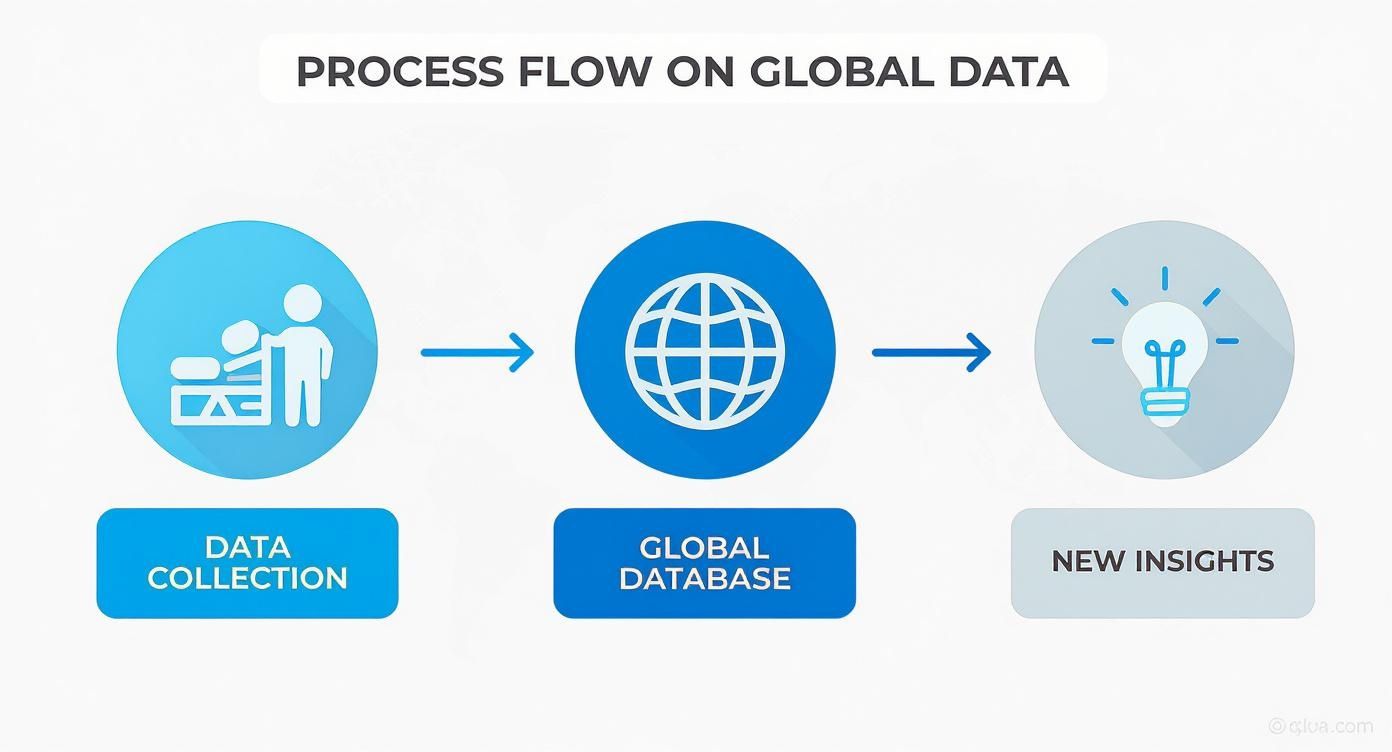
The fight against prostate cancer isn't happening in isolation anymore. Gone are the days when a single lab or a local clinic held all the pieces. Today, it’s a global, data-driven effort where shared knowledge has become our most powerful weapon, completely changing how we design clinical trials and accelerating progress for patients everywhere.
Think of it this way: a clinical trial at one hospital is like studying a single piece of a massive jigsaw puzzle. It’s valuable, sure, but it only gives you a tiny glimpse of the whole picture. When researchers combine data from thousands of patients across dozens of countries, they can finally assemble the entire puzzle, revealing patterns and insights that were completely invisible before.
This modern approach hinges on what we call real-world evidence (RWE). Instead of only looking at data from the sterile, controlled environment of a traditional trial, RWE pulls in information from everyday clinical care. It shows us how treatments actually perform in the real world, with diverse patients who have other health conditions, giving us a much clearer picture of a drug's true effectiveness and safety.
The Power of Big Data in Urology
This collaborative model is already paying off in big ways. Major international projects are building huge, shared databases that pool anonymized patient information from all over the world. A fantastic example is a European project called PIONEER+, which is setting a new standard by combining massive datasets to study how metastatic prostate cancer is treated. By digging into this real-world information, researchers can pinpoint which treatments work best for different patients in different healthcare systems. You can read more about how this real-world data is being used on uroweb.org.
This mountain of data helps us answer critical questions that smaller studies just can't tackle. For instance, researchers can now:
- Figure out the best treatment sequences: They can see the most effective order to give different therapies to help patients live longer.
- Spot rare side effects: With a much larger pool of patients, subtle or uncommon side effects are easier to find and understand.
- Move toward personalized care: The data can reveal how specific genetic markers or patient traits affect a treatment's success, which is the cornerstone of precision medicine.
By seeing how therapies work on a global scale, we learn faster and make smarter decisions that ultimately help everyone.
This kind of global teamwork means a breakthrough in one country can quickly help patients in another. It tears down geographical barriers, speeding up drug approvals and helping us write more effective clinical guidelines for doctors all over the world.
What This Means for Patients
So, what does all this mean for you? This data-driven shift in clinical trials for prostate cancer has real, tangible benefits. The insights we gain from these massive analyses help us design better trials—the very ones you might consider joining. They make sure studies are built to answer the most important questions, making them far more likely to lead to real advancements.
On top of that, this global effort gives us a much more complete picture of prostate cancer itself. By studying the disease across diverse ethnic and genetic backgrounds, we get a richer, more accurate understanding of how it works. That knowledge is absolutely critical for developing treatments that work for all men, not just a small, select group.
Ultimately, this collaborative approach turns every individual patient's experience into a powerful, collective force for change. Each person's journey adds to a global library of knowledge, fueling the development of next-generation therapies and bringing us closer to a future where prostate cancer is a manageable disease. It's an interconnected effort that ensures our path forward is built on the strongest evidence possible.
Finding the Right Clinical Trial for You
Knowing that clinical trials are a powerful option is one thing; finding the right one that fits your diagnosis and personal goals is the next crucial step. The process can feel a bit like searching for a needle in a haystack, but with the right tools and a clear strategy, you can navigate the search with confidence.
Your journey really begins with a frank conversation with your oncologist. They understand the nuances of your medical history, your prostate cancer's specific characteristics, and your overall health. This makes them your single most important guide in this process.
Where to Start Your Search
While your doctor is your primary resource, several trusted online databases can help you explore potential clinical trials for prostate cancer. Think of these platforms as central hubs that pull together information from research institutions all over the world.
One of the most comprehensive and widely used resources is ClinicalTrials.gov, a database managed by the U.S. National Library of Medicine. It's a massive repository, listing studies from over 220 countries.
Don't let the sheer volume of information intimidate you. The key is to use the search filters effectively to narrow thousands of studies down to a manageable list. You can typically refine your results by:
- Condition: Start simple with "prostate cancer."
- Location: Find trials near you to keep travel and logistics manageable.
- Recruitment Status: Always select "recruiting" to see studies that are currently open to new patients.
- Phase: Filter by Phase 1, 2, or 3, depending on your situation and what you and your doctor have discussed.
Other excellent places to look include the National Cancer Institute (NCI) and patient advocacy groups like the Prostate Cancer Foundation. These organizations often feature curated lists of prominent trials worth exploring.
Key Questions to Ask the Research Team
Once you and your oncologist pinpoint a promising trial, the next step is to connect with the research team to get more details. It’s best to treat this as an interview—you're assessing whether the study is truly the right fit for you.
Before diving into a list of questions, it's helpful to remember why this conversation is so important. Your participation directly fuels medical progress, so you need to feel completely comfortable and informed before committing.
The table below outlines the essential questions you should have ready for your discussion with the study coordinator or principal investigator.
Asking these questions empowers you to make a fully informed decision. Remember, informed consent isn't just a signature on a form; it's an ongoing conversation to ensure you are clear and comfortable with every aspect of your participation.
Your doctor will also carefully review the study's specific eligibility criteria. These details are vital and may include factors like how far your cancer has spread. To better understand how doctors determine this, you can learn more from our guide to the bone scan for prostate cancer. Taking this proactive approach ensures you find a trial that is not just scientifically sound, but also practically and personally right for you.
Navigating Enrollment Costs and Safety Protocols
Once you and your doctor zero in on a clinical trial that looks like a good fit, the conversation naturally shifts to the practical stuff. For most people, two big questions pop up right away: "How much will this cost?" and "How do I know it's safe?" Let's break those down, because getting clear answers is crucial before you move forward.
It all starts with something called informed consent. This is much more than just signing a form. Think of it as an open, ongoing conversation with the research team where they walk you through everything—the study's goals, exactly what you'll be doing, the potential upsides, and the known risks.
This is your time to get all your questions out on the table. Seriously, there's no such thing as a silly question here. The whole point is to build a partnership based on trust, making sure you feel completely in the loop every step of the way.
Clarifying the Financial Picture
There’s a common myth that clinical trials will leave you with a mountain of medical bills. The reality is usually quite different. The finances are actually pretty well defined, so you shouldn't be hit with surprise costs. It just comes down to knowing who covers what.
Here’s a simple way to think about it:
- Research Costs: Anything that’s part of the experiment itself is typically paid for by the trial sponsor (like a pharmaceutical company). This covers the new drug or therapy being tested, plus any extra scans, lab work, or appointments that are only required for the study.
- Standard Care Costs: These are the regular costs of your prostate cancer care that you’d have whether you were in the trial or not. Things like routine check-ups, standard medications, or treatments for side effects are usually billed to your health insurance, just like normal.
Good news: The Affordable Care Act (ACA) requires most private insurance plans to cover these routine patient costs. Still, it’s always smart to have a chat with the trial’s financial coordinator and your insurance company ahead of time to make sure everyone is on the same page.
Your Safety Is the Top Priority
Let me be crystal clear: in any clinical trial for prostate cancer, your safety and well-being are paramount. This isn't just a nice sentiment; it's a system of strict rules and independent oversight designed to protect every single person who participates.
Every study has to be approved and watched over by an Institutional Review Board (IRB). This is an independent committee of doctors, scientists, and even people from the community whose main job is to make sure the trial is ethical and that your rights are protected from start to finish.
Every clinical trial in the United States is also overseen by the Food and Drug Administration (FDA). This federal oversight ensures that all research follows strict national standards designed to maximize patient safety and data integrity.
While you're in the trial, the research team will monitor you very closely. This means frequent check-ins and tests, which allows them to catch and manage any side effects right away.
And remember, this is your choice. You can decide to leave a trial at any time, for any reason, without having to explain yourself. Doing so won't change your relationship with your doctor or impact the quality of your future care. You are always in the driver's seat.
Taking Your Next Steps with Confidence
https://www.youtube.com/embed/hyaUvUIYyww
Thinking about a prostate cancer clinical trial can feel like a huge step, but you don't have to figure it all out on your own. The best way forward is to be methodical, gather your information, and lean on your support system. Your first move should always be a candid conversation with your oncologist.
This is your chance to talk through your goals, your worries, and all your questions. Go in prepared. Jot down a list of what's most important to you, using what you've learned about trial phases, potential upsides, and what to ask the research team. This simple act of preparation turns a complex process into a clear, actionable plan.
Partnering for Clarity and Access
Let's be honest, the world of cancer research can be a maze. Having specialized support can make all the difference, and that's where a partner like Hirschfeld Oncology comes in. We offer expert consultations to help figure out if a clinical trial is a good fit for your specific diagnosis and treatment history.
Think of us as your advocate and navigator. We're here to help you by:
- Evaluating Your Situation: We'll do a deep dive into your medical records and treatment history to see if you might be a match for any ongoing studies.
- Connecting You to Resources: If there's a promising trial out there for you, we can help identify the leading research institutions running it and help you make a connection.
- Providing Expert Guidance: We’ll break down the complicated trial details, helping you weigh the potential risks and benefits as they relate to your own health goals.
Exploring a clinical trial is about opening new doors, not closing old ones. An expert second opinion can bring peace of mind, validate your current treatment, or introduce you to possibilities you never knew existed.
Empowering Your Decision
Our entire goal is to pull back the curtain on this process and give you the knowledge you need to make a decision that you feel good about. Whether you're just looking for a second opinion or actively searching for a trial, having an experienced team in your corner helps you move forward with confidence.
At Hirschfeld Oncology, we are dedicated to providing that support. We’ll help you find the right information and connect you with leading research opportunities, making the journey into prostate cancer clinical trials feel less overwhelming and more hopeful.
Common Questions About Prostate Cancer Trials
When you start looking into clinical trials for prostate cancer, it’s completely normal to have a long list of questions. Getting clear, honest answers is the only way to make a decision that you and your family can feel confident about. Let's walk through some of the most common concerns we hear from patients.
Will I Get a Placebo Instead of Real Treatment?
This is often the first question on everyone's mind, and it's a critical one. The short answer is: it's extremely unlikely.
In today's cancer research, particularly for a serious illness like prostate cancer, it's considered unethical to give a patient a placebo alone if a proven, effective treatment already exists.
Instead, clinical trials almost always compare the new, investigational treatment against the current standard of care. This means that at a minimum, you’re guaranteed to receive the best treatment that is already approved and available. The new drug might be tested against the standard care, or sometimes it's added to it. In that "add-on" scenario, one group gets the standard treatment plus the new drug, while the control group gets the standard treatment plus a placebo. This helps researchers see exactly what effect the new drug has. The study team will always explain the specifics to you upfront.
What If I Change My Mind?
This is another big one. What happens if you join a trial and decide it's not for you? You can relax on this point.
Your participation is 100% voluntary, from start to finish. You have the absolute right to leave a trial at any time, for any reason—no questions asked. It won’t impact your future care or your relationship with your doctor in any way. If you do decide to withdraw, your medical team will simply help you transition smoothly to the best alternative treatment available.
How Do I Know If I Am Eligible?
It's natural to wonder how you actually get into a study. Every clinical trial has a very specific set of rules called eligibility criteria that act as a blueprint for who can participate.
These criteria aren't there to be difficult; they’re designed to keep participants safe and ensure the study's results are scientifically sound. They usually look at factors like:
- The stage and specific type of your prostate cancer
- What previous treatments you've had
- Your overall health status and any other medical conditions
- In some cases, specific genetic markers found in your tumor
Your oncologist is your best resource for figuring out if a trial might be a good fit. If a study looks promising, the research team will then guide you through a detailed screening process. This usually involves a few exams, blood work, and scans to officially confirm that you meet all the requirements before you join.
Navigating these questions is much easier when you have an expert in your corner. At Hirschfeld Oncology, we offer one-on-one consultations to help you make sense of your options and decide if a clinical trial is the right path for you. To explore emerging therapies and chart your course, visit us at https://honcology.com/blog.
.png)
.png)