


.png)


The call often comes after a blur of appointments, scans, and half-understood terms. You hear “high grade serous carcinoma,” and suddenly your mind jumps in ten directions at once. Is this ovarian cancer? Where did it start? Why are they talking about genetics? What happens next?
If that's where you are right now, take one step back. You do not need to understand everything in one day. You need a clear explanation of what this diagnosis means, why your doctors are recommending certain tests and treatments, and which questions will matter most as you make decisions with your family and care team.
Your First Step After a HGSC Diagnosis
A diagnosis of high grade serous carcinoma, often shortened to HGSC, can feel like the floor has shifted. Many patients tell me the same thing: they remember one or two words from the appointment, then almost nothing after that. That's a normal response to a life-changing conversation.
One reason this cancer gets so much attention in gynecologic oncology is that it's the dominant form of serious ovarian cancer. HGSC accounts for about 75% of all epithelial ovarian cancer cases and nearly three-quarters of epithelial ovarian cancer deaths globally, according to this review of high-grade serous carcinoma research. The same source notes a stark survival difference based on when it's found: the five-year relative survival rate is 92% when the cancer is localized to the ovaries or fallopian tubes, compared with 32% when it has metastasized.
Those numbers are sobering, but they also explain something important. HGSC is a major focus of research because doctors and scientists know it causes so much of the burden of ovarian cancer. That intense focus has led to better surgery strategies, better understanding of where the disease starts, and more personalized use of targeted therapy.
What to do in the first few days
The first step isn't to become an expert overnight. It's to slow the process enough that you can make good decisions.
- Ask for copies of your records. Get the pathology report, imaging reports, operative notes if surgery has happened, and any blood test results.
- Write down your questions. People often forget what they wanted to ask once they're in the room.
- Bring another person to appointments. A family member or close friend can listen, take notes, and help you remember details later.
- Pay attention to your stress response. Sleep disruption, racing thoughts, and physical tension can make decision-making harder. Some people benefit from practical support like stress management for women's health while they're going through diagnosis and treatment planning.
Practical rule: If you leave an appointment confused, that doesn't mean you failed to understand. It means your team needs to explain it more clearly.
The mindset that helps most
Try to separate two things that often get mixed together: the seriousness of the diagnosis, and the usefulness of next steps. HGSC is aggressive. Both statements can be true at once. But it's also a cancer where treatment choices often depend on details that can be measured and acted on, including stage, pathology, and genetic findings.
That's why the early phase matters so much. The goal isn't just to “start treatment.” The goal is to understand your version of this disease well enough to choose the right sequence of care.
What Is High Grade Serous Carcinoma
The name sounds technical, but each word tells you something useful.
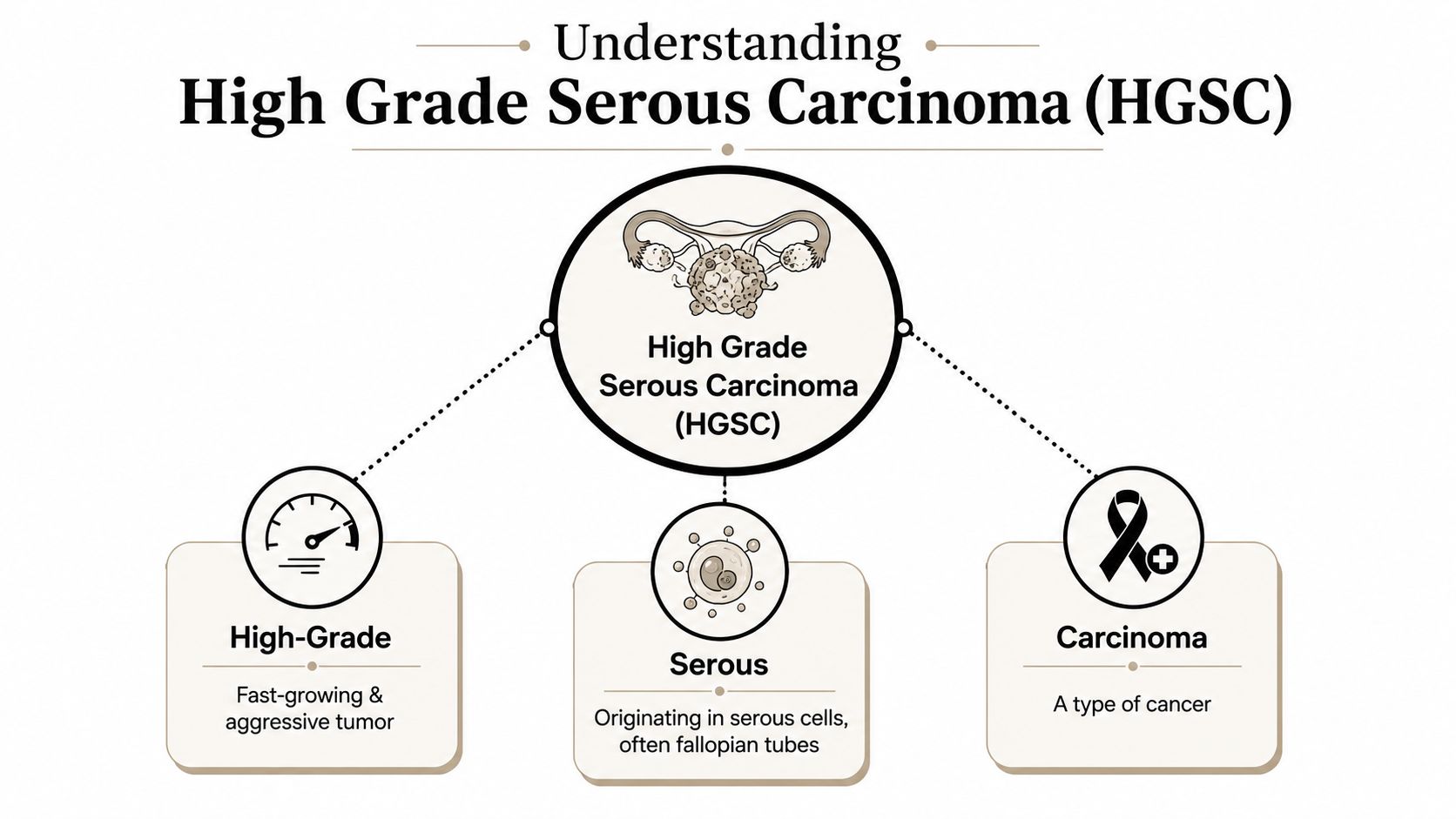
High grade means the cancer cells look very abnormal under the microscope and tend to grow and spread more aggressively than low-grade forms.
Serous refers to the type of epithelial tissue involved. In this disease, that tissue is now understood to be closely linked to the fallopian tube lining.
Carcinoma means a cancer that arises from epithelial cells, which are cells that line surfaces and structures in the body.
The defining genetic feature
What really sets HGSC apart is not just how it looks. It's the biology inside the tumor cells.
HGSC is defined by near-universal, greater than 96%, somatic or germline TP53 mutation, which disrupts the G1/S cell cycle checkpoint and leads to major genomic instability, as described in this pathology and molecular review of HGSC. That same review explains that this TP53 abnormality is the sine qua non of HGSC, meaning it is the signature feature that defines the disease.
If that sounds abstract, think of TP53 as part of a cell's emergency braking system. Healthy cells accumulate damage over time. Before they divide, they're supposed to pause, assess that damage, and either repair it or stop growing. When TP53 is broken, that brake no longer works properly. The damaged cell keeps moving forward.
Why that matters for treatment
This broken repair control creates chaos inside the cancer cell. The tumor becomes genetically unstable. That instability helps the cancer behave aggressively, but it also creates vulnerabilities.
In plain language, some HGSC cells survive by leaning heavily on backup DNA repair pathways. That's one reason platinum-based chemotherapy and PARP inhibitors can be effective in the right setting. They exploit weaknesses in how these cancer cells handle DNA damage.
Here's the key point many patients miss: your doctors aren't ordering genetic and molecular tests out of curiosity. They're trying to find out which repair systems your cancer still depends on.
For a broader overview of ovarian cancer types and where HGSC fits, this ovarian cancer guide from Hirschfeld Oncology can help place the diagnosis in context.
A useful way to think about HGSC
A lot of people hear “ovarian cancer” and assume all ovarian cancers behave the same way. They don't.
HGSC is its own disease category in a practical sense because:
- It has a common molecular signature. TP53 mutation is a defining hallmark.
- It tends to grow fast. That affects urgency, treatment planning, and recurrence risk.
- It often responds to specific drug classes. Platinum agents and PARP inhibitors make sense because of the tumor's DNA repair weaknesses.
The diagnosis is not just a label from the microscope. It's a map of how the cancer behaves and which treatments may work best.
Understanding Its Origin and Symptoms
One of the most upsetting parts of this diagnosis is how often patients say, “I knew something felt off, but nothing pointed clearly to cancer.” That experience makes more sense once you understand where HGSC usually begins.
Today, the leading view is that HGSC originates predominantly from the distal fallopian tube epithelium, with precursor lesions known as serous tubal intraepithelial carcinoma, or STIC, according to this ASCO educational review on high-grade serous ovarian cancer. That review also notes that HGSC recurs in the majority of patients within three years and has a median overall survival of about 40 months.

Why the fallopian tube origin matters
For years, many people thought these cancers started mainly on the surface of the ovary. We now understand that many begin earlier in the fallopian tube, especially near the fimbrial end. That change in understanding has been a major shift in gynecologic oncology.
It also helps explain why symptoms may be subtle at first. A lesion in the fallopian tube can be microscopic. It can spread before it creates a large, obvious mass that would clearly announce itself.
If you want a plain-language look at how tube-based cancers are understood clinically, this fallopian tube cancer explainer is a helpful companion read.
Why symptoms are easy to dismiss
Early symptoms often overlap with everyday digestive or pelvic complaints. Patients commonly describe:
- Bloating or abdominal fullness
- Pelvic pressure or discomfort
- Feeling full quickly when eating
- Changes in bowel or bladder habits
- A sense that something is persistently “off”
None of these symptoms automatically means HGSC. That's exactly the challenge. The symptoms are real, but they're not specific.
A person may think it's stress, menopause, constipation, weight fluctuation, or a benign gynecologic issue. A primary care doctor may initially think the same. That doesn't mean anyone missed something obvious. It means the disease often develops in a way that hides in plain sight.
The emotional side of vague symptoms
Many families replay the timeline and ask whether the diagnosis should have come earlier. Usually, there isn't one single symptom that would have clearly identified HGSC right away. Instead, there's a pattern that becomes clearer only in hindsight.
If your symptoms seemed vague, that fits the biology of this disease. It is not proof that you ignored something obvious.
One more point matters here. The fact that HGSC often starts in the tube and spreads early is one reason maintenance therapy becomes such an important discussion after initial treatment. The issue isn't just shrinking visible disease. It's trying to keep microscopic disease from regaining momentum.
Your Diagnostic and Staging Journey
Once HGSC is suspected, the next challenge is figuring out exactly what is present, where it is, and how to confirm it. This part can feel mechanical, but every step answers a different clinical question.
What each test is trying to tell your team
Imaging often comes first. A CT scan can show masses, fluid, or signs that cancer has spread within the abdomen or beyond it. In some cases, doctors also use PET imaging or other scans when they need a better sense of active disease.
A CA-125 blood test may be part of the picture. This test can be useful for tracking disease activity, but it has limits. A high result does not prove HGSC, and a normal result doesn't rule it out. It's a marker that must be interpreted alongside imaging, symptoms, and pathology.
The part that gives the final answer is tissue. That may come from a biopsy, a laparoscopy, or surgery. Pathologists examine the cells under the microscope and use tools such as immunohistochemistry to identify the tumor type. That's how the diagnosis becomes definite.
Why stage matters so much
Staging describes where the cancer is located, not how hard a person has fought, and not whether treatment can still help. Patients often hear “advanced stage” and feel as though the entire rest of the conversation has already been decided. It hasn't.
A simple way to think about stage is this:
| Stage | What it generally means |
|---|---|
| Stage I | Cancer appears limited to the ovaries or fallopian tubes |
| Stage II | Cancer involves pelvic structures beyond the original site |
| Stage III | Cancer has spread within the abdomen outside the pelvis and often to lining surfaces |
| Stage IV | Cancer has spread to more distant sites outside the abdomen or to fluid around the lungs |
The exact staging details can get technical, and your doctor may use very specific terms. But the practical point is straightforward. Stage helps the team decide how to sequence surgery, chemotherapy, maintenance treatment, and whether other approaches should be discussed.
Questions worth asking at this point
Appointments are more productive when you know what decisions are on the table. Consider asking:
- Do I have confirmed HGSC on pathology? Ask what findings support that diagnosis.
- What stage do you believe this is right now? If the stage could still change after surgery, ask what might alter it.
- Will I have surgery first, or chemotherapy first? The order depends on how extensive the disease appears and whether surgery is likely to remove enough tumor safely.
- What genetic testing do you recommend? This becomes important for treatment selection, especially maintenance therapy.
Bring one written page to every visit. Put the top three questions at the top. If you only get through those, the appointment was still a success.
The part that often confuses families
People sometimes think scans and blood tests should be enough. In most cases, they aren't. Imaging can strongly suggest cancer, and CA-125 can support suspicion, but pathology is what confirms the diagnosis.
That distinction matters because treatment decisions for HGSC are increasingly tied not just to “cancer yes or no,” but to the exact type of cancer and the biology inside it.
Standard and Emerging Treatment Strategies
Most HGSC treatment plans are built in layers. The first layer is aimed at controlling visible disease. The next layer tries to suppress microscopic disease that may still be present after the initial response.
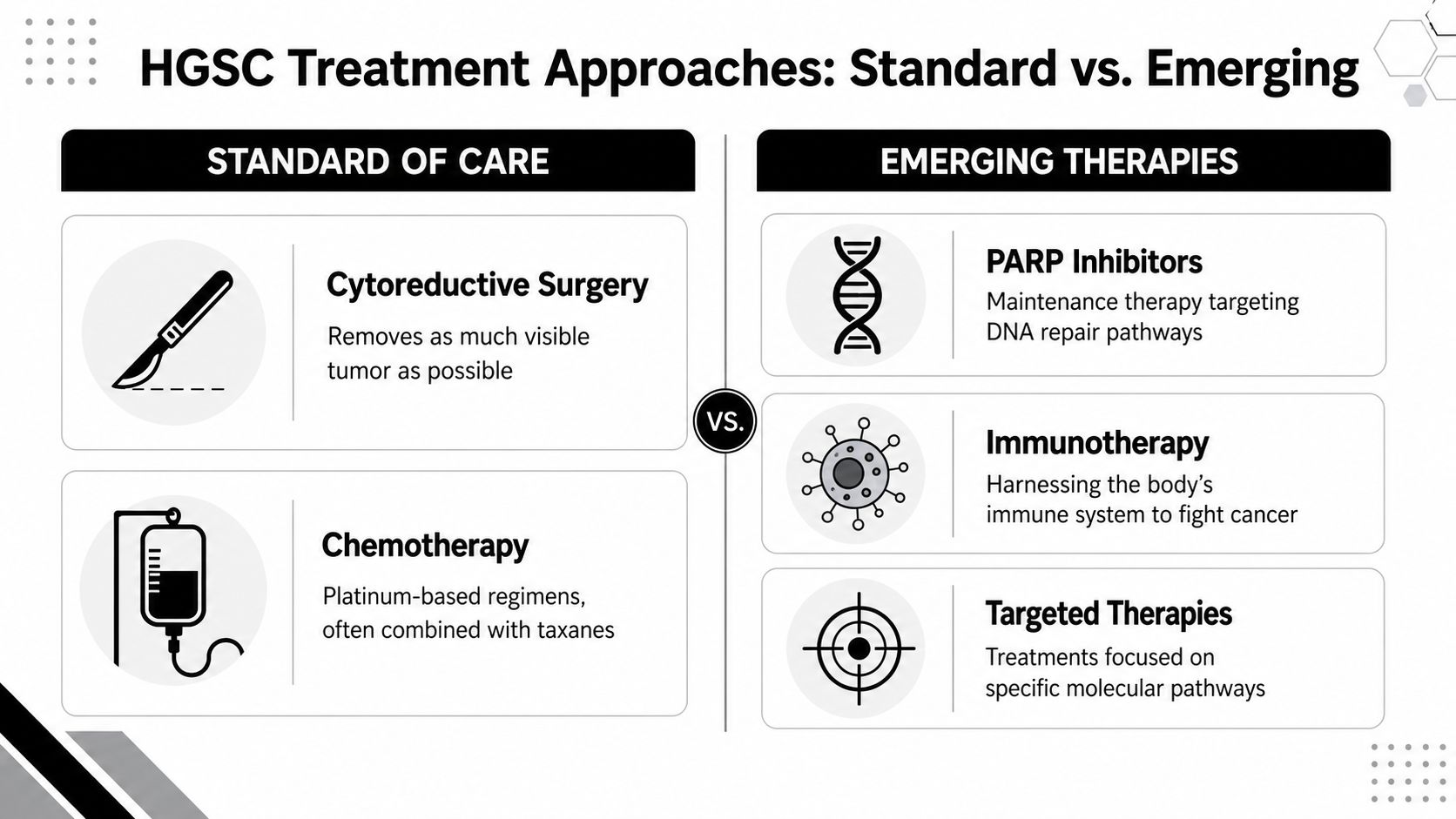
A common foundation includes cytoreductive surgery, often called debulking surgery, plus platinum-based chemotherapy. The reason for that combination is simple. Surgery removes as much visible tumor as possible, and chemotherapy treats cancer cells that remain.
Standard treatment and why it works
Surgery matters because HGSC often spreads across surfaces in the abdomen. A skilled gynecologic oncology team aims to remove as much visible disease as is safely possible. The amount of tumor left behind can affect what happens next.
Chemotherapy usually includes a platinum agent such as carboplatin, often paired with a taxane such as paclitaxel. HGSC is often initially responsive to platinum treatment because of its DNA repair weaknesses.
But initial response doesn't always mean durable control. Between 20% and 30% of patients relapse within six months of standard platinum-based chemotherapy, and patients with BRCA1/2 mutations show the highest responsiveness to PARP inhibitors, according to this review of treatment response and recurrence in HGSC. The same source notes that PARP inhibitors received FDA approval for first-line maintenance for a subset of advanced ovarian cancer patients and significantly improve progression-free survival for that group.
Why genetic testing changes the conversation
Many patients hear terms like BRCA, homologous recombination deficiency, or HRD and wonder whether these are side issues. They aren't.
Think of DNA repair as a toolkit. If a tumor already has important tools missing, a drug that blocks one of the remaining repair pathways can leave the cancer cell unable to cope with damage. That is the logic behind PARP inhibitors.
Patients with BRCA1/2 mutations often benefit the most because those tumors already have a serious defect in one major DNA repair process. When PARP is blocked, the cancer cell may have too few repair options left.
A side-by-side way to think about options
- Surgery aims to reduce visible tumor burden.
- Platinum chemotherapy attacks rapidly dividing cells and exploits DNA repair weakness.
- PARP inhibitor maintenance tries to keep residual cancer cells from recovering after an initial response.
- Immunotherapy and other targeted therapies may be considered in selected cases, depending on the tumor biology, prior treatment, and trial availability.
Here's a brief visual overview before we go further:
Questions to discuss with your oncologist
These discussions are often more useful than asking, “What's the best treatment?” A better question is, “What makes one option fit my cancer better than another?”
Consider asking:
- Am I a candidate for surgery first, or is chemotherapy first more realistic?
- Has my tumor been tested for BRCA1/2 and related repair pathway features?
- Would maintenance therapy make sense after my initial treatment response?
- If my response is partial, how does that change the plan?
- Should I consider a clinical trial now, or keep one in reserve for recurrence?
The right treatment plan is rarely the most aggressive plan on paper. It's the one that matches the tumor biology, disease extent, and what your body can tolerate.
What about newer or more aggressive approaches
Some patients, especially those with advanced disease, ask about options beyond the standard sequence. That can include discussion of HIPEC, additional targeted strategies, or clinical trials.
The key is to ask not only whether a treatment exists, but why your team does or does not think it fits your specific case. A useful oncology visit should leave you understanding the reasoning, not just the recommendation.
Navigating Advanced and Recurrent HGSC
Recurrence is one of the hardest parts of high grade serous carcinoma. Many patients do everything right. They complete surgery. They respond to chemotherapy. They may even start maintenance therapy. Then the cancer returns. It's natural to ask whether treatment failed.
That question needs a more careful answer. Sometimes recurrence happens not because the original treatment was wrong, but because the biology of HGSC is more complex than “kill the tumor cells and you're done.”

Why recurrence may happen even after a good initial response
A growing area of research looks beyond the cancer cells themselves and studies the tumor microenvironment. This includes the nearby supportive tissue, signaling systems, and non-cancer cells that can help cancer return.
Recent research highlighted by the National Cancer Institute describes a major challenge in recurrent HGSC. Standard protocols do not target high-risk mesenchymal stem cells within the tumor microenvironment, and these cells may help initiate tumor growth by damaging healthy cells. That work points to the future need for therapies that target the “soil” as well as the cancer “seed,” as explained in this National Cancer Institute discussion of high-risk MSCs in the STIC pathway.
That idea offers significant reassurance, even though it's scientifically unsettling. If cancer comes back, it doesn't always mean the visible tumor was the whole story.
A different way to frame the next decision
When HGSC recurs, the goal is no longer just to repeat what worked before. The better question is: what is driving this version of the disease now?
That may lead to discussion of:
- Platinum sensitivity versus resistance
- Whether a PARP inhibitor still has a role
- Clinical trials aimed at resistant disease
- Individualized dosing approaches when toxicity matters
- Symptom-focused treatment that preserves daily function
For patients trying to understand what “platinum-resistant” really means in practical terms, this guide to platinum-resistant ovarian cancer can make those conversations easier to follow.
Hope that is practical, not vague
Patients with recurrent disease don't need false reassurance. They need a plan that still has purpose.
That plan may include another line of systemic therapy. It may involve a trial. It may focus heavily on symptom control while still treating active disease. It may also include rebuilding strength after surgery, chemotherapy, or prolonged fatigue. Supportive rehabilitation can matter more than many people realize, and resources focused on reclaiming strength post-ovarian cancer can help patients think about recovery as part of treatment, not something separate from it.
Recurrence changes the strategy. It doesn't erase the value of treatment, and it doesn't remove the possibility of meaningful options.
Questions worth asking in recurrent disease
- What do you think is driving my recurrence biologically?
- Am I still likely to benefit from platinum-based treatment?
- What trial options fit my prior treatments and current condition?
- How are you balancing cancer control with side effects and quality of life?
These are complex questions. You don't need a medical degree to ask them. You only need a team willing to answer clearly.
Finding Your Expert Care Team in New York and Beyond
The quality of your care team matters in every cancer diagnosis. In high grade serous carcinoma, it matters even more because treatment decisions are rarely one-size-fits-all. The best plan often depends on pathology, stage, surgical judgment, genetic results, prior response, and your own goals.
Who should be at the center of your care
For most patients, a gynecologic oncologist should play a central role, especially in diagnosis, staging, and surgery decisions. Medical oncologists also become essential, particularly when chemotherapy, maintenance therapy, recurrent disease treatment, or clinical trials enter the picture.
A strong team usually includes more than one specialist. It may involve:
- A gynecologic oncologist for staging and surgical planning
- A medical oncologist for systemic treatment strategy
- A genetics professional to discuss inherited risk and test interpretation
- Nursing and infusion staff who know how to manage side effects early
- Palliative care or symptom management clinicians who focus on comfort, function, and daily quality of life
Palliative care deserves special mention. Many people hear that term and think it means giving up. It doesn't. In cancer care, it often means better symptom control, clearer communication, and stronger support while active treatment continues.
What to look for when choosing where to go
Not every cancer center approaches recurrent or complex HGSC in the same way. When you're comparing practices or hospitals, ask practical questions:
| What to ask | Why it matters |
|---|---|
| How often do you treat HGSC? | Experience helps with nuance, not just standard protocols |
| Do you review pathology and genetics in treatment planning? | Personalized decisions depend on both |
| What happens if the first plan stops working? | You want to hear a thoughtful roadmap, not only first-line treatment |
| Can you help with symptom control and day-to-day side effects? | Treatment is easier to continue when problems are addressed early |
| Do you discuss clinical trials or less toxic alternatives when appropriate? | Advanced disease often requires creative, evidence-aware thinking |
Second opinions are not disloyal
Families sometimes worry that asking for another opinion will offend the first doctor. It shouldn't. High-stakes decisions deserve confirmation, especially if surgery sequencing, maintenance treatment, or recurrent disease options are uncertain.
A good second opinion can do one of two useful things. It can confirm that your current plan is sound, which brings peace of mind. Or it can open a door to an option that wasn't discussed the first time.
Keep quality of life on the agenda
There's a common mistake in cancer care. Everyone focuses so hard on the scan and the next drug that no one asks whether the patient can sleep, eat, walk comfortably, think clearly, or get through the week without feeling overwhelmed.
Those issues are not secondary. They affect whether treatment is tolerable and whether life still feels livable during treatment. The best teams take them seriously from the beginning.
If you're in New York and looking for an outpatient setting that treats complex cancers with personalized planning, thoughtful infusion support, and attention to both efficacy and tolerability, it helps to seek a consultation with a practice that regularly works with advanced-stage and treatment-resistant disease.
If you or a loved one is facing high grade serous carcinoma and want help thinking through treatment options, recurrence, symptom management, or next-step questions, Hirschfeld Oncology offers educational resources and consultation pathways designed for patients navigating complex cancer care decisions.
.png)
.png)






