.png)


TL;DR: A full CT scan appointment often takes 60 to 90 minutes in real life, even though the actual scan itself is often under 5 minutes. The standard scan process is usually 15 to 30 minutes total, and contrast dye can add 10 to 15 minutes for IV administration and monitoring.
If you're reading this right after hearing that your oncologist wants a CT scan, you're probably not wondering about the engineering of the machine. You're wondering how to fit this into an already packed week, whether you'll miss your ride, whether you'll be wiped out afterward, and whether this is going to turn into an all-day ordeal.
Those are sensible questions.
For people living with cancer in New York City, scan timing isn't a minor detail. It affects work, childcare, infusion schedules, appetite, fatigue, and how much energy you have left by the afternoon. A CT scan is usually one of the faster imaging tests we use, but the difference between scan time and appointment time is what catches many patients off guard.
The Moment You Hear "We Need a Scan"
A common scene in oncology goes like this. The visit is moving along, you're following the discussion as best you can, and then the plan changes slightly. Your doctor says, "We need a CT scan."
That sentence tends to crowd out everything that came before it.
Most patients immediately jump to practical questions. How long is a CT scan. Do I need contrast. Can I eat. Can I go to treatment afterward. Can I take the subway home if I'm already tired. If you've just started care, the uncertainty can feel bigger than the scan itself.

I usually tell patients that CT is one of the most manageable parts of cancer imaging. It's quick, it's structured, and once you know the steps, the day feels far less mysterious. The emotional stress often comes less from the machine and more from the waiting, the commuting, and trying to coordinate one more appointment in the middle of treatment.
A CT appointment is usually easier when you know what part takes minutes, what part takes longer, and where delays usually happen.
That matters even more in Brooklyn and the rest of NYC, where one medical errand can easily stretch because of traffic, elevators, parking, or a late train. If this is your first oncology workup, it may also help to review what to expect at your first oncology appointment so the scan fits into the larger picture of your care.
The good news is that this is a solvable problem. The process is predictable enough that you can plan your day around it without guessing.
Scan Time vs Total Appointment Time
The simplest answer is this. The scanner time is short. The appointment time is longer.
Baking a cake involves mixing, measuring, and setting up the pan, which takes time, even though the actual baking may be the shortest part. CT works the same way. Positioning, check-in, changing, contrast, and brief monitoring often take longer than the pictures themselves.
According to Craft Body Scan's summary of CT timing, a standard CT scan typically lasts 15 to 30 minutes total, including preparation and imaging, while the scan itself is often under 5 minutes. That same source notes that head or brain CTs take 5 to 15 minutes, chest CTs 5 to 20 minutes, abdominal or pelvic CTs 10 to 30 minutes, and full-body scans 30 to 45 minutes. It also notes that IV contrast can add 10 to 15 minutes, and that results are often available in 24 to 48 hours.
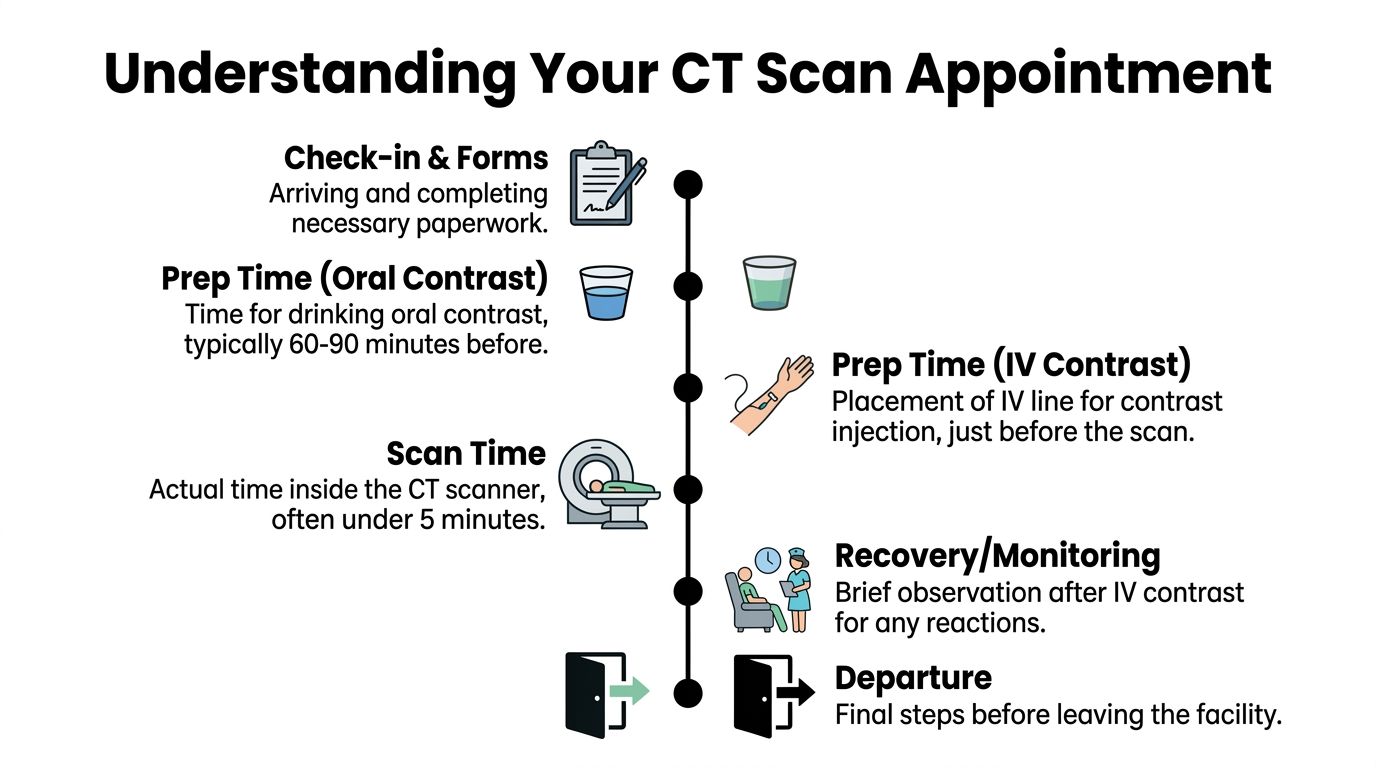
What happens before the scan
Before you ever lie on the table, several things may need to happen.
- Check-in: Front desk staff confirm your appointment, identity, and paperwork.
- Changing clothes: You may be asked to switch into a gown and remove metal items.
- IV setup: If contrast is needed, a technologist or nurse places an IV.
- Positioning: The team has to line you up carefully so the images answer the clinical question.
If you arrive weak, in pain, nauseated, or dehydrated, positioning may take longer. That isn't a problem. It just means the team needs to slow down and make you safe and comfortable.
What the actual scan feels like
Once you're on the table, the scan often moves quickly. The machine is open and short, not like the longer tunnel many patients picture from MRI. Patients often find this part surprisingly brief.
You may hear instructions such as holding still or holding your breath for a few seconds. Those instructions matter. Good images save you from repeat scans.
Practical rule: Plan for the whole appointment, not the time inside the machine.
Why your real-world day may take longer
In oncology, I usually advise patients to reserve a wider block of time than the technical scan duration suggests. That's not because the imaging itself is slow. It's because real life in the city isn't friction-free.
A realistic timeline often includes:
| Part of visit | What it involves |
|---|---|
| Arrival | Finding the suite, checking in, paperwork |
| Prep | Changing, medication review, IV placement if needed |
| Imaging | The actual CT pictures |
| Short follow-up | Monitoring after IV contrast, getting discharge instructions |
| Departure | Elevator waits, pharmacy stops, ride pickup, or transit |
This is why patients sometimes say, "The scan took five minutes, but I was there much longer." Both statements can be true.
What doesn't work is scheduling a CT in a tight slot between major commitments and assuming you'll be out immediately. What works is treating it like a half-day medical task, especially if contrast is involved or if you're trying to pair it with another appointment.
Key Factors That Change Your CT Scan Duration
Not every CT is built the same way. When patients compare notes, one person may say, "I was in and out," while another says, "I was there much longer." Usually, both are right.
The difference comes from what the scan is trying to show.

IV contrast changes the workflow
IV contrast acts like a visual highlighter. It helps the radiologist see blood vessels and certain tissues more clearly, which can matter when we're tracking tumors, inflammation, or spread of disease.
The extra time isn't just the injection. Staff may need to confirm your history, place the IV, administer the contrast safely, and briefly observe you afterward. If your veins are difficult because of treatment, dehydration, or prior frequent access, this part can become the longest segment of the visit.
For some oncology patients, a port may also be part of the conversation. In some centers, port access is straightforward. In others, the imaging site may prefer a peripheral IV. That's worth clarifying before scan day so you don't arrive with one plan and hear another at check-in.
Oral contrast is slower for a simple reason
When the digestive tract needs to be outlined more clearly, oral contrast may be used. The time issue here isn't complexity. It's waiting.
You have to drink it, and then it needs time to move where it needs to go. That's why some abdominal scans feel less like a quick test and more like a staged appointment.
What doesn't work is arriving rushed and assuming every abdominal study runs like a chest CT. What works is asking the scheduler, "Will I need oral contrast, IV contrast, both, or neither?"
Body area matters
A scan focused on one region is different from a broader survey. A chest CT is often more straightforward than a study that includes the abdomen and pelvis, especially when contrast timing matters.
Patients don't need to memorize the technical details. They do need to know that "CT scan" is a category, not one identical experience every time.
Your physical condition matters too
A person who can lie flat comfortably and hold still usually moves through the process faster. A person with pain, shortness of breath, nausea, or severe fatigue may need more setup time.
That is normal in oncology care. The solution isn't to push through without speaking up. Tell the technologist what usually causes trouble.
- If lying flat hurts: Ask for support under the knees or head.
- If you get warm or flushed with contrast: Mention any prior reaction or concern before the scan starts.
- If you tire easily: Ask what the sequence will be so you can pace yourself.
- If you have a port or difficult veins: Bring it up early, not after several IV attempts.
Patients often feel calmer after seeing the equipment and hearing the steps in plain language. This short overview can help:
If the schedule seems longer than expected, it usually means the team is trying to get the best images safely, not that something has gone wrong.
A Practical Checklist For Your Scan Day
Preparation lowers stress better than reassurance alone. On scan day, the patients who feel most steady are usually the ones who know what to bring, what to ask, and what to leave out of the morning.
The day before
Write down the basics in one place. Appointment time, address, suite number, whether contrast is planned, whether you need to avoid food beforehand, and how you're getting there.
A few practical moves help:
- Confirm instructions: If the office gave you prep directions, read them the day before, not while you're putting on shoes.
- Hydrate unless told otherwise: Being reasonably hydrated can make IV placement easier.
- Choose simple clothing: Wear clothes that are easy to change out of and easy to put back on when you're tired.
- Pack lightly but deliberately: Bring ID, insurance information, your medication list, and something quiet to do while waiting.
If nausea, constipation, or fatigue has been rough that week, tell the imaging center ahead of time. They may not change the medical order, but they can often help with timing and comfort.
The morning of
Don't improvise. Follow the instructions you were given for eating and drinking. If anything is unclear, call before leaving home.
This short list helps many patients:
- Leave jewelry at home if possible.
- Bring a sweater or light layer because imaging areas can feel cool.
- Arrive early enough to breathe, not rushing in from the train platform.
- Take your usual support items if they're allowed, such as glasses, a cane, or a small snack for afterward.
At the imaging center
Speak up early. A CT appointment goes more smoothly when the technologist knows what tends to be difficult for you.
Questions worth asking include:
- Will I need IV contrast today
- Will there be any waiting time after the scan
- Can I eat right after
- How will results get back to my oncology team
Bring the question that's really bothering you. For many patients, it isn't "How does CT work?" It's "Will I still have enough energy to get home?"
If you tend to minimize symptoms, this is the wrong day to do it. Mention dizziness, trouble lying flat, prior contrast issues, or severe scan anxiety before the process begins.
Specific Advice for Oncology Patients in NYC
Cancer care in New York City is its own logistical discipline. The scan may be brief, but the day around it often isn't.
Schedule around your energy, not just the calendar
If you receive infusion therapy, don't assume the "efficient" plan is to stack everything into one packed day. Sometimes it is. Often it isn't.
Many patients do better when the scan happens on a non-infusion day, especially if treatment leaves them drained, nauseated, or less able to tolerate delays. The right question isn't just, "When is the next opening?" It's, "When will I physically handle this best?"
That same thinking applies to travel. A short subway ride can feel long after treatment. A car service may be worth arranging if you already know stairs, transfers, or heat will push you too far that day.
Build in New York friction
People often plan the medical part and forget the city part.
Leave room for the elevator that stops on every floor. Leave room for the traffic bottleneck near the bridge. Leave room for the clinic building that has a sign outside but a different suite number inside. This isn't pessimism. It's practical planning.
A few city-specific habits help:
- Use a calendar block, not a single appointment time: Protect travel and recovery time too.
- Keep one contact person updated: If a spouse, adult child, or friend is helping, text them when you're checked in.
- Avoid back-to-back commitments: Don't schedule something important immediately after the scan unless you can easily cancel it.
- Ask where results will land: Portal, oncology office, or both.
Communication support matters
In a busy city, language barriers can magnify scan-day stress. If English isn't your first language, or if a family member usually interprets but can't attend, ask what interpretation support is available. Resources such as Video Remote Interpreting in Healthcare are useful for understanding how remote language access works in medical settings and what to request in advance.
For patients who want their cancer care close to home, this Brooklyn cancer center overview gives a sense of how outpatient oncology care can be coordinated locally rather than pieced together across the city.
One practical option in Brooklyn is Hirschfeld Oncology, which provides oncology care and an infusion setting for patients who need close coordination between treatment discussions, symptom management, and follow-up planning. For many patients, that kind of coordination reduces the number of separate calls and moving parts around scan week.
In oncology, convenience isn't superficial. Fewer transfers, fewer separate sites, and fewer scheduling handoffs can conserve real energy.
What Happens After Your CT Scan
Most patients can leave soon after the scan is complete, unless the team wants brief observation because contrast was used or there was a specific concern during the visit.
If you received contrast, you'll usually be told to drink fluids afterward unless you've been given different instructions for another medical reason. The point is simple. Help your body clear it and get back to your normal routine.
When results come back
The images don't interpret themselves on the spot. A radiologist reviews them, creates a report, and sends that report to the clinician who ordered the scan.
For many patients, the next stressful part is the waiting. If you want a grounded explanation of what CT imaging can and can't show, this article on whether a CT scan can detect cancer is a useful companion.
How to think about the result
A report is not the same thing as a treatment decision. In oncology, a scan matters because of the context around it. Symptoms, labs, prior scans, current treatment, and your goals all matter.
That's why I always encourage patients not to read one phrase in the portal and assume they understand the whole picture. The right next step is a conversation with the oncology team that knows your case.
If you don't hear anything when expected, call. Calm follow-up is part of good care.
Frequently Asked Questions About CT Scans
Is the radiation dangerous
CT uses radiation, and that's a reasonable thing to ask about. The average exposure is 2 to 10 mSv, compared with about 3 mSv of annual background radiation, as described in the earlier cited Craft Body Scan summary. In oncology, the question isn't whether radiation exists. It does. The question is whether the scan gives information important enough to guide treatment, and often it does.
What if I'm claustrophobic
CT is usually easier than MRI for claustrophobic patients because the machine is more open and the scan is fast. Tell the staff before the scan starts if enclosed spaces make you anxious.
Simple things help. Ask them to explain the sequence before you lie down. Keep your eyes closed if that makes it easier. Focus on the fact that the picture-taking portion is brief.
What if my IV is hard to place
This comes up often in cancer care. Chemo, dehydration, and repeated blood draws can all make access tougher.
Don't wait until the second or third attempt to mention your history. Tell the technologist which arm has worked best in the past, whether a port has been used before, and whether you tend to get lightheaded.
Should I keep copies of reports and scan dates
Yes, especially if multiple doctors are involved or a family member helps coordinate appointments. A simple system for medications, appointments, reports, and questions can lower confusion over time. Caregivers may find this guide on organizing medical records for caregivers helpful for building a practical routine.
If you need help making sense of scan timing, results, or how imaging fits into a broader cancer treatment plan, visit Hirschfeld Oncology for patient-focused guidance and next-step information.
.png)
.png)