


.png)


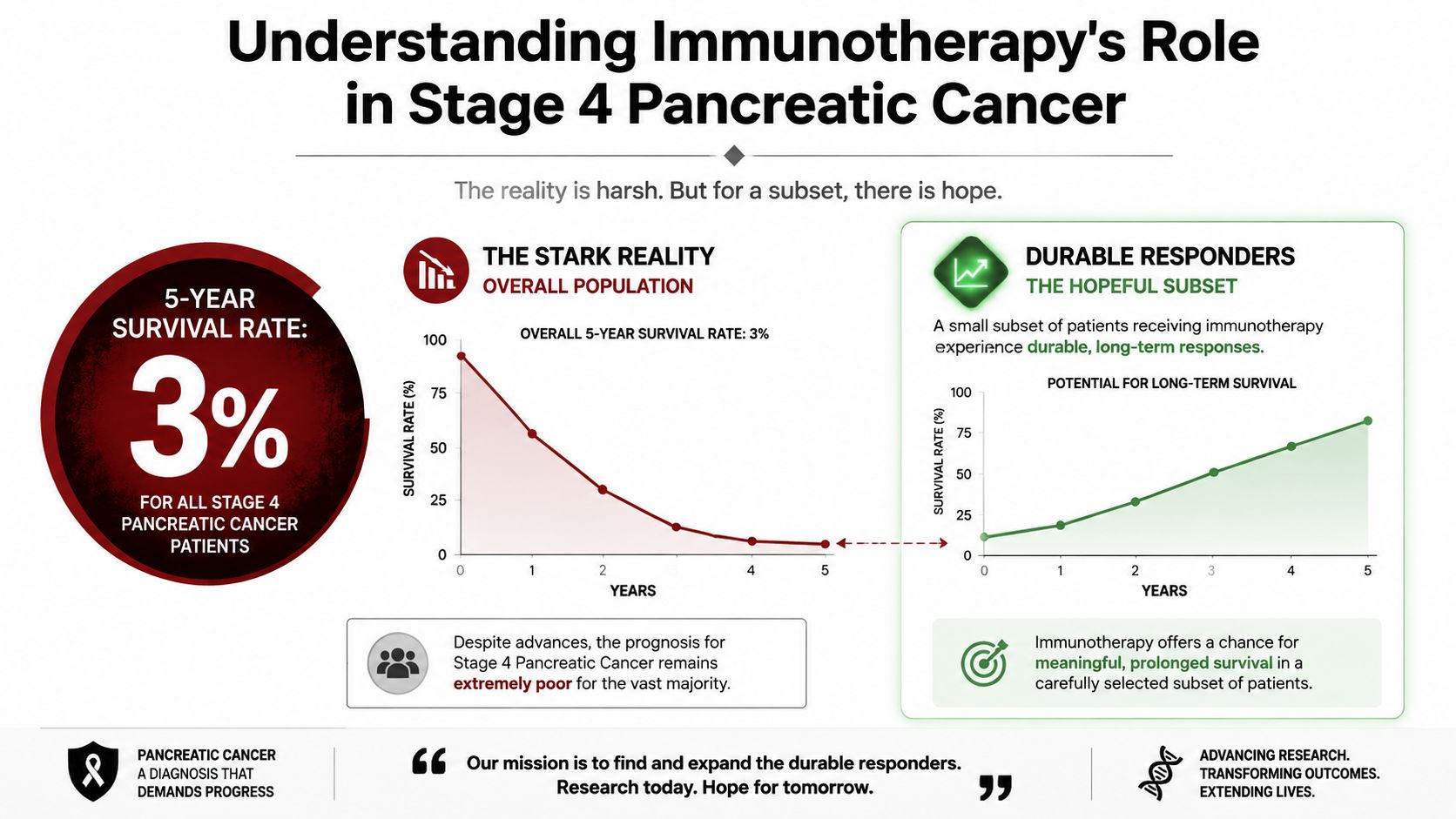
A striking reality frames every discussion of immunotherapy for stage 4 pancreatic cancer: in one real-world analysis, only 827 patients who received passive or active immunotherapy were compared with 188,290 patients receiving standard care. The immunotherapy group had a 1-year overall survival of 42.3%, compared with 17.2% for standard care, but that result doesn't mean immunotherapy works broadly for metastatic pancreatic cancer. The treated patients were a selected group, and the apparent benefit likely reflects both treatment selection and tumor biology. MedPage Today's report on the National Cancer Database analysis
For families, the most important question isn't, “Does immunotherapy work?” It's, “Does this tumor have the biology that gives immunotherapy a reasonable chance to work?” The answer depends heavily on biomarker testing, especially for MSI-H, meaning microsatellite instability-high, and dMMR, meaning deficient mismatch repair. These features occur in only a small minority of pancreatic cancers, so testing can separate an evidence-based opportunity from an unlikely treatment.
Understanding Immunotherapy's Role in Stage 4 Pancreatic Cancer
Stage 4 pancreatic cancer is metastatic disease, meaning cancer has spread beyond the pancreas. Treatment usually focuses on controlling cancer throughout the body, easing symptoms, preserving daily function, and extending life. Immunotherapy has changed care for some cancers, but pancreatic ductal adenocarcinoma remains one of the more difficult cancers for immune treatments because its surrounding environment often suppresses immune activity.
Why most pancreatic tumors resist checkpoint therapy
Doctors often describe tumors as “hot” or “cold.” A hot tumor contains immune cells that have recognized cancer and are attempting to attack it. A checkpoint inhibitor may help by releasing inhibitory signals that keep those immune cells from working effectively.
A cold tumor presents a different problem. It may contain fewer active immune cells, create an immunosuppressive environment, and form a dense tissue structure that makes immune access more difficult. Pancreatic adenocarcinoma is typically considered immunologically cold, which helps explain why PD-1 and PD-L1 inhibitors have shown little benefit in patients whose tumors lack the right biomarkers. A review of immunotherapy in pancreatic cancer
For the small MSI-H or dMMR subgroup, the situation can be different. In May 2017, pembrolizumab, sold as Keytruda, became the first immunotherapy approved for advanced pancreatic cancer with these tumor features. The FDA later expanded the tissue-agnostic indication in March 2023 to include unresectable or metastatic MSI-H/dMMR solid tumors, which matters because pancreatic cancer qualifies through its molecular characteristics rather than through a pancreas-specific approval. Lustgarten Foundation's overview of pancreatic cancer immunotherapy
The practical message: Immunotherapy isn't a general replacement for chemotherapy in stage 4 pancreatic cancer. It's an established option for a narrow, test-defined group and a research strategy for many others.
The eligible subgroup is estimated at about 0.8% to 1.3% of pancreatic cancer cases, and another estimate describes roughly 1 in 50 advanced pancreatic cancer patients as having the relevant biology. Lustgarten Foundation That small proportion creates both urgency and confusion. A positive result can open a treatment with meaningful potential, including durable control in some patients. A negative result doesn't mean treatment has stopped. It means the oncology team should prioritize chemotherapy, targeted treatment when appropriate, supportive care, or a clinical trial rather than using checkpoint therapy empirically.
Patients and families looking for a broader explanation of immune treatment across metastatic cancers can also review this guide to immunotherapy for stage 4 cancer. The central distinction remains the same: proven use, biomarker-selected use, and experimental use are not interchangeable.
Types of Immunotherapy Used in Pancreatic Cancer Treatment
Immunotherapy isn't one drug or one procedure. It's a group of approaches that try to help the immune system identify cancer, remove barriers to immune attack, or deliver specially prepared immune cells to malignant tissue.
Checkpoint inhibitors
Checkpoint inhibitors work like releasing a brake. Some cancer cells exploit immune checkpoint signals to reduce T-cell activity. Pembrolizumab blocks PD-1 signaling and can restore immune activity when the tumor has characteristics that make it visible to the immune system.
For advanced pancreatic cancer, pembrolizumab has the clearest established role when testing identifies MSI-H or dMMR disease. The treatment isn't routinely effective in unselected pancreatic cancer, so a patient generally shouldn't receive it because the cancer is advanced or because immunotherapy has worked well in another cancer type.
Nivolumab and other checkpoint drugs may appear in research protocols or combination trials, but that doesn't make them standard treatment for ordinary microsatellite-stable pancreatic ductal adenocarcinoma. The treatment decision must follow the tumor's molecular findings and the patient's overall condition.
Cancer vaccines
Cancer vaccines are designed as training tools. Instead of broadly stimulating immunity, they aim to teach immune cells to recognize tumor-associated or tumor-specific markers.
Researchers have studied approaches such as GVAX and newer vaccine platforms, including mRNA-based strategies. These treatments remain investigational for pancreatic cancer. A vaccine may be offered through a clinical trial, sometimes with chemotherapy, radiation, or another immune treatment, but patients should ask whether the treatment is approved, trial-only, or being used under a special access pathway.
The National Cancer Institute's report on neoantigen vaccines describes the direction of this research, where a vaccine is designed around mutations found in an individual patient's tumor. That personalized approach is promising, but early signals and research activity aren't the same as established benefit for routine care.
Cellular therapies
Cellular therapy uses the patient's immune cells as the starting material. Doctors may collect T cells, expand them in a laboratory, or genetically engineer them before returning them to the patient.
CAR-T therapy equips T cells with a receptor intended to help them recognize a cancer target. Tumor-infiltrating lymphocyte therapy, or TIL therapy, expands immune cells that have already entered a tumor. Both approaches face special challenges in pancreatic cancer, including finding a reliable target and helping engineered or expanded cells reach and persist within the tumor environment.
| Approach | Current position in pancreatic cancer | What patients should understand |
|---|---|---|
| Checkpoint inhibitors | Established only for selected biomarker-positive disease | Pembrolizumab is the key evidence-based example for MSI-H/dMMR tumors |
| Cancer vaccines | Investigational | Usually requires enrollment in a clinical trial |
| CAR-T or TIL therapy | Investigational | Availability depends on a specific study, target, prior treatment, and health status |
These distinctions matter when evaluating online treatment claims. A clinic or study may use the word “immunotherapy” for an approved medicine, a clinical trial, or an unproven commercial intervention. Patients who need help understanding treatment choices and potential legal questions related to treatment complications can consult information on medical malpractice and pancreatic cancer from Porter Law Group.
This video provides a visual introduction to immune-based cancer treatment concepts:
Biomarker Testing and Patient Eligibility Criteria
Biomarker testing determines whether immunotherapy is a realistic option for a person with stage 4 pancreatic cancer. The first question is whether the tumor is MSI-H or dMMR, because either finding can identify a cancer more likely to respond to pembrolizumab. This testing separates the small group with a potential checkpoint-inhibitor option from the larger group that needs another treatment strategy.
Testing generally starts with tumor tissue from a biopsy or surgery. A pathology or molecular laboratory can examine the sample for mismatch repair proteins and microsatellite instability. A blood-based liquid biopsy may also analyze circulating tumor DNA, but its usefulness depends on how much tumor DNA reaches the bloodstream and what the specific assay can detect.
The core eligibility findings
MSI-H and dMMR describe related, though different, laboratory findings. MSI testing looks for instability in repetitive DNA sequences. dMMR testing looks for the loss of proteins that repair DNA. Either result may support consideration of checkpoint inhibition, yet the oncology team must interpret it alongside the tumor type, previous treatments, and applicable treatment criteria.
The positive finding is uncommon, roughly one patient in a hundred in pancreatic cancer. That low detection rate makes a negative result expected for many patients, while testing still matters because an actionable result cannot be identified without looking for it. Estimates and patient education materials describe the subgroup as rare. Lustgarten Foundation PubMed review of biomarker strategies
TMB provides another piece of information. Tumor mutational burden, or TMB, estimates the number of mutations in a tumor. Pembrolizumab has a tissue-agnostic approval for solid tumors with TMB at or above 10 mutations per megabase. Pancreatic cancer reviews discuss TMB as a possible way to identify a small subset of refractory or recurrent tumors that may benefit from checkpoint blockade. Oncotarget review of TMB and pancreatic cancer TMB does not guarantee a response and should not be read separately from the rest of the report.
A practical testing checklist
Ask the oncology team whether the treatment record includes:
- MSI testing: Confirm whether the tumor is MSI-H or microsatellite stable.
- Mismatch repair testing: Ask whether the report shows deficient or proficient MMR.
- TMB assessment: Find the result and the laboratory's interpretation.
- Broad genomic profiling: Look for potentially actionable alterations and clinical trial matches.
- Inherited-risk evaluation: Discuss germline testing when family history or clinical features make it appropriate.
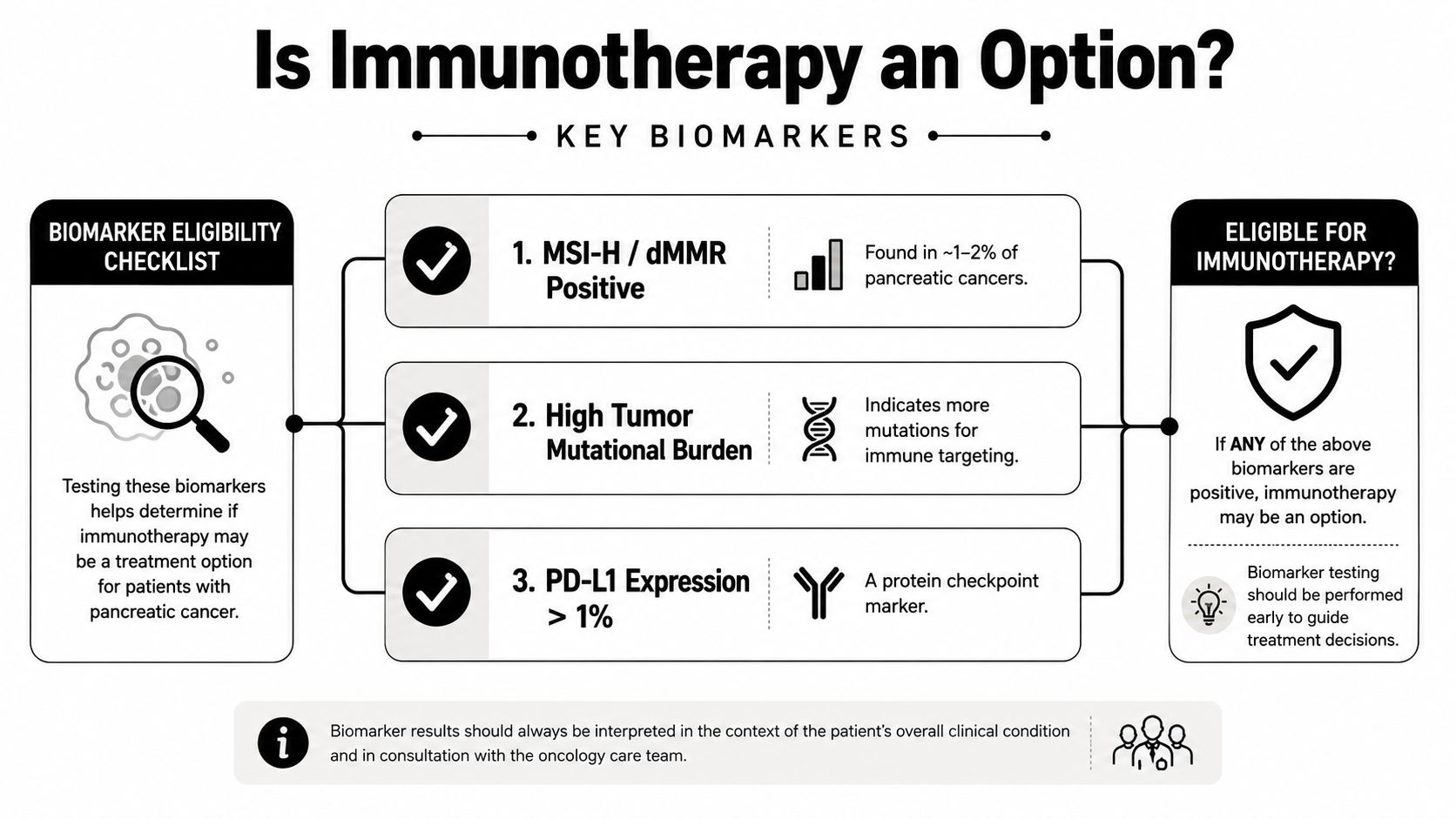
PD-L1 expression may appear on the report, but PD-L1 alone does not necessarily create the same treatment opportunity as MSI-H or dMMR. Different assays may produce different results, samples from separate tumor areas may vary, and one tumor can contain several molecular populations. Reviews support considering MSI, dMMR, TMB, and PD-L1 together rather than treating one marker as decisive. PubMed review of biomarker strategies
For a patient-friendly framework on tailoring immune treatment, review these nine steps to personalizing immunotherapy for pancreatic cancer. If tissue is limited or the laboratory result conflicts with the clinical picture, ask whether repeat testing, another laboratory, or a liquid biopsy could clarify the finding.
A negative MSI, dMMR, or TMB result redirects care rather than ending it. The plan may focus on chemotherapy, targeted treatment when a relevant alteration exists, symptom-focused care, or clinical trials testing ways to make immunologically “cold” tumors more responsive.
Current Evidence and Combination Therapy Approaches
The evidence is easiest to understand when single-agent treatment and combination research are kept separate. Single-agent checkpoint inhibition has a narrow role in pancreatic ductal adenocarcinoma. In MSI-H/dMMR disease, pembrolizumab has established activity. In microsatellite-stable, low-TMB disease, checkpoint blockade alone hasn't shown convincing benefit.
Real-world data illustrate why patient selection matters. In the National Cancer Database analysis covering 2004 to 2018, the immunotherapy group had median overall survival of 10 months, compared with 3.4 months for chemotherapy in the reported analysis. The study also reported 3-year survival of 8.8% versus 3.4% and 5-year survival of 3.6% versus 2.0%. MedPage Today These findings are important but shouldn't be read as a randomized proof that immunotherapy benefits every patient. The groups differed in treatment selection, and only a small fraction received immunotherapy.
Why combinations are being studied
Researchers are testing whether chemotherapy, targeted drugs, vaccines, radiation, or other immune agents can change the pancreatic tumor environment. The logic is straightforward: chemotherapy may release tumor material, radiation may expose cancer antigens, and targeted therapy may disrupt pathways that help cancer avoid immune recognition. A checkpoint inhibitor could then have more immune activity to amplify.
That biological rationale remains under investigation. A systematic review of six randomized trials found mixed survival results overall, although three studies improved overall survival and four showed increased immune activity. National Cancer Institute discussion of emerging vaccine research The results don't establish a universal combination regimen for metastatic pancreatic cancer, but they show why trial design and molecular selection matter.
| Treatment approach | Evidence level | Target population | Key findings |
|---|---|---|---|
| Pembrolizumab alone | Established, biomarker-selected | MSI-H/dMMR solid tumors, including eligible pancreatic cancers | Meaningful activity is concentrated in the biomarker-positive subgroup |
| Checkpoint inhibitor for unselected PDAC | Limited | Microsatellite-stable or unselected disease | Low activity has been reported, so routine empiric use isn't supported |
| Immunotherapy plus chemotherapy | Investigational in many pancreatic cancer settings | Patients meeting a study's clinical and molecular criteria | May alter the tumor environment, but results remain mixed |
| Immunotherapy plus targeted therapy | Trial-based | Patients with a relevant molecular alteration | Depends on the mutation, drug combination, and prior treatment |
| Neoantigen vaccines and immune combinations | Research-only | Patients whose tumors fit a study protocol | Early signals are promising but require clinical-trial context |
Patients should ask a very direct question before starting a combination: Is this an approved treatment for my biomarker profile, or is it being offered only through a clinical trial? That distinction protects against confusing biological promise with dependable clinical benefit.
Managing Side Effects and Quality of Life Considerations
Checkpoint inhibitors often feel different from chemotherapy because their main risks come from an immune system that becomes overactive against healthy tissue. A patient may have relatively little nausea or hair loss and still develop inflammation in an organ that needs urgent treatment.
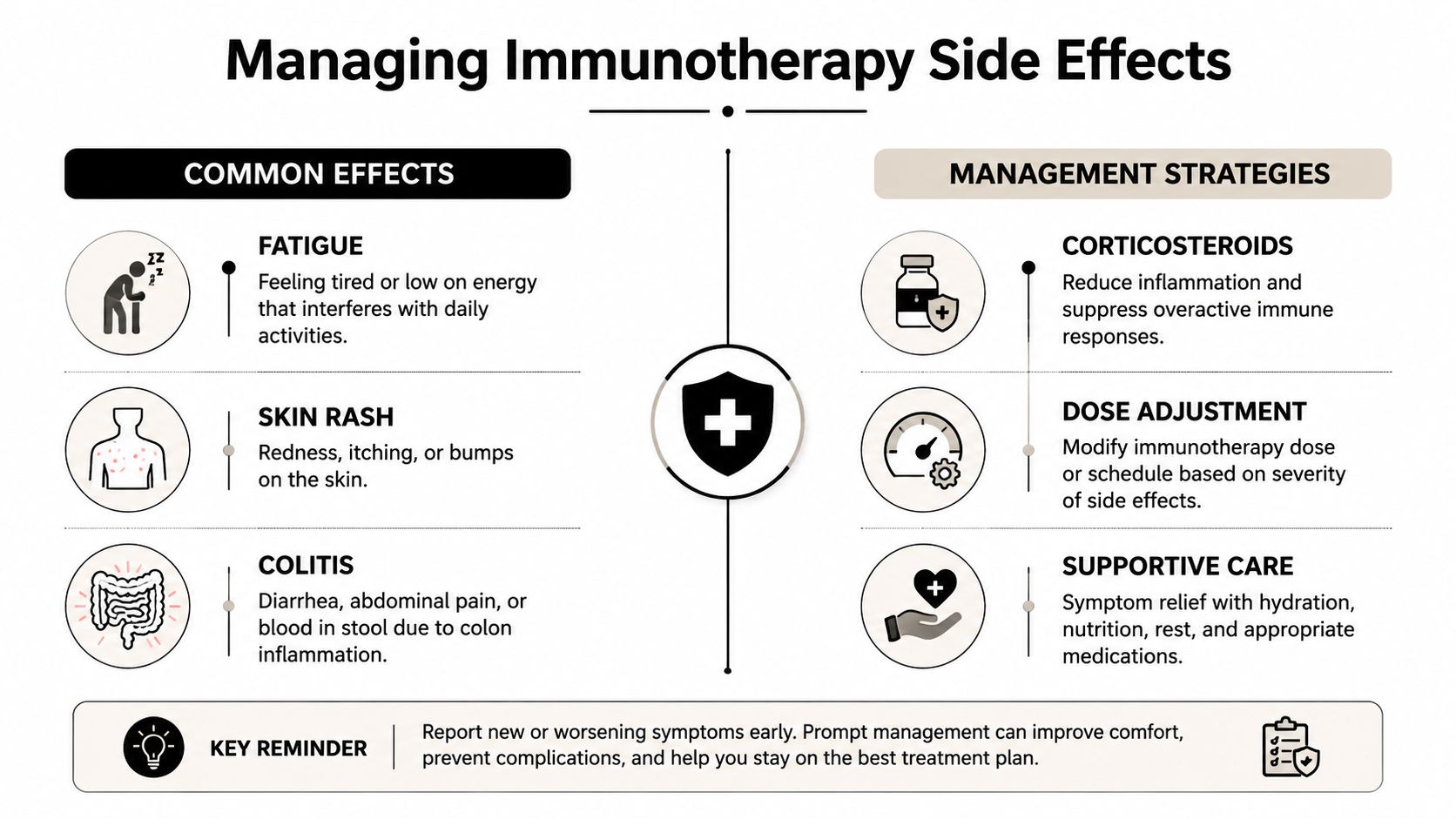
Common immune-related effects include fatigue, skin rash, colitis, hepatitis, and endocrine dysfunction. Endocrine problems may affect the thyroid or other hormone-producing systems, and symptoms can appear during treatment or after treatment has ended. The care team usually monitors symptoms and laboratory results so that inflammation can be addressed early.
Symptoms that deserve a prompt call
Don't wait for the next scheduled infusion if you develop:
- New or worsening diarrhea: Report persistent diarrhea, blood, cramping, or abdominal pain because colitis can worsen quickly.
- Yellowing skin or eyes: This can signal liver inflammation or another urgent complication.
- Breathing changes: New cough, chest discomfort, or shortness of breath may require evaluation for lung inflammation.
- Severe weakness or confusion: These symptoms can accompany endocrine or neurologic problems.
- Extensive rash or blistering: Skin reactions need assessment, especially when painful or rapidly spreading.
Treatment may involve holding immunotherapy, prescribing corticosteroids, giving organ-specific supportive care, or adjusting the dose and schedule. Patients shouldn't stop prescribed steroids suddenly or restart treatment without oncology guidance.
The guide to immune-related adverse events can help patients prepare questions, but it doesn't replace urgent contact with the treating team. Keep a written record of symptoms, their start date, medicines taken, bowel changes, temperature, and changes in energy.
Quality of life includes more than physical toxicity. Travel to appointments, infusion time, laboratory monitoring, caregiver availability, nutrition, pain, mood, and the ability to continue meaningful activities all belong in the treatment conversation. Palliative care can support these needs alongside active cancer treatment, and patients may explore Life Primary Care palliative services for additional symptom and family support.
Call before symptoms become severe. Immune-related complications are often more manageable when the oncology team knows about them early.
Clinical Trials and Emerging Treatment Options
A clinical trial can be appropriate at diagnosis, after a standard treatment stops working, or when a tumor's molecular profile matches a new approach. It isn't automatically a last resort. For patients with microsatellite-stable disease, a trial may be the most realistic way to access an immune combination that isn't available in routine practice.
Consider a patient whose tumor is MSI-H and who can receive pembrolizumab through standard care. That person may not need a trial to access checkpoint inhibition, although a study could still be relevant if it tests a carefully designed combination. Another patient with MSS disease and a KRAS-pathway alteration may not have a standard immunotherapy indication, but could qualify for a trial pairing a targeted drug with an immune agent. In both situations, eligibility depends on more than the biomarker. Prior therapies, organ function, measurable disease, medications, and overall functional status can all matter.
How trial matching works
Begin with the treating oncologist and ask for a trial review before the next treatment decision. Search ClinicalTrials.gov using pancreatic cancer, metastatic disease, immunotherapy, and the tumor's molecular findings, then confirm every eligibility detail with the study site.
NCI-designated cancer centers and pancreatic cancer advocacy organizations can also help identify studies. Ask these questions:
- What is the treatment phase? Earlier-phase studies focus more on safety and dosing, while later studies provide stronger comparisons with existing care.
- What happens if the treatment doesn't work? Clarify whether standard therapy remains available afterward.
- What costs are covered? Ask about the study drug, testing, travel, lodging, caregiver time, and routine care.
- How often are visits required? Some trials require frequent scans, blood tests, infusions, or trips to another city.
- What tissue is needed? A new biopsy may be required if the available specimen is too old or insufficient.
Emerging approaches include CAR-T cells, TIL therapy, neoantigen vaccines, oncolytic viruses, and checkpoint inhibitor combinations. These strategies may offer a rational path for selected patients, but they remain research-based in pancreatic cancer and shouldn't be described as established cures.
Hirschfeld Oncology provides consultations for patients and families who want to review molecular results, understand immune-treatment eligibility, and consider individualized regimens or trial opportunities alongside their local oncology care.
Hirschfeld Oncology can help you review MSI-H/dMMR, TMB, and broader molecular testing results before deciding whether immunotherapy or a clinical trial fits your situation. Visit Hirschfeld Oncology to explore consultation options and discuss a treatment plan aligned with your goals, health, and tolerance for side effects.
.png)
.png)






