.png)


When you receive a breast cancer diagnosis, one of the first words you'll hear is either "invasive" or "non-invasive." It’s a crucial distinction that really shapes everything that comes next.
So, what does invasive breast cancer actually mean? Think of the milk ducts and lobules in the breast as tiny, contained rooms. In this type of cancer, the abnormal cells have broken out of their original "room" and started to move into the surrounding healthy breast tissue.
It’s this "breakout" that defines the cancer as invasive. This doesn’t automatically mean it has spread far and wide, but it does mean it now has the potential to. The cells have gained access to the blood vessels and lymph channels—the body's superhighways—that can carry them to other places.
What an Invasive Diagnosis Means
Hearing the word "invasive" can be alarming, but it's important to see it for what it is: a medical description of the cancer's behavior. It tells us the cancer isn't sitting still. Understanding this is the first step toward understanding your treatment plan.
The two most common forms of invasive breast cancer are named after where they started their journey:
Invasive Ductal Carcinoma (IDC): This is the one we see most often, making up about 80% of all invasive breast cancers. The journey here begins in a milk duct, but the cells have pushed through the duct wall into the breast's fatty tissue. IDC often, but not always, forms a distinct, hard lump.
Invasive Lobular Carcinoma (ILC): Making up a smaller portion of cases, ILC starts in the lobules—the glands that produce milk. These cells behave a bit differently. Instead of clumping into a hard mass, they often spread out in a single-file line, which can create a feeling of thickening or fullness in the breast rather than a classic lump.
Invasive vs. Non-Invasive Breast Cancer at a Glance
To really get a handle on this, it helps to see the two types side-by-side. The key difference is whether the cancer cells have stayed put or started to move.
This distinction is precisely why early detection through mammograms is so powerful. Finding cancer when it's still non-invasive, or in situ, can dramatically simplify treatment and improve the long-term outlook.
The numbers show just how many lives this disease touches. In 2026 alone, it's estimated that nearly 322,000 women and over 2,600 men in the U.S. will be diagnosed with invasive breast cancer. On top of that, another 60,000+ cases of non-invasive (in situ) cancer are expected. These figures highlight the critical need for a personalized, expert-driven approach to every single case.
Understanding Your Diagnosis and Staging
An abnormal mammogram is often the first sign, but it’s really just the starting point. Think of what comes next as a fact-finding mission, where each step is designed to get a clearer and clearer picture of what’s happening in the breast tissue. We move from a general suspicion to a precise diagnosis.
To get a better look, we’ll often use more detailed imaging, like a diagnostic mammogram, a breast ultrasound, or in some cases, a breast MRI. These tools help us see the size, shape, and specific features of the tissue in question. They give us a much sharper image than the initial screening.
But imaging can only tell us so much. The only way to know for sure if cancer is present is to perform a biopsy. This is a straightforward procedure where a small tissue sample is taken from the suspicious area. That sample is then sent to a pathologist—a doctor who specializes in analyzing cells under a microscope to identify disease. This is the definitive step that confirms or rules out invasive breast cancer.
Decoding Your Pathology Report
If the biopsy confirms cancer, the pathologist’s findings are detailed in a pathology report. This document is one of the most critical pieces of your entire journey; it’s essentially the blueprint for your treatment plan. It can seem technical, but it’s really just a detailed description of the cancer’s unique identity.
The report will confirm that the cancer is invasive and, crucially, it will identify its specific "markers." These markers are like tags on the cancer cells that tell us what’s making them grow. The three most important ones are:
- Estrogen Receptor (ER) Status: If the cells are ER-positive, it means the hormone estrogen is acting like fuel, encouraging the cancer to grow.
- Progesterone Receptor (PR) Status: In the same way, PR-positive status means the hormone progesterone is helping to drive the cancer’s growth.
- HER2 Status: This refers to a protein called human epidermal growth factor receptor 2. When a cancer is HER2-positive, it has too many copies of this protein, which can cause it to grow and spread more aggressively.
This isn’t just abstract information; it directly guides our treatment choices. For instance, a cancer that feeds on estrogen (ER-positive) can be treated very effectively with therapies that block estrogen. A HER2-positive cancer can be fought with drugs specifically designed to shut down that overactive protein. This is the heart of personalized cancer care.
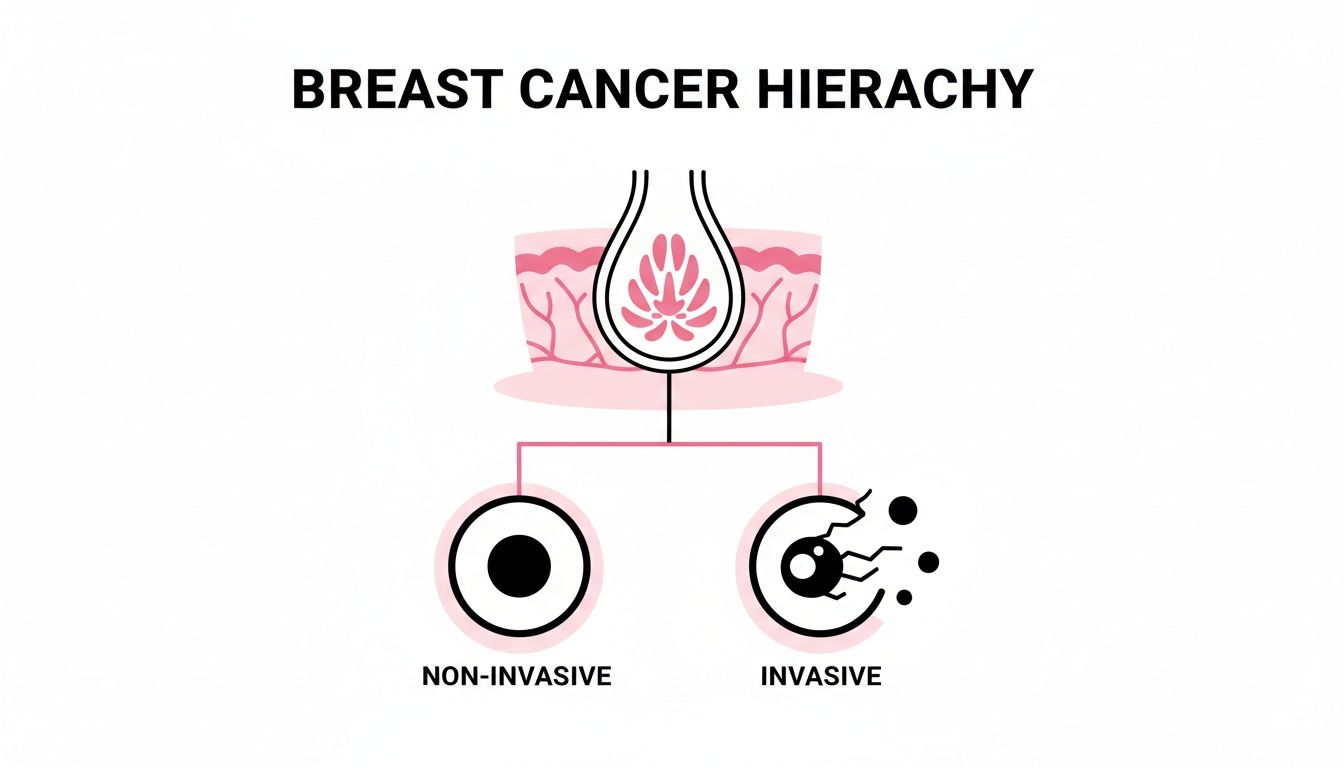
As the diagram shows, the key difference is whether the cancer has stayed put (non-invasive) or broken through to surrounding tissue (invasive). Your pathology report gives us this vital answer.
Mapping the Cancer with Staging
Once invasive breast cancer is confirmed, the next step is staging. Staging is simply the process of figuring out exactly how much cancer is in the body and where it has gone. It’s like creating a map before a road trip. To plan the best route (your treatment), you first need to know your exact starting point and if the cancer has traveled anywhere else.
Staging isn't just a label; it's a powerful tool that helps your care team predict the cancer's likely behavior and select the most effective treatments to fight it.
The standard system used for staging is the TNM system. Each letter gives us a key piece of information:
- T (Tumor): This describes the size of the original tumor and whether it has grown into nearby breast tissue.
- N (Nodes): This tells us if the cancer has spread to any nearby lymph nodes, which are small glands that are part of your immune system.
- M (Metastasis): This indicates whether the cancer has metastasized, or spread, to distant parts of the body, like the bones, liver, lungs, or brain.
By combining the T, N, and M factors, we determine an overall stage, ranging from Stage 1 (an early, localized cancer) to Stage 4 (a cancer that has spread to distant organs). Having a clear understanding of your cancer’s stage and its unique markers empowers you to partner with your oncology team and make informed decisions about the road ahead.
Standard Treatment Approaches for Invasive Breast Cancer
When we’re building a treatment plan for invasive breast cancer, we’re not just picking a single solution off the shelf. Think of it more like assembling a team of specialists. We almost always use a combination of strategies—what we call multimodal therapy—to attack the cancer from every possible angle.
These strategies fall into two main camps: local treatments, which are zeroed in on the breast and nearby tissues, and systemic treatments, which travel throughout your entire body to hunt down any rogue cancer cells.
The whole point is to get rid of the cancer and do everything we can to make sure it never comes back. The specific sequence of therapies we recommend will depend entirely on your cancer’s unique personality—its stage, grade, and those crucial molecular markers like hormone receptor and HER2 status.

Local Treatments to Control the Tumor Site
Local therapies are our ground game. They focus directly on the tumor in the breast and sometimes the adjacent lymph nodes to clear the primary site of disease.
Surgery is almost always the first major step to physically get the tumor out. There are two main paths here:
- Lumpectomy: This is a breast-conserving surgery where the surgeon removes just the tumor and a small "margin" of healthy tissue around it. To be safe, it's almost always followed by radiation to clean up any invisible cancer cells left behind.
- Mastectomy: In this procedure, the entire breast is removed. We might recommend this if a tumor is particularly large, if there are several tumors in one breast, or for a number of other medical and personal reasons.
After surgery, especially a lumpectomy, radiation therapy is a standard part of the plan. Using high-energy beams, similar to X-rays, we can precisely target the area to destroy any microscopic cancer cells that might be lingering. This one-two punch of surgery and radiation dramatically lowers the risk of the cancer ever returning in that breast.
Systemic Treatments for Whole-Body Protection
While local treatments take care of the main tumor, we have to account for the "invasive" part of the diagnosis. Cancer cells can break away and travel through the bloodstream. Systemic therapies are our answer to that. They act like a full-body security detail, circulating everywhere to find and destroy cancer cells before they can set up a new home.
The widespread use of systemic therapies is one of the biggest reasons survival rates have improved so much. They tackle the disease on a global scale, not just a local one.
Here are the workhorses of systemic treatment:
Chemotherapy
Chemotherapy uses powerful drugs designed to kill fast-growing cells, which is a classic trait of cancer. We might give it before surgery (neoadjuvant chemo) to shrink a large tumor and make the operation simpler, or after surgery (adjuvant chemo) to mop up any cells that may have escaped. Whether you need it depends on the tumor's size, grade, and if cancer was found in your lymph nodes.
Hormone Therapy
If your cancer is hormone receptor-positive (ER+ and/or PR+), it means estrogen is essentially acting like fuel for the fire. Hormone therapy, also called endocrine therapy, is a game-changer here. These drugs work by either blocking the hormones from latching onto the cancer cells or by lowering the body's overall estrogen levels. The main players are drugs like tamoxifen and a class of medications called aromatase inhibitors.
Targeted Therapy
This is a much smarter, more precise way to fight cancer. Unlike chemo, which is a bit of a blunt instrument, targeted therapies are engineered to attack a specific vulnerability in the cancer cells. The classic example is for HER2-positive breast cancer. These cancers make too much of a protein called HER2, which signals them to grow aggressively. Drugs like trastuzumab (Herceptin) are designed to find that HER2 protein and shut it down. As you can see in our guide on breast cancer targeted therapy, this approach has completely changed the outlook for patients with this subtype.
By carefully combining these local and systemic treatments, we build a comprehensive plan that gives our patients the best possible shot at a long, healthy life beyond cancer.
Emerging and Innovative Treatment Strategies
While the standard treatments for invasive breast cancer are incredibly effective, the world of oncology never stands still. For cancers that are particularly aggressive, have spread, or have stopped responding to the usual therapies, we now have a new playbook of strategies that offers real hope. This is where treatment gets truly personal, moving beyond one-size-fits-all approaches to target the unique biology of an individual’s cancer.
This shift toward smarter, more precise therapies is making a huge difference. The death rate from breast cancer in the U.S. has plummeted by 44% since its peak in 1989, a testament to better screening and treatment that has saved an estimated 546,000 lives through 2023. Yet, invasive cases are still on the rise, which pushes researchers to find even better ways to fight the disease while protecting a patient's quality of life. You can explore more of these breast cancer progress and outlook findings on BusinessWire.

Next-Generation Targeted Therapies
We’ve seen how targeted therapies for HER2-positive cancers completely changed the game, but the science didn't stop there. Researchers are constantly uncovering new weaknesses in cancer cells, which has led to a whole new wave of sophisticated drugs.
These newer therapies offer powerful options when first-line drugs stop working. One of the most promising types is a class of drugs called antibody-drug conjugates (ADCs). Think of an ADC as a "smart bomb" for cancer. It links a targeted antibody, which homes in on a specific protein on the cancer cell, to a potent dose of chemotherapy. This clever combination allows the drug to deliver its toxic payload directly to the tumor, minimizing collateral damage to healthy cells.
Unleashing the Immune System with Immunotherapy
One of the most exciting frontiers in all of cancer care is immunotherapy. Our immune system is our body's natural defense force, but cancer cells have tricks to hide from it or switch it off. Immunotherapy is designed to strip away the cancer's disguises, essentially "reawakening" the immune system to recognize and attack the disease.
A major category of these drugs is called immune checkpoint inhibitors. They work by blocking the "don't-eat-me" signals that cancer cells use to fool immune cells. Once that signal is blocked, the cancer becomes visible again, and the body’s own T-cells can go on the attack. While it isn't the right fit for every breast cancer, it has been a true breakthrough for some patients, especially those with certain types of triple-negative breast cancer.
The goal of immunotherapy isn't to poison the cancer, but to empower your own body to eliminate it. It’s a fundamental shift in how we think about treating cancer.
The Role of Low-Dose Metronomic Chemotherapy
Chemotherapy has been a workhorse in cancer treatment for decades, but the side effects can be tough. A smarter, gentler approach called low-dose or metronomic chemotherapy is changing that. Instead of hitting the body with high doses in cycles, this strategy uses much lower doses of chemo given more frequently, often on a continuous schedule.
The thinking behind it is entirely different from traditional chemo:
- Starve the Tumor: It focuses on cutting off the tumor's blood supply (a process called angiogenesis), which it needs to grow and spread.
- Improve Quality of Life: The lower doses are far easier on the body, helping patients feel better and maintain their daily routines.
- Boost the Immune System: Some studies suggest it can also help stimulate the body’s immune response against the cancer.
This approach is proving especially useful for managing advanced or metastatic breast cancer, helping to turn it into a more manageable, chronic condition.
Accessing the Future Through Clinical Trials
Every one of these advanced treatments was once only available through a clinical trial. These research studies are how we find out if new therapies are not only safe but better than what we currently use.
For patients whose cancer is resistant to standard treatments, a clinical trial can open the door to the absolute forefront of medicine. Participating gives you a chance to receive a potentially life-changing therapy years before it's widely available. It's an incredibly important option to consider when you're exploring every possible avenue for your care.
Navigating Advanced and Metastatic Breast Cancer
When invasive breast cancer travels to distant parts of the body—think bones, liver, lungs, or the brain—we call it Stage 4, or metastatic breast cancer. This diagnosis changes things. The conversation shifts from seeking a cure to managing the cancer as a long-term, chronic illness.
Our focus becomes twofold. First, we want to control the cancer's growth to help you live as long as possible. But just as crucial is protecting and improving your quality of life. Every treatment decision becomes a careful negotiation between a therapy's effectiveness and its impact on your daily well-being.
A New Philosophy of Care
Treating metastatic disease is much more like a marathon than a sprint. We typically use a sequential approach: we’ll stay with one therapy until it stops working or the side effects become too much to handle, and then we pivot to the next best option. This strategy is designed to keep the cancer in check for as long as possible, often giving you breaks from more demanding treatments along the way.
Constant monitoring is a huge part of this. Through regular imaging scans and blood work, your oncology team can keep a close eye on how the cancer is responding. This lets us make smart, timely adjustments to your care plan whenever needed.
With Stage 4 invasive breast cancer, how we define "success" evolves. It’s about creating long stretches of stability, keeping symptoms under control, and empowering you to live your life as fully as you can.
Prioritizing Quality of Life
Living with advanced cancer means managing the disease itself and the side effects that come with treatment. A truly comprehensive care plan looks beyond just the cancer cells. It must include robust supportive care to help with common issues like:
- Pain management to keep you comfortable and active.
- Controlling fatigue and nausea to help maintain your energy and appetite.
- Emotional and psychological support to help you navigate the journey.
This is where palliative care becomes so important—and it’s often misunderstood. Think of it as an extra layer of support focused entirely on relief, comfort, and easing symptoms. It can be brought in at any time after a metastatic diagnosis, not just at the very end of life. Looking into comprehensive care, including palliative care services, can make a world of difference.
This disease has a massive global footprint. In 2022 alone, breast cancer was responsible for 2.3 million new diagnoses in women and led to 670,000 deaths worldwide, highlighting just how universal this health challenge is. You can find more about these global breast cancer statistics from the World Health Organization.
This global reality only reinforces why a personalized approach—one that puts your well-being on equal footing with disease management—is so critical. For a deeper dive into managing this stage, take a look at our guide on living with Stage 4 breast cancer. At Hirschfeld Oncology, we specialize in creating these highly individualized plans for patients with complex, advanced cancers, ensuring your care always aligns with what matters most to you.
Finding Expert Care and Second Opinions in NYC
An invasive breast cancer diagnosis is a life-altering event, and the path forward can feel overwhelming. You don’t have to navigate it alone. Building the right medical team is arguably the most critical decision you'll make, especially when you're up against a complex diagnosis in a place like New York City.
Feeling completely sure about your treatment plan is everything. This is why getting a second opinion isn't a sign of doubt—it's a smart, proactive step toward taking control of your health. An expert consultation can validate your current treatment, open your eyes to a different approach, or even introduce you to clinical trials and therapies you didn't know existed.
When to Consider a Second Opinion
So, when is it a good time to get that second set of eyes on your case? A second opinion is particularly powerful if:
- You've been told your treatment options are limited.
- You're dealing with a rare or aggressive subtype of breast cancer.
- Your cancer has become resistant to standard treatments.
- You want to explore options that better align with your quality-of-life goals, such as low-dose chemotherapy or other less aggressive regimens.
A second opinion is about empowerment. It’s about gathering all possible information to make sure the treatment plan you choose is the absolute best fit for your cancer, your body, and your life.
At Hirschfeld Oncology, we are dedicated to providing this exact level of personalized, in-depth care for patients in Brooklyn and throughout NYC, including nearby communities like Williamsburg and Bushwick. Our entire practice is built on a simple philosophy: use sophisticated science to design highly effective treatments that also prioritize your well-being and minimize harsh side effects.
For anyone facing advanced or treatment-resistant invasive breast cancer, we provide a place to thoughtfully explore every single avenue. If you’re looking for an experienced partner to help guide your care, we invite you to request a consultation. Let's map out a clear path forward, together.
Frequently Asked Questions About Invasive Breast Cancer
Getting an invasive breast cancer diagnosis can feel overwhelming, and it's natural to have a lot of questions. We've gathered some of the most common ones we hear from patients and their families to help bring some clarity during a confusing time.
What Is the Difference Between Invasive Ductal and Invasive Lobular Carcinoma?
The simplest way to think about it is where the cancer started and how it behaves.
Invasive Ductal Carcinoma (IDC) is the most common type we see. It begins inside a milk duct, but then it breaks through the wall of the duct and grows into the nearby breast tissue. This often creates a distinct, hard lump that you or your doctor might feel.
On the other hand, Invasive Lobular Carcinoma (ILC) starts in the lobules, which are the glands that actually produce milk. ILC cells have a strange habit of growing in a single-file line, like soldiers marching. This growth pattern tends to cause a general thickening or fullness in the breast, not a clear lump, which can make it a bit trickier to spot on a mammogram.
Can Invasive Breast Cancer Be Cured?
Absolutely. For most people diagnosed with early-stage invasive breast cancer—that’s Stages I, II, and III—the goal of treatment is a complete cure, and the success rates are very high. The key is catching it before it has traveled to distant parts of the body.
If the cancer has already spread to other organs (what we call Stage IV or metastatic disease), the situation changes. At this point, it’s not typically considered curable, but it is very much treatable. The focus of our work then shifts to managing the cancer as a chronic condition, controlling its growth for as long as possible while making sure you maintain an excellent quality of life.
Why Are Hormone Receptors and HER2 Status So Important?
Think of these markers as the cancer's "fingerprint." They tell us exactly what’s driving the cancer's growth, which allows us to attack it with precision. This is the cornerstone of modern, personalized breast cancer treatment.
Hormone Receptors (ER/PR): If a tumor is Estrogen Receptor-positive (ER+) or Progesterone Receptor-positive (PR+), it means it's using your body's own hormones as fuel. This is actually a good thing because it gives us a clear target. We can use highly effective hormone-blocking therapies to essentially starve the cancer cells.
HER2 Status: A HER2-positive cancer has an overabundance of a specific protein that acts like a gas pedal, telling the cells to grow and divide aggressively. We now have incredible targeted drugs designed to block this exact protein, effectively slamming on the brakes. These therapies have completely changed the outlook for patients with this subtype.
Understanding your cancer's unique receptor status is what allows us to move beyond a one-size-fits-all approach. We can choose treatments that are designed to exploit your cancer's specific weaknesses.
At Hirschfeld Oncology, creating these deeply personalized treatment plans is what we do every day, especially for patients with advanced or complex cases. If you're looking for a second opinion or want to explore every possible care option in the NYC area, we’re here to help. You can learn more by exploring our oncology blog.
.png)
.png)