.png)


You're sitting in clinic with a pathology report in your hand, trying to read past the jargon. One word jumps out. KRAS. That single line can feel like a verdict, but it isn't one. It's a molecular clue that changes the next set of questions, especially whether there's a treatment you can match to the tumor you have today.
The right response to a kras mutation targeted therapy result is not panic, and it's not blind optimism either. It's a methodical check of the exact KRAS subtype, the tumor type, the rest of the molecular profile, and the realistic options that follow. Some patients can move into a targeted drug now. Others need broader testing, a trial, or a different first step because the biology doesn't line up yet.
When the Pathology Report Says KRAS
A KRAS result means the tumor has a somatic mutation, which is a change that arose in the cancer cells themselves, not something you inherited from a parent. That distinction matters because it changes who else in the family needs to think about testing, and usually it's the tumor that drives the treatment decision. The report may tell you KRAS is present, but it often won't tell you enough by itself to choose a drug.
Start with the exact subtype
The first question is which KRAS variant is listed. That detail matters because current approved therapy is built mainly around KRAS G12C, not every KRAS mutation. A report that says “KRAS positive” without the subtype is incomplete for treatment planning.
The next question is which cancer type you have. KRAS behaves differently in pancreatic, colorectal, and lung cancer, and the treatment path changes with that context. In compiled clinical datasets, KRAS mutations appear in about 81.72% of pancreatic adenocarcinomas and 37.97% of colorectal carcinomas, and other sources describe rates of roughly 86% in pancreatic cancer, 41% in colon or colorectal cancer, and 35% in lung adenocarcinoma, which is why the finding carries so much weight in these diseases. The biology and the treatment choices are tightly linked, as shown in the review of KRAS distribution and tumor-type split in this clinical overview.
Practical rule: A KRAS result should trigger a treatment conversation, not end one. If the report doesn't name the variant, ask for the full molecular report before you agree to a plan.
Treat the report as a starting point
A pathology report does not automatically say you qualify for a targeted drug. It tells you the tumor has a driver that may matter, but eligibility depends on the mutation type, whether the cancer has already been treated, and whether the drug is approved for that exact situation. In the modern era, the field moved from “undruggable” to actionable with direct KRAS G12C inhibitors, beginning with the FDA approval of sotorasib in 2021 for previously treated KRAS G12C-mutated non-small cell lung cancer, as summarized by Memorial Sloan Kettering's update on KRAS-targeted colorectal therapy.
That's why the report is a beginning, not a verdict. Your next move is to identify the subtype, confirm whether broader genomic testing was done, and decide whether the tumor belongs in standard treatment, a targeted regimen, or a clinical trial.
What KRAS Does and Why It Matters
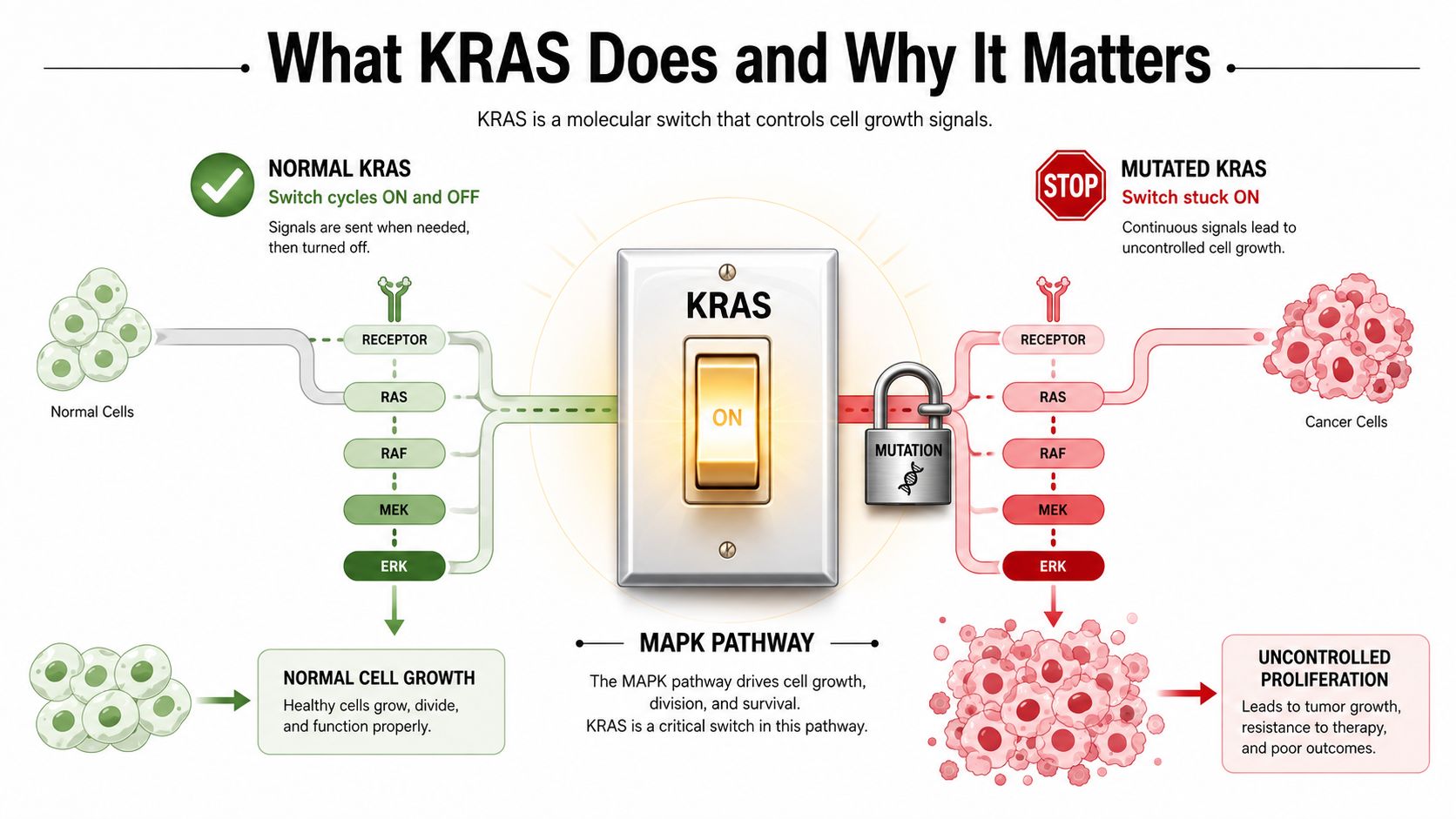
KRAS works like a molecular switch on a growth-signaling pathway. In a normal cell, the switch turns on when the cell needs to grow or divide, then turns off when the job is done. A mutation can jam that switch in the ON position, so the cell keeps receiving growth signals even when it shouldn't.
Why one amino acid change changes treatment
KRAS sits on the MAPK pathway, one of the major routes cells use to decide whether to grow. A single amino-acid substitution can alter the pocket where a drug binds, or keep the protein active long enough to drive uncontrolled proliferation. That's the reason a mutation in the same gene can be either highly actionable or not yet druggable, depending on the exact variant.
The clinically meaningful split is simple. G12C is the subtype with approved drugs right now. G12D, G12V, G12X, and other variants are not matched to an approved direct inhibitor in the same way, even though they're the focus of intense development. In gastrointestinal cancers, G12D and G12V dominate in pancreatic disease, while G12C is more often seen in lung cancer, which is why mutation-specific therapy is most feasible in non-small cell lung cancer and a smaller subset of colorectal cancer.
Why KRAS changes other drug choices
KRAS status doesn't just matter for targeted therapy. In colorectal cancer, KRAS mutations often explain why EGFR inhibitors don't work well on their own. If the pathway is already locked on downstream, blocking EGFR upstream doesn't solve the problem. That's also why the exact subtype matters more than the headline word “KRAS positive.”
A KRAS mutation is not a diagnosis by itself. It's a map marker. Treatment only makes sense when you know the tumor type, the subtype, and the rest of the molecular context.
Smoking-associated lung adenocarcinomas carry G12C more often than many other tumor types, which is one reason lung cancer became the early proving ground for KRAS inhibition. In practice, that means a lung patient with G12C may have a clear drug path today, while a pancreatic patient with a different KRAS variant may need a trial or a broader strategy instead of waiting for a label that doesn't yet exist.
Approved Drugs and Emerging Agents Worth Knowing
The approved drugs matter because they define what you can use now. The research pipeline matters because many people with a KRAS mutation still do not fit the current approved path, especially when the variant is not G12C.
The drugs you may hear about in clinic
Sotorasib and adagrasib are the two names patients hear first. Sotorasib was the first major FDA-approved KRAS G12C inhibitor for previously treated KRAS G12C-mutated non-small cell lung cancer. Adagrasib later broadened the field, including a colorectal regimen with cetuximab that marked an important shift in KRAS-directed care. For a concise summary of that clinical evolution, see the targeted-therapy overview.
Their benefit is real, but it is not curative. In the CodeBreaK 100 study supporting sotorasib approval in KRAS G12C-mutant NSCLC, the response rate was about 41%, the median progression-free survival was 6.3 months, and about 30% of patients were alive at 2 years. In KRYSTAL-1, adagrasib showed an ORR of about 43%, a median duration of response of 8.5 months, a median PFS of 6.5 months, and a median OS of 12.6 months, as reviewed in a peer-reviewed article on KRAS inhibitors.
Approved and emerging KRAS-targeted agents
| Agent | Target Variant | Status | Indication | ORR / Median DoR |
|---|---|---|---|---|
| Sotorasib | G12C | Approved | Previously treated KRAS G12C-mutated NSCLC | ORR about 41%, median DoR not stated in verified data |
| Adagrasib | G12C | Approved | KRAS G12C-mutated NSCLC, colorectal use with cetuximab | ORR about 43%, median DoR 8.5 months |
| Adagrasib plus cetuximab | G12C | Priority review accepted in 2024, described as approved by 2026 | Previously treated KRAS G12C-mutated colorectal cancer | Efficacy not quantified in verified data |
| MRTX1133 | G12D | Investigational | Early development for G12D-mutant tumors | Not yet established |
| Pan-KRAS inhibitors such as RMC-6236 | Multiple KRAS states | Investigational | Broad KRAS-mutant solid tumors | Not yet established |
The next wave matters most for patients with non-G12C disease. MRTX1133 targets G12D, and pan-KRAS inhibitors such as RMC-6236 are trying to widen eligibility beyond a single amino-acid substitution. Combination strategies that pair KRAS inhibitors with EGFR antibodies, SHP2 inhibitors, SOS1 inhibitors, or immune checkpoint blockade are also central, because monotherapy rarely keeps the pathway shut for long.
What patients should take from this
If your tumor is G12C, approved targeted therapy may be available now, usually after prior systemic treatment. If your tumor is not G12C, a clinical trial may be more useful than waiting for a future approval. That is the practical decision point.
Do not stop at “KRAS positive.” The variant decides the path.
How to Get Tested the Right Way
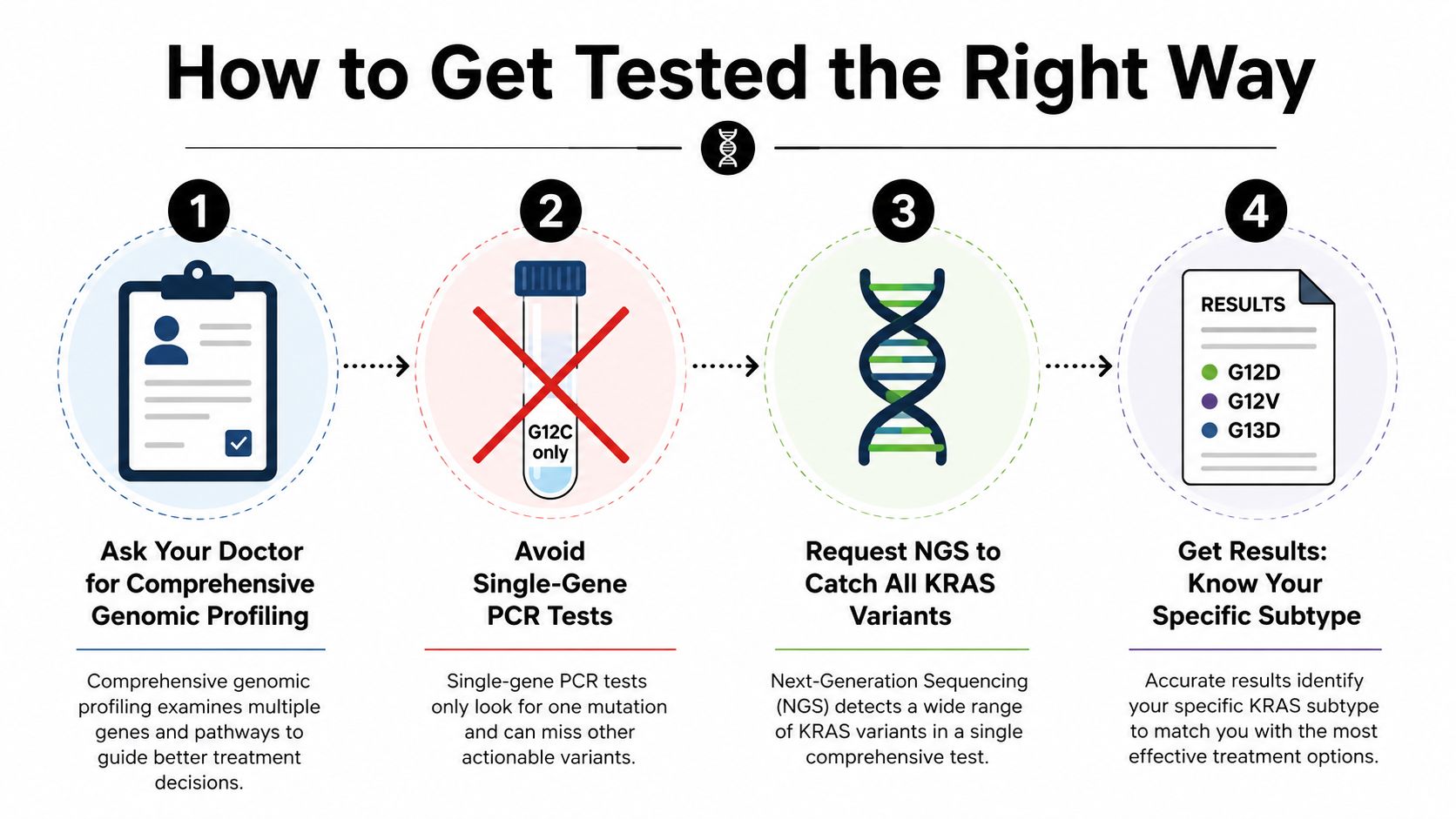
Testing has to be broad enough to matter. A single-gene PCR test can find a known target like G12C, but it can miss other KRAS variants and the co-mutations that change how the tumor behaves. If the test is too narrow, you can get a result that sounds useful and still miss the treatment story.
Ask for comprehensive profiling, not a shortcut
You want next-generation sequencing when possible. Broad panels can identify G12D, G12V, G12R, G13, Q61, A146, and the co-mutations that often travel with them, including STK11, KEAP1, and TP53. Those extra findings can shape prognosis and trial eligibility, even when they don't produce an immediate approved drug.
Specimen choice matters too. Fresh tumor tissue from a recent biopsy gives the most direct readout when enough material is available. Archived blocks can still work, especially if the tissue is adequate. Liquid biopsy from blood is useful when tissue is hard to get or the disease is progressing, but it can miss a mutation if the tumor isn't shedding enough DNA into the bloodstream.
Make the system do the work
Reflex testing should happen automatically. The oncologist should not need to remember to order KRAS testing later, because by then you've already lost time. Ask whether your pathology lab triggers profiling by default for the cancer type you have, and whether the result will be reported in a format your oncologist will use.
You can also use the molecular testing guide to understand how broad profiling fits into a treatment plan.
Ask the lab directly: What exact KRAS variants will this test detect, and what co-mutations will it report? If the answer is vague, the test is too narrow.
Before you sign consent, ask three concrete questions. What variants does this panel cover? Will a blood test be used if tissue is insufficient? How will I get the full report, not just the one-line summary? Those answers tell you whether the test can support kras mutation targeted therapy decisions or just produce another document for the chart.
Watch a short overview of the testing workflow
What Response and Resistance Look Like
Patients usually want a simple answer after the first scan: is this working or not? With KRAS G12C targeted drugs, the answer is often yes at first, then no later. Responses can be real and clinically meaningful, but they are often temporary, and that is the trade-off you need to understand before starting treatment.
A shrinking tumor is not a minor win. Less pain, easier breathing, and fewer symptoms can buy time and reduce the pressure to make rushed decisions. In KRAS G12C-mutant NSCLC, response rates are meaningful, but the benefit is usually measured in months, not years, even when the first scan looks encouraging. The same pattern has been described in the KRAS inhibitor review and in day-to-day practice.
The upside is meaningful, the durability problem is real
Targeted therapy does not fail because it is useless. It fails because the tumor adapts. That adaptation can happen through several routes at once, which is why a good first response does not guarantee a lasting one.
Colorectal cancer is the clearest example. Monotherapy responses are much lower there, so EGFR antibodies became part of the standard combination strategy. The biology is straightforward. If you block KRAS in one place, the cancer can route around the block somewhere else.
What resistance usually looks like
Resistance often shows up as secondary KRAS mutations, KRAS amplification, or bypass signaling through EGFR, MET, NRAS, HRAS, NF1 loss, BRAF, MEK, and PI3K reactivation. Some tumors also switch phenotype through EMT. Reviews of the field describe this as convergent adaptive biology, not one fixed escape pattern.
That is why many patients relapse within roughly 4 to 6 months on monotherapy. The timeline varies, but the problem is consistent. A scan that looked better early can change quickly once the tumor finds a new growth route.
| Drug / Indication | ORR | Median PFS | Common Resistance Mechanisms |
|---|---|---|---|
| Sotorasib in KRAS G12C-mutant NSCLC | About 41% | 6.3 months | Secondary KRAS changes, bypass signaling, amplification |
| Adagrasib in KRAS G12C-mutant NSCLC | About 43% | 6.5 months | Secondary KRAS changes, EGFR and MET bypass, pathway reactivation |
| KRAS G12C therapy in colorectal cancer | Lower than NSCLC with monotherapy | Not established in verified data | EGFR-driven escape, pathway rebound, co-alterations |
When progression happens, ask for a repeat biopsy or ctDNA review. The next step depends on what the tumor changed into. A new KRAS alteration, a bypass pathway, or a histologic shift can point you toward a different combination or a different trial.
If a targeted drug stops working, ask what changed molecularly before you assume the class is finished. The answer often decides the next treatment move.
Why Clinical Trials Belong Early in the Conversation
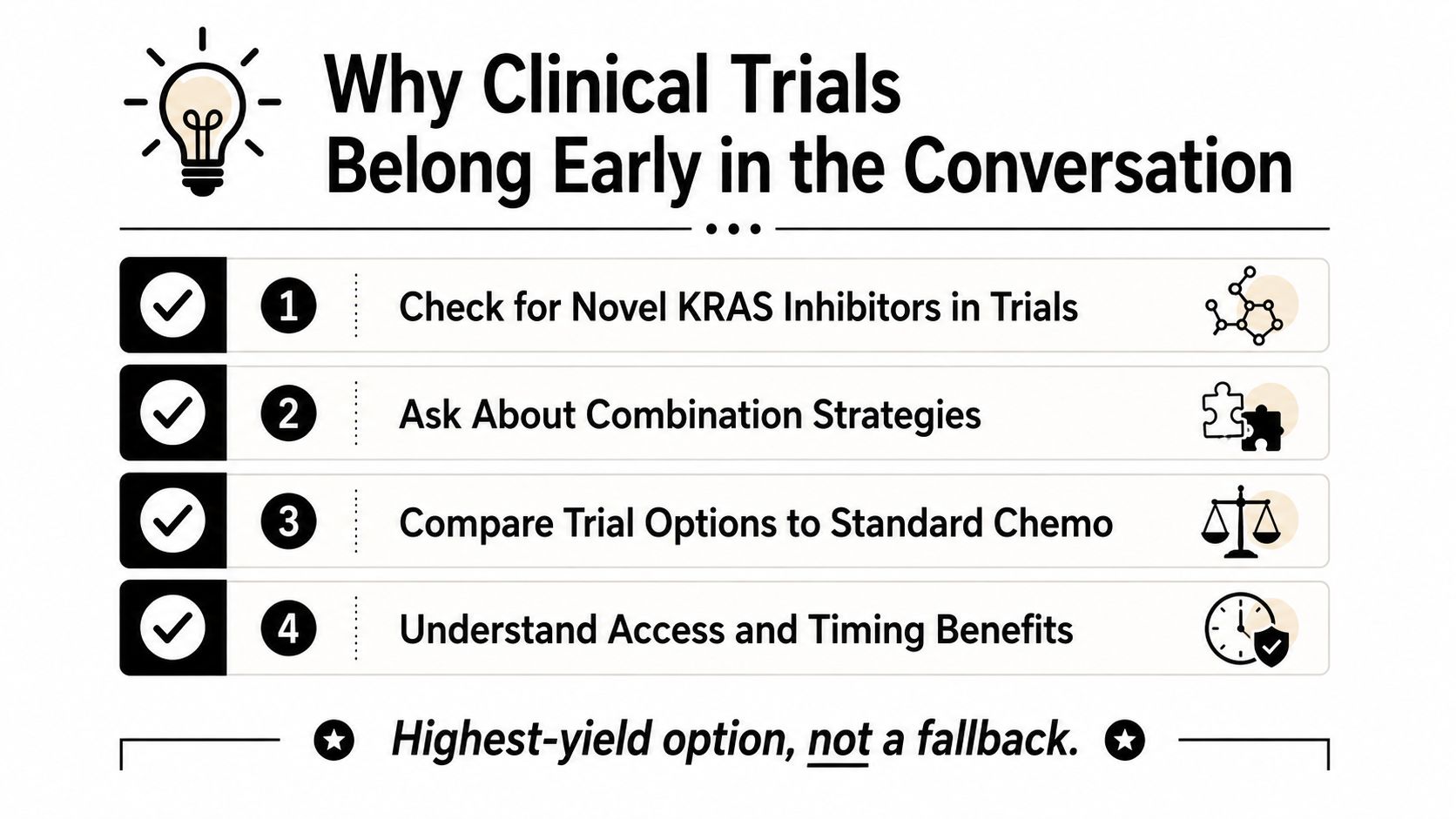
For most patients with a KRAS mutation, especially non-G12C disease, a trial is not a last resort. It's the best available way to match the tumor biology you have. Waiting until every standard option is exhausted often means worse performance status, more symptoms, and fewer trials you can safely enter.
What the current trial landscape is trying to solve
The strongest programs now include pan-KRAS inhibitors, G12D-selective agents like MRTX1133, G12V and G12R programs, and next-generation G12C inhibitors built to overcome resistance. Combination trials are also important, especially those pairing KRAS blockade with SHP2, SOS1, EGFR, or MEK inhibitors. These combinations are not random add-ons. They're designed to stop the pathway from rerouting around the first block.
The clinical trials guide is a useful starting point if you're trying to understand where these studies live and how access works. It won't list every study you need, but it will tell you what to look for.
How to search without wasting time
Use ClinicalTrials.gov first, then cross-check the major cancer center trial finders. Search by exact KRAS variant, not just “KRAS mutated.” Inclusion criteria usually hinge on the variant, prior therapy line, performance status, and organ function. If you only search by cancer type, you'll miss studies that fit the biology but not the diagnosis label.
Travel and timing matter too. Some studies need more frequent visits early on, blood draws, or extra scans. That commitment is worth it when the trial fits the mutation and the tumor is still controlled enough to give you time to join.
If you're eligible now, act now. Don't wait for the disease to force your hand. The earlier you enter the trial conversation, the more options you keep open.
Questions to Bring to Your Next Appointment
A strong appointment changes the plan. A passive appointment just repeats the chart. Bring a written list, ask for straight answers, and make sure someone with you is taking notes.
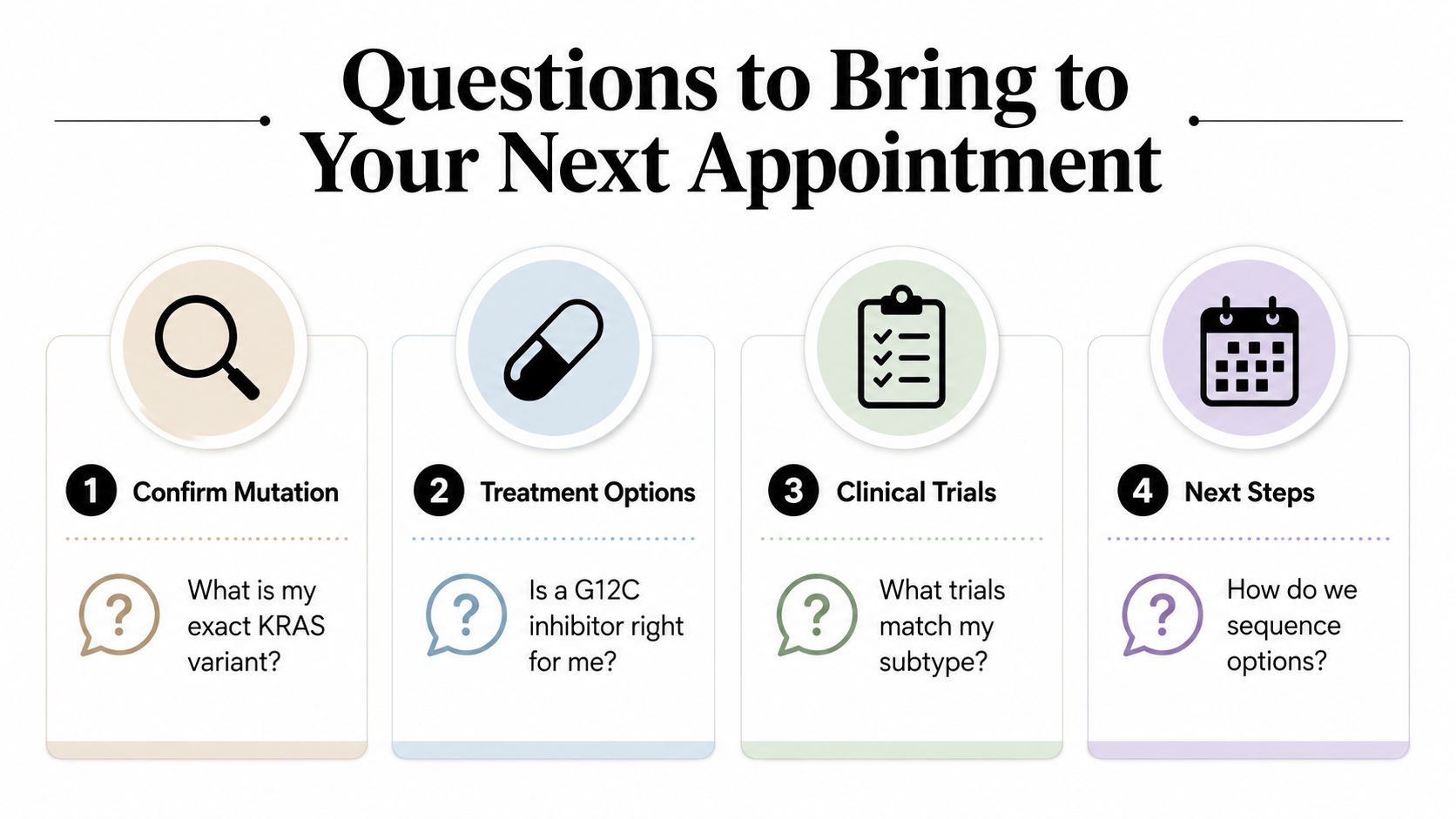
Confirm the mutation
- What is my exact KRAS variant? If the answer is just “KRAS positive,” the report is too vague for decision-making.
- Was sequencing done, or only a limited panel? A narrow test can miss other actionable alterations.
- Do I have co-mutations like STK11 or KEAP1? Those findings can change how I interpret response chances and trial eligibility.
Compare treatment options
- Is a G12C inhibitor right for me now? That depends on the variant, the cancer type, and prior treatment.
- If not, what is the next standard option, and why? I want to know the logic, not just the label.
- What supportive care do you use for side effects like diarrhea or liver enzyme elevation? I need to know how toxicity will be managed before I start.
Ask about trials and sequencing
- What trials match my exact subtype today? If there isn't one, ask what nearby academic centers have openings.
- Would you recommend a repeat biopsy or ctDNA when the cancer progresses? That can reveal the resistance mechanism and guide the next move.
- How will response be tracked? Ask about imaging timing and whether molecular trends will be followed.
Write the answers down, then ask for a copy of the molecular report before you leave. If possible, bring a caregiver who can catch details you miss when the conversation gets dense.
How Hirschfeld Oncology Approaches KRAS Care
Hirschfeld Oncology handles KRAS results the way they should be handled, as a molecular problem that has to be matched to the right patient, the right timing, and the right next step. The practice uses a molecular tumor board approach, so pathologists, medical oncologists, and clinical trial coordinators can review the result together instead of treating it as a one-line lab update. That matters when the question is not just “Is KRAS present?” but “Does this patient qualify for targeted therapy now, or should we push toward a trial?”
What the workflow looks like in practice
The first pass is making sure the report is complete. If the patient has only had limited testing, the team can push for broader genomic profiling so the subtype and co-alterations are known before treatment starts. For non-G12C disease, that often means trial matching first, not after the patient has already burned through the most useful windows.
For patients who do qualify for a G12C inhibitor, treatment can be given through the clinic's infusion and outpatient care pathways with close toxicity monitoring. The practical issues are the ones that matter most, liver enzymes, symptoms, and whether the regimen is still doing what it should be doing on scans and bloodwork. The team also uses ctDNA in follow-up when appropriate so early resistance doesn't surprise everyone at the next imaging appointment.
Good KRAS care is operational, not theoretical. The tumor board, the lab, and the next appointment all have to line up.
Access, follow-up, and real-world logistics
Insurance pre-authorization can slow everything down, so the clinic's staff helps with that process instead of handing families a stack of forms and wishing them luck. Financial counseling also matters because targeted drugs and testing can create friction long before treatment starts. For patients who travel from outside Brooklyn, telehealth follow-ups help keep monitoring consistent without forcing every visit to happen in person.
A new patient should bring the pathology report, any prior molecular testing, imaging disks or reports, and a treatment history with exact drug names if possible. The first month usually focuses on confirming eligibility, securing records, deciding whether a trial or approved drug makes more sense, and setting the monitoring plan before the first dose. If you're trying to decide whether kras mutation targeted therapy is the right path, this is the kind of coordinated review that keeps the decision grounded in facts instead of guesswork.
If you have a KRAS-mutated cancer and you want a straight answer about testing, eligibility, or trial matching, visit Hirschfeld Oncology and ask for a consultation. The right next step depends on the exact variant, the tumor type, and whether a targeted drug or trial is available for you now, and that conversation should happen with a team that knows how to move quickly.
.png)
.png)