.png)


The call often comes after a routine blood test. A CA-125 value has climbed from its lowest point, a scan shows a new pelvic nodule, or persistent pain has appeared after months of maintenance therapy. You and your family may hear the word recurrence and feel as though the entire treatment plan has collapsed.
It hasn't. Recurrent ovarian cancer demands a new plan, but it isn't a single decision called “more chemotherapy.” Your team must first confirm what has changed, measure how long the cancer stayed controlled after platinum treatment, assess whether surgery is realistic, review prior PARP inhibitor exposure, and match treatment to the tumor's biology and your priorities. This is the practical meaning of ovarian cancer recurrence treatment today.
When Ovarian Cancer Comes Back
Maria, a patient I'll call by that name, had completed chemotherapy and maintenance treatment. She felt well, but her CA-125 began rising. A scan later showed small areas of disease near the pelvis. Her first question was immediate: “What do we do now?”
The correct answer wasn't chosen from a single list of drugs. We reviewed the date of her last platinum treatment, the pace and location of the recurrence, her previous medicines, her blood counts, and what she valued most. She wanted active treatment, but she also wanted to preserve enough energy to spend time with her family. Those priorities mattered as much as the scan.
Recurrence is common in advanced ovarian cancer. A review reports that up to 70% of patients with stage III or IV disease relapse within 3 years after surgery and platinum-based chemotherapy, as described in this review of recurrent ovarian cancer management. That fact is painful, but it also explains why follow-up, retreatment, maintenance therapy, symptom control, and clinical trials are built into modern care.
The first questions after a recurrence call
Your oncologist should clarify several issues before recommending a regimen:
- Is the recurrence confirmed? A changing CA-125 can raise concern, but imaging, symptoms, and sometimes biopsy provide the fuller picture.
- When did the cancer last receive platinum? The interval strongly influences whether carboplatin-based treatment remains useful.
- Where is the disease? A few surgically accessible sites create a different discussion from widespread disease involving several organs.
- What treatments have already been used? Prior PARP inhibitors, bevacizumab, taxanes, and other drugs affect later choices.
- What matters most to you? Longer disease control, fewer clinic visits, avoiding neuropathy, preserving independence, or pursuing a trial may lead to different recommendations.
The central principle: recurrence changes the decision tree. It doesn't erase your options.
Some patients may be candidates for a platinum combination. Others need a non-platinum drug, a targeted treatment, bevacizumab, secondary cytoreductive surgery, or a clinical trial. The right sequence depends on the disease, not on a universal timetable.
Understanding Recurrence and How Soon It Happens
A 14-month platinum-free interval generally reopens discussion of carboplatin-based combination therapy. Doctors classify recurrence partly by measuring the platinum-free interval, the time between the last platinum treatment and the return or growth of cancer. The usual dividing line is 6 months. Relapse more than 6 months after platinum is generally called platinum-sensitive, while disease that returns or progresses within 6 months is considered platinum-resistant. Cancer that progresses during platinum treatment is often described as platinum-refractory.
Clinical language can be more specific. A recurrence from 6 to 12 months may be called partially platinum-sensitive in some treatment discussions. A relapse beyond 12 months often gives the team greater confidence that platinum retreatment may help. These labels describe the cancer's behavior, not anything you did or failed to do.
Timing matters because a longer treatment-free interval tends to predict a better chance of responding again. In one recurrent early-stage high-risk group, patients whose treatment-free interval exceeded 24 months had a median survival of 35 months, compared with 10 months for those recurring sooner, according to the reported recurrence and survival review. These figures cannot predict one person's outcome, but they explain why the exact treatment dates belong at the center of the discussion.
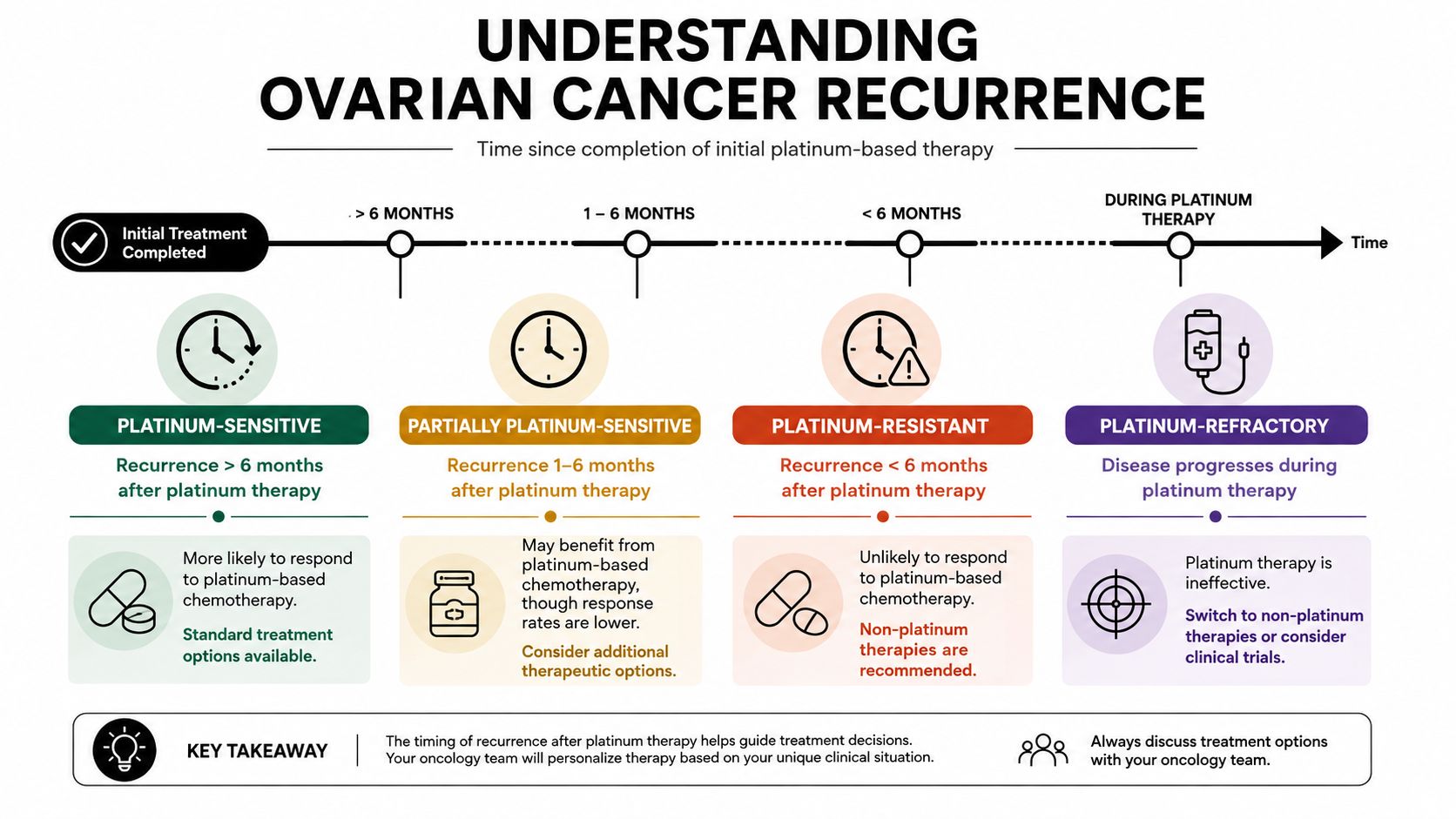
Compare your interval with the treatment categories
A recurrence diagnosed 14 months after carboplatin usually brings carboplatin-based combinations back into consideration. Current expert guidance lists carboplatin with paclitaxel, gemcitabine, or pegylated liposomal doxorubicin among preferred platinum-sensitive regimens, as outlined in this expert guidance on platinum-sensitive recurrence.
A recurrence four months after platinum leads to a different discussion. Repeating the same strategy is less likely to help, so non-platinum chemotherapy, targeted therapy, bevacizumab-containing treatment, or a clinical trial may be more appropriate. Prior treatment and biomarker results determine the choice.
An eight-month interval sits between those categories. The team may still recommend platinum, but expected benefit must be weighed against prior toxicity, residual neuropathy, blood-count recovery, and signs of emerging resistance.
Why the interval isn't the whole story
The interval starts the assessment. It does not prescribe treatment. A patient with a long interval but severe neuropathy may reasonably avoid another taxane. Someone with limited disease may need a surgical opinion before chemotherapy. Cancer that progressed while a patient was taking a PARP inhibitor may show less platinum sensitivity than the calendar suggests, shifting attention toward targeted therapy or a clinical trial.
Bring your treatment records and ask your oncologist to write down the exact date of the last platinum dose and the date recurrence was confirmed. Review common ovarian cancer recurrence symptoms, and report new or worsening symptoms directly to your care team.
How Doctors Confirm and Stage Recurrent Disease
A rising CA-125 after treatment can create immediate anxiety, but one result does not establish recurrence. Doctors compare the trend with your post-treatment nadir, the lowest recorded value, and assess it alongside symptoms, examination findings, and imaging. The goal is to determine whether the marker reflects visible or clinically meaningful disease.
Treatment does not automatically begin with a blood-test change. Some patients prefer therapy as soon as CA-125 rises, while others wait for symptoms or imaging to show disease requiring treatment. In the MRC OV05 and EORTC 55955 trial, starting treatment on the basis of CA-125 elevation alone did not improve overall survival compared with waiting for clinical or radiographic evidence. That result supports a deliberate discussion about timing, rather than an automatic response to the laboratory value.
The confirmation process
CT is usually the practical first scan because it evaluates the chest, abdomen, and pelvis and can measure tumor burden. PET-CT may identify metabolically active areas when CT findings are uncertain. MRI gives more detailed views of selected pelvic or soft-tissue abnormalities. The choice depends on the suspected disease location, earlier scans, kidney function, contrast considerations, and the specific question the team needs answered.
Biopsy is not required for every clear recurrence. It becomes more useful when imaging is ambiguous, a second cancer or noncancerous condition remains possible, or new tissue could provide molecular information that changes treatment. A sample can also confirm that the current disease remains the original ovarian cancer subtype.
What the staging workup must answer
The workup should establish:
- Disease distribution: Is recurrence confined to the pelvis, spread through the abdomen, or present outside the abdominal cavity?
- Resectability: Could surgery remove all visible disease without unacceptable harm?
- Treatment timing: How long has the cancer been away from platinum, and did it progress during or after PARP inhibitor treatment?
- Tumor biology: Are BRCA, homologous recombination deficiency, microsatellite status, and other actionable markers known?
- Baseline fitness: Are blood counts, kidney function, blood pressure, nutrition, and performance status adequate for the proposed treatment?
Prior PARP exposure belongs in this assessment. Progression while taking a PARP inhibitor can indicate reduced platinum sensitivity, even when the calendar interval appears favorable. That finding can shift the discussion toward a different targeted approach or a clinical trial instead of assuming that repeating the previous sequence will work.
| Tool | What It Shows | When It Is Used |
|---|---|---|
| CA-125 trend | Whether a tumor marker is changing from its prior baseline | During surveillance and alongside symptoms or imaging |
| CT scan | Anatomical disease location and measurable tumor burden | Common first-line imaging for suspected recurrence |
| PET-CT | Areas with increased metabolic activity | When CT findings are unclear or disease mapping needs clarification |
| MRI | Detailed soft-tissue and pelvic anatomy | For selected pelvic or indeterminate findings |
| Biopsy | Histology and potentially updated molecular information | When imaging is uncertain or new tissue could guide therapy |
Do not let a CA-125 number force a rushed decision. Ask what the scan shows, whether treatment now is likely to improve your situation, whether surgery deserves review, and whether close monitoring is medically reasonable.
Treatment Options for Ovarian Cancer Recurrence
There are several treatment lanes, and each solves a different problem. A platinum-sensitive recurrence may call for a combination designed to produce a strong response. Platinum-resistant disease often requires a different mechanism, symptom-focused goals, or a trial that offers access to an investigational approach.
The main treatment lanes
Platinum-based retreatment usually means carboplatin paired with paclitaxel, gemcitabine, or pegylated liposomal doxorubicin. Expert guidance identifies these combinations as preferred options for platinum-sensitive relapse, and bevacizumab can be added to a platinum doublet and continued as maintenance in current recurrence guidance. The main trade-offs include neuropathy with taxanes, fatigue, nausea, infusion reactions, and low blood counts.
Non-platinum salvage treatment may include weekly paclitaxel, pegylated liposomal doxorubicin, topotecan, or etoposide. These drugs are commonly considered when platinum is unlikely to help or when prior platinum toxicity makes rechallenge unattractive. Cytopenias, fatigue, nausea, hand-foot symptoms with liposomal doxorubicin, and neuropathy with paclitaxel can limit treatment.
Secondary cytoreductive surgery is not appropriate for every recurrence. It deserves consideration only when a gynecologic oncology surgeon believes complete gross resection is highly achievable and the patient can tolerate the operation. Surgery may offer a meaningful period without visible disease, but it carries risks such as bowel complications, infection, delayed recovery, and loss of function.
PARP inhibitors, including olaparib, niraparib, and rucaparib, are targeted medicines whose usefulness depends on treatment history and tumor biology. BRCA mutation and HRD status may support their use in selected settings, but prior PARP exposure can change the expected benefit. Review the practical issues in this overview of PARP inhibitor therapy, then ask whether your current situation matches an approved indication or a clinical trial.
Bevacizumab targets tumor blood-vessel formation and may be combined with chemotherapy or continued as maintenance. It can work regardless of BRCA status, but hypertension, protein in the urine, bleeding, blood clots, impaired wound healing, and rare bowel complications require careful screening.
Immunotherapy and combination trials may be appropriate when biomarkers, prior treatment, histology, or trial eligibility support them. Pembrolizumab combinations are being studied and used in selected settings, but immunotherapy can cause inflammatory effects involving organs such as the thyroid, liver, bowel, lungs, or skin.
| Treatment Lane | Best Candidates | Typical Benefit | Key Risks |
|---|---|---|---|
| Platinum combination | Longer platinum-free interval and adequate recovery | Tumor response and renewed disease control | Neuropathy, fatigue, nausea, cytopenias |
| Non-platinum chemotherapy | Platinum-resistant disease or platinum intolerance | Symptom relief or temporary control | Fatigue, low counts, neuropathy, hand-foot symptoms |
| Secondary surgery | Limited, technically removable recurrence | Removal of visible disease in selected patients | Operative complications and recovery burden |
| PARP inhibitor | Selected biomarker and treatment-history profiles | Maintenance or targeted disease control | Fatigue, nausea, cytopenias, rare serious blood disorders |
| Bevacizumab | Patients suitable for anti-angiogenic therapy | Added disease control with chemotherapy or maintenance | Hypertension, proteinuria, bleeding, bowel and wound risks |
| Immunotherapy or trial | Biomarker-matched or otherwise eligible patients | Access to a different mechanism | Immune-related inflammation and unknown trial risks |
The most important caveat is post-PARP treatment. In a multicenter retrospective study of women with platinum-sensitive recurrence during PARP inhibitor treatment, subsequent platinum chemotherapy produced an objective response rate of 23.3%, disease control of 43.3%, and median progression-free survival of 4.5 months, with frequent severe blood-count toxicity, as reported in this post-PARP platinum study. Another cohort using platinum chemotherapy with bevacizumab followed by bevacizumab maintenance reported an 82.6% objective response rate and 91.3% disease control, underscoring why the regimen and maintenance plan matter.
Choosing the Right Therapy for Your Situation
The treatment decision should answer five questions. The calendar, prior PARP exposure, molecular results, disease map, and your own goals all matter. No single factor deserves to dominate every case.
Five variables that steer the recommendation
Platinum sensitivity interval comes first. A patient whose cancer returns after 24 months without treatment may be a strong candidate for platinum retreatment, assuming prior toxicity and current health permit it. The combination may then be followed by maintenance therapy, observation, bevacizumab maintenance, or a trial.
Prior PARP inhibitor exposure changes the calculation. Someone whose cancer progressed on a PARP inhibitor within 6 months shouldn't be told that the old platinum-sensitive label guarantees a strong platinum response. The post-PARP evidence described above supports a more cautious discussion about expected benefit, blood-count risks, bevacizumab-containing strategies, and trials.
BRCA and HRD status can open or close targeted-treatment options. Germline testing looks for inherited changes, while tumor testing examines alterations within the cancer. If testing is old, incomplete, or based on a small specimen, ask whether new tissue or liquid biopsy could provide useful information.
Tumor burden and disease distribution determine whether surgery, systemic treatment, or both belong in the plan. A surgeon may recommend cytoreduction for carefully selected disease that can be completely removed. Widespread or rapidly progressive disease generally requires systemic treatment first.
Patient goals and performance status are not secondary considerations. A person who wants the longest possible remission may accept more monitoring and toxicity. Another may prioritize independence, fewer infusions, travel, or time away from treatment. Both choices can be medically sound.
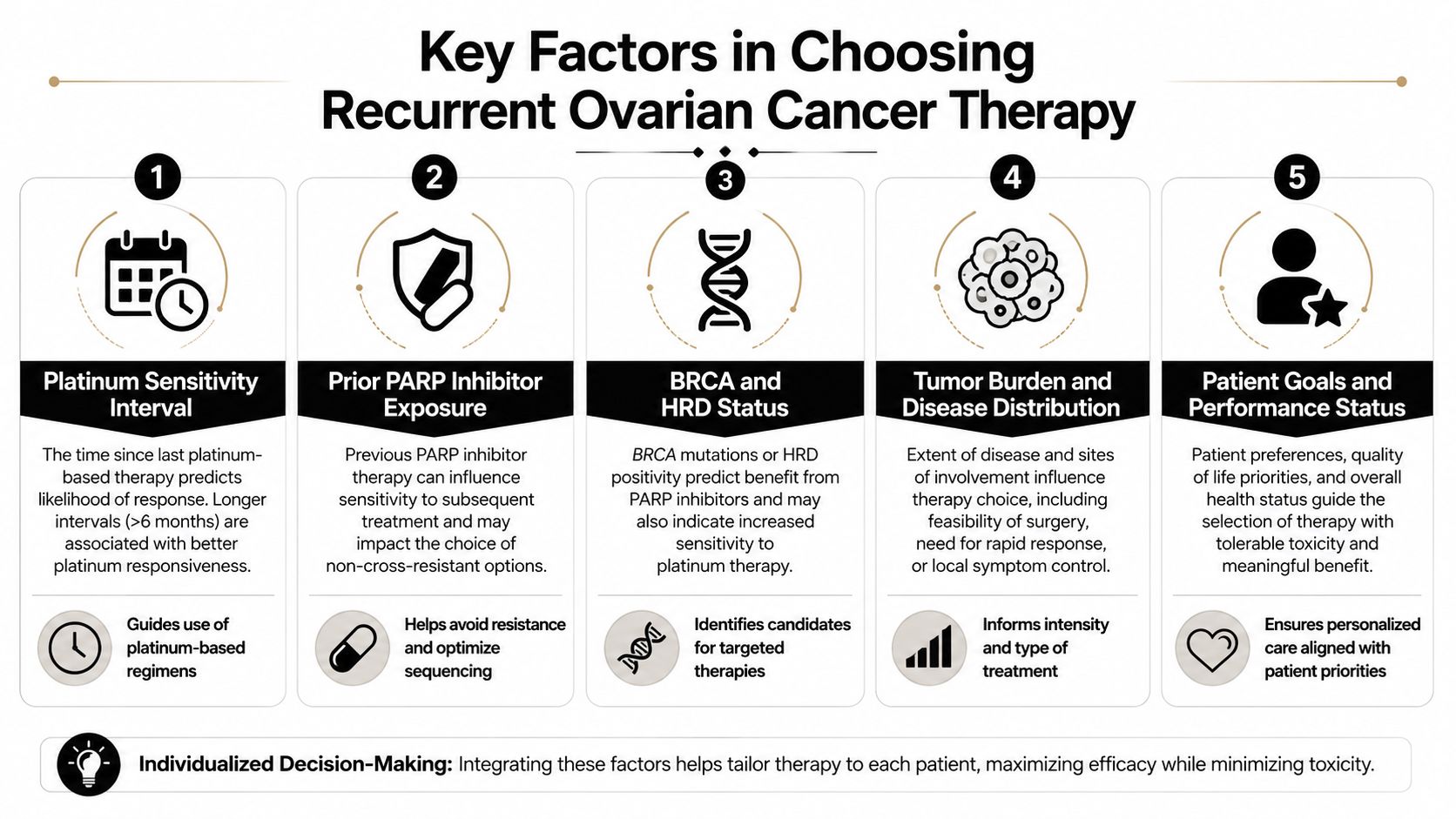
A 24-month treatment-free interval and no previous PARP inhibitor exposure may lead toward carboplatin-based retreatment followed by a maintenance discussion. By contrast, progression on PARP treatment within 6 months may push the team toward a non-platinum mechanism, a biomarker-directed drug, bevacizumab in the right setting, or a clinical trial.
Molecular retesting can be worthwhile when the original tumor sample is unavailable or when the cancer's behavior has changed. Ask whether sequencing can identify BRCA reversion changes, HRD-related findings, microsatellite instability, or another actionable feature. For a fuller discussion of resistant disease, review this guide to platinum-resistant ovarian cancer.
My recommendation: choose the treatment that fits the cancer's current biology and your life. The newest drug isn't automatically the right drug.
Living Well Through Recurrence Treatment
Recurrent ovarian cancer often requires repeated decisions over time. That makes quality of life a treatment outcome, not an optional add-on. A regimen that controls disease but leaves you unable to walk comfortably, eat normally, sleep, or participate in family life may need adjustment.
Taxane-related neuropathy can affect balance, buttoning clothes, and driving. Fatigue may result from treatment, anemia, poor sleep, pain, depression, or several causes at once. Bowel changes can follow surgery, medication, adhesions, or radiation. Pain, lymphedema, nausea, appetite loss, and sexual health concerns deserve direct treatment rather than quiet endurance.
Build supportive care into every visit
Ask your team about anti-nausea medicines, bowel regimens, pain plans, anemia evaluation, physical therapy, nutrition support, and medication reviews. Palliative care can work alongside cancer treatment to manage symptoms and clarify goals. It doesn't mean treatment has stopped.
Mental health support matters because recurrence creates a life lived between scans. A psycho-oncology referral, support group, therapist, social worker, or trusted family routine can reduce isolation. Intimacy and fertility concerns also deserve an honest conversation, even when fertility preservation is no longer possible, because body image, sexual function, and relationships remain part of health.

Practical rehabilitation can help address weakness, balance problems, mobility limits, and recovery after surgery. Patients and caregivers may find useful guidance in this resource on Lake City Physical Therapy recovery, particularly when a structured rehabilitation plan is needed.
Protect your autonomy
Advance care planning isn't giving up. It records who should speak for you, what treatments you would accept, and what matters if you become too ill to decide in the moment. Choosing a treatment break, reducing chemotherapy intensity, or stopping an ineffective regimen can be a rational medical decision.
Tell your team about symptoms early. Waiting until neuropathy, dehydration, pain, or exhaustion becomes severe makes treatment harder. Your care plan should protect time outside the infusion center, not only chase the next scan.
Finding the Right Care Team and Next Steps
Recurrence should be managed by a team that treats gynecologic cancers regularly, not by a general oncology practice working without specialist support. Look for access to a gynecologic oncologist, molecular profiling, surgery review, PARP and anti-angiogenic therapy, symptom management, and active clinical-trial screening.
Ask direct questions before committing to a plan:
- Guideline alignment: Does the team follow current NCCN guidance for recurrent ovarian cancer?
- Molecular testing: Can they obtain tumor sequencing quickly, and will they test both inherited and tumor-specific changes when appropriate?
- Trial access: Which trials are open for my ovarian cancer subtype, treatment history, and biomarker profile?
- Surgical review: Will a gynecologic oncology surgeon assess whether complete cytoreduction is feasible?
- Team coordination: Do medical oncology, surgery, radiology, pathology, palliative care, and rehabilitation review complex cases together?
- Communication: Who should you call when fever, pain, diarrhea, neuropathy, or other treatment effects appear?
Continuity also matters. You need a point person who knows your treatment history, understands your priorities, and can explain why the plan changes when scans or molecular results change. A tumor board can be particularly valuable when surgery, targeted treatment, and clinical-trial enrollment compete for priority.
In Brooklyn, Hirschfeld Oncology is one specialized option patients may consider for individualized recurrence treatment, genomic testing, and trial-matching support. Its care model includes outpatient infusion and treatment planning for complex cancers, but patients should compare centers based on specialist access, trial availability, communication, and the specific expertise their case requires.
Bring your pathology reports, operative notes, scan discs or reports, treatment dates, medication list, genetic results, and a written list of goals to your next appointment. Ask the oncologist to explain the expected benefit, major risks, alternatives, and what would trigger a change in strategy.
Hirschfeld Oncology offers individualized cancer treatment, genomic testing, symptom-focused monitoring, and support in evaluating emerging options for recurrent ovarian cancer. Visit Hirschfeld Oncology to learn more and prepare for a consultation about a treatment plan matched to your disease biology and personal priorities.
.png)
.png)