.png)


You're sitting in a consultation room or staring at a scan report, and the sentence you're trying to process is simple and brutal, the pancreatic cancer has spread. At that point, families don't need vague reassurance. They need a clear plan, a frank explanation of what treatment can still do, and an honest view of the trade-offs.
Pancreatic cancer treatment stage 4 is not about chasing a cure that standard care can't deliver. It's about choosing the right first move, getting the right biomarkers, deciding how hard the body can safely be pushed, and making symptom control part of the treatment plan from day one. The week-one decisions matter because they shape whether treatment is aggressive, modified, or focused on comfort and function.
When Stage 4 Pancreatic Cancer Becomes the Diagnosis
The diagnosis usually lands in one of three ways. A scan for pain or weight loss shows spread to the liver, lungs, or peritoneum. A biopsy after jaundice reveals metastatic disease. Or the cancer comes back after earlier treatment, and now the question is no longer whether it's pancreatic cancer, but how far it has moved.
Stage 4 means the cancer has gone beyond the pancreas to distant sites, which is why surgery alone is no longer enough. At this point, the disease is managed as a whole-body problem, not a local one. That shifts the goal from eradication to control, symptom relief, and preserving daily function.
The first 30 days are decision-heavy
Families usually think they need one big answer. They need five practical ones.
- Which regimen fits the body now. Good performance status opens the door to combination chemotherapy, while frailty changes the plan.
- How intense treatment should be. Some patients can handle multi-drug therapy, others need dose reduction or a gentler sequence.
- Whether biomarker testing has been done. That affects targeted therapy, immunotherapy, and trial eligibility.
- Whether a trial is realistic. Trial access should be discussed early, not after every standard option is exhausted.
- What supportive care is needed immediately. Pain, nutrition, biliary obstruction, and anxiety are not side issues.
Practical rule: if the first appointment doesn't produce a treatment path, a biomarker plan, and a symptom plan, the visit wasn't complete.
That's the right lens for the rest of this guide. The next sections walk through the numbers, the frontline regimens, biomarker-driven options, lower-toxicity plans, trials, symptom care, and what a focused Brooklyn-based consultation can look like.
What the Survival Numbers Mean
The numbers are grim, and pretending otherwise helps no one. The U.S. SEER summary for pancreatic cancer shows 3.4% five-year relative survival for distant disease, and 51% of cases are diagnosed at the distant stage, which is a big reason this cancer still ranks among the deadliest major cancers despite progress in care. SEER pancreatic cancer statistics

Johns Hopkins summarizes stage IV pancreatic cancer as having a five-year survival rate of 1% and an average survival of about one year after diagnosis. Those figures are not contradictions, they are different ways of describing the same disease burden from different populations and definitions. Johns Hopkins overview and prognosis
What the averages can't tell you
These are population averages, not forecasts for one person. They include patients diagnosed years ago, people who were too sick for treatment, and patients whose tumors lacked modern biomarker testing. That means the numbers are useful for setting expectations, but not for predicting your exact outcome.
A more useful question is whether the treatment path is changing the odds in front of you. For families trying to understand what a percentage means in real terms, this breakdown of absolute risk vs relative risk helps separate a headline number from the clinical picture.
The better signal is direction. One registry analysis found that 1-year survival for distant-stage pancreatic cancer increased from 14% to 22% between 2004 and 2019. Another literature review reported rising survival over time in metastatic disease, including a climb in 1–5 year survival from 9.29% in 2000 to 22.99% in 2014. JGO historical survival analysis
Bottom line: the baseline is still poor, but it isn't frozen in time.
That matters because treatment goals are based on reality, not optimism theater. Stage 4 therapy is usually chosen to extend life, reduce symptoms, and protect function. The numbers justify urgency, but they also justify serious treatment, because the historical curve has moved in the right direction.
First-Line Chemotherapy in Stage 4 Disease

For metastatic pancreatic ductal adenocarcinoma, chemotherapy remains the backbone of treatment. The usual first-line choices are FOLFIRINOX and gemcitabine plus nab-paclitaxel, and the right call depends less on the stage label than on the person sitting in front of me. Performance status, bilirubin, liver function, neuropathy risk, age, and comorbidity burden all shape that decision.
How oncologists choose between the two
FOLFIRINOX is the more aggressive option. It combines folinic acid, 5-fluorouracil, irinotecan, and oxaliplatin, and in U.S. practice it is often given in a dose-modified form rather than the original full-intensity protocol. That reflects adaptation to real-world patients who still want the benefit of combination therapy without being crushed by toxicity.
Gemcitabine plus nab-paclitaxel is the other standard first-line pathway. It is often the more practical choice when a patient needs treatment, but not the heaviest treatment. The combination is still systemic therapy, still active, and still used with intent to control disease. For a straightforward clinical overview of that regimen, this gemcitabine and Abraxane practical guide is a useful reference.
Current major guidance recommends FOLFIRINOX or gemcitabine/nab-paclitaxel for patients with good functional status, especially ECOG 0–1, with adequate bilirubin and liver function. After FOLFIRINOX, a gemcitabine-based regimen can be used in selected ECOG 0–2 patients with favorable comorbidity profiles. NCI pancreatic treatment PDQ
What the regimen intensity changes
Intensity can translate into measurable survival differences in the right patient. In the phase III data summarized by UCLA, NALIRIFOX produced median overall survival of 11.1 months versus 9.2 months with a two-drug comparator, and progression-free survival improved from 5.6 to 7.4 months. That is not a miracle, but it is real.
The point is not that everyone should get the most intense plan. The point is that stronger regimens can help selected patients, while weaker bodies need a smarter approach.
Clinical reality: the best regimen is the one the patient can complete.
Families sometimes ask which drug is “best.” That is the wrong question. The right question is whether the patient can tolerate the treatment long enough to benefit from it. The first visit should end with a regimen, a monitoring plan, and a backup if the first choice proves too toxic.
Targeted Therapy and Immunotherapy by Biomarker
Most stage 4 pancreatic cancer does not qualify for a targeted or immune-based drug. That's the uncomfortable truth, and it's still worth saying because it prevents false hope. But for the smaller group with the right tumor features, biomarker-directed therapy can change the plan completely.
The biomarkers that actually matter
BRCA1/2 or PALB2 mutations point toward platinum sensitivity and can open the door to PARP inhibitors such as olaparib after appropriate chemotherapy. MSI-H or dMMR status can make a patient eligible for pembrolizumab, regardless of the tumor's organ of origin. NTRK fusions can qualify a patient for larotrectinib or entrectinib. HER2 amplification is still being studied in basket trials and combination strategies.
Here's the practical part. If the tumor has never had genomic profiling, that needs to be fixed quickly. If it has, the report should be reviewed for both immediate options and future ones. Biomarkers don't just affect first-line therapy, they shape second-line planning and trial access.
| Biomarker | Therapy Class | Eligible Patients | Setting |
|---|---|---|---|
| BRCA1/2 or PALB2 | Platinum-based chemotherapy, PARP inhibition | Patients with an actionable inherited or tumor alteration | Standard care in selected patients |
| MSI-H or dMMR | Immunotherapy | Patients whose tumor shows mismatch repair deficiency or high microsatellite instability | Tumor-agnostic treatment pathway |
| NTRK fusion | Targeted therapy | Rare patients with an NTRK gene fusion | Standard targeted option when present |
| HER2 amplification | Targeted combinations | Selected patients in studies or specialized programs | Trial-based or investigational use |
Why this testing has to happen early
Genomics are not a luxury add-on in metastatic pancreatic cancer. They're a sorting tool. If the tumor has an actionable alteration, you don't want to discover it after two rounds of ineffective chemotherapy.
Ask for the actual report, not a vague summary. You need the biomarker name, the result, and the treatment implication.
Most patients won't have one of these markers, and that's exactly why standard chemotherapy still matters. But the minority who do can move into a different treatment lane, and that lane should be identified at the start.
Lower-Toxicity and Individualized Regimens
A lot of online advice treats lower-intensity treatment like a compromise. I don't. For frail stage 4 patients, it's often the correct plan.
When less is the right amount
Many people with metastatic pancreatic cancer are older, malnourished, dealing with biliary stents, or carrying other diseases that make full-intensity treatment unsafe. In that setting, a dose-modified regimen, sequential single-agent therapy, or a low-dose approach can be more honest than forcing a patient through something they won't finish.
That's not a retreat. It's medicine.
One large analysis found that only 49.1% of stage IV patients received systemic therapy, and use was lower among older patients, women, African American and Hispanic patients, uninsured or publicly insured patients, and those treated outside academic centers. PanCAN stage 4 treatment access overview
What individualized care looks like in practice
A plan might start with one drug, then add another if the first is tolerated. It might begin after a biliary obstruction is treated, or after nutrition is stabilized. It might use a lighter schedule to preserve strength, especially when the main goal is maintaining function while still treating the cancer.
That is the philosophy Hirschfeld Oncology uses in complex cases, individualized regimens built around the patient's performance status and goals. It's not about rejecting standard care, it's about matching the treatment to the body in front of you.
Good oncology is selective. It knows when to intensify, and when not to.
The families who do best in this setting ask hard questions early. Can the patient walk in independently? Is appetite collapsing? Is neuropathy already present? Is the liver working well enough for treatment? These questions matter as much as the scan.
Finding and Enrolling in a Clinical Trial
Clinical trials are not a last-ditch move. In stage 4 pancreatic cancer, they're part of the normal conversation, especially if standard chemotherapy is unlikely to deliver enough.
The three trial types worth looking for
First, there are first-line combination trials that add a new agent to standard chemotherapy. Second, there are second-line trials for patients whose disease has progressed after FOLFIRINOX or gemcitabine/nab-paclitaxel. Third, there are biomarker-selected trials for patients with BRCA, MSI-H, KRAS-related, or other actionable findings.
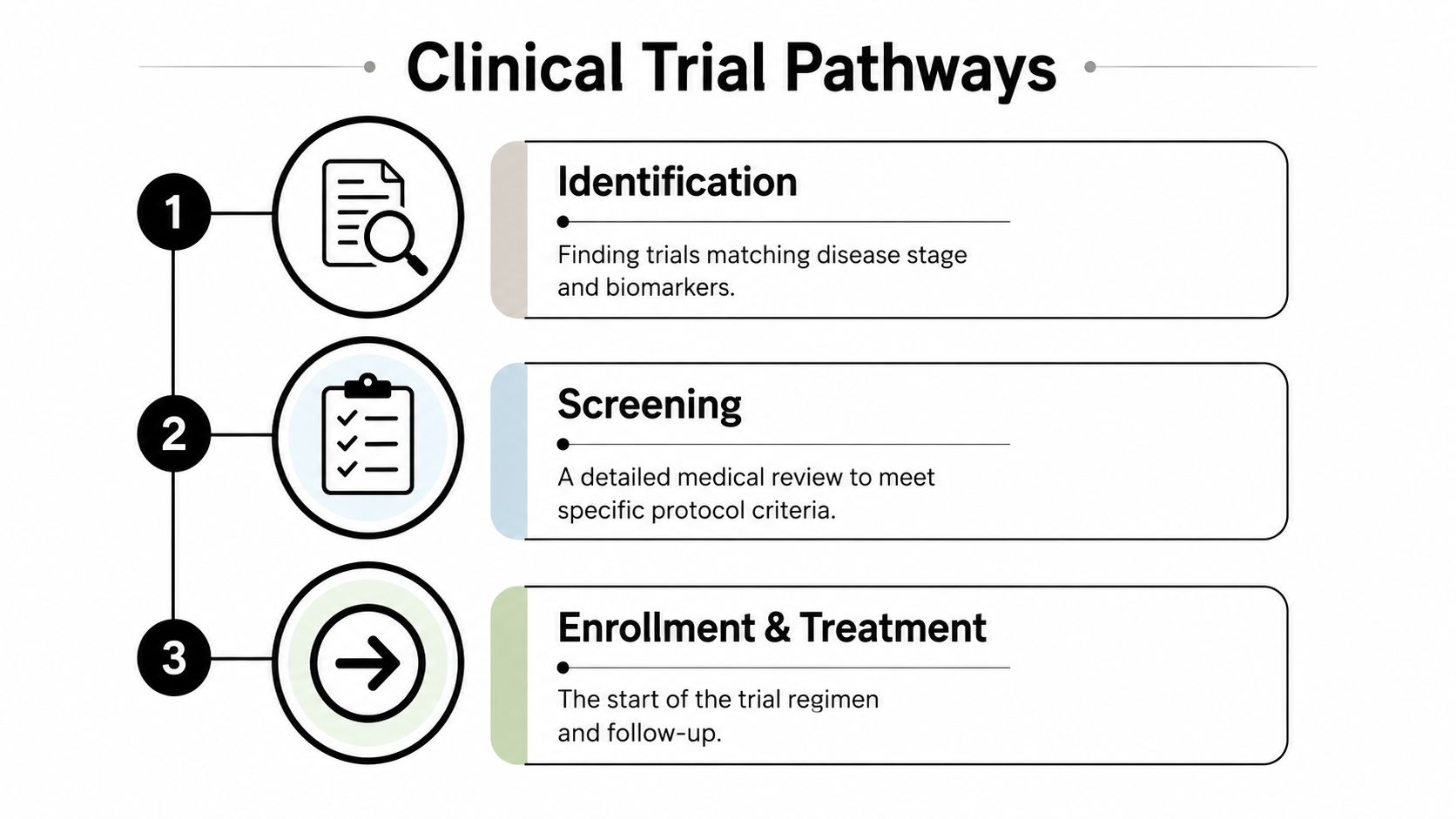
The search itself should be practical. On ClinicalTrials.gov, use the condition, stage, and biomarker fields. Then screen for travel burden, visit frequency, randomization, and whether standard-of-care drugs are included. If a trial requires weekly travel that the family can't realistically manage, it's not a good trial for that patient, no matter how promising the science sounds.
What to ask before signing anything
- What's the control arm? You need to know what the standard comparison is.
- What does the schedule require? Number of visits matters more than people think.
- Are standard drugs covered? Some trials add investigational therapy on top of ordinary care.
- What happens if the cancer grows? That answer should be clear before enrollment.
- Can I get in quickly? Stage 4 pancreatic cancer doesn't wait for paperwork.
This guide to clinical trial opportunities for pancreatic cancer patients is useful if you want a more detailed patient-facing overview of how trial access gets discussed in real clinics.
Don't accept “no trial available” at face value. Ask whether the search included biomarker eligibility and nearby centers.
A good oncologist doesn't treat trials as a separate universe. Trials sit on the same table as chemotherapy, biomarker results, and supportive care.
Palliative Care and Symptom Management That Works
A stage 4 pancreatic cancer diagnosis forces fast choices, but symptom control should start right away. Palliative care is active symptom treatment, and it belongs in the plan from the beginning.
What families should ask for right away
The main problems are predictable. Pain often comes from celiac plexus involvement. Biliary obstruction may need stenting. Ascites can require drainage. Cachexia and weight loss need nutrition support. Blood clots need immediate attention. Depression and anxiety are part of the disease burden, not a side note.
Interventional gastroenterologists handle stents. Pain specialists can perform celiac plexus blocks or neurolysis. Radiation oncologists may use palliative radiation for local pain. Oncology dietitians help with weight loss and poor intake. Palliative medicine physicians coordinate the whole picture.
Early palliative care usually improves quality of life because it addresses symptoms before they spiral. It also helps some patients tolerate chemotherapy better by improving sleep, intake, and mobility.
For a practical patient-facing perspective on what good coordination and communication should look like, Recepta.ai's patient experience tips are worth reading alongside this discussion.
What good symptom control changes
Good symptom management does not replace cancer treatment. It makes treatment possible. A patient with less pain, better biliary drainage, and better nutrition is more likely to finish therapy, keep appointments, and stay out of crisis care.
Symptom control is treatment. If pain, nausea, or obstruction are ignored, the cancer plan fails in practice even if it looks good on paper.
Families should ask for a specific plan, not just “supportive care.” Ask who manages pain, who manages stents, who manages appetite, and who to call after hours if symptoms change fast.
How a Consultation at Hirschfeld Oncology Works
A good consultation for stage 4 pancreatic cancer should feel like a workup, not a sales pitch. The first visit at Hirschfeld Oncology in Brooklyn starts with a detailed review of pathology, imaging, prior treatment, and the exact sequence of what has already been done. If biomarker testing or genomic profiling hasn't been completed, that gets addressed immediately.
What the first visit should include
The team checks performance status, liver function issues like bilirubin, comorbidity burden, and whether the patient can tolerate combination treatment or needs a gentler plan. Then comes the key conversation, what matters most right now, life extension, symptom relief, time at home, or a combination of those goals.
Treatment plans are individualized and may include immunotherapy, low-dose chemotherapy, targeted therapy, or a combination, with close toxicity monitoring. The practice focuses on advanced and complex cancers, including pancreatic, bile duct, colorectal, gastric, breast, ovarian, and esophageal disease, and it takes on patients whose standard options have narrowed or run out.
Why the setting matters
The practice serves Williamsburg, Bushwick, and greater New York City, and the in-house infusion center lets treatment start without bouncing between disconnected sites. For patients who are juggling multiple appointments, that matters more than most clinics admit.
If you're comparing how different practices document visits, a tool like the 2026 Dragon Medical Dictation guide from AIDictation can help you understand how clinicians can capture complex oncology decisions more cleanly during a fast-moving consultation.
The best first visit ends with three things, a clear working plan, the next test or infusion date, and a direct contact path for questions. You should leave knowing who is managing the cancer, who is managing symptoms, and what happens next if the first treatment doesn't fit.
If you're dealing with stage 4 pancreatic cancer right now, don't wait for the disease to force your next step. Hirschfeld Oncology offers individualized consultation, infusion-based treatment, and close symptom-focused monitoring for advanced cancers, including pancreatic disease. Reach out now so you can review your pathology, biomarker status, and treatment options with a team that deals with complex cases every day.
.png)
.png)