.png)


When you’re going through cancer treatment, you hear a lot of new and often intimidating terms. If your oncologist mentions that your cancer is "refractory," it can be especially jarring. So, what does that actually mean?
Put simply, refractory cancer is cancer that doesn’t respond to treatment from the very beginning. The initial therapy—whether it’s chemotherapy, radiation, or something else—just isn't shrinking the tumor or stopping its growth.
What Refractory Cancer Really Means
Think of it this way: your first treatment is like a specific key, designed to fit the lock on your cancer cells and stop them from multiplying. With refractory cancer, that key just doesn't fit the lock. For a whole host of biological reasons, the cancer has a built-in defense against that particular therapy, and the treatment can't get a foothold.
It's crucial to understand how this differs from a few other terms you might hear from your care team, as the distinction has a big impact on your next steps.
Decoding Common Cancer Terms
To help clear up any confusion, here’s a simple breakdown of these often-mixed-up terms. They sound similar, but each one describes a very different situation in your cancer journey.
Understanding which category your cancer falls into is the first step your oncology team takes to figure out what to do next.
How Doctors Diagnose It
There isn't a single, definitive test that shouts "refractory!" Instead, your oncologist reaches this conclusion by carefully observing how your cancer behaves during the initial rounds of therapy. It's a diagnosis based on a collection of evidence.
This typically involves a few key checks:
- Imaging Scans: Your doctor will use PET scans, CT scans, or MRIs to get a clear picture of the tumors. If these scans show that the tumors are still growing despite treatment, it’s a strong signal that the cancer is refractory.
- Tumor Markers: These are specific substances in your blood or tissue that can indicate cancer activity. If the levels of these markers are rising during therapy, it suggests the treatment isn't having the desired effect.
- Clinical Observation: Just as important is how you are feeling. Your oncologist will assess your overall health and symptoms. If your symptoms aren't improving or are getting worse, it adds to the evidence that the current approach isn't working.
This diagnosis isn't a dead end. Far from it. Think of it as a critical turning point—a sign that the first strategy failed and it’s time to pivot. It’s the moment your team starts searching for a new set of keys. If you want to dig deeper into this topic, you can read more about what happens when chemotherapy stops working.
A refractory cancer diagnosis means the first line of defense was ineffective, but it simultaneously opens the door to a more personalized and targeted second line of attack, often involving advanced therapies tailored to your cancer's unique biology.
This situation requires a shift toward different, often more advanced, treatment strategies. For instance, some tumors are refractory to powerful immunotherapy drugs known as checkpoint inhibitors. This growing challenge is pushing researchers to develop new solutions, a market you can explore more insights on at Future Market Insights.
Why Cancer Develops Treatment Resistance
To understand what makes a cancer refractory, we first have to grapple with a tough question: why does a treatment that was working suddenly stop? The answer isn't that the treatment failed, but rather that the cancer outsmarted it. Cancer is incredibly adaptive.
It’s helpful to stop thinking of a tumor as one single thing. Instead, picture it as a diverse, chaotic population of individual cells. When a treatment like chemotherapy begins, it’s like a massive attack that wipes out the weakest, most vulnerable cells in that population.
But what about the outliers? In that huge crowd of cells, a few might have unique traits that just happen to make them resilient to that specific attack. These are the survivors.
With all their competition gone, these few tough cells now have all the space and resources they need to multiply. Before long, they’ve repopulated the area, creating a new tumor made up almost entirely of cells that the original treatment can't touch. In essence, the cancer has evolved.
This flowchart shows how that common progression from diagnosis to resistance can unfold.
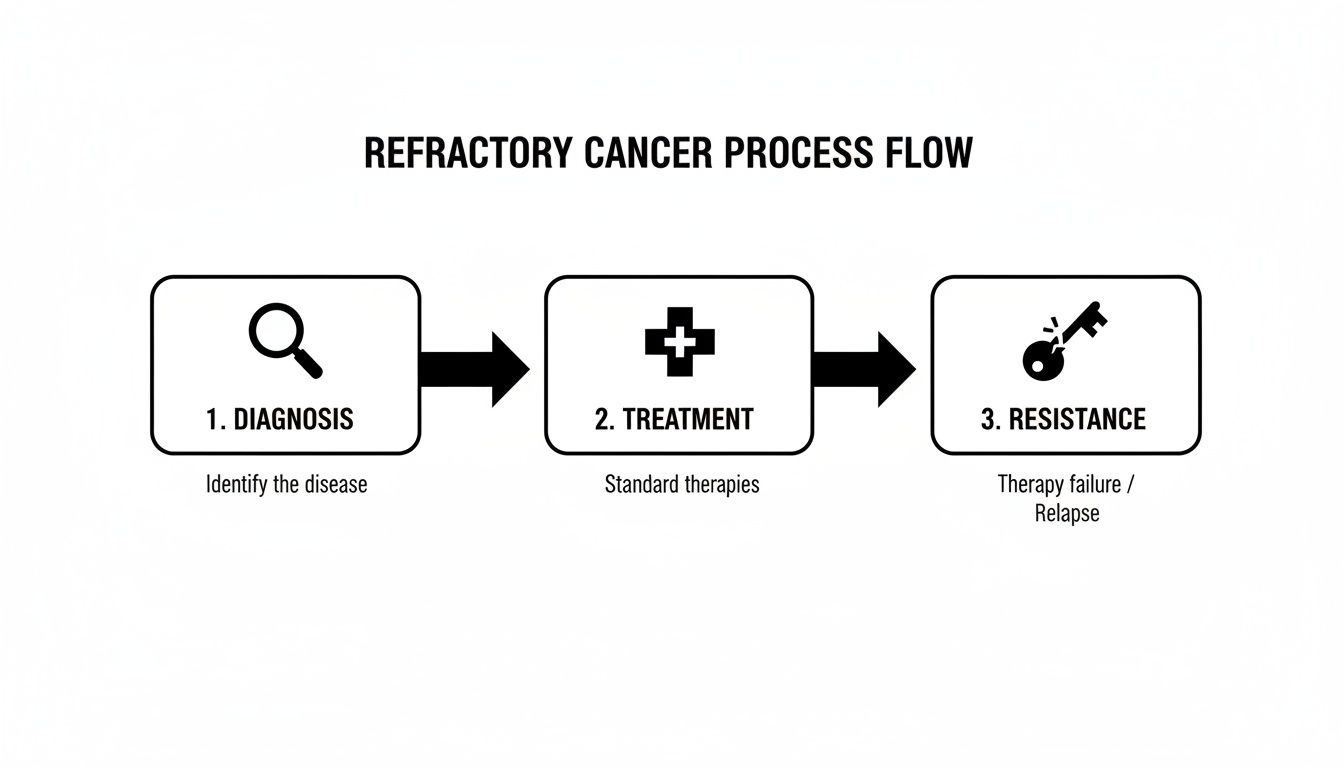
This process shows how the very act of treatment can unintentionally select for the strongest, most resistant cancer cells, paving the way for the cancer to become refractory.
The Role of Genetic Mutations
So, what makes those survivor cells so tough? Most of the time, it comes down to genetic mutations. Cancer cells are messy and unstable; when they divide, they make mistakes in their DNA far more often than healthy cells do.
Most of these genetic typos are useless or even fatal to the cancer cell itself. But every so often, a random mutation gives the cell a powerful new survival tool.
It’s like the cancer cell has suddenly developed a new defense mechanism. This can happen in a few key ways:
- Drug-Ejecting Pumps: A mutation might create tiny pumps on the cell’s surface that literally spit a chemotherapy drug back out before it can cause any harm.
- Changing the Lock: Targeted therapies are like keys designed to fit a specific lock (a protein) on the cancer cell. A mutation can change the shape of that lock, so the drug-key no longer fits.
- Super-Powered Repair Kits: Other mutations can boost a cell's ability to repair the DNA damage caused by chemo or radiation, allowing it to shrug off the attack and keep dividing.
This relentless process of mutation is why a cancer that was shrinking can suddenly start growing again. A new, resistant family of cells has taken over.
The Challenge of Tumor Heterogeneity
This leads to another critical concept: tumor heterogeneity. This simply means that even within a single tumor, there are multiple, distinct groups of cancer cells living together. Some neighborhoods in the tumor might be vulnerable to a treatment, while others are naturally resistant from the start.
This diversity is a huge hurdle. A treatment might shrink the sensitive parts of the tumor, making it look like it's working beautifully on scans. Meanwhile, the resistant pockets of cells are left behind, completely unaffected and free to take over the territory.
Tumor heterogeneity isn't a sign of failure. It's a fundamental biological reality of cancer. It forces us to move beyond one-size-fits-all attacks and develop smarter strategies that can tackle the different cell populations at once.
This is why understanding the specific genetic profile of your tumor is so important. Advanced testing can identify the unique biomarkers that are driving the cancer’s growth and helping it resist treatment. You can learn more about what cancer biomarkers are in our detailed guide and how they are used to create better treatment plans.
A refractory diagnosis doesn’t mean the fight is over. It means it’s time to change the plan. The goal shifts to gathering better intelligence on this newly evolved enemy so we can launch a new, more precise attack aimed at its specific weak points.
The Reality of a Refractory Cancer Prognosis
Hearing the words "refractory cancer" is tough. Your mind probably goes straight to one question: what does this mean for my future? It's a completely normal and necessary question to ask. When you start looking up survival statistics for cancers known to be stubborn, the numbers you find can be incredibly disheartening.
But it’s absolutely critical to understand what those statistics really represent.
Think of survival rates as a rearview mirror. They show what happened to patients who were treated years ago, often with therapies that we’ve since improved upon or replaced entirely. They don’t reflect today’s pace of discovery, and they certainly don’t predict your individual outcome. Your prognosis isn't some fixed number pulled from a chart; it's something that is actively being shaped right now.
Putting Statistics into Context
So, if these numbers aren't about you, why do we even talk about them? Because they give us the wide-angle view. They show us the scale of the challenge and explain why there's a massive global effort to find better answers. Refractory cancers are a major reason why overall cancer survival hasn't progressed as fast as we'd like.
For instance, the five-year survival rate for pancreatic cancer still hovers around 13%, largely because it is so often resistant to treatment from the start. On a larger scale, forecasts for 2026 in the U.S. suggest we'll see over 2.1 million new cancer cases and more than 626,000 deaths. A significant number of those situations will involve a refractory diagnosis, which is precisely what drives the urgent work being done in labs and clinics around the world. You can see these projections for yourself in this comprehensive cancer statistics review.
The point of these figures isn't to cause fear. It’s to show you that oncologists, researchers, and drug developers see this problem clearly and are relentlessly focused on solving it.
Your prognosis is not a statistic. It’s a personal journey shaped by your unique cancer biology, your overall health, and the specialized care you receive. A refractory diagnosis is the starting line for a new, highly focused strategy.
This is where the conversation turns away from the masses and focuses squarely on you.
What Truly Shapes Your Prognosis
While general statistics can paint a grim picture, they completely miss the power of a personalized, modern approach. Several key factors can fundamentally change your path forward, moving you far beyond the limits of old data.
Three things, in particular, make all the difference:
- Access to Specialized Care: Finding an oncologist who lives and breathes complex, hard-to-treat cancers is vital. These specialists are immersed in the latest research and are often more familiar with emerging therapies or creative treatment combinations that aren't yet common knowledge.
- Advanced Diagnostic Testing: Getting a deep, comprehensive genomic profile of your tumor is no longer a "nice to have"—it's a necessity. This kind of testing can reveal the specific mutations that are fueling the cancer's resistance, giving your team a roadmap to attack its precise weaknesses with targeted therapies or immunotherapies.
- Innovative Treatment Options: A refractory diagnosis is what opens the door to the most advanced medicine available. This can mean joining a clinical trial to get first access to next-generation treatments, or it might involve using existing drugs in new, low-dose ways to control the disease while protecting your quality of life.
Ultimately, a refractory cancer diagnosis is a serious challenge, but it is also a clear signal to act. It’s the moment to pivot from standard protocols to a smarter, more personalized plan. Your future isn't set in stone; it's an evolving reality that you and your expert care team can build together.
Exploring Innovative Treatment Strategies

When standard cancer treatments stop working, it doesn’t mean you’ve run out of options. Far from it. A refractory cancer diagnosis is a signal to pivot, moving beyond conventional approaches and into a new class of advanced strategies designed to outsmart a resistant tumor.
This is where the science gets really personal. Instead of using broad weapons, the focus shifts to highly specific tools that exploit the tumor’s unique biology. We take what we’ve learned about why the cancer became refractory and use that knowledge to find its Achilles' heel.
Unlocking New Doors With Targeted Therapy
Targeted therapy is one of the most important developments in modern cancer care. If traditional chemo is like a blanket bombing raid, targeted therapy is a precision-guided missile. It works by identifying and attacking the specific genetic mutations that are actually driving the cancer’s growth and survival.
To figure out which drug might work, your oncologist will first need to understand your tumor's genetic makeup. This is done with comprehensive genomic profiling, a test that analyzes a piece of your tumor tissue or a blood sample to map out its unique mutations. The results highlight the "driver mutations"—the specific genetic flaws that are telling the cancer to grow and resist treatment.
Once a target is locked in, we can use a drug specifically designed to shut that pathway down. For instance, if a cancer is fueled by a mutation in a gene like EGFR or ALK, there are drugs that can block those signals and halt the cancer's growth. This approach is often incredibly effective and can come with fewer side effects than chemo because it zeroes in on the cancer cells, largely leaving healthy cells alone.
Targeted therapy transforms the fight against refractory cancer from a battle of brute force into a mission of surgical precision. By identifying the cancer’s specific driver mutations, we can deploy drugs designed to disable its core survival mechanisms.
This granular level of detail is a game-changer. It allows us to choose a treatment based on the cancer's biological blueprint, not just where it is in the body.
Re-Engaging the Immune System
Immunotherapy was a huge leap forward, harnessing the power of a patient's own immune system to fight cancer. But clever tumors can learn to hide from immune cells or even turn them off. When a cancer becomes refractory to initial immunotherapy, oncologists have a few tricks up their sleeve to reactivate that immune response.
These creative strategies often involve new combinations or next-generation therapies:
- Combination Immunotherapy: Using two different immunotherapy drugs together can often achieve what a single drug can't. Think of one drug "uncloaking" the cancer cells so the immune system can see them, while another drug "supercharges" the T-cells to go on the attack.
- Immunotherapy Plus Targeted Therapy: This combination can be especially potent. The targeted therapy weakens the cancer cells from the inside, making them more vulnerable to the immune attack spurred by the immunotherapy.
- CAR-T Cell Therapy: This is a truly personalized living drug. A patient's T-cells are collected, sent to a lab where they are genetically engineered to recognize a specific protein on the surface of the cancer cells, and then infused back into the patient. These newly trained "super-cells" then hunt down and destroy the cancer.
This approach has been particularly revolutionary for blood cancers. In cases of relapsed or refractory diffuse large B-cell lymphoma (DLBCL), for example, CAR-T cell therapies have provided a powerful new option where previous treatments have failed. This has created a major shift, as you can see from the expanding market for refractory DLBCL treatments.
Rethinking Chemotherapy
Even an old standby like chemotherapy can be reimagined for refractory cancer. Instead of the high-dose cycles known for causing tough side effects, some patients can benefit from something called low-dose metronomic chemotherapy. This approach uses much smaller doses of chemo taken more frequently, sometimes even daily.
The goal here isn't to obliterate the cancer cells in one massive assault. Instead, the steady, low dose works to make the tumor's environment hostile. It's particularly good at disrupting the tumor's ability to grow new blood vessels, a process called angiogenesis. By cutting off its blood supply, you effectively starve the tumor over time. This gentler strategy can often be sustained for much longer and with a far better quality of life.
Clinical Trials: First Access to the Future
It’s so important to shift your mindset about clinical trials. For refractory cancer, a clinical trial is not a "last resort"—it is first access to the future of oncology. These studies give patients the opportunity to receive groundbreaking treatments years before they become available to the general public.
Joining a trial connects you with the newest targeted therapies, immunotherapies, and innovative combinations being developed by the world's leading cancer researchers. For anyone with a refractory diagnosis, clinical trials often represent the most promising path forward, offering new hope and real options when standard treatments are no longer enough.
How to Navigate Your Care After a Refractory Diagnosis

Hearing that your cancer is "refractory" can feel like hitting a wall. It's a heavy diagnosis, but it’s not an endpoint. Think of it as a detour—a moment to pause, regroup, and take a more hands-on role in mapping out the road ahead.
Taking charge of what you can control is incredibly empowering. It helps you channel your energy away from uncertainty and toward a clear, actionable plan.
Come Prepared: Key Questions For Your Oncologist
Your next appointment is a crucial one. Walking in prepared with a thoughtful list of questions can completely change the dynamic of the conversation, helping you move from feeling overwhelmed to feeling like a true partner in your own care.
The goal is to get a clear picture of every possible option. You want to understand the specifics of your cancer and what personalized treatments might work now.
Here are some of the most important questions to get you started:
- Genomic Testing: "Have we done a comprehensive genomic profile of my tumor? If we have, what did the results show? If not, is that something we can do to look for specific targets?"
- Treatment History: "Can you help me understand why my cancer was refractory to the last treatment? Knowing what didn't work can help us decide what to try next."
- Clinical Trials: "Are there any clinical trials I might be a good candidate for? It doesn't matter if they are here or at another center."
- Therapy Options: "Looking at my cancer's profile, could targeted therapy, a different immunotherapy combination, or even low-dose chemotherapy be on the table for me?"
The answers you get aren't just medical jargon. They are the essential pieces you need to build your new treatment plan, giving you the clarity to make choices that truly align with your goals.
It's a great idea to bring a notebook or a friend to your appointment. Having a second set of ears is invaluable when you're absorbing so much new information.
The Power Of A Second Opinion
Getting a second opinion isn't about questioning your doctor's abilities. For a complex diagnosis like refractory cancer, it’s a smart and standard step to ensure you’re seeing the full landscape of possibilities.
An oncologist who focuses on hard-to-treat cancers, like our team at Hirschfeld Oncology, may have seen cases like yours before. They might know about specific drug combinations or have access to trials that aren't available at your local hospital. Their perspective can either confirm you’re on the best path or open up entirely new avenues to explore.
Don't forget to care for yourself emotionally, too. A refractory diagnosis is tough, and managing your mental well-being is just as important as the medical treatment. Resources like online mental health support can provide crucial coping strategies and a safe space to process everything.
Turning Information Into Action
Once you’ve had these conversations and gathered more information, the real work begins. It's time to collaborate with your chosen care team to put together a new, personalized strategy.
This plan isn’t set in stone. It should be flexible, adapting to how you feel and what matters most to you in terms of quality of life. The point is to move forward with purpose, confident that you are exploring every path available.
Clinical trials are one of the most important of those paths. To get a better handle on this option, you can learn more about how cancer clinical trials work and what they might offer.
Partnering With Hirschfeld Oncology for Your Care
Getting a refractory cancer diagnosis can feel overwhelming, and it's a time when you need an oncologist who sees more than just a challenging case. You need a true partner, someone who will dig deeper and explore every possible option right alongside you. This is the very reason Hirschfeld Oncology exists.
Our practice was specifically built to handle these complex, hard-to-treat cancers. With over two decades of board-certified experience, Dr. Azriel Hirschfeld focuses on strategies that are not only effective but also designed to protect your quality of life. We see a refractory diagnosis not as an endpoint, but as a clear signal to get more creative and personal with your care.
Your Personalized Care Plan
We don't rely on standard, one-size-fits-all protocols. Instead, our Brooklyn-based practice zeroes in on what makes your cancer different, using advanced diagnostics to guide every decision. This allows us to find less toxic, more precise ways to manage the disease.
Some of these strategies include:
- Low-Dose Metronomic Chemotherapy: A "slow and steady" approach to control cancer growth while dramatically reducing the harsh side effects of traditional chemo.
- Targeted Therapies: Treatments aimed squarely at the specific genetic weak points of your cancer cells.
- Creative Immunotherapy Combinations: Smartly designed regimens to help your own immune system recognize and overcome the cancer's defenses.
A huge part of our approach is focusing on symptom management from day one. We firmly believe that keeping you strong and feeling as well as possible is fundamental to the success of any treatment. Our mission is to build a plan that truly reflects your personal goals, making sure you always feel in control of your health journey.
For patients in Brooklyn and throughout NYC, our practice offers more than just advanced treatment—we offer a partnership. We are committed to leaving no stone unturned, restoring a sense of hope, and working with you to find the best path forward.
Taking the next step is straightforward. It all starts with a consultation where we can listen, understand your story, review your medical history, and begin discussing what a personalized plan could mean for you. Your fight is our fight, and we're ready to join your team.
Frequently Asked Questions About Refractory Cancer
Hearing the term "refractory cancer" can feel overwhelming, and it's completely normal to have a flood of questions. We've gathered some of the most common ones we hear from patients to give you clear, straightforward answers and help you understand what comes next.
Does Refractory Mean My Cancer Is Untreatable?
Absolutely not. This is a common and understandable fear, but refractory simply means the cancer has stopped responding to a specific treatment you've been on. It doesn't mean all options are off the table.
Think of it as a clear signal that it's time to pivot and change our game plan. This is where we shift our focus to exploring different approaches that can outsmart the cancer. These new strategies often include:
- Targeted drugs that go after the cancer's specific genetic weak spots.
- Immunotherapy combinations designed to wake up your immune system to fight the cancer again.
- Clinical trials, which can give you access to the next generation of cancer therapies before they are widely available.
It’s a change in direction, not a dead end.
Can Cancer Become Refractory More Than Once?
Yes, it can. Cancer is adaptive, and as it grows, it can develop new mutations that allow it to resist different treatments. Each time we treat the cancer, we put pressure on it, and any cells that survive can grow into a new tumor that has learned to evade that specific therapy.
This is precisely why a dynamic, forward-thinking approach is so important. An experienced oncologist will constantly monitor how the cancer is behaving—often using tools like genomic testing—to anticipate these changes. The goal is to adjust the treatment plan and try to stay one step ahead of the disease.
How Is Quality of Life Managed?
When dealing with refractory cancer, your quality of life isn't just a secondary concern; it becomes a central pillar of the entire treatment plan. It’s woven into every decision we make, right alongside fighting the cancer itself.
We accomplish this by integrating palliative care early on. This isn't about end-of-life care; it's an extra layer of support focused on aggressively managing symptoms, optimizing your nutrition, and preventing side effects before they start. We might also explore treatments with a lighter touch, like low-dose chemotherapy, to keep the cancer in check while helping you feel as strong and as well as possible for as long as possible.
At Hirschfeld Oncology, creating these kinds of personalized, adaptive plans for patients with refractory cancer is what we do. Our focus on less toxic regimens and proactive symptom management helps you maintain your quality of life while continuing the fight. Explore our approach and learn more at https://honcology.com/blog.
.png)
.png)