.png)


You may be reading this in a very strange moment. Treatment is over, or at least the most intense phase is over. Friends want to celebrate. Family wants to hear good news. And you're sitting with a quieter question that can feel harder than chemo, surgery, or radiation.
What now?
For many people, breast cancer remission sounds like the finish line. In real life, it often feels more like crossing into a new season. There's relief, gratitude, fatigue, and sometimes a nagging fear that if you stop watching closely, something will be missed. That mix of emotions is normal.
The good news is that you are not stepping into unknown territory alone. The National Breast Cancer Foundation states that over 4 million breast cancer survivors live in the United States today, and the overall 5-year relative survival rate for all stages combined is 92% according to the source summarized in this PubMed-indexed reference. Those numbers don't erase the difficulty of this experience, but they do tell us something important. Many people live beyond treatment and learn how to build a steady, meaningful life afterward.
The Milestone After Treatment What Comes Next
I often think about the patient who rings the bell, smiles for the photo, gets into the car, and then cries halfway home.
Not because treatment failed. Because treatment changed their daily life so completely that when the appointments slow down, the silence can feel unsettling. During active treatment, your job is clear. Go to the infusion. Take the pills. Recover from surgery. Show up for scans. Once that phase ends, many patients suddenly feel less protected, even when things are going well.
That's why remission matters. It marks a major milestone. It means your care team has seen a meaningful response to treatment, and now the focus shifts from fighting through each day to protecting the progress you've made.
Why this moment feels so complicated
A family member might say, “You're done now.” Medically, that's often not the full story.
You may still have follow-up visits, mammograms, bloodwork, endocrine therapy, symptom management, or decisions about maintenance treatment. For some people with advanced or treatment-resistant disease, remission may come after several treatment adjustments, not one straight path. For others, remission may be partial rather than complete, and that still matters.
Breast cancer remission is not a small thing. It is evidence that treatment has changed the course of the disease.
A more useful way to think about remission
Instead of asking whether remission means everything is over, ask a better question: What kind of chapter am I in now?
For some patients, it's a recovery chapter. Energy slowly returns. Hair regrows. Sleep improves. For others, it's a monitoring chapter. The cancer is under control, but the plan still includes ongoing treatment and close observation. For patients with more complex disease, remission can be a period of stability that creates time, options, and breathing room.
That's why I encourage families to treat remission with both hope and realism. Celebrate it. Respect it. Don't assume it means your relationship with oncology is finished. Often, it means your relationship with care is becoming more strategic and more personalized.
Defining Your Remission Status
The word “remission” gets used a lot, but patients often hear it without anyone really translating it into plain language.
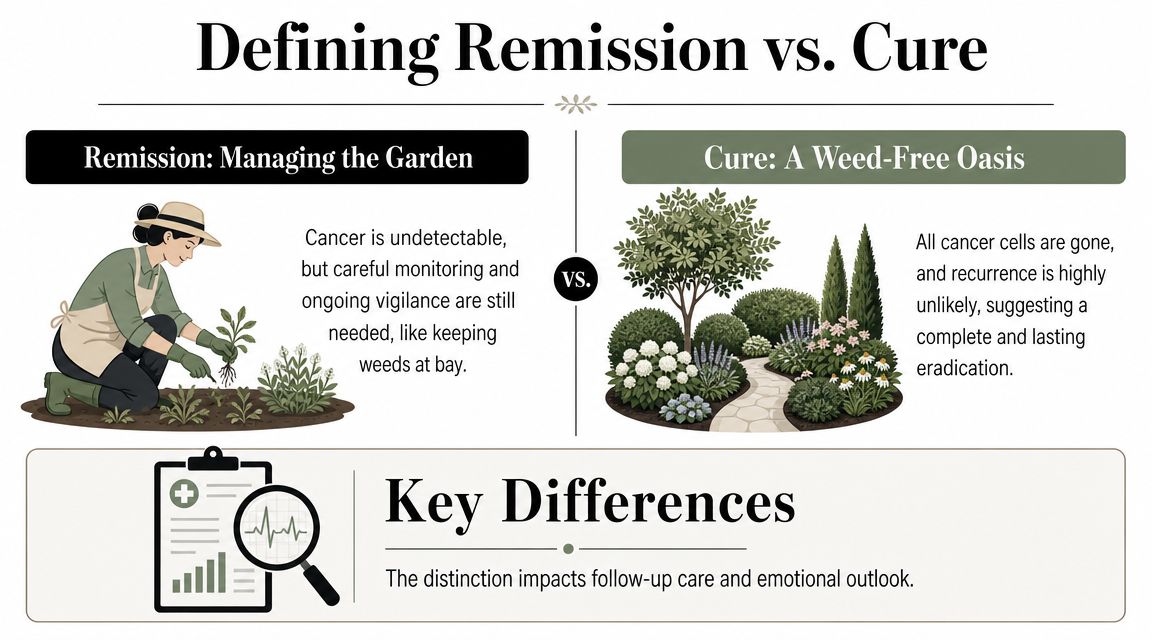
The simplest analogy I know is a garden.
If you remove every visible weed, the garden looks clear. That's excellent progress. But anyone who has gardened knows that tiny roots or seeds can still remain under the soil. You don't ignore the garden after that. You keep watching it, watering what helps, and removing anything suspicious early. That is very close to how oncologists think about remission.
Remission versus cure
In breast cancer, remission means the disease has responded to treatment. A cure means the cancer is gone and highly unlikely to return. Those are not the same thing.
Patient education from Breastcancer.org on remission and NED explains that complete remission means all detectable signs of cancer have disappeared, but microscopic residual disease can still remain. That's also why someone may be told they have no evidence of disease, often shortened to NED, even though undetectable cancer cells may still persist.
This is one reason your oncologist may recommend ongoing treatment after good news. If you're taking endocrine therapy, targeted treatment, or another maintenance approach, it isn't because the team is being pessimistic. It's because medicine respects what scans and exams cannot always see.
Complete and partial remission
Here is a simple way to separate the terms.
| Remission Type | What It Means | Next Steps |
|---|---|---|
| Complete remission | No detectable signs of cancer on available tests and exams | Continue follow-up, monitor for recurrence, and consider maintenance treatment when indicated |
| Partial remission | The cancer has shrunk or improved significantly, but some detectable disease remains | Continue or adjust treatment, monitor response, and reassess goals over time |
A partial remission is not a failure. For many patients, especially those with advanced disease, reducing the amount of cancer in the body can relieve symptoms, improve function, and create more room for future treatment choices.
Why doctors keep following you after “good” scans
Patients often say, “If the scan is clear, why do I still need appointments?”
Because breast cancer biology can be quiet. Some cells don't show up on routine imaging. Some subtypes can recur years later. Some side effects from prior treatment need management even when the cancer is controlled.
Practical rule: Think of remission as a strong checkpoint, not a lifetime warranty.
That mindset helps reduce confusion. It also protects you from the emotional crash that happens when people around you assume remission means all concern should disappear overnight.
Modern Treatments That Induce Remission
Breast cancer remission doesn't come from one treatment. It comes from a plan that matches the disease in front of you.
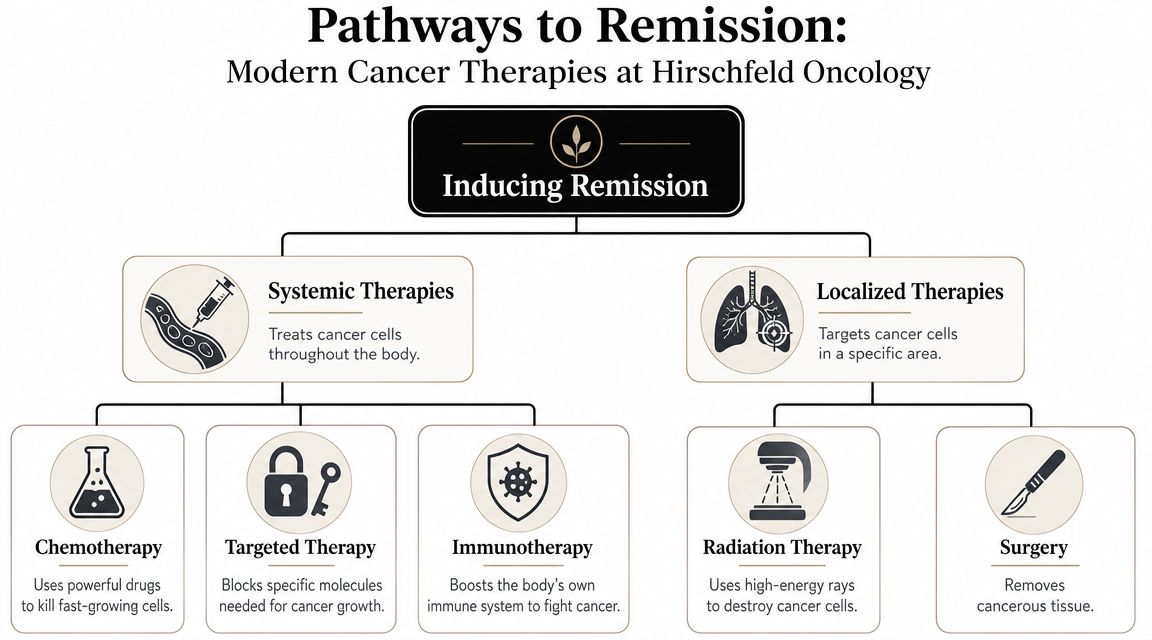
That plan may include surgery or radiation for local control. It may also include systemic treatments that travel through the body and treat cancer cells wherever they are. The key point is that breast cancer is not one uniform illness. The biology matters. The stage matters. Prior treatments matter. Your goals matter.
Why treatment has to be tailored
The National Cancer Institute's PDQ summary notes that the likelihood of durable remission is strongly stage- and subtype-dependent, and it also describes examples where adding chemotherapy to endocrine therapy improved long-term outcomes in a high-risk group. In one premenopausal subgroup, endocrine therapy plus chemotherapy improved 5-year invasive disease-free survival to 94.2% versus 89.0% with endocrine therapy alone, according to the NCI breast cancer treatment PDQ.
The same source also includes a subtype-specific example for triple-negative breast cancer. A SEER-based estimate reported 5-year survival of 92.4% for localized disease, 67.5% for regional disease, and 14.9% for distant or metastatic disease. That doesn't mean triple-negative cases can't respond well. It means they often require careful treatment selection and close reassessment.
The treatments patients most often ask about
Some therapies aim to remove or destroy visible cancer in a specific area.
- Surgery removes breast tumors and sometimes lymph nodes when that fits the overall plan.
- Radiation therapy treats a defined area to lower the chance that remaining cancer cells in that region will grow.
Other therapies work throughout the body.
- Endocrine therapy is commonly used when the cancer is hormone receptor-positive. It helps block the signals that feed cancer growth.
- Chemotherapy attacks fast-growing cells. In some settings it's used before surgery, after surgery, or for metastatic disease control.
- Targeted therapy blocks a specific pathway or marker the cancer depends on. If you want a plain-language overview, this guide to breast cancer targeted therapy can help you understand why biomarker testing matters.
- Immunotherapy helps the immune system recognize and attack cancer more effectively in selected cases.
Where low-dose chemotherapy fits
Patients with advanced or treatment-resistant disease often worry that the only remaining option is harsher treatment.
That isn't always true.
In real-world oncology practice, doctors sometimes use low-dose chemotherapy or modified schedules when the goal is to control cancer while reducing the burden of side effects. The reasoning is straightforward. A treatment only helps if the patient can stay on it safely and recover between cycles. For some people, gentler dosing or different combinations may support remission or disease control with better day-to-day function.
Hope for complex diagnoses
This is especially relevant for patients who have already been through several therapies. A remission conversation shouldn't focus only on early-stage disease. People with recurrent, metastatic, or biologically aggressive breast cancer also deserve realistic hope. Sometimes that hope comes from a new targeted option. Sometimes from immunotherapy. Sometimes from a lower-intensity regimen built around quality of life.
One example of a practice that offers personalized regimens including immunotherapy, low-dose chemotherapy, targeted therapy, and outpatient infusion support is Hirschfeld Oncology in Brooklyn. For patients seeking options after standard pathways have become harder to tolerate, a second opinion focused on individualized treatment planning can be worthwhile.
Your Follow-Up Schedule During Remission
After treatment, many patients want a calendar. Not because they love appointments. Because uncertainty is harder than structure.
Your follow-up plan is the medical version of routine maintenance. It gives your team regular chances to look for recurrence, manage late effects, review medications, and answer questions before small issues become bigger ones.

What follow-up usually includes
A breast cancer remission plan is personalized, but the building blocks are often familiar.
- Office visits: Your oncologist checks symptoms, examines you, reviews treatment effects, and decides whether anything new needs attention.
- Breast imaging: Mammograms remain central for many patients after treatment for early-stage disease. Some people also need ultrasound or MRI based on their history.
- Medication review: If you're taking endocrine therapy or another long-term treatment, follow-up visits help assess benefit, side effects, and adherence.
- Symptom-guided testing: Additional scans or bloodwork may be ordered when symptoms, exam findings, or the cancer history make them appropriate.
Why the schedule changes over time
Follow-up is often more frequent earlier on, then becomes less frequent if things remain stable. That doesn't mean your team is less concerned. It means the plan is adapting to your risk profile and your recovery.
For some patients, survivorship care also includes ongoing therapy that functions as a bridge between active treatment and surveillance. If you're trying to understand that middle ground, this explanation of maintenance chemotherapy can help clarify why some people continue treatment even during remission.
Keep one document with your diagnosis details, past treatments, current medications, pathology reports, and scan dates. It makes every future appointment easier.
Questions worth bringing to each visit
You don't need to memorize everything. A short note on your phone is enough.
- What symptoms should prompt a call before my next appointment?
- What tests are routine for me, and what tests are only done if something changes?
- Are my current symptoms likely from past treatment, ongoing medication, or something that needs a closer look?
- If I was treated across different clinics, who is coordinating my full survivorship plan?
That last question matters more than many people realize. Remission care works best when someone is clearly responsible for the whole picture.
Managing the Fear of Cancer Recurrence
Fear of recurrence is one of the most common burdens in survivorship. It can show up the night before a scan, in the shower when you feel a scar line, or during an ordinary backache that suddenly feels loaded with meaning.
The answer isn't to pretend that fear is irrational. The answer is to give it structure.
Stage at diagnosis is one of the clearest factors shaping long-term outlook. The National Cancer Institute reports a 5-year relative survival rate of 99.3% for localized breast cancer, 86.3% for regional disease, and 31% for distant or metastatic disease in SEER data, which is why early detection and stage-specific monitoring remain so important according to the NCI breast cancer survival summary. Those figures are survival statistics, not a promise for any one person, but they help explain why your oncologist talks differently about risk depending on the original stage.
When to watch and when to call
Most aches are not recurrence. Healing tissue can stay tender. Endocrine therapy can cause joint pain. Radiation can leave firmness or discomfort. Anxiety can make every sensation louder.
Still, certain changes deserve a call to your oncology team, especially if they are persistent, new, or clearly worsening.
- A new lump or swelling: In the breast, chest wall, underarm, or collarbone area.
- Ongoing pain that doesn't settle: Especially if it's focal, deep, or different from your usual treatment-related soreness.
- Neurologic changes: New headaches, weakness, numbness, balance trouble, or confusion.
- Breathing or liver-related concerns: Unexplained shortness of breath, ongoing cough, yellowing of the skin, or significant abdominal symptoms.
If you're trying to sort through the difference between normal worry and symptoms that need evaluation, this guide on breast cancer recurrence may help frame the conversation for your next visit.
Managing the emotional side
Knowledge lowers panic, but it doesn't eliminate it. Some patients need formal support to keep fear from taking over daily life, sleep, or relationships. If anxiety is becoming hard to manage, counseling can be a useful part of survivorship care. For readers looking for local mental health help, this resource on holistic support for anxiety in St. Petersburg offers a patient-friendly example of how therapy can address health-related worry.
You do not have to choose between being vigilant and living your life. Good survivorship care makes room for both.
Embracing a Holistic Survivorship Plan
A remission plan should protect more than scan results. It should protect your energy, your mood, your relationships, your ability to work or parent, and your sense that your body still belongs to you.
That broader view matters because many people leave treatment with visible relief and invisible burdens. Fatigue lingers. Neuropathy makes buttons hard to fasten. Sleep gets disrupted. Food tastes different. Intimacy changes. A spouse becomes a caregiver and doesn't know how to step back. None of that means you are failing at recovery. It means survivorship is real medical work.

Building a care plan that covers daily life
A good survivorship plan often includes more than oncology.
A systematic review discussed in Frontiers Oncology Reviews found that patient navigation and interventions that specifically address financial, cultural, and geographic barriers improve access to care and reduce time from diagnosis to treatment. That idea carries into remission. When transportation, language, insurance, work schedules, or family responsibilities get in the way, even the best medical plan can break down.
Here are parts of survivorship care that often deserve active planning:
- Physical recovery: Fatigue, neuropathy, lymphedema risk, bone health, and menopausal symptoms may all need targeted support.
- Emotional recovery: Some patients want a support group. Others prefer one-on-one counseling. Both are valid.
- Nutrition and movement: You don't need a perfect diet or an extreme exercise program. You need sustainable habits your body can tolerate.
- Practical coordination: Someone should help you keep track of specialists, refills, imaging, and financial or access barriers.
The value of support that fits your culture and location
Patients often hear generic advice that doesn't match real life. A single parent with a subway commute, a patient translating medical visits for herself, or a family coordinating care across countries may need a different kind of support.
For people looking at international or cross-cultural resources, this guide to support for chronic conditions in Italy is a useful example of how psychological resilience can be framed for patients living with long-term medical uncertainty.
A short educational video can also help families start these conversations together.
What a whole-person survivorship week can look like
One patient may spend the week very differently than another, but whole-person care often looks ordinary on the surface.
- A walk on two days because fatigue is still heavy.
- A refill call for endocrine therapy.
- A physical therapy appointment for shoulder tightness after surgery.
- A support group or counseling session.
- A follow-up message to the oncology office about a new symptom instead of worrying about it.
That is survivorship. Not dramatic. Not glamorous. Steady, coordinated, and protective of your long-term health.
Partnering With Your Oncology Specialist
The right oncology partner matters most when the path isn't straightforward.
That includes patients with stage 4 disease, recurrent breast cancer, mixed responses to treatment, difficult side effects, or uncertainty about what to try after a standard plan stops working. It also includes families who need someone to explain options in plain language and help weigh quality of life alongside disease control.
A specialist can help in several ways.
- Second-opinion review: Re-check pathology, prior imaging, treatment history, and goals before the next decision.
- Treatment adjustment: Consider whether targeted therapy, immunotherapy, endocrine treatment, or a lower-intensity chemotherapy strategy fits better.
- Symptom management: Control pain, fatigue, nausea, neuropathy, and treatment burden so the plan remains livable.
- Care coordination: Make sure follow-up, infusion scheduling, and outside specialists aren't working in isolation.
For families supporting an older adult through cancer recovery, practical routines outside the clinic also matter. Gentle movement can be part of that picture, and this guide to activities for aging loved ones offers ideas caregivers may find useful at home.
If you live in Brooklyn, Williamsburg, Bushwick, or nearby NYC neighborhoods, partnering with an oncology team that is comfortable managing complex and advanced cases can make the next step feel less overwhelming. The goal isn't false reassurance. It's a clear plan, thoughtful monitoring, and a treatment strategy that matches your disease and your life.
If you want help understanding remission, reviewing a difficult breast cancer treatment plan, or exploring options such as immunotherapy, targeted therapy, or lower-intensity chemotherapy, Hirschfeld Oncology offers consultations for patients and families who need a careful, individualized next step.
.png)
.png)