.png)


You warm up soup. You cut fruit into smaller pieces. You bring out the one yogurt they liked last week. Then you watch the tray come back almost untouched.
For many families, that's the moment fear spikes. It doesn't feel like a nutrition problem. It feels like watching someone slip away in front of you, one missed meal at a time. If you're dealing with a cancer patient not eating, your worry makes sense.
This usually isn't stubbornness, and it usually isn't a simple matter of “just try harder.” Loss of appetite in cancer can come from the disease itself, treatment side effects, poor digestion, pain, anxiety, depression, and the exhausting emotional weight of being sick. In advanced cancers, it's common enough that families should treat it as a medical issue, not a character issue.
What helps most is a combination of clarity and gentleness. You need to know what may be driving the eating problem, which parts can be treated, what you can do at home, and when to stop troubleshooting on your own and call the oncology team.
A Loving Meal Left Untouched
A daughter cooks her father's favorite rice dish because he used to ask for it every Sunday. He takes two bites, pushes the plate away, and says he just can't. A spouse buys protein shakes, soups, crackers, smoothies, and pudding, hoping one of them will finally work. A son starts tracking every spoonful because the days blur together and he needs proof that his mother ate something.
This is the situation in many homes. Food becomes loaded. Every meal feels like a test. Every refusal feels personal, even when you know it isn't.
Loss of appetite is common in advanced cancer. Anorexia, or loss of appetite, affects 30 to 85% of people with advanced cancers and is associated with a 20 to 30% reduction in overall survival according to pancreatic cancer survival and staging data from SEER. In advanced pancreatic cancer, where 51% of cases are diagnosed at a distant stage, up to 90% report profound anorexia in that same source.
That doesn't make it easier to watch. It does mean you are not failing if your loved one isn't eating normally.
Practical rule: Stop thinking in terms of normal meals. Start thinking in terms of barriers. Hunger may not be the main problem.
Some patients say food smells wrong. Some say they feel full after three bites. Some are nauseated before the first forkful. Others want to eat but feel guilty, scared, or too tired to try. Families often see only the untouched plate, but the reason behind it matters. The right response for nausea is different from the right response for depression, mouth pain, constipation, or poor pancreatic digestion.
Your job isn't to win a battle at the kitchen table. Your job is to notice patterns, lower pressure, and help the medical team understand what's changing.
Understanding Why a Cancer Patient Stops Eating
When a cancer patient stops eating, families often assume the problem is appetite alone. In practice, there are usually several problems layered together. Think of it as three overlapping tracks. The cancer can change metabolism. Treatment can make food unpleasant. Emotional distress can shut down the desire to try.

The cancer itself can disrupt hunger
Some tumors do more than take up space. They change how the body uses energy and how the brain reads hunger signals. Cachexia, a syndrome involving severe weight loss and muscle wasting, affects 50 to 80% of advanced cancer patients and directly causes about 22% of all cancer deaths globally according to the NIH review of cancer cachexia. In pancreatic cancer, the prevalence is over 80% in that same review.
This matters because cachexia is not the same as ordinary poor eating. In ordinary starvation, the body tries to conserve. In cachexia, the body often keeps breaking down muscle even when someone does eat. That's why families can work so hard on calories and still feel like they're losing ground.
If you want a deeper explanation of how this syndrome works, this overview of cancer cachexia is a useful starting point.
Cachexia changes the rules. A patient may want to please the family, may even eat a little more for a day, and still not rebuild strength the way you'd expect.
Treatment can make eating feel miserable
Chemotherapy, radiation, targeted therapy, pain medicines, and even antibiotics can make food hard to tolerate. The issue may be one symptom or several at once:
- Nausea and vomiting: Food becomes associated with feeling sick.
- Mouth sores or a sore throat: Eating burns or stings.
- Taste changes: Meat may taste metallic. Favorite foods may suddenly seem bitter.
- Dry mouth: Swallowing becomes work.
- Constipation: Patients feel full, bloated, and uncomfortable.
- Fatigue: Even chewing can feel like a chore.
When families say, “They won't eat,” I often translate that mentally into a more useful question: “What happens when they try?” That answer tells you where to focus.
The emotional barrier is real
A patient may refuse food because they're scared of nausea, discouraged by weight loss, grieving the loss of normal life, or feeling pressure every time a plate appears. Some patients also describe a strange guilt. They know the family wants them to eat, but they can't force appetite into existence. Then meals start to feel like a performance they're failing.
This is one reason mealtime arguments backfire. Pressure adds stress. Stress can worsen nausea, tighten the throat, and make a patient want even more distance from food.
A few clues can help you sort out what may be going on:
| What you notice | What it may suggest |
|---|---|
| “I'm hungry, but I feel sick after a few bites” | Nausea, delayed stomach emptying, pain, early fullness |
| “Everything tastes terrible” | Treatment-related taste changes |
| “I'm not hungry at all” | Disease-related appetite loss or emotional withdrawal |
| “I want to eat, but food goes right through me” | Digestive problems, including pancreatic issues in GI cancers |
| “Please stop asking me” | Mealtime pressure, overwhelm, or depression |
Families don't need to diagnose this alone. But noticing patterns gives your oncology team something they can act on.
Practical At-Home Nutritional Strategies
At home, the goal is not to recreate healthy eating from before cancer. The goal is to make eating easier, less stressful, and more worthwhile when only small amounts are possible. That usually means changing volume, texture, timing, and expectations.
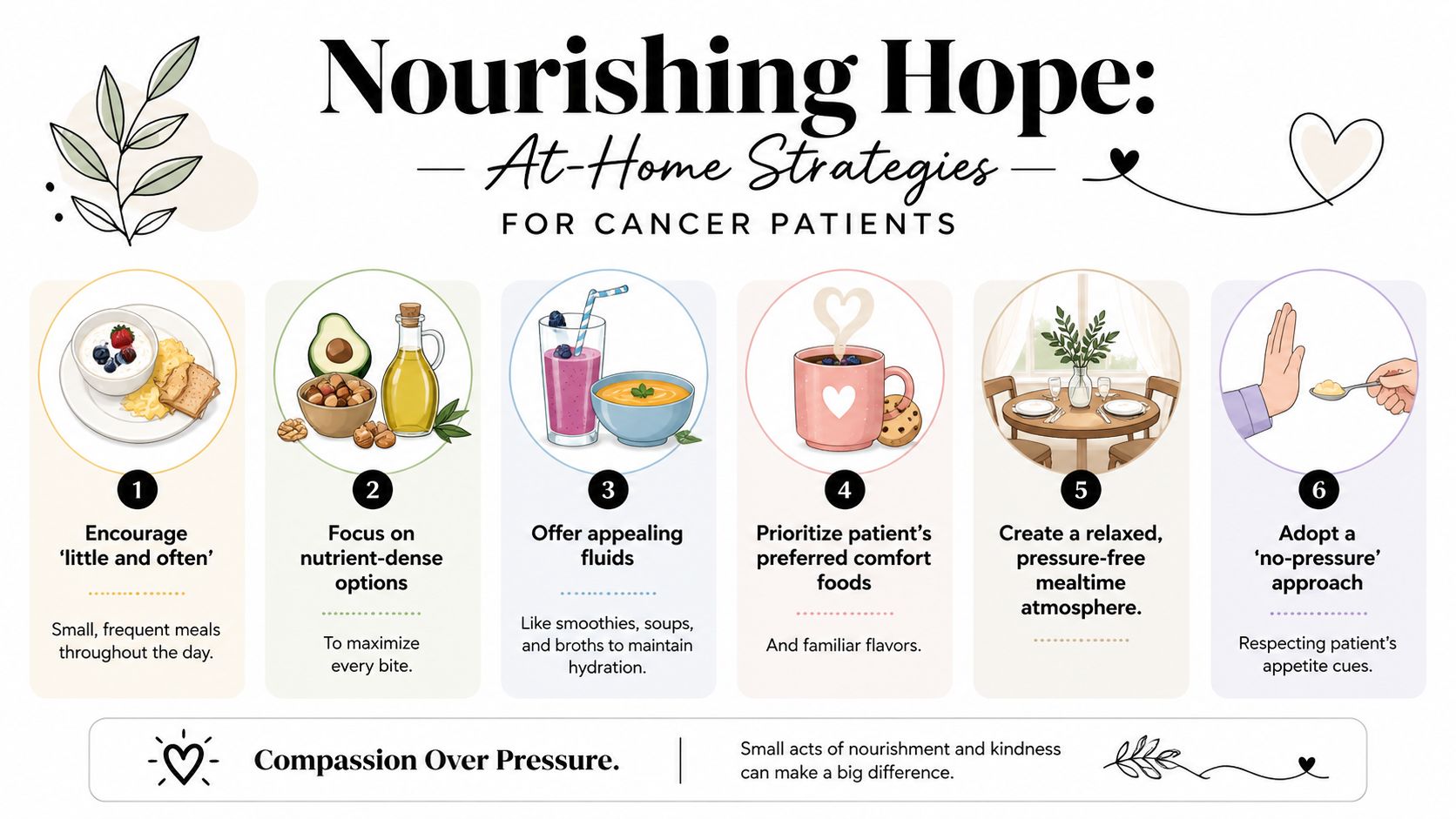
Think in bites and sips, not meals
A full plate can look impossible. A few bites may feel manageable. Instead of three standard meals, offer small chances to eat throughout the day. Patients often tolerate better intake earlier in the day or during a short window when nausea is lowest.
Try options that deliver more in less volume:
- Soft calorie-dense foods: yogurt, pudding, custard, mashed potatoes with olive oil, avocado, nut butter
- Easy proteins: scrambled eggs, cottage cheese, Greek yogurt, tofu, shredded chicken in broth
- Drinkable nutrition: smoothies, milkshakes, oral nutrition supplements, blended soups
A few practical food pairings often work better than big mixed plates. Peanut butter on toast points. Full-fat yogurt with honey. Mashed sweet potato with butter. Small bowls beat dinner plates.
For more ideas designed for active treatment, what to eat during chemotherapy offers a useful framework.
Match food to the symptom
One mistake families make is offering the right food at the wrong moment. The better approach is to match the food to what's bothering the patient that day.
If the issue is mouth pain or tenderness, use cooler, softer foods:
- Cold or room-temperature choices: smoothies, yogurt, applesauce, chilled pudding
- Avoid rough textures: chips, crusty bread, dry rice, acidic sauces if they sting
If the issue is nausea:
- Keep smells low: cold foods often smell less intense than hot foods
- Use plain options first: crackers, toast, rice, noodles, broth
- Don't serve large portions: large portions can trigger instant refusal
If the issue is early fullness:
- Separate food and large drinks: too much liquid with meals can fill the stomach fast
- Choose concentrated calories: a few sips of a shake may do more than half a sandwich
“Would two bites feel easier than a full plate?” often works better than “What do you want for dinner?”
Protect the atmosphere around food
A patient who feels watched may stop sooner. A patient who expects a fight may avoid the table entirely. Keep mealtime low pressure and short. Serve small amounts. If they finish, offer more. If they don't, clear the dish without commentary.
A few house rules help:
- Don't negotiate every bite. Repeated urging usually increases resistance.
- Don't praise normal eating too intensely. Some patients feel they're being graded.
- Do ask about timing. “Are there times of day when food goes down more easily?”
- Do keep favorites available. This is not the time to chase perfect nutrition.
There's also a mental health side to appetite that families often miss. If stress, fear, or depression are shaping the eating struggle, it helps to understand the gut-brain axis and psychiatric care in plain language. Not every patient needs psychiatric treatment, but many benefit when emotional distress is treated as part of the nutrition problem instead of a separate issue.
What usually doesn't work
Some well-meant tactics create more trouble than help:
- Forcing large meals: This often increases nausea and dread.
- Moral language about food: “You have to eat to fight” can create shame when the patient physically can't.
- Constant menu changes: Too many choices can overwhelm someone already exhausted.
- Fat-free or diet foods: When intake is limited, low-calorie substitutions usually work against you.
The best home strategy is boring but effective. Keep portions small, keep options easy, and count anything tolerated as a win.
Medical Support for Managing Appetite and Symptoms
When home strategies aren't enough, medical support should start early. This isn't about “giving up and moving to medicines.” It's about removing obstacles that make eating harder than it has to be.

Treat the symptom blocking intake
If a patient is nauseated, constipated, in pain, or developing mouth sores, appetite won't improve much until those symptoms are addressed. Families sometimes ask for an appetite stimulant first, but the better first move is often to ask, “What is stopping them from eating comfortably?”
That may mean:
- Anti-nausea medication before meals or before chemotherapy
- Pain control adjusted so swallowing or sitting up to eat is less difficult
- Constipation treatment if bloating and fullness are the actual issue
- Mouth care for sores, dryness, or fungal infection
If nausea is part of the picture, anti-nausea drugs used in cancer care can make the whole plan more realistic.
Appetite stimulants help some patients, not all
Drugs such as megestrol acetate or dronabinol can be appropriate in selected patients. They may improve appetite or make eating feel more possible. They are not magic, and families should know that before pinning all hope on them.
What they can do well is reduce one layer of the problem. What they usually can't do is reverse complex muscle loss on their own if cachexia is already driving weight and strength decline. That trade-off matters. Sometimes a modest appetite benefit is still worthwhile if it improves comfort, energy, or treatment tolerance.
Don't miss pancreatic exocrine insufficiency
In advanced GI cancers, especially pancreatic cancer, patients may not just be eating less. They may be digesting poorly. Pancreatic exocrine insufficiency, or PEI, affects 80 to 90% of pancreatic cancer patients, and pancreatic enzyme replacement therapy can lead to symptomatic improvement in 90% of cases and weight stabilization or gain in 80% according to this upper GI cancer education resource on PEI and enzyme therapy.
Clues include greasy or pale stools, bloating, urgent bowel movements after eating, foul-smelling stools, and feeling full fast. If the body isn't breaking food down properly, patients may avoid eating because eating reliably makes them feel worse. In those cases, PERT, often with pancrelipase, can make a substantial difference.
A short explainer may help families frame the discussion with the medical team:
Feeding tubes and IV nutrition have a place
Families often ask about tube feeding or IV nutrition when a cancer patient is not eating. These options can help in selected situations, especially when the gut still works but oral intake is too low, or when there's a temporary, reversible barrier to swallowing. They also come with burdens, logistics, and risks.
That's why these decisions should be individualized. The right question isn't “Why haven't we started tube feeds?” The right question is “What problem are we trying to solve, and is this the best tool for it?”
How to Talk About Food Without Starting a Fight
Mealtime tension can damage the relationship faster than families expect. When every conversation turns into “Please eat,” patients may start avoiding both food and the people offering it. A better approach is to trade pressure for curiosity.

Use questions that lower defensiveness
Emotional distress often worsens appetite loss, and caregiver guidance is often too vague to help. Motivational interviewing techniques have been shown to improve caloric intake by 20 to 30% in palliative care settings according to this review of appetite loss and cancer. The reason is simple. Patients respond better when they feel understood, not managed.
Try these scripts:
Instead of “Why aren't you eating?”
Say “It seems like eating is really hard today. What feels worst about it?”Instead of “You need to finish this.”
Say “Would a few bites or a few sips feel more doable?”Instead of “What do you want?”
Say “Would something cold, something bland, or just a drink be easiest?”Instead of “You have to keep your strength up.”
Say “I want to support you without making this harder.”
These phrases work because they give the patient control. They also give you useful information.
What to avoid saying
Some phrases come from love and still land badly:
| Avoid | Try instead |
|---|---|
| “Do it for me” | “I'm with you. We'll take this one step at a time.” |
| “If you don't eat, you'll get weaker” | “Tell me what happens when you try to eat.” |
| “You ate more yesterday” | “Today seems different. What changed?” |
A patient can feel full, nauseated, sad, and guilty at the same time. Speak to the struggle, not just the plate.
Show care in ways that aren't food
If every act of love arrives on a tray, the patient may start dreading the tray. Sometimes support looks better as a walk to the window, lip balm for a dry mouth, help rinsing after vomiting, a favorite show, or sitting together without asking them to try one more bite.
That doesn't mean food stops mattering. It means the relationship matters too. Preserving trust often makes the next attempt at eating go better.
When to Call Your Oncology Team and Find Support
Some eating problems can be adjusted at home. Others need a same-day call. Don't wait for a routine visit if the pattern is worsening or the patient is becoming weak, confused, or dehydrated.
Call the oncology team if the patient:
- Can't keep food or liquids down
- Has signs of dehydration, such as very dry mouth, dizziness, reduced urination, or unusual sleepiness
- Has new trouble swallowing
- Has uncontrolled nausea, vomiting, diarrhea, or constipation
- Seems to be losing weight quickly or becoming much weaker
- Has greasy, pale, or foul-smelling stools after meals, especially in pancreatic or other GI cancers
- Stops eating because of pain, depression, or fear
When you call, be concrete. A good report sounds like this:
“For the last several days, he's only taken sips of fluids and a few bites of soft food. He feels full quickly, says food smells bad, and had loose greasy stools after eating.”
That gives the nurse or physician something usable.
Questions worth asking
Bring focused questions instead of a general plea to “help them eat”:
- Could this be a side effect of treatment or a sign of progression?
- Do they need anti-nausea, constipation, pain, or mouth sore treatment adjusted?
- Could pancreatic enzyme replacement help?
- Should we involve a dietitian or palliative care team now?
- At what point should we consider hydration, enteral feeding, or other nutrition support?
Practical support matters too. Food insecurity affects 25 to 50% of cancer patients, and clinic-based food pharmacy programs plus connections to local resources such as SNAP-related support have been associated with treatment adherence gains of up to 25% according to this review on food insecurity and cancer care.
For families in Brooklyn, Williamsburg, and Bushwick, ask your oncology social worker, nurse navigator, or clinic staff about:
- God's Love We Deliver for medically specific meals in New York City
- SNAP enrollment assistance through local hospital social work or community organizations
- Clinic pantry or food pharmacy programs if your center offers them
- Transportation and meal delivery support through local cancer support services
A cancer patient not eating is never just a kitchen problem. It's a symptom, a stressor, and often a signal that the care plan needs adjustment.
If you need experienced help sorting through appetite loss, treatment side effects, pancreatic symptoms, or nutrition barriers in advanced cancer, Hirschfeld Oncology offers practical guidance for patients and families in Brooklyn and across NYC. Their team focuses on complex cancers, close symptom monitoring, and individualized treatment plans designed to improve tolerability as well as care options.
.png)
.png)