.png)


For many people, the word "chemotherapy" brings to mind images of IV drips, long hours in a clinic, and a life revolving around hospital appointments. But what if you could manage your cancer treatment from your own living room? That’s the reality for a growing number of patients, thanks to chemo in pill form, also known as oral chemotherapy. This isn't just a matter of convenience; it represents a major change in how we approach cancer care.
The New Era of At-Home Cancer Treatment
Think about traditional IV chemotherapy for a moment. It often requires you to schedule your life around trips to an infusion center. Oral chemotherapy flips that script. It puts more control back in your hands, allowing you to integrate treatment into your daily life rather than letting it dictate your schedule.

This move toward at-home treatment is fueled by incredible scientific progress, especially in the field of targeted therapies. These aren't just old IV drugs put into a capsule. They are often newer, smarter medications designed from the ground up to attack cancer cells with specific genetic markers, making them perfectly suited for oral delivery.
The Growing Preference for Oral Therapies
This isn't a minor trend. The shift toward chemo in pill form is one of the most significant developments in modern oncology, backed by some truly impressive numbers.
Between 2008 and 2020, the use of oral chemotherapy saw a 58.8% increase in units dispensed. Oral medications now account for about a quarter of the entire oncology drug pipeline. The pace is only accelerating. In 2020, an astonishing 67% of new FDA approvals for cancer drugs were for pills that patients could take at home. You can dig into the research yourself on the Frontiers in Pharmacology website.
What this tells us is something we see in our practice every day: the future of cancer care is happening as much in the patient’s home as it is in the clinic, with a dual focus on powerful treatment and preserving quality of life.
This evolution is especially meaningful for patients with complex or treatment-resistant cancers. At practices like Hirschfeld Oncology, we are constantly working with these advanced oral agents. By building them into highly personalized treatment plans, we can often give our patients a better quality of life and a renewed sense of control over their journey.
How Oral Chemotherapy Works and Who It Is For
A common question I hear from patients is, "How can a pill do the same job as an IV drip?" It’s easy to think of oral chemotherapy as just a powdered version of an IV drug packed into a capsule, but the science is much more sophisticated than that.
These medications are specifically designed to do two things: survive the incredibly harsh, acidic environment of your digestive tract and then get absorbed properly into your bloodstream to hunt down cancer cells.
Think of it this way: IV therapy is like a direct, hand-delivered courier service. An oral drug, on the other hand, is like a high-tech package sent through the mail. It needs special armor—the pill's formulation—to withstand the rough journey and arrive at its destination ready to work.
The Two Main Types of Oral Cancer Drugs
When we talk about cancer pills, we're usually referring to one of two distinct strategies for fighting the disease. They work on fundamentally different principles, much like the difference between a weed killer that blankets a whole lawn versus one that only targets dandelions.
Traditional Oral Chemotherapy: These pills act a lot like their IV cousins. They are cytotoxic, meaning they target and destroy cells that divide quickly. While this is great for hitting fast-growing cancer cells, it's also why they can cause side effects by affecting healthy, rapid-turnover cells in your hair, mouth, and stomach. Capecitabine, a common treatment for breast and colorectal cancers, is a classic example.
Targeted Therapy Pills: This is where treatment becomes truly personalized. These are more like "smart drugs," engineered to identify and attack cancer cells with specific genetic flags or protein abnormalities that fuel their growth. By being more selective, they often spare healthy cells, leading to a different, and sometimes more manageable, set of side effects. Imatinib, which transformed the treatment of certain leukemias, is a pioneering example of a targeted pill.
Determining Who Is a Good Candidate
Switching to or starting with a cancer pill isn't just about convenience. It’s a serious clinical decision that hinges on whether it's the right fit for your specific cancer, your body, and your ability to manage your care at home.
The choice to use an oral agent isn't just about convenience. It’s a clinical decision based on the cancer's biology, the specific drug's mechanism, and the patient's ability to be an active partner in their own care at home.
To figure out if you're a good candidate, your oncologist will weigh several critical factors.
Key Factors for Candidacy
- Cancer Type and Stage: Some cancers—like certain breast, lung, colorectal, and blood cancers (leukemias and lymphomas)—respond exceptionally well to established oral therapies. Where you are in your cancer journey (the stage) also heavily influences the best treatment path.
- Presence of Genetic Markers: This is the absolute key for targeted therapies. Your oncologist may analyze a tumor biopsy to search for the specific genetic mutations a pill is designed to attack. If your cancer has that "target," you could be an excellent candidate. No target, no go.
- Ability to Swallow and Absorb Medication: This might sound basic, but it's crucial. If you have trouble swallowing pills or suffer from conditions that cause severe nausea, vomiting, or malabsorption, an oral drug may not get into your system reliably enough to work.
- Capacity for At-Home Management: Taking chemo in pill form moves the treatment center from the clinic to your home. It demands a high level of personal responsibility. A good candidate is someone who can stick to a strict schedule, watch for side effects, and keep in close contact with their care team. For patients with memory issues or who simply find it hard to manage complex medication schedules, supervised IV therapy is often a safer choice.
The final call is always a partnership between you and your oncology team. As you'll see in our deeper dive into the different kinds of cancer pill treatments, the best approach is one that is both medically sound and fits your personal circumstances.
Oral Chemo vs. IV Chemo: A Head-to-Head Comparison
For decades, the word “chemotherapy” painted a very specific picture: a patient in a clinic, hooked up to an IV drip for hours at a time. But that image is changing. With the rise of chemo in pill form, we have a powerful new way to fight cancer, and it’s critical to understand how these two approaches differ.
The biggest myth I hear from patients is that a pill must be a “weaker” or less serious form of treatment. Let’s clear that up right now: that’s absolutely not the case. A drug’s effectiveness has nothing to do with whether it’s delivered through a vein or swallowed as a pill. What matters is getting the right drug to the right place to do its job.
Oral medications are carefully designed to be absorbed by your digestive system and are proven to reach the necessary concentration in your blood to fight cancer. For many cancers, these pills aren't just a convenient alternative—they are the gold standard.
Efficacy Is Never a Compromise
One of the first questions patients ask is, "Will this pill work as well as an IV?" The answer, backed by extensive clinical research, is a resounding yes. For the right patient and the right cancer, oral therapies are just as potent, and sometimes even more effective, than their IV counterparts. The goal is always to match the drug to your cancer's specific biology, not to choose based on the delivery method.
Take, for example, a landmark phase III trial for metastatic breast cancer. In this study, an oral version of the drug paclitaxel was directly compared to the standard IV infusion. The results were stunning: the pill led to higher tumor shrinkage rates (35.8% for the oral drug vs. 23.4% for IV). Patients taking the pill also lived longer and had a dramatic reduction in neuropathy, a painful nerve-damage side effect that often limits the use of IV paclitaxel.
This visual helps explain the two main philosophies behind how these oral drugs work.
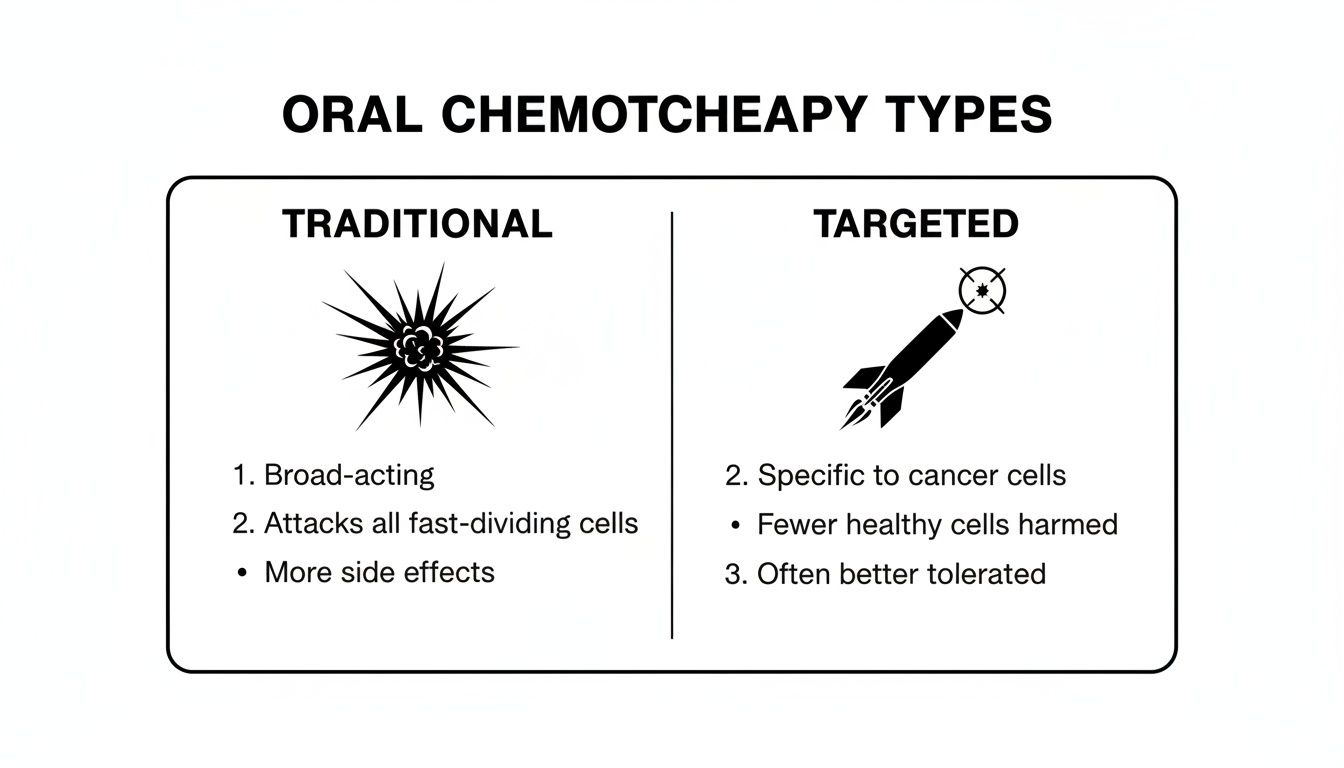
As you can see, some are broad-acting agents, much like traditional chemo, while others are highly precise drugs that zero in on specific vulnerabilities in cancer cells.
To give you a clearer picture, let's break down the key differences between these two treatment methods.
Oral Chemotherapy vs. IV Infusion At a Glance
| Aspect | Oral Chemotherapy (Pill Form) | IV Chemotherapy (Infusion) |
|---|---|---|
| Location | Taken at home or on the go. | Administered in a hospital or clinic. |
| Schedule | Typically daily or on a frequent, consistent schedule. | Cycles of treatment every 1-3 weeks. |
| Convenience | High. No travel or clinic time for administration. | Low. Requires scheduled appointments and travel. |
| Drug Delivery | Steady, continuous dose in the bloodstream. | High-dose "peak" followed by a "valley" as it wears off. |
| Side Effects | Often more persistent but milder (e.g., diarrhea, skin rash, fatigue). | Often more acute and intense after infusion (e.g., severe nausea, hair loss). |
| Patient Role | High responsibility for adherence and self-monitoring. | Passive role during infusion; staff handles administration. |
This table highlights the trade-offs. While taking a pill at home offers incredible freedom, it also shifts more responsibility for managing the treatment plan onto you and your caregiver.
A Different Approach to Side Effects
Both oral and IV chemotherapy are powerful medications, so side effects are a reality. The type and timing of those side effects, however, can be very different.
IV chemo is usually a high-dose infusion given over a few hours. This creates a "peak and valley" effect in your body, where side effects like intense nausea, fatigue, or hair loss can hit you hard right after treatment and then slowly fade.
Oral chemo, on the other hand, is generally taken in smaller, consistent daily doses. This provides a steady level of the drug in your system, which helps you avoid the harsh post-infusion crashes.
Instead of a big hit every few weeks, you get a continuous, low-level dose. For many, this translates to less severe nausea and a lower chance of hair loss, but it can introduce other challenges that need careful management.
Common issues we watch for with oral agents include:
- Gastrointestinal Upset: Diarrhea is very common and requires a proactive plan to manage.
- Skin Reactions: Some drugs cause rashes or hand-foot syndrome (redness and soreness on palms and soles).
- Mouth Sores: Painful sores, known as mucositis, can develop.
- Persistent Fatigue: While often less severe than with IV chemo, a constant, nagging tiredness can still impact daily life.
To understand more about the mechanisms behind these drugs, take a look at our guide on how chemotherapy works.
The Quality-of-Life Difference
This is where the distinction between oral and IV therapy becomes most personal. For many patients, the impact on day-to-day life is the single biggest factor, and it's where chemo in pill form really shines.
Taking your treatment at home means you get to sidestep the logistical, physical, and emotional toll of frequent clinic visits.
- No More Needles: If you have a fear of needles or your veins are difficult to access, this is a massive relief.
- You Own Your Schedule: You’re no longer tied to infusion appointments. That freedom gives you more time for work, family, hobbies—for living your life.
- A Feeling of Normalcy: Managing your treatment from home restores a powerful sense of control and autonomy, which is psychologically crucial when you're navigating a cancer diagnosis.
While oral chemotherapy does demand more from you in terms of sticking to your schedule and monitoring side effects, the trade-off is a level of freedom that IV treatment just can't match. This empowerment is a vital part of modern, patient-focused cancer care.
Your Role in Making At-Home Treatment a Success
When your cancer treatment comes in the form of a pill, the entire dynamic of your care shifts. Suddenly, the most critical part of your therapy isn't happening in a clinic infusion chair—it's happening in your own home. While the convenience is undeniable, this change puts you in the driver's seat, and with that comes a new level of responsibility.
The success of your at-home treatment boils down to one simple but powerful concept: adherence.
Think of it like managing a chronic condition such as diabetes. It requires a daily commitment and a solid routine. Missing doses of your chemo in pill form, taking them at the wrong time of day, or stopping the medication without talking to your doctor can genuinely undermine how well the treatment works. It’s a serious responsibility, but the good news is you are never expected to manage it all by yourself.
A Partnership, Not a Solo Mission
Taking your treatment at home doesn’t mean you’re on your own. The best way to think about it is as a partnership between you and your oncology team. Our job is to build a safety net of support around you, making it as straightforward as possible for you to stay on track.
This isn't about simply handing you a prescription and hoping for the best. A proactive support system is fundamental to making oral therapies work. We set up dedicated programs to anticipate challenges and provide you with solutions before they even become problems.
This support network usually includes:
- Clear, Upfront Education: Before you even take your first pill, we'll walk you through everything—when to take your medicine, if it should be with food, and exactly what to do if you accidentally miss a dose.
- A Plan for Side Effects: You'll get a simple, actionable guide for managing common side effects. We'll tell you which over-the-counter products are safe to use and exactly when you need to pick up the phone and call us.
- Proactive Nurse Check-Ins: Don't be surprised when one of our oncology nurses calls you just to check in. These calls are a chance for us to see how you're feeling, ask about side effects, and answer any questions you've thought of since your last appointment.
- Tools to Keep You Organized: We can give you practical tools to help you stay on top of your schedule. This might be a simple pill diary, a medication log, or even recommendations for helpful smartphone apps with built-in reminders.
Why Sticking to the Plan Is So Critical
The connection between taking your medication consistently and getting the best results isn't just a theory—it's a fact backed by hard data. Unfortunately, studies show that nonadherence is a real issue, with rates somewhere between 12-30% for major oral cancer drugs.
But the payoff for being consistent is huge. In treating Chronic Myeloid Leukemia (CML), for instance, patients who have over 90% adherence to their medication are three times more likely to achieve a complete molecular response. That's a massive difference.
A diagnosis is stressful enough without having to worry about the financial cost of treatment. Oral chemo can be an excellent option for many patients if they can access it. It is good to know help is available through many different channels.
This is precisely why dedicated support programs are becoming the standard. National surveys show that 71% of U.S. cancer institutions now have specific programs for oral chemotherapy, with a huge focus on improving both safety (58%) and adherence (58%). You can dive deeper into these statistics by reading the full findings on oral chemotherapy programs.
Practical Tips for Managing Your Pills at Home
So, how do you make this work in real life? The goal is to build new habits and weave your treatment seamlessly into your daily routine.
Here are a few strategies that our patients find incredibly helpful:
- Get a Pill Organizer: A simple weekly pillbox is the easiest way to see at a glance whether you’ve taken your medication for the day.
- Set Daily Alarms: Use your phone, a smartwatch, or a simple clock to set a recurring daily reminder. Don't rely on memory alone.
- "Habit Stack" Your Doses: Link taking your medication to something you already do every single day without fail, like brushing your teeth in the morning or setting out your coffee mug for the next day.
- Keep a Simple Log: In a small notebook, jot down the time you take your pill and any side effects you notice. This log is incredibly valuable information for us during your check-ins and appointments.
Part of managing at-home care is also making sure you never run out of your medication. To keep things simple, it's worth looking into options like a guide to using a prescription refill service to ensure your next supply arrives on time.
Your active role is what unlocks the full potential of oral chemotherapy. With a strong support system behind you, you’ll always have the help you need to succeed.
Navigating the Costs of Oral Chemotherapy
The idea of taking your cancer treatment at home is a huge relief for many people, but it brings up a financial reality that can be tricky. When we talk about chemo in pill form, one of the first questions on everyone's mind is, "What's this going to cost me?" The answer often catches people off guard, not just because of the price itself, but because of how insurance looks at it.
There’s a fundamental difference in how your insurance benefits work here. Traditional IV chemotherapy, which you get at a clinic, is almost always paid for through your plan's medical benefit. Think of this as the part of your insurance that covers doctor's appointments and hospital services. Oral chemotherapy, on the other hand, is a prescription you get from a pharmacy. That means it falls under your pharmacy benefit.
This isn't just a paperwork shuffle—it can completely change what you pay out-of-pocket.
Understanding Your Pharmacy Benefit
Unfortunately, pharmacy benefits often have different, and sometimes much higher, cost-sharing rules than medical benefits. It's common for these powerful oral medications to be put in the highest "tier" of a drug plan, which shifts more of the cost onto you. This is where you might get some sticker shock.
You’ll start hearing a few key terms, and it’s important to know what they mean for your wallet:
- Deductible: The amount you have to pay yourself before your insurance plan starts chipping in.
- Co-pay: A set dollar amount you pay for each prescription. For specialty drugs, this can be a pretty high number.
- Co-insurance: A percentage of the drug's total cost that you’re responsible for. This can add up incredibly fast, especially since some oral agents cost thousands of dollars every month.
For example, your plan might demand a 25% co-insurance for a specialty medication. If that drug costs $10,000 a month, your share could be $2,500 right off the bat. This is a very real hurdle, and it can feel completely overwhelming.
Finding the Financial Support You Need
While those numbers can be frightening, please know that you are not expected to face them alone. A whole support system exists specifically to help patients get access to these life-extending medications. You should never assume the initial price you're quoted is the price you'll actually have to pay.
A cancer diagnosis is stressful enough. Worrying about how to afford treatment shouldn't be part of it. Help is out there, and our job as your care team is to connect you with it.
Your oncology clinic is your first and most important ally. Most practices, including Hirschfeld Oncology, have financial navigators or social workers on staff whose entire job is to solve these cost-related problems. They are absolute experts at finding and securing financial aid. For a deeper dive, you can read our guide on finding cancer financial assistance.
Actionable Steps to Lower Your Costs
Here are the main sources of financial help your care team will help you look into:
- Manufacturer Assistance Programs: The drug companies that make these medications almost always have patient assistance programs (PAPs). Depending on your eligibility, they might offer the drug at a very low cost or even for free.
- Non-Profit Organization Grants: Many foundations and charities offer grants to help patients cover their co-pays and other costs. These are often specific to certain cancer types (like breast or colorectal cancer) and can make a world of difference.
- Specialty Pharmacy Support: The specialty pharmacies that dispense chemo in pill form have their own financial counselors. They’re pros at working with your insurance company and the drug manufacturer to find discounts and get you enrolled in support programs.
The bottom line is this: while the financial side of oral chemotherapy takes some work to manage, there is almost always a way to make it affordable. Your oncology team is your partner in this process, and we're here to make sure cost never gets in the way of your care.
How We Personalize Oral Chemotherapy at Hirschfeld Oncology
When you're dealing with an advanced or stubborn cancer, a standard, one-size-fits-all treatment plan often isn't enough. You need a team that thinks outside the box. At Hirschfeld Oncology, our approach to oral chemotherapy is founded on that principle—it’s much more than just prescribing chemo in pill form. We partner with you to develop a deeply personalized and supportive care strategy right from the start.

For many of our patients, this journey starts with a deep dive into their tumor's genetic makeup. Think of it less like a broad-spectrum attack and more like precision key-making. By identifying the specific genetic mutations driving the cancer, we can match you with a targeted therapy that has the best chance of working, creating new possibilities where other treatments have stalled.
A Focus on Precision and Quality of Life
Our strategy frequently involves customized, low-dose drug regimens. This approach has two main goals: hitting the cancer hard while also dialing back the side effects that can really drag down your quality of life. We firmly believe that treatment should help you live better, not just longer.
For instance, specific genetic tests like DPD gene mutation analysis can flag patients who are likely to have a severe reaction to certain chemotherapy drugs. This information allows us to adjust the plan for safety and effectiveness before treatment even begins. It's this careful attention to detail that is at the core of our practice.
This isn't just about prescribing a pill; it's about crafting a comprehensive care plan that provides hope. We aim to offer compassionate, forward-thinking care that gives you the best possible outcome while honoring your personal goals.
This dedicated support is built into every phase of your treatment. What that really means is you have a team proactively managing your care, not just reacting to issues as they come up.
Comprehensive Support for At-Home Treatment
Successfully managing chemo in pill form at home requires a strong support system. We build that safety net for you.
Our commitment includes:
- Meticulous Follow-Up: We stay connected through regular check-ins, whether in person or via telehealth, to keep a close eye on your progress and how you're feeling.
- Proactive Side Effect Management: We don't wait for problems to become overwhelming. We equip you with a clear plan to manage side effects from day one and are always just a phone call away if you need us.
- Ensuring Adherence and Safety: Taking your medication correctly is absolutely critical for it to work. We give you the education and tools you need to stay on track and handle your pills safely.
For patients navigating complex diagnoses, this kind of personalized management can make a tremendous difference. It changes taking oral chemotherapy from a lonely task into a true partnership, ensuring you always have an experienced team in your corner.
Common Questions About Chemo in Pill Form
When we discuss the possibility of chemo in pill form, it's natural for a lot of questions to come up. It’s a big shift from the traditional image of IV drips, and moving treatment into your own hands can feel both empowering and a little daunting. Let's walk through some of the most common concerns I hear from patients every day.
The first question is almost always about strength. Can a pill really be as effective as an IV infusion? The answer is a definite yes. A drug’s power isn't about how it gets into your body; it's about what it does once it's there. These oral medications are designed specifically for absorption through your digestive system and have been proven just as effective—and in some cases, even more suitable—for certain types of cancer.
For example, a drug like capecitabine is a mainstay for treating gastrointestinal cancers, and its survival and response rates are right on par with its IV counterparts. It all comes down to finding the right key for the right lock, matching the specific drug to your cancer’s unique biology.
Managing Doses and Side Effects
Of course, taking such powerful medicine at home brings up practical questions. A big one is, "What happens if I miss a dose?" The single most important rule here is to never double up on your next dose. Doing so can overwhelm your system and make side effects much worse. Just give your oncology team a call—we'll tell you exactly what to do.
This brings us to side effects. Are they less severe with oral chemo? The honest answer is that they're often different, and for some people, that difference can make them feel more manageable.
Because chemo in pill form is typically taken in smaller, consistent daily doses, you can often avoid the dramatic peaks and troughs in side effects that sometimes come with IV infusions. For many, this means less of that intense, post-treatment nausea.
However, taking a daily medication means you might face more persistent, lower-grade issues that we need to manage proactively. These can include things like:
- Diarrhea or other stomach upset
- Skin rashes, particularly on the hands and feet
- A nagging, low-level fatigue
Staying Connected with Your Care Team
This brings up another great point: if you aren't coming into the clinic for infusions, how do we track your progress? Just because you're taking your treatment at home doesn't mean you're on your own. Far from it. We remain very closely involved in your care.
We'll set up a regular rhythm of communication, using a mix of telehealth appointments and in-person check-ins. You’ll also have scheduled blood tests to keep an eye on everything from your organ function to your blood counts. And, of course, we’ll use periodic imaging scans (like CT or PET scans) to see exactly how the cancer is responding. This ensures we're always on top of your treatment, keeping it safe and effective.
At Hirschfeld Oncology, our team is here to provide clear, steady guidance and support for patients on oral therapies. To learn more or request a consultation, please visit us at https://honcology.com/blog.
.png)
.png)