.png)


You're sitting in an exam room, hearing your oncologist use a phrase that sounds serious and technical, phase 3 clinical trial. You may feel two things at once, hope that something new could help, and fear that you're being asked to step into the unknown. That reaction is normal, and it's exactly why the details matter.
A phase 3 clinical trial is the late-stage testing step used to confirm whether a treatment works and to monitor adverse reactions before approval. The U.S. FDA says these studies typically involve 300 to 3,000 volunteers, last 1 to 4 years, and are built to evaluate efficacy and safety monitoring. In oncology, trials are often larger and longer because the important outcomes are survival, progression, or recurrence, not just a short-term response as the FDA explains.
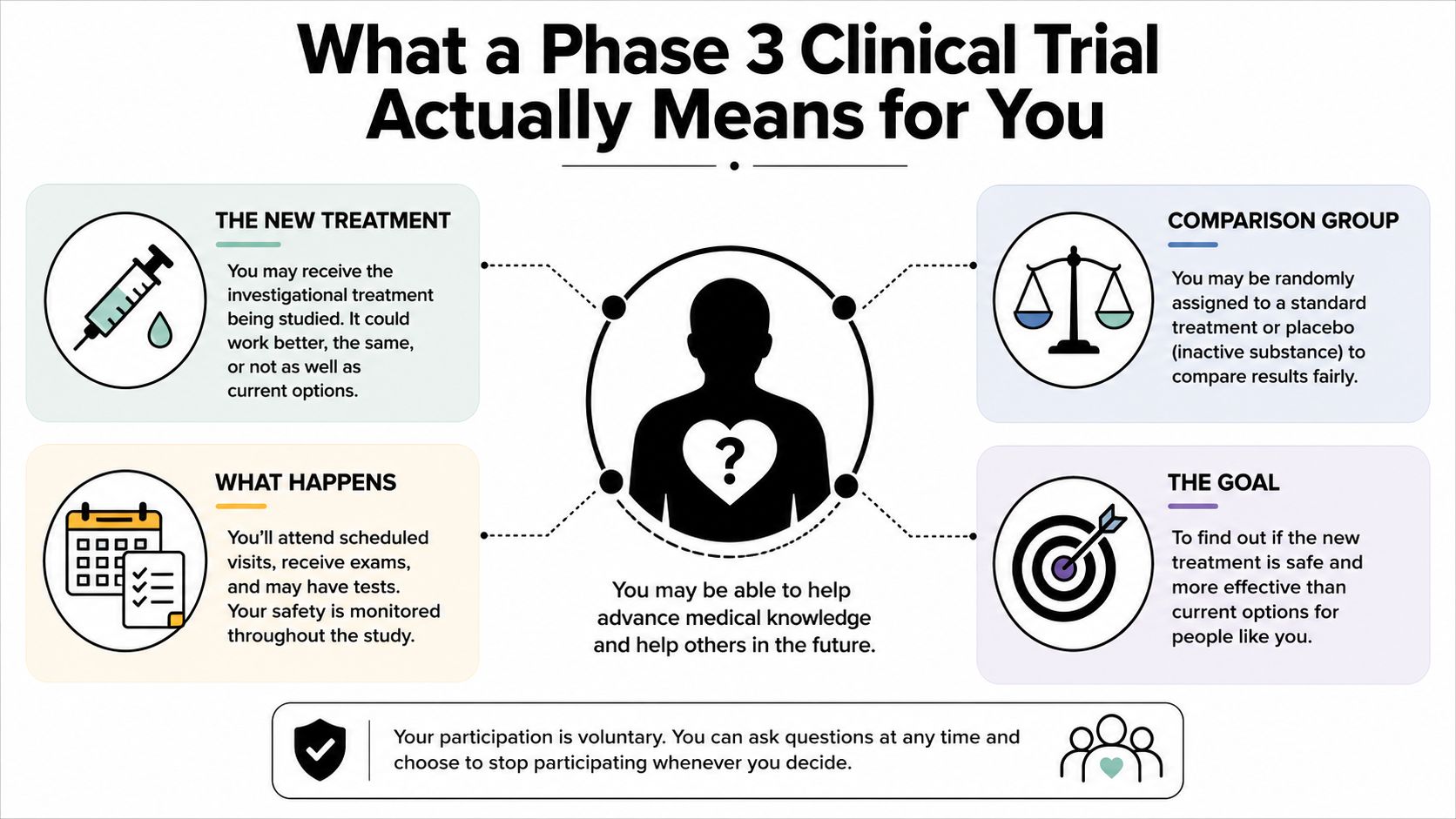
What a Phase 3 Clinical Trial Means for You
A patient hears “phase 3” and often assumes it means “last resort” or “science is still guessing.” That's not quite right. It means the treatment has already shown promise in earlier testing, and now researchers are checking whether it helps enough people, in a more realistic and regulated setting, to justify approval.
A phase 3 trial works like a final check before a treatment becomes part of routine cancer care. The idea is simple, even if the details are not. Researchers want to see whether the therapy still holds up when it is used with the kind of patients, side effects, and treatment choices that matter in everyday oncology, while also watching for harms that could change the risk-benefit balance FDA phase 3 guidance.
The scale matters. 300 to 3,000 volunteers sounds abstract until you realize that the study needs enough people to show whether the treatment's effect is real and not just luck FDA phase 3 guidance. That is also why the process can take 1 to 4 years, especially in oncology where outcomes such as progression or recurrence may take time to observe FDA phase 3 guidance.
Practical rule: a phase 3 trial is not a promise that a treatment will work for you. It is a structured way to learn whether it works well enough, safely enough, and consistently enough to matter for many patients.
Eligibility is the part many families do not expect. A phase 3 study may be large in theory, yet still leave out people whose cancer journey does not match the trial design, such as patients with certain prior treatments, other health conditions, or disease features the protocol does not allow. That can make a trial feel less like an open door and more like a carefully measured doorway, one that only fits some patients cleanly and asks others to stand outside.
If you want a simple map of where phase 3 fits among the other trial stages, this clinical trial phases guide gives a helpful overview. For patients and families, the key question is not just whether a phase 3 trial exists, but whether its design and eligibility rules match your specific cancer situation closely enough to make participation realistic.
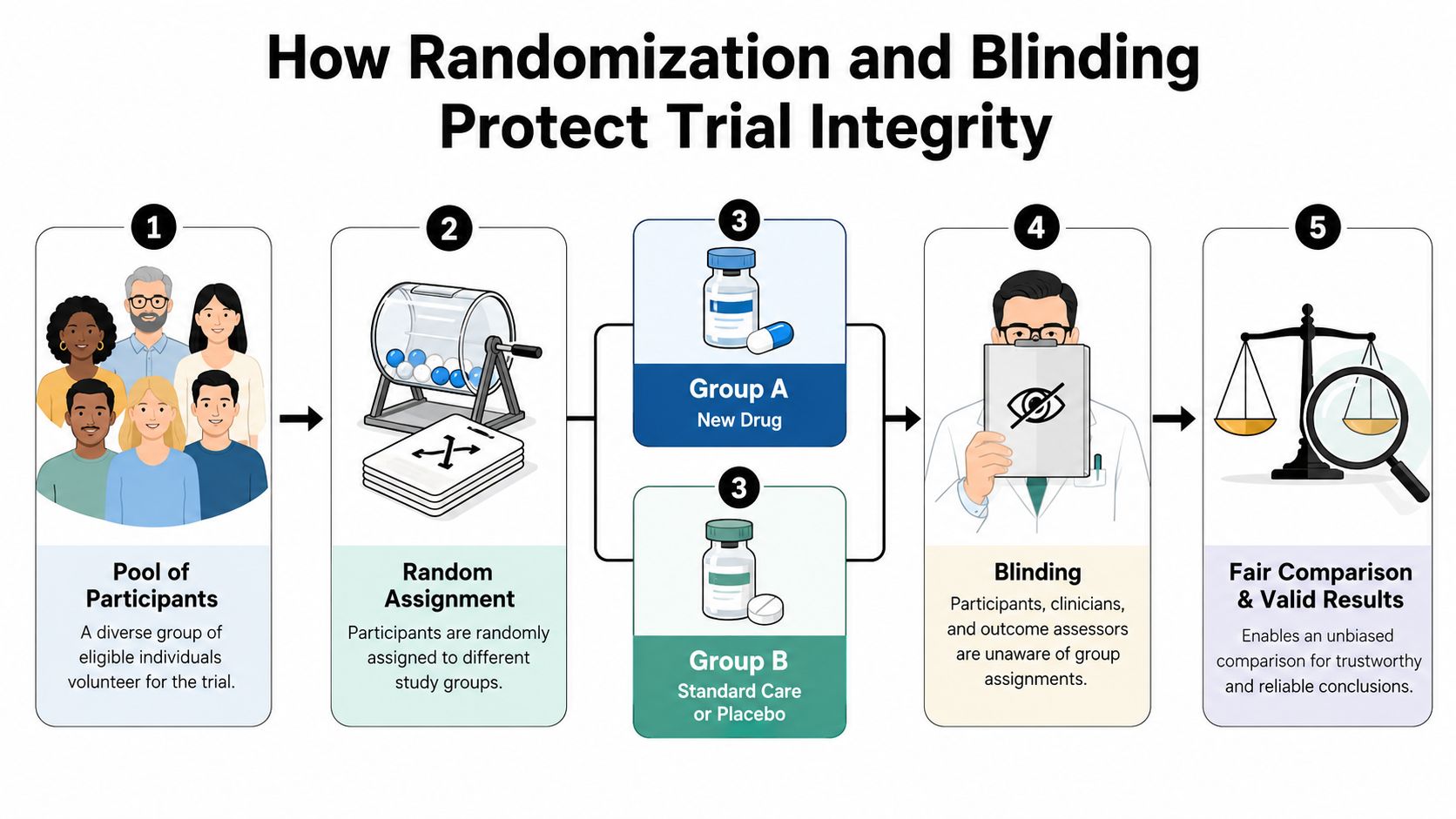
How Randomization and Blinding Protect Trial Integrity
A phase 3 trial has to answer a hard question fairly. Did the treatment help because it worked, or because patients, doctors, or chance influenced the result? That is why these studies are typically randomized, double-blind, controlled as described in the trial setup guide.
Randomization assigns the comparison by chance
Randomization means participants are placed into groups by chance, not by preference. The assignment works like a coin being flipped for each person, so one side of the study does not fill up with sicker patients while the other side ends up with healthier ones. That helps keep the comparison fair and reduces the risk that the results are skewed by who happened to enter which arm.
Blinding keeps expectations from shaping the outcome
Double-blind means neither the patient nor the clinician knows who received which treatment, unless there is a medical reason to break the blind trial setup guide. That matters because expectations can change how symptoms are reported, how side effects are interpreted, and even how treatment decisions are made. When the packaging looks identical, people are less likely to guess and less likely to shape the result without meaning to.
The control group is the measuring stick
In oncology, if an effective treatment already exists, the new therapy is usually compared against that standard rather than against nothing trial setup guide. That matters because patients are not being asked to give up known care just to join research. The comparison tells doctors whether the new option adds meaningful benefit without adding harm that outweighs the gain.
A protocol also has to name the primary endpoint and the statistical hypothesis before the first participant is enrolled trial setup guide. That sounds technical, but the logic is simple, the trial must decide in advance what “success” means.
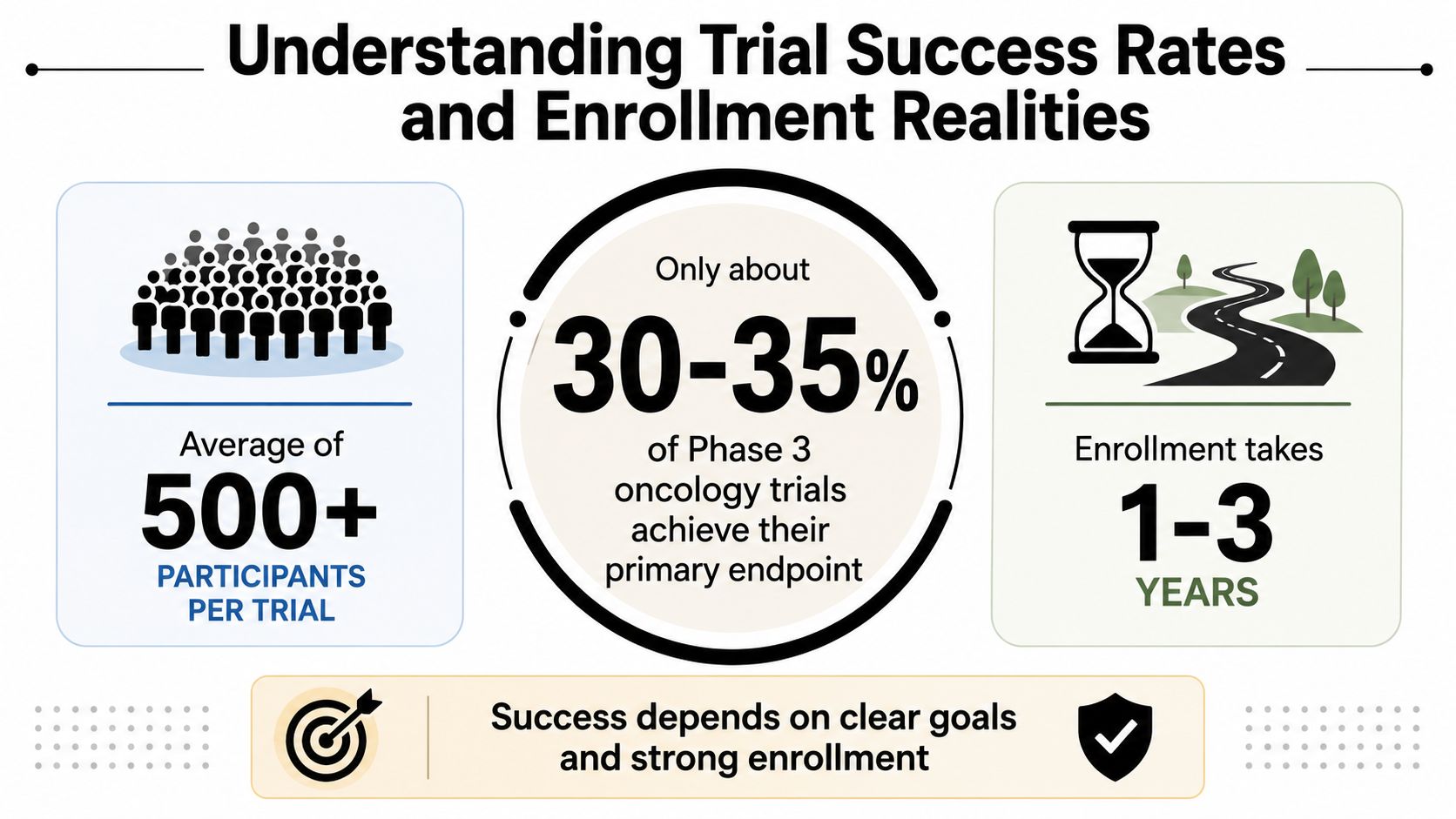
Understanding Trial Success Rates and Enrollment Realities
The hardest truth about oncology research is that late-stage doesn't mean guaranteed. A cohort of solid-tumor phase III trials found an overall success rate of 48.3%, with earlier starts around 30% to 40% and later starts around 50% to 70% depending on the time period studied oncology trial outcomes analysis. Another phase-transition analysis estimated the chance of advancing from phase 3 to approval at about 59.0% same evidence base.
That matters for families because a trial can close without meeting its endpoint even after many people have participated. It doesn't mean the effort was meaningless, but it does mean the result didn't clear the bar for approval. In practical terms, the study may still teach the field something useful, even if the treatment itself doesn't become standard care.
Enrollment is often the bottleneck
The operational side is just as revealing. One review of cooperative-group development found that opening a trial required 769 steps, 36 approvals, and about 2.5 years from formal concept review to study opening FDA summary of trial development complexity. Recruitment has also become slower, with the average recruitment period rising from 13 months in 2008 to 2011 to 18 months in 2016 to 2019, while the median number of registered sites increased from 43 to 64 over the same periods FDA summary of recruitment trends.
Those delays show up in real participation patterns. In one trial operations analysis, 38.8% of cooperative-group trials at cancer centers had zero accruals, and 39.1% closed with 20 or fewer enrollments oncology operations analysis. Across more than 10,000 trials, the median started sample size was 302, the median completed sample size was 228, and the overall drop-out rate was 11% same analysis.
A trial can be scientifically well designed and still struggle to enroll enough patients. That's a system problem, not a patient failure.
Why Trial Eligibility Criteria May Exclude Real-World Patients
A lot of people assume trial eligibility is just a medical checklist. In reality, it's also a gatekeeper that can leave out patients who are very much part of everyday oncology care. Recent reviews and oncology analyses show that restrictive inclusion and exclusion criteria, multi-visit logistics, travel burden, and narrow site geography can systematically reduce participation for older adults, patients with comorbidities, rural patients, and racial and ethnic minorities underserved patient access analysis.
That means “you don't qualify” doesn't always mean “your cancer is too unusual” or “you're too sick to benefit.” Sometimes it means the study was built around a narrower group than the people who need cancer treatment in real life. One oncology review also found that underrepresented groups are still routinely excluded from breast cancer trials same underserved patient access analysis.
Why this gap matters
If a trial excludes patients with heart disease, kidney problems, mobility limits, or long travel distances, the results may not reflect what happens in a typical cancer clinic. That can make the study easier to run, but less representative of the people who will eventually use the treatment. The tradeoff is central to understanding whether a trial is relevant to your situation.
Policy changes are trying to respond. FDA diversity action plans and decentralized trial elements are getting more attention, but the practical questions still matter, including whether these changes improve access without weakening data quality or making the protocol too hard to carry out in cancer care underserved patient access analysis.
If you're comparing options, ask whether the trial population looks like you. Age, prior treatments, travel requirements, and comorbidities all affect whether the study is realistic, not just whether the cancer type matches.
Navigating the Practical Logistics of Trial Participation
A phase 3 trial usually sounds more complicated on paper than it feels in the first conversation, but the day-to-day commitment is real. There can be repeated visits for exams, labs, scans, and symptom checks, and the research team may ask you to track medication use or side effects between appointments. The rhythm of care often becomes part of the decision itself.
What the routine can look like
Before enrolling, ask how often you'll need to come in and whether those visits are clustered or spread out. Some trials require frequent follow-up early on, then less often later, depending on what they're measuring. If you live far from the site or rely on a caregiver for transport, that schedule can shape whether participation is practical.
Helpful rule: if the visit schedule would be hard to keep during a bad week, it's probably worth discussing before you sign consent.
The financial side deserves the same attention. Trial sponsors commonly cover research-related procedures, but patients may still face ordinary care costs, travel, lodging, meals, and time away from work or caregiving duties. Ask the research coordinator to separate “trial-covered” from “usual care” line by line, because that's where surprises usually appear.
A few patient rights are fundamental. You have to give informed consent, you can leave the trial at any time, and you should know how the team handles worsening symptoms or side effects. If your condition changes, the protocol may no longer fit, and the team should explain what happens next.
The practical questions here are as important as the medical ones. A trial can be scientifically sound and still be a poor fit for the realities of your life, especially if your energy, transportation, or caregiving support is already stretched thin.
How to Find and Evaluate the Right Clinical Trial
Searching for a trial is part database work and part clinical judgment. ClinicalTrials.gov is the right starting point because it lets you search by cancer type, location, and status, but the listing only helps if you know how to read it carefully. A trial can look open on paper and still be unusable if it's too far away, too restrictive, or no longer enrolling.
Start with the basics. Match the study to your diagnosis, stage, treatment history, and current health status. Then check the status label, because an “active” study isn't the same as one that's actively accepting participants, and an “enrolling” study may still have narrow slots or site-specific limits.
Read beyond the title
The title may sound promising, but the eligibility section tells you who the study was built for. Look for requirements tied to prior therapies, organ function, performance status, and disease measurements. Those details often decide eligibility more than the headline description does.
If you want help translating those criteria into plain language, a specialized oncology team can be useful. Hirschfeld Oncology, for example, offers clinical trial participation as part of its oncology services and can help patients think through fit, referral, and treatment goals alongside their other options. For a broader overview of how patients and doctors approach this process, this cancer clinical trials guide can also help you prepare for the conversation.
Don't treat a trial listing like a yes-or-no quiz. Treat it like a map that still needs a clinician to read the terrain.
Bring the list to your oncologist or trial office and ask whether the study reflects your cancer journey, not just your diagnosis code. A strong match is about accessibility, timing, and realistic logistics, not only whether the drug sounds promising.
Key Questions to Ask Before Enrolling in a Phase 3 Trial
A phase 3 trial can look straightforward on a listing page, but the test is whether it fits your diagnosis, your daily life, and the treatment path you are already on. Trial design is a bit like a recipe written for a very specific kitchen, and eligibility rules often leave out people whose cancer care does not match that exact setup. That is why shared decision-making matters so much, as explained in why shared decisions matter in cardiology, because the choice has to make sense for the person, not just for the protocol.
Ask about the design
- What is the control group? This tells you what the new treatment is being compared with, and whether the study is testing against standard care or another option.
- Is it blinded? If you won't know which treatment you're getting, ask how the team handles symptoms, side effects, and emergency unblinding.
- What is the main endpoint? The primary endpoint is the study's main definition of success, so you want to know whether it measures survival, progression, symptom control, or something else.
The control arm matters because it shows what the study team considers the fair comparison. If the trial is testing an immunotherapy approach, a review of immunotherapy clinical trials can help you see how different study designs handle response, side effects, and follow-up.
Ask about your fit and flexibility
- Do I meet every eligibility requirement? A partial match usually isn't enough, and the site can tell you which criteria matter most.
- What happens if my condition changes? Cancer doesn't always stay on the schedule the trial expects, so you need to know what the protocol allows.
- Can I leave if it becomes too hard? You should understand the process for withdrawal before you enroll.
Eligibility rules often filter out real-world patients. A study may be built around ideal organ function, a narrow prior-treatment history, or a level of physical strength that many people with cancer do not have. That does not mean the trial is bad, it means you need to check whether the study reflects your own cancer story, not just the diagnosis name on paper.
Ask about logistics and follow-through
- How often are the visits? Frequency affects transportation, childcare, work, and caregiver support.
- What costs are covered? Separate research procedures from routine care, travel, and lodging.
- What if the drug doesn't work for me? You deserve a clear answer about next steps, including what standard treatment remains available.
Logistics can decide whether a trial is realistic. A study that looks promising on a screen may still be hard to manage if the site is far away, the visit schedule is tight, or your family support is limited. Ask for every answer in plain language, and ask again if the first explanation sounds vague.
A good response is specific, calm, and written down when needed. If the team cannot explain the rules clearly, that is a sign to pause and get a second opinion before signing anything.
.png)
.png)